
Healthcare SEO is the work of making your practice easy for Google to find, understand and trust, so patients searching for care near you can reach you. For most practices that means an accurate Google Business Profile, helpful pages written or reviewed by named clinicians, honest reviews and HIPAA-aware tracking.
Most advice on this topic is a keyword list and a promise. This guide is different: it follows what Google Search Central and Google Business Profile Help actually say, adds the HIPAA and FTC rules that general SEO articles skip, and tells you what to do first. It is written for the owner or manager who has to decide how much to do in-house and what to ask a vendor. No ranking numbers are quoted here because none can be promised.
Key takeaways
- No one can guarantee a Google ranking, and local ranking cannot be bought.
- Start with an accurate Google Business Profile, then service and provider pages with named clinicians.
- Ask every patient for reviews the same way, never pay for them and never confirm patient status in a reply.
- Check every analytics tag against HHS tracking guidance, especially on scheduling and login pages.
- Measure booked first visits, not just clicks.
What does healthcare SEO cover?
Healthcare SEO covers three connected jobs: your presence in local results and maps, the pages on your website, and the trust signals that show a real clinic and real clinicians stand behind both. Rankings follow from doing those three well. They cannot be bought, and no one controls them.
Google is blunt about this. Its guidance says no one can guarantee a #1 ranking and warns against SEOs who claim to. Its starter guide adds that there are no secrets that automatically rank a site first. Treat any proposal that promises a position as a red flag.
Healthcare also sits in a stricter category. Google treats health as a “Your Money or Your Life” (YMYL) topic, where weak information can affect a person’s wellbeing. That raises the bar for who wrote a page, how it was checked and how plainly you present your credentials. We cover that below.
| Workstream | What it covers | What Google's documentation says | Usual owner |
|---|---|---|---|
| Business Profile and local listings | Name, address, phone, categories, hours, photos | Local results rely mainly on relevance, distance and prominence; you cannot pay for a better local ranking | Office manager |
| Website pages | Service, condition, provider and location pages | Write content readers find helpful and reliable; give each page a unique title and description | Marketing lead with clinician review |
| Trust signals | Bylines, credentials, medical review, sources, dates | Trust is the most important part of E-E-A-T, and YMYL topics get the strictest standard | Practice owner or medical director |
| Reviews | Asking every patient, replying safely | More reviews and positive ratings can help your local ranking | Front desk and office manager |
| Technical health | Mobile display, HTTPS, Core Web Vitals, crawlability | Core Web Vitals are used by ranking systems, but relevance still matters most | Web developer |
| Measurement | Search Console, call and form tracking | Search Console shows how your site performs in Google Search | Marketing lead |
Source: Google Search Central (SEO Starter Guide; Creating helpful content; Page experience) and Google Business Profile Help (How to improve your local ranking), reviewed 2026.
Where should a medical practice start with SEO?
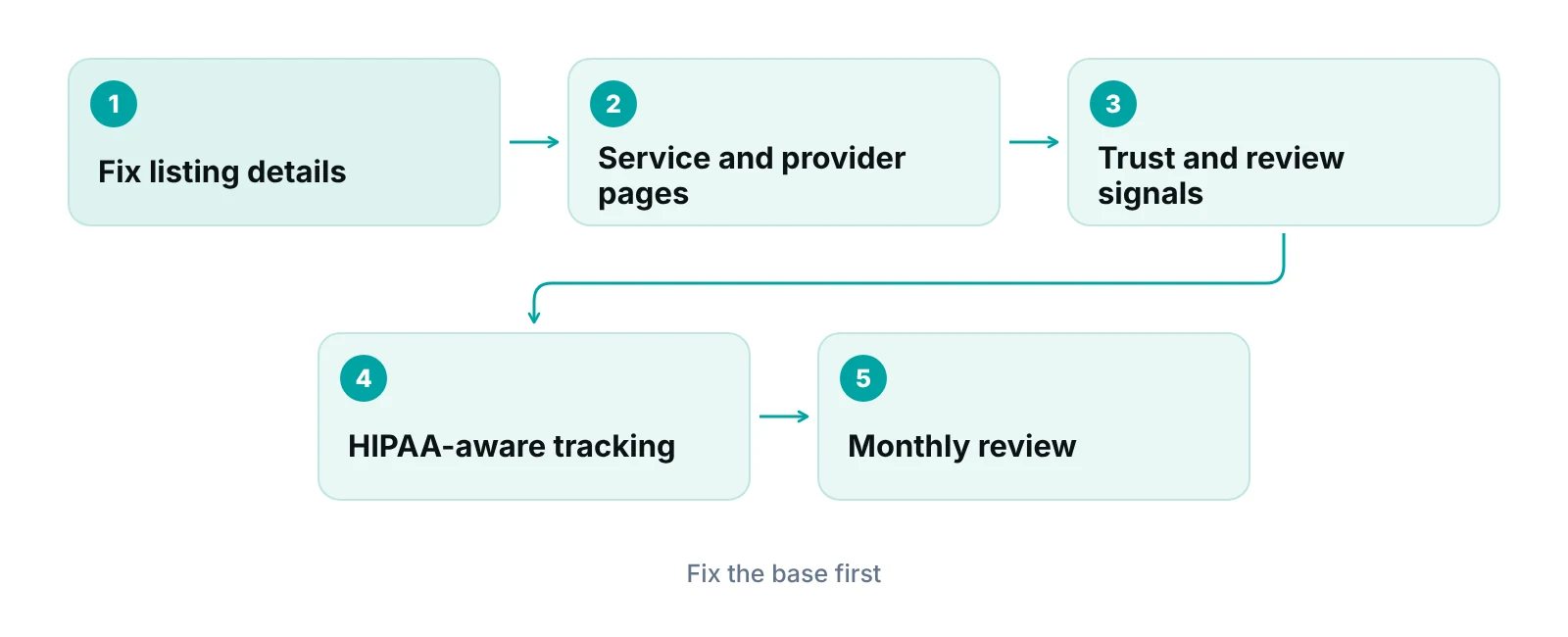
Start with the part patients see first: your Google Business Profile and the accuracy of your contact details. Then fix the pages that describe what you treat, then earn reviews, then tighten tracking. This order is our recommendation, not a Google rule, because errors in the first step undercut the rest.
If you want the wider view of which channels to run alongside search, our guide to marketing strategies for small medical practices covers the options. This article stays on search.
How do local SEO and Google Business Profile work for a practice?
Local SEO is how you appear when someone searches for care near them. Google says local results are mainly based on relevance, distance and prominence. Relevance is how well your profile matches the search. Distance is how far you are from the searcher. Prominence is how well known you are, which includes reviews and links from other websites.
Google also states there is no way to request or pay for a better local ranking. What you control is accuracy, completeness and reputation. The profile used to be called Google My Business and is now Google Business Profile, so search for the current name when you read older advice.
Get the profile right
- Use your real-world name. Google’s guidelines say the name should reflect your actual business name, and that adding extra content such as taglines or keywords is not permitted. A suspended profile can erase your map presence.
- Use a real, staffed address. Post-office boxes and virtual offices do not qualify.
- Choose few, specific categories. Google’s advice is to use as few categories as possible and the most specific one that fits.
- Keep hours and details identical everywhere. Match the profile to your website and to any directory that lists you.
- Add photos and respond to reviews. Both are on Google’s list of ways to improve a local result.
Individual doctors and multi-provider offices
Google lets individual practitioners have their own profile if they serve the public and can be reached at the verified location during stated hours. For an office with several providers, the organization creates the location profile and each provider’s profile uses only the practitioner’s name. A practitioner should not create several profiles to cover several specialties, and support staff should not create their own.
Specialty changes what patients search for and what they need to see. A pain clinic, a pediatric office and a dermatology group do not answer the same questions. Browse the specialties we work with to see how the operations side differs, then match your pages to the way your own patients ask.
Avoid city-page spam
Do not publish dozens of near-identical “urgent care in [town]” pages. Google’s spam policies describe doorway abuse, which includes pages created to rank for similar queries and funnel users to one destination. One strong page per location you actually staff is the safe version.
What do YMYL and E-E-A-T mean for a medical website?
E-E-A-T stands for experience, expertise, authoritativeness and trustworthiness. Google’s helpful content guidance says trust is the most important of the four, and that E-E-A-T is not itself a specific ranking factor. It also says systems give more weight to strong E-E-A-T on YMYL topics, and health is one.
For YMYL topics, Google says content should be highly accurate and consistent with established expert consensus. In practice, that tells you what a medical page must show:
- Who. Name the author and link to a short bio with credentials. Google warns against fabricated creator profiles, so use real people only.
- How. If a clinician reviewed the page, say so and give the review date. If automation or AI played a substantial role in producing it, Google recommends explaining that where readers would ask.
- Why. Google calls this the most important question: the page should exist mainly to help the patient, not to capture search traffic.
- Sources. Link primary sources, such as public health agencies and professional bodies, instead of repeating statistics you cannot trace.
- Dates and updates. Show when a page was last reviewed and set a recurring review.
“The practices we see earning trust online are not the ones with the cleverest keywords. They are the ones where a patient can tell exactly which clinician stands behind the page.”
— Awais Afzal, Healthcare Operations & Data Analyst
Quality raters do not decide rankings. Google says search raters have no control over how pages rank and that rater data is not used directly in its ranking algorithms. The E-E-A-T idea is still a useful checklist, because it describes what a careful reader wants to see before trusting a health page.
What content should a medical practice publish?
Publish pages that answer the real questions your patients ask before they call: what you treat, how a visit works, who the clinicians are, what to bring, and how to reach you. Start with those, then add educational pages only where a clinician can review them.
- Service and condition pages. One page per service you really provide, in plain language, with a clear next step.
- Provider pages. Credentials, the conditions each provider treats and the locations where they see patients.
- Location pages. Address, hours, parking, how to get there and which providers are on site.
- First-visit and insurance pages. What to bring, how scheduling works and how to ask about coverage, without promising what a plan will pay.
- Patient education. Reviewed by a clinician, dated, sourced to public health bodies, and written as general information, not personal medical advice.
Use Google Search Console to see the queries that already bring people to you, and use a keyword tool for ideas, noting the date and country of any numbers you use. We removed the monthly-search table from the older version of this article because it had no source or date. Search volumes change, so a table without a date misleads.
Write titles and descriptions for people. Google’s starter guide asks for titles that are unique to the page, clear and concise, and meta descriptions that are short and specific to one page. Do not repeat a keyword unnaturally: the spam policies list keyword stuffing and blocks of city names as examples of abuse.
Be careful with mass-produced content
Google’s spam policies name scaled content abuse: many pages generated mainly to manipulate rankings, including with generative AI. If a vendor offers to produce hundreds of pages, ask who reviews each one. For a medical site, the answer must be a qualified person.
A modern site also needs to work on a phone and load quickly. Our guide to medical website design for healthcare covers the design side that supports these pages.
How do reviews affect healthcare SEO, and how do you handle them safely?
Reviews affect local visibility. Google states that more reviews and positive ratings can help your local ranking. They also shape whether a patient chooses to call. The rules on how you ask for them and how you reply are strict, and healthcare adds a privacy layer.
| Situation | Safer approach | Why it matters |
|---|---|---|
| Asking for reviews | Send the same request to every patient after a visit | The FTC says a general solicitation to all customers is exempt from some provisions of its review rule; asking only patients you think are happy is not specifically prohibited but could violate the FTC Act |
| Paying for positive reviews | Do not do it | The FTC rule (16 CFR Part 465, effective October 21, 2024) prohibits buying reviews where the incentive depends on the sentiment |
| Threatening a patient over a review | Do not do it | The same rule covers review suppression, including intimidation and unfounded legal threats |
| Replying to a review | Do not confirm that the reviewer is a patient or mention any care; invite them to contact the office | HHS settled with a dental practice for $10,000 in 2019 over social media disclosures of patients’ protected health information |
| Negative or unfair review | Reply professionally; flag anything that breaks Google’s posting guidelines | Google advises responding promptly and politely, and lets you flag reviews that break its guidelines |
Sources: FTC, Consumer Reviews and Testimonials Rule Q&A (2024); HHS OCR, Elite Dental Associates resolution (October 2, 2019); Google Business Profile Help (2024). The advice not to confirm patient status is our own practice guidance.
Have your privacy officer write a reply policy before anyone responds. Our post on online reputation management for doctors covers the day-to-day process, and the FTC review-rule Q&A is worth reading before you build a review-request workflow.
What technical SEO does a practice website need?
Make sure Google can crawl and index your pages, and that they load and display well on a phone. Google says Core Web Vitals are used by its ranking systems and recommends good scores, but it also warns that chasing a perfect score purely for SEO may not be the best use of your time.
Mobile display and HTTPS are not described as direct ranking factors on that page, but Google still recommends checking both. HTTPS also matters to patients, who may submit contact forms. Relevance still outweighs everything else: Google says its systems seek the most relevant content even if the page experience is poor.
- Crawlability. Check robots.txt and that important pages are not blocked or set to noindex.
- Internal links. Link your service, provider and location pages so each can be found.
- Structured data. LocalBusiness markup needs a name and address, and Google says it does not guarantee that features using structured data will appear. Keep it consistent with the visible page.
- Image alt text. A short, descriptive line helps search engines understand each image.
- Fix broken forms and phone links. A good ranking is wasted if the call button fails on a phone.
We removed the old claim that a page taking more than three seconds to load is “most likely” abandoned. It had no source, and we would rather give you the checks Google actually documents.
How do you track SEO results without breaking HIPAA?
Measure what you need, but be cautious with tracking technologies on pages where a patient may reveal health information. The HHS Office for Civil Rights has published guidance on HIPAA and online tracking technologies, and a federal court vacated part of it in June 2024. Check the current position with your privacy officer before you add or keep any tag.
| Where it sits | What HHS says | Practical step |
|---|---|---|
| Public pages (home, services, blog) | Many tracking technologies on unauthenticated pages do not access PHI, so HIPAA generally does not regulate them, unless the page collects information tied to an individual’s health or care | Keep analytics to what you need and review what each tag collects |
| Appointment or symptom-checker pages with no login | These can involve PHI, since an email address or the reason for seeking care can be individually identifiable health information | Treat as high risk; confirm vendor terms before adding any tag |
| Patient portal or login pages | Tracking technologies there generally have access to PHI | Do not place marketing tags there without a BAA and a Privacy Rule permission |
| Cookie banner | A banner asking users to accept cookies is not a valid HIPAA authorization | Do not treat a banner as permission to share PHI |
| Vendors that receive PHI | A tracking vendor that creates, receives, maintains or transmits PHI for a covered function is a business associate, with or without a BAA | Get a signed BAA before PHI is disclosed |
| The June 20, 2024 court ruling (AHA v. Becerra) | A Texas federal court vacated the guidance to the extent it said HIPAA applies when an IP address links to a visit to an unauthenticated public page about health conditions or providers | Check whether HHS has taken further action |
Source: HHS Office for Civil Rights, Use of Online Tracking Technologies by HIPAA Covered Entities and Business Associates (content last reviewed June 26, 2024).
Separately, HHS says marketing communications that use PHI generally need the patient’s written authorization, with exceptions such as face-to-face communication and communications about treatment. See the HHS marketing guidance. A vendor that handles PHI for you is a business associate and needs a written agreement first, per the HHS business associate guidance. Our HIPAA compliance checklist for medical practices gives you a wider list to review.
Ask which tags run on which pages
Ask your web vendor for a written list of every analytics, advertising and chat tag on the site and the pages each runs on. Most practices cannot answer this from memory.
How long does healthcare SEO take, and what should you measure?
No one can promise a timeline. Google says changes can take effect quickly or take months, and suggests waiting a few weeks before judging whether a change helped. An earlier version of this article gave a fixed range of months. It had no source, so we dropped it.
Measure the actions that matter to a front desk, not just traffic. Use Search Console for the queries and pages that bring people to you, then connect them to calls, form fills and booked first visits.
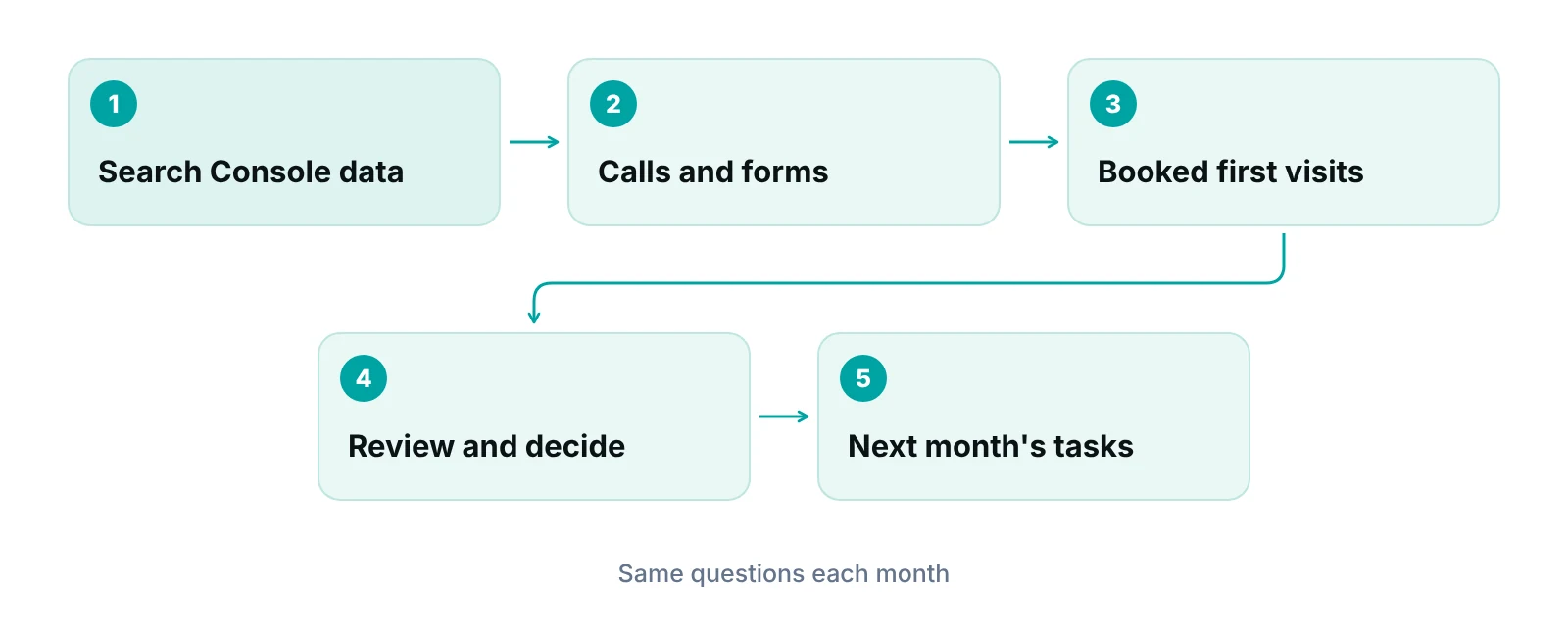
- Queries and pages. Which searches show your practice, and which pages receive the clicks.
- Calls and forms. How many came from search, and how many were answered or returned the same day.
- Booked first visits. The number that matters most. A call that nobody answers is a lost patient, however well the page ranks.
- Profile actions. Calls, direction requests and website clicks from your Business Profile.
SEO only pays back if the phone is answered. If calls go to voicemail, look at virtual medical assistant support for the front desk before you spend more on rankings. To judge the money side, read our guide to medical marketing ROI and try the revenue calculator.
Do AI search features change healthcare SEO?
Not in the basics. Google’s documentation says the best practices for SEO remain relevant for AI features in Google Search, with no additional requirements and no special schema or file to add. A page must be indexed and eligible to appear with a snippet, and inclusion is never guaranteed.
So the work above is the work. Clear text, accurate pages, a consistent Business Profile and visible clinician credentials are what a person or a system needs when deciding whether to rely on you. Treat anyone selling a secret AI-ranking trick with the same caution as one who sells guaranteed rankings.
Should you do SEO in-house or hire a vendor?
Do the profile, reviews and page accuracy in-house if you have a capable office manager and a clinician who can review content. Hire help for technical work, content production at scale and reporting. Whoever you choose, keep ownership of your accounts. Our dental SEO guide gives a longer vendor-comparison framework that applies to any specialty.
Questions to put in writing before you sign:
- Do you guarantee rankings? Google says to be wary of anyone who does.
- Can you show previous work and references? Google suggests asking for examples and checking references.
- Who owns the Business Profile, website and analytics accounts? It must be you.
- What access do you need? Google advises granting only read access to Search Console during an audit.
- Who writes and reviews medical content? Ask for the clinician reviewer’s name.
- Which tracking tags will you add, and will you sign a BAA where PHI could be involved?
Get a second opinion on a proposal
Send us the SEO proposal or the current website. In a free practice audit we review your listing, pages and call handling, and tell you what to ask the vendor.
If you prefer to talk it through first, contact our team.
Our recommendations
- Check your Business Profile this week. We would start by checking the name, address, phone, categories and hours against Google’s guidelines, because a suspended or inconsistent listing undoes every other task.
- Put a clinician's name on every medical page. Add an author and a reviewer with credentials and a review date. We would rather have fewer pages with a visible clinician behind each one than many anonymous pages.
- Write a review policy before you ask for reviews. Decide who asks, who replies and what a reply may never contain. Ask every patient the same way, and never offer payment tied to a positive rating.
- Audit your tracking tags. List every tag and the pages it runs on. Remove anything on login, scheduling or symptom pages unless your privacy officer has cleared it and a BAA is in place.
- Count booked visits, not clicks. Set a monthly review of Search Console, calls and booked first visits. If calls go unanswered, fix the phone before you pay for more traffic.
- Refuse guarantees. Walk away from any vendor who promises a ranking or will not give you ownership and read access to your own accounts.
Bottom line
Healthcare SEO works when the basics are accurate, the content is written by people patients can identify, reviews are earned honestly and tracking respects HIPAA. If you want help with local search, Google Ads or reputation work, see our healthcare digital marketing services, or start with a free practice audit.
Frequently asked questions
What is healthcare SEO?
Healthcare SEO is the work of making a medical practice easy to find in Google Search and Maps and credible to the people who find it. It covers your Business Profile, website pages, reviews, technical health and measurement. It does not include buying a ranking, which Google says is not possible for local results.
How long does healthcare SEO take to work?
No source supports a fixed timeline. Google says changes can show up quickly or take months, and suggests waiting a few weeks before judging whether a change helped. Competition, your starting point and how much you fix all matter. Be wary of any vendor who promises a date or position.
Is Google Business Profile the same as Google My Business?
Yes. Google My Business was renamed Google Business Profile, so older articles use the earlier name. It is the listing that controls how your practice appears in local results and maps. Use your real-world name, a staffed address, few specific categories and accurate hours.
Can I put tracking pixels on my practice website?
You can, but with care. HHS says many tools on public pages do not touch protected health information, while tools on login pages and scheduling or symptom pages can. Vendors that receive PHI need a business associate agreement. A cookie banner is not a HIPAA authorization. Ask your privacy officer first.
Do patient reviews help my Google ranking?
Google says more reviews and positive ratings can help local ranking. Ask every patient the same way, never pay for positive reviews, and never confirm in a reply that someone is your patient. Replying publicly with details of care can be a privacy violation.
Should a small practice hire an SEO agency?
Sometimes. Do the profile, reviews and page accuracy in-house, and hire for technical work and reporting. Keep ownership of your accounts, get written scope, and grant only read access at first. Google advises asking for examples of previous work and references.
Get your free practice audit
Tell us about your practice. We will contact you using the details you give.
- A review of your recent claims, denials and A/R aging
- Where your front desk and prior authorizations slow payment
- A prioritized fix list you keep, whether or not you hire us
Pricing is quoted after the audit, based on your volume and the services you choose. Prefer to talk? Call +1 (302) 556-2288.
Sources
- Creating helpful, reliable, people-first content — Google Search Central (2026)
- SEO Starter Guide — Google Search Central (2026)
- Do you need an SEO expert? — Google Search Central (2026)
- Spam policies for Google web search — Google Search Central (2026)
- AI features and your website — Google Search Central (2026)
- Understanding page experience in Google Search results — Google Search Central (2026)
- LocalBusiness structured data — Google Search Central (2026)
- How to improve your local ranking on Google — Google Business Profile Help (2026)
- Guidelines for representing your business on Google — Google Business Profile Help (2026)
- What's new in Google Business Profile: August 2024 — Google Business Profile Help (2024)
- Use of Online Tracking Technologies by HIPAA Covered Entities and Business Associates — HHS Office for Civil Rights (2024 (last reviewed June 26, 2024))
- Marketing (HIPAA Privacy Rule) — HHS Office for Civil Rights (n.d.)
- Business Associates — HHS Office for Civil Rights (2026 (last reviewed July 30, 2026))
- Resolution agreement: Elite Dental Associates — HHS Office for Civil Rights (2019)
- Consumer Reviews and Testimonials Rule: Questions and Answers — Federal Trade Commission (2024)
Disclaimer: This article is general educational information for practice owners and managers. It is not legal, HIPAA compliance, medical or SEO advice. Google, HHS and FTC guidance changes; have your privacy officer or a healthcare attorney review tracking tools, review requests and marketing materials before use.