
Dental SEO services help patients find your practice on Google by improving your Business Profile, website pages, technical setup, reviews and reporting. They are worth hiring when the scope is written, you own the accounts, nobody guarantees rankings, and the work respects HIPAA, FTC and Google rules.
Most dental SEO guides read like sales pages. This one is for the owner or office manager who has a proposal on the desk and wants to know what is in it and what to question. It draws on Google Search Central and Business Profile documentation, HHS guidance on HIPAA marketing and online tracking, and the FTC’s rule on consumer reviews. It is general information, not legal or compliance advice, and it contains no promised results.
Key takeaways
- Dental SEO is six jobs: search research, Google Business Profile, service pages, technical basics, links and reviews, and reporting.
- No one can guarantee a number-one Google ranking, and Google does not accept payment for organic placement.
- Own your Business Profile, analytics and website logins, with the agency added as a user.
- HIPAA marketing and tracking rules and the FTC review rule apply to what an agency does in your name.
- Judge SEO by calls, forms and booked visits, not rankings alone.
What do dental SEO services include?
Dental SEO services cover six jobs: finding the searches your patients use, tuning your Google Business Profile, building service pages, fixing the technical basics of your site, earning legitimate links and reviews, and reporting on what happened. Every credible package is some mix of these. The differences are in how much each vendor does, and how clearly they show their work.
Search engine optimization (SEO) means making your website and local listings easy for Google to understand and easy for patients to choose. It is not advertising. Google states that it never accepts money to include or rank sites in its organic results, so no vendor can buy you a position there. What you pay an SEO for is labor, expertise and reporting.
| Service area | What it covers | What you should be able to see |
|---|---|---|
| Search research | The phrases patients use for your services and your area, grouped by page | A keyword-to-page map you can read, not a list of raw keywords |
| Google Business Profile | Your name, address, categories, hours, services, photos and review replies | Admin access for your own account, plus a log of what was changed |
| Service and location pages | One useful page per core service (for example implants, clear aligners, emergency visits) and per office | Page drafts for your clinical and compliance review before they go live |
| Technical basics | HTTPS, mobile display, page speed, crawlability, titles, headings, image alt text | A written fix list with each change dated |
| Links and citations | Accurate listings on real directories, local partnerships, community and association links | Named sources for every link, never a bulk package |
| Reporting | Calls, form requests and booked visits traced to search, plus Search Console data | A monthly report that ties work done to patient actions |
Source: RCM Finder summary of Google Search Central and Google Business Profile documentation (accessed October 2026).
If a proposal lists “SEO” as one line, ask for the breakdown before you compare prices.
How does a patient go from a search to a booked visit?
A patient usually moves through five steps: a search, a look at the map results, a visit to your website, a call or form, and a booked appointment. SEO touches the first three. Whether the last two happen depends on your phones, your online forms and your front desk.
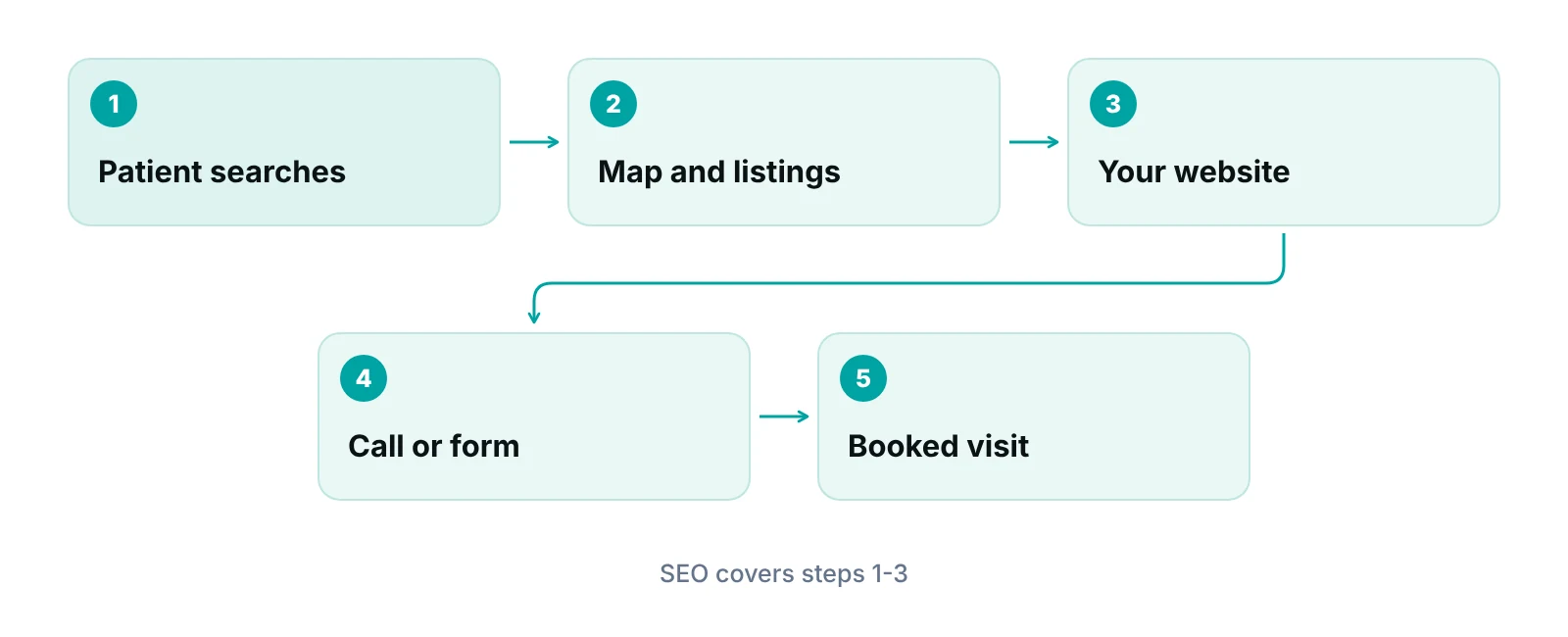
This is why “rankings” alone are a weak measure. A practice can appear in the map results and still lose the patient because the call goes to voicemail, or the form goes to an inbox nobody checks. Our guide to virtual assistants for dental offices covers the front-desk side. For your own team, a virtual medical assistant for your practice can answer calls and web requests during the hours your staff cannot.
Dental searches also split by urgency. Someone with a broken tooth wants a phone number and today’s hours. Someone comparing implants wants detail and an idea of what insurance covers. Good SEO gives them different pages. Those pages should reflect how dental practices actually work: procedure mix, insurance and cash-pay patients, and office hours.
How should a dental practice manage its Google Business Profile?
Claim your profile, keep the name exactly as it appears on your signage, choose categories that describe the core business, and reply to reviews under a written policy. Google’s own search visibility checklist recommends claiming a Business Profile if you run a local business.
Google’s guidelines for representing your business are specific, and agencies that ignore them put your listing at risk. Per those guidelines:
- The name must match your real-world name. Marketing taglines and service or location details do not belong in it, and unnecessary information can lead to suspension. “Smith Dental – Best Implants Near Me” is the kind of name to avoid.
- Each business should have one profile, with one page per physical location. Virtual offices are not eligible.
- Individual practitioners can have their own profile if they are public-facing and reachable at the verified location during stated hours. Check this with your agency before they create profiles for each dentist.
- Choose the fewest categories that describe the core business. The description should be accurate and may not contain promotions, prices or links.
- Any promotion or giveaway must clearly link to its terms.
Reviews are the other half of local visibility. They are also where the FTC’s rules apply. The FTC’s final rule on consumer reviews and testimonials (16 CFR Part 465) addresses fake or false reviews that misrepresent a reviewer’s experience, buying positive or negative reviews, undisclosed reviews from insiders, and fake social media followers or views. In practice: ask every patient the same way, never pay for or trade value for a positive review, never write reviews yourself or have staff post them without disclosure, and do not buy followers. See also online reputation management for doctors.
Replying to patient reviews
A public reply that confirms a reviewer was treated at your office may reveal health information. Ask your privacy officer or healthcare attorney to approve a reply template before anyone, including an agency, posts on your behalf.
What does good website work look like for a dental practice?
Good dental website work means one clear page per service and per office, written for patients, loading securely on a phone, with descriptive links and image text. It is mostly editing and structure, not tricks.
Service and location pages
Each page should answer the questions a patient has before calling: what the service is, who it suits, what the visit involves, what insurance or payment options you accept and how to book. Your dentists should review clinical content. Avoid outcome promises.
Technical basics
Google’s visibility checklist puts user experience first and lists serving the site over HTTPS and making pages load quickly and display properly on all screen sizes. Its SEO Starter Guide asks for page titles that are unique, clear and accurate, descriptive link text, and short, descriptive image alt text.
Content volume
More pages do not mean better SEO. Google’s spam policies cover keyword stuffing, such as blocks of city names or unnatural repetition, and scaled content abuse, which includes mass-producing low-value pages with AI tools. A set of near-identical “dentist in [town]” pages is the typical example. Ask who writes, reviews and signs off on content.
Links and citations
Real links come from real relationships: your dental society, local schools and charities you support, community events. The same spam policies list buying or selling links for ranking, excessive link exchanges and low-quality directory links as violations. Paid links are allowed only when qualified with a nofollow or sponsored attribute. Because you remain responsible for the actions of any company you hire, this is a risk you carry, not only the agency.
Which HIPAA, FTC and Google rules apply to dental SEO?
Dental SEO has to respect HIPAA’s marketing and tracking rules, the FTC’s review rules and Google’s own policies. If your practice is a HIPAA covered entity, your marketing choices, your website tools and your vendors all fall under it. Use the table below to start a conversation with your privacy officer.
| Area | What the source says | What it means for you |
|---|---|---|
| HIPAA marketing | Marketing is a communication that encourages people to use a product or service, and generally needs the individual’s written authorization. Face-to-face talks, promotional gifts of nominal value and treatment communications are carved out. Selling patient information for a third party’s purposes always needs authorization. | Get written authorization before using a patient’s name, photo or story. Do not hand patient lists to a marketing vendor for its own use. |
| Website tracking tools | Tracking on public pages generally does not reach PHI, but scheduling pages, login pages and portals can. Tracking vendors that handle PHI need a Business Associate Agreement, and a cookie banner is not a HIPAA authorization. | Ask your agency what analytics, pixels, call recording and form tools run on booking pages, and where that data goes. |
| Reviews and testimonials | 16 CFR Part 465 covers fake reviews that misrepresent experience, buying positive or negative reviews, undisclosed insider reviews and fake social media indicators. | Ask every patient the same way, offer nothing in exchange for a positive review, and disclose staff or relative reviews. |
| Google Business Profile | Names must match real-world signage with no taglines. One profile per location. Descriptions carry no promotions, prices or links. | Check your listing name and categories against the guidelines before an agency edits them. |
| Google spam policies | Buying links for ranking, low-quality directory links, keyword stuffing and scaled low-value content violate Google’s policies. | Ask for the source of every link and a written content plan. |
Sources: HHS Office for Civil Rights (HIPAA marketing and online tracking technologies guidance); FTC final rule, 16 CFR Part 465; Google Business Profile guidelines; Google Search spam policies. Accessed October 2026.
One caution on tracking. HHS posted a bulletin on online tracking technologies and notes that on June 20, 2024 a federal court in Texas (American Hospital Association v. Becerra) vacated a portion of it, the part about IP addresses tied to visits to public pages about specific conditions or providers. HHS said it was evaluating next steps. The rest of the bulletin, including the points about scheduling pages and vendor agreements, is still on HHS’s site.
For the wider compliance picture, see our HIPAA compliance checklist for medical practices. The HHS marketing guidance is short and worth reading before you approve any campaign.
How long does dental SEO take, and how do you measure it?
Nobody can give you an honest fixed timeline. Google’s SEO Starter Guide says some changes can take effect in a few hours while others could take several months, and advises waiting a few weeks before judging a change. That is why you should ask a vendor for the results they expect and the timeframe, as Google itself suggests in its guidance on hiring an SEO.
Measure what the practice cares about: patients. Search Console shows how your site performs in Google Search. Your phone system and forms show who asked for an appointment. Your practice management system shows who booked and who came.
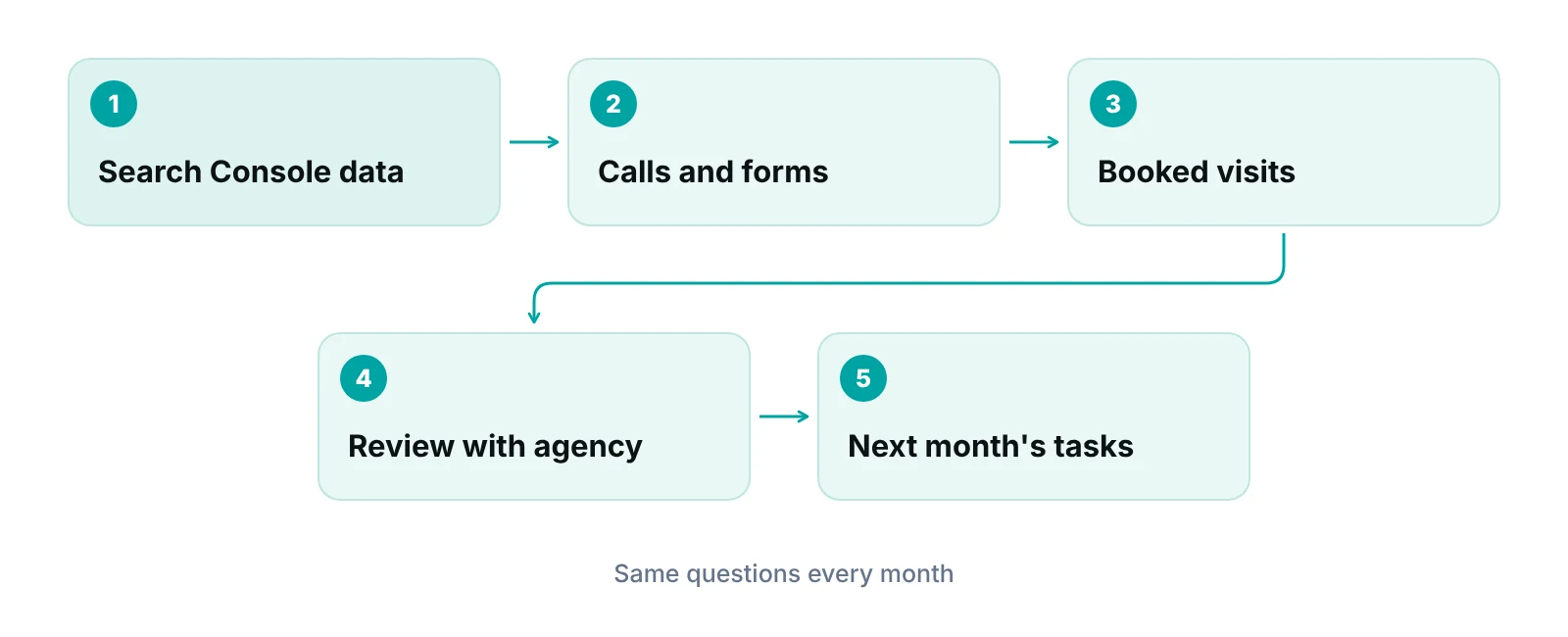
- Calls and form requests from search, by location.
- New-patient appointments booked and how many attended.
- Search Console clicks and impressions for your service and location pages.
- Google Business Profile activity and new reviews, with how each was requested.
- Work completed last month and planned next month, in plain language.
Our guide to measuring medical marketing ROI goes deeper on tracking. If you want to look at what happens to the new patient’s claim after they book, our revenue calculator is a place to start.
Are dental SEO services worth hiring out?
It depends on your time, your market and what your office can do on its own. Google’s checklist describes SEOs as professionals who can help, and suggests hiring one only if you need extra help. Compare three options.
- Do it yourself: Claim your Business Profile, keep hours accurate, ask patients for reviews the same way, and fix the technical basics. This costs time, not retainer fees, but someone must own it every month.
- Hire in-house: Best for groups with several locations and enough steady work. It adds a salary and the need to manage the person.
- Hire an agency or consultant: Useful when you need technical skill, content production and reporting without a new hire. You need to supervise it, because you remain responsible for what is done in your name.
Whichever route you choose, price only means something against a written scope. Our healthcare SEO guide covers the wider medical picture, and our marketing strategies for small practices covers how SEO fits alongside referrals and email.
How do you choose a dental SEO provider?
Choose a provider that explains its work in plain language, shows its reporting, protects your access and account ownership, and understands HIPAA. Reject anyone who guarantees rankings. Google says plainly that no one can guarantee a #1 ranking on Google.
| Topic | Good sign | Red flag |
|---|---|---|
| Promises | Describes the work and what it expects to learn | Guarantees a first-page or number-one ranking |
| Timeline | Explains what you should see and when, and what could delay it | Fixed dates for results with no conditions |
| Access | You own your Business Profile, analytics and website logins; read-only access used for audits | The agency owns the accounts or refuses to share logins |
| Links | Names each link source and how it was earned | Link packages, bulk directories, or a vague “our network” |
| Content | Dentist-reviewed, written for patients, with a sign-off step | Mass-produced town pages or unreviewed AI text |
| Compliance | Asks about HIPAA, signs a Business Associate Agreement when it will touch patient data, and explains the tools it uses | Has never heard of the tracking bulletin, or says “HIPAA does not apply to marketing” |
Sources: Google Search Central, “Do you need an SEO?” and spam policies; HHS OCR online tracking and marketing guidance. Accessed October 2026.
Google suggests asking for examples of past work, whether they follow Google’s Search Essentials, how they measure success, and whether they will document every change and the reason for it. Add the compliance questions from the table. For audits, Google also advises granting only read access to Search Console.
RCM Finder’s healthcare digital marketing service covers local SEO, Google Ads and reputation work for medical and dental practices. We quote pricing after a free practice audit. Ask us the same questions as any other vendor. We put a Business Associate Agreement in place before accessing patient data.
Compare providers with a second opinion
Send us the proposal you are considering. In a free practice audit we look at your listing, website and call handling, and tell you which questions to ask the vendor.
Our recommendations
- Fix your listing before you pay for anything. We would start by checking your Google Business Profile name, categories, hours and address against Google’s guidelines, because a suspended listing undoes every other task.
- Write a one-page scope in plain words. List the six service areas in the first table and mark which ones are in or out. A proposal that will not itemize is hard to compare.
- Keep ownership of every account. Your Business Profile, Search Console, analytics and website should sit under logins you control, with the agency added as a user.
- Put your privacy officer in the room early. Review the booking forms, call recording and analytics tools before launch, not after a complaint.
- Review the same five numbers each month. Calls, forms, booked visits, attended visits and Search Console clicks. Trends matter more than any single month.
Bottom line
Dental SEO services are worth paying for when the scope is written, the accounts are yours, the work respects HIPAA and Google’s rules, and the reports show patient actions. Start with the basics in this guide, compare providers using the red-flag table, and see how our healthcare digital marketing service can support local SEO, Google Ads and reputation work for your office.
Frequently asked questions
What do dental SEO services include?
They include search research, Google Business Profile management, service and location pages, technical website fixes, link and citation work, and reporting. Ask for each item in writing, with what you will receive and who approves it. A package that bundles everything into one line makes proposals impossible to compare.
How much do dental SEO services cost?
Fees vary with scope, number of locations and local competition, so we do not quote a range. Compare providers on a written scope and a monthly report, not on price alone. RCM Finder quotes pricing after a free practice audit, once we know what your practice needs.
How long does dental SEO take to work?
Google says some changes can show within hours while others take several months, and that you should wait a few weeks before judging a change. Treat any fixed promise as a warning sign. Ask the provider what results to expect, in what timeframe, and how they will measure them.
Can I do dental SEO myself?
Yes, for the basics. You can claim your Google Business Profile, keep hours and services accurate, make sure your site loads securely on phones and ask patients for reviews the same way. Hire help for content, technical fixes or reporting only if your team cannot own them monthly.
Does HIPAA apply to dental SEO?
If your practice is a covered entity, yes. HIPAA’s marketing rules generally require written authorization to use patient information in promotions, and HHS guidance says tracking tools on scheduling and login pages can reach protected health information. Ask your privacy officer to review the tools and vendors.
Can a dental SEO company guarantee first-page rankings?
No honest provider can. Google states that no one can guarantee a number-one ranking and that it never accepts money to rank sites in organic results. Walk away from a guarantee, and from vendors that rely on link schemes or unreviewed mass content.
Get your free practice audit
Tell us about your practice. We will contact you using the details you give.
- A review of your recent claims, denials and A/R aging
- Where your front desk and prior authorizations slow payment
- A prioritized fix list you keep, whether or not you hire us
Pricing is quoted after the audit, based on your volume and the services you choose. Prefer to talk? Call +1 (302) 556-2288.
Sources
- Do you need an SEO? — Google Search Central (2026)
- SEO Starter Guide — Google Search Central (2026)
- Spam policies for Google web search — Google Search Central (2026)
- Basic search visibility checklist — Google Search Central (2026)
- Guidelines for representing your business on Google — Google Business Profile Help (2026)
- Marketing (HIPAA Privacy Rule guidance) — HHS Office for Civil Rights (2026)
- Use of Online Tracking Technologies by HIPAA Covered Entities and Business Associates — HHS Office for Civil Rights (2026)
- Trade Regulation Rule on the Use of Consumer Reviews and Testimonials (final rule, Federal Register notice) — Federal Trade Commission (2024)
Disclaimer: This article is general educational information about dental marketing. It is not legal, compliance or professional advice. HIPAA, FTC, Google and state dental board advertising rules vary and change; have your privacy officer or a healthcare attorney review campaigns, review requests, testimonials and tracking tools before use.