
There is no single cognitive behavioral therapy CPT code. CBT is billed with the individual psychotherapy code that matches session time: 90832 for 16 to 37 minutes, 90834 for 38 to 52 minutes and 90837 for 53 minutes or longer. Your note should name the CBT intervention and the recorded minutes.
You finish a CBT session, check the clock and see 46 minutes. Which code goes on the claim, and could your note prove it if a payer asked? Small coding and documentation gaps, such as a missing stop time or an add-on without a reason, are a common cause of denied or reviewed psychotherapy claims.
This guide covers the time rules, the add-on codes, documentation that holds up and the digital CBT codes that look attractive but need caution. For the wider picture, see our mental health CPT codes guide.
Key takeaways
- CPT codes the service and its time, not the method, so CBT uses 90832, 90834 or 90837.
- A standard 50-minute session is a 90834; 90837 needs at least 53 minutes of psychotherapy.
- Add 90785 only when a named communication factor occurred, and never with crisis or family codes.
- RTM code 98978 exists, but coverage is unconfirmed and one major payer lists it as not covered.
- Strong CBT notes show times, the intervention, the plan link and the patient response.
Is there a cognitive behavioral therapy CPT code?
No. CPT describes the service you deliver, not the technique behind it. A cognitive behavioral therapy session is reported with the individual psychotherapy code that matches how long you spent with the patient, family member or both. Exposure work, behavioral activation, thought records and skills training all land on the same few codes.
That is why a search for “CBT CPT code” can feel unhelpful. The useful questions are different. How many minutes of psychotherapy did the session contain? Was anything added to the visit, such as a crisis or a communication barrier? Does the note show what was done and why? This guide answers those three in order. For the wider code family, see our mental health CPT codes guide.
The method still matters in one place: your documentation. Payers do not pay more for CBT, but a note that names the CBT intervention is the strongest proof that the minutes were psychotherapy and that the service was medically necessary. The First Coast Service Options Medicare page puts it plainly: the medical record must show the length of time spent in the psychotherapy encounter.
Who this guide is for
Therapists, group-practice owners and billing staff who deliver CBT and want to choose the right code, support it in the note and avoid avoidable denials. It does not give clinical advice, and it does not replace the current CPT book or your payer contracts.
The three codes that carry most CBT sessions: 90832, 90834 and 90837
Most individual CBT sessions are reported with one of three stand-alone psychotherapy codes. They are separated by time only. According to First Coast Service Options, a Medicare Administrative Contractor, 90832 covers 16 to 37 minutes, 90834 covers 38 to 52 minutes and 90837 covers 53 minutes or longer. A session shorter than 16 minutes does not support any psychotherapy code. The American Psychiatric Association CPT overview gives the same bands.
| CPT code | Session length | Typical CBT use | Check before billing |
|---|---|---|---|
| 90832 | 16 to 37 minutes | Short follow-up, skills check-in, brief exposure review | Is the note clear that the session was psychotherapy and not just a phone check-in? |
| 90834 | 38 to 52 minutes | Standard 45- to 50-minute CBT session | Start and stop time, or total minutes, are recorded |
| 90837 | 53 minutes or longer | Extended exposure session, trauma-focused work, long first working session | Time supports 53 minutes; the plan explains why the longer visit was needed |
| Under 16 minutes | Not reportable as psychotherapy | Brief contact between sessions | Do not use a psychotherapy code; check payer rules for other services |
Source: First Coast Service Options, Psychotherapy services (2026); American Psychiatric Association, CPT overview. Descriptions paraphrased; CPT is a trademark of the AMA.
Two details cause most of the avoidable errors.
- Time is counted with the patient and/or a family member. The APA overview states that psychotherapy time includes time with the family member, not only the patient. Time spent writing the note, or in a separate administrative call, is not session time.
- A standard 50-minute hour is a 90834. Fifty minutes falls inside the 38 to 52 minute band. Reaching 90837 takes at least 53 minutes of psychotherapy, so the note should show the longer time rather than assume it.
- One unit per day for these codes. First Coast states that, effective July 1, 2022, Medicare denies more than one unit of 90832, 90834 or 90837 on a claim line, except in partial hospitalization (place of service 52). Check what your own payers do when a patient has two separate sessions on one day.
If you want a closer look at each band, see our posts on the 90832 CPT code and its 16 to 37 minute rule and on billing 90834 and 90837.

When a CBT session needs more than the base code
Some sessions include something the base code does not capture. CPT has specific codes for three situations. Each has rules, and adding one without the right note creates a documentation risk rather than extra revenue.
Interactive complexity (90785)
Interactive complexity is an add-on, not a standalone service. The American Psychiatric Association guidance lists four communication factors, and at least one must be present during the visit: managing maladaptive communication among participants, caregiver emotions or behaviors that interfere with the treatment plan, evidence or disclosure of a sentinel event and a mandated report to a third party, and the use of play equipment, physical devices or an interpreter to overcome barriers. It may be reported with psychotherapy codes 90832, 90834 and 90837 and with 90791, 90792 and 90853. It does not change the time you count for the psychotherapy code.
The same guidance says multiple participants alone do not qualify when communication is straightforward, and CMS is quoted there as saying the code generally should not be billed solely for translation or interpretation. A session that was simply emotional or hard is not enough. The note must name the specific factor that occurred. In child and adolescent CBT, caregiver involvement is common, so this is a frequent place for denials and record reviews.
Crisis psychotherapy (90839 and 90840)
The APA CPT overview describes 90839 as the first 60 minutes of crisis psychotherapy and 90840 as an add-on for each additional 30 minutes beyond that first 60. It also notes that the CPT manual defines what counts as a crisis. Interactive complexity cannot be reported with 90839 or 90840. Treat these codes as a separate service with their own record, and read the CPT definition of a crisis before using them on a session that was simply emotional. Confirm the current CPT definition and each payer’s policy before you build a workflow around them.
Psychotherapy with a medical visit (90833, 90836, 90838)
When a prescriber provides an evaluation and management (E/M) visit and psychotherapy in the same encounter, the add-on psychotherapy codes use the same three time bands as the stand-alone codes. First Coast states that the E/M and the psychotherapy must be significant and separately identifiable if both are billed. Whether your payer also wants a modifier on the E/M line is payer specific. Check the contract rather than assuming. The 45-minute add-on is 90836.
| Situation | Code family | What the note must show | Do not combine with |
|---|---|---|---|
| Scheduled individual CBT session | 90832, 90834 or 90837 | Minutes of psychotherapy, intervention used, response | More than one unit of the same code on a line (Medicare) |
| Caregiver or communication barrier changed how the session had to run | Add 90785 to the psychotherapy code | The specific factor, for example caregiver emotions that interfered with the treatment plan | Crisis codes; family psychotherapy codes; E/M alone |
| Urgent crisis session | 90839, with 90840 for each added 30 minutes | Why it was a crisis, and the time spent | Interactive complexity |
| Prescriber visit plus therapy in one encounter | E/M plus 90833, 90836 or 90838 | Separate, identifiable work for each service, and psychotherapy minutes | Stand-alone 90832 to 90837 for the same minutes |
| Family psychotherapy | 90846 or 90847, not 90832 to 90837 | Who attended and the treatment goal addressed | 90785 |
Source: First Coast Service Options (2026); American Psychiatric Association, CPT overview and interactive complexity guidance. Confirm current CPT guidelines.
How to document CBT so the code holds up
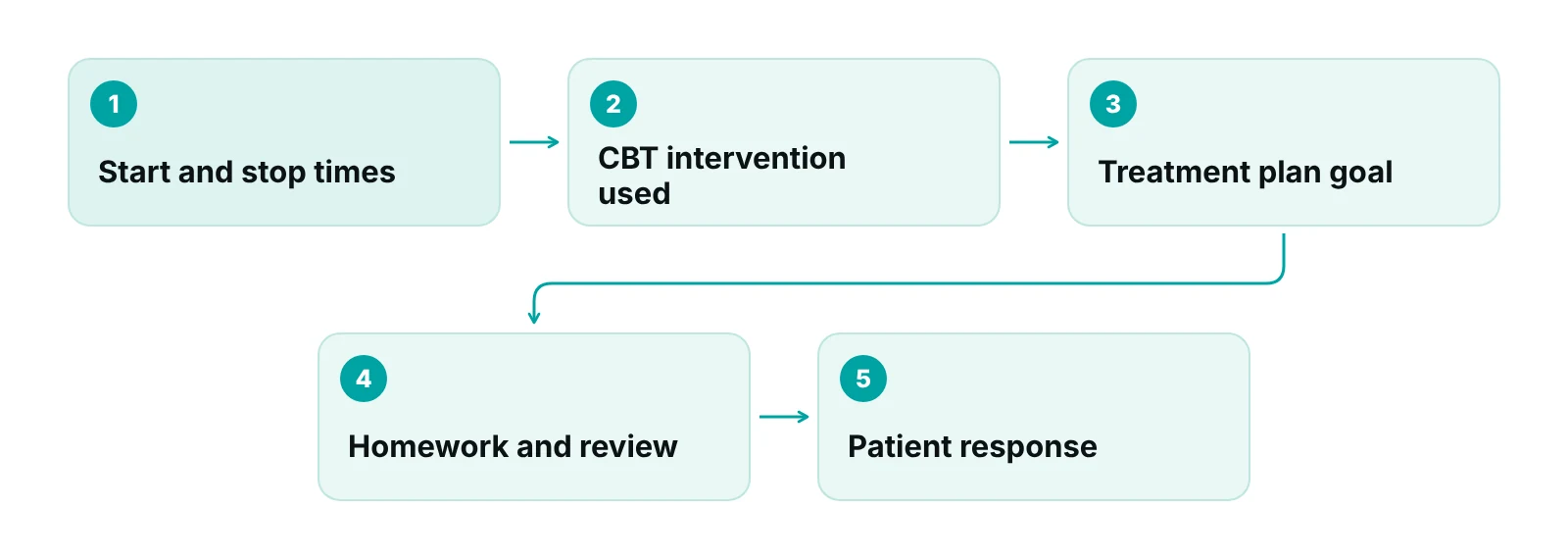
A time-based code is only as strong as the note behind it. Reviewers look for three things: the minutes, the intervention and the link to the treatment plan. Generic text fails all three, because it could describe any session for any patient.
| Element | Weak note | Stronger note |
|---|---|---|
| Time | “Session held.” | Start time, stop time and total psychotherapy minutes |
| Intervention | “Discussed anxiety.” | “Used cognitive restructuring on catastrophic predictions about work; reviewed the thought record.” |
| Plan link | “Continue CBT.” | Which treatment goal this session addressed and what changed since the last visit |
| Homework | “Homework given.” | The specific task assigned, and the prior task reviewed |
| Progress | “Patient stable.” | Symptoms or functioning compared with the plan, and a plan revision if progress stalled |
Copy-forward text deserves special care. If fifty notes in a row read the same, a reviewer has little reason to believe each session was a separate, necessary service. Notes that show progress, or a change in the plan when progress stalls, answer the medical necessity question before it is asked.
Brief screening and assessment tools also come with their own coding and documentation rules. Our post on CPT 96127 documentation requirements covers what to record when a scored questionnaire is part of the visit.
“A code is a promise about what happened in the room. The note is how a practice keeps that promise.”
Digital CBT and remote therapeutic monitoring: be careful
Remote therapeutic monitoring (RTM) is a family of codes for device-based tracking between visits. CPT includes 98978, a device supply code that supports monitoring of cognitive behavioral therapy. In one national commercial payer’s policy, effective May 15, 2026, Cigna lists 98978 in a group of RTM codes that it does not cover or reimburse for any indication. That is one payer, but it shows how a code can exist in CPT and still not be payable.
Medicare is a separate question. In its 2026 therapy code list, CMS names the RTM codes it treats as “sometimes therapy” services (98975, 98976, 98977, 98979, 98980, 98981, 98984 and 98985) and says therapists must always provide RTM under a therapy plan of care. CBT device code 98978 is not among them. The CMS therapy services page says three new RTM codes (98979, 98984 and 98985) were added for 2026. We could not confirm from these sources that Medicare pays for 98978 or that a psychotherapist can bill it.
The practical rule: do not build a revenue plan on RTM for CBT until the specific payer has confirmed in writing that it covers the specific code for your specialty and license type. A practice that assigns app-based homework can still do so for clinical reasons. It simply should not assume the app creates a billable service.
Group and family CBT
Group and family sessions use different codes from the individual psychotherapy family, and the rules do not transfer.
- Group CBT: 90853 is the CPT code for group psychotherapy. Interactive complexity can be added to it when a qualifying factor is documented.
- Family sessions with the patient: First Coast states that 90832 through 90838 already include psychotherapy with family members as informants. A separate family psychotherapy service can be reported only when it is a separate, distinct service in a separate time interval.
- Family psychotherapy codes: 90846 and 90847 are the family psychotherapy codes, and interactive complexity cannot be added to them. Our 90846 time range guide walks through the rules.
Common CBT billing mistakes and how to prevent them
Most CBT denials trace back to a few repeat problems. Each one is cheaper to fix in the workflow than on appeal.
- Hunting for a “CBT code.” Bill the psychotherapy time code and link it to the diagnosis the clinician documents. The method belongs in the note.
- Rounding up to 90837. A 50-minute session is a 90834. Make start and stop times mandatory fields.
- Adding 90785 for a hard session. Use it only when a named communication factor occurred, and never with crisis or family psychotherapy codes.
- Assuming telehealth works the same everywhere. Medicare contractors define modifier 95 as a synchronous audio-video telemedicine service and say telehealth modifiers must accompany distant-site telehealth services, per First Coast. Payers differ on modifiers, place of service and audio-only visits, so confirm each one.
- Repeating the same note. Copy-forward language makes sessions look interchangeable. Record the goal, the intervention and the response each time.
- Ignoring denials. A pattern of time or documentation denials points to a template or training gap. Review them by payer and code, not one by one.
Want a second set of eyes on your psychotherapy claims?
Send us your current time, note and coding workflow, and we will show where claims could be exposed. The practice audit is free, and any pricing is quoted after the audit.
Practices that bill behavioral health benefit from a process that ties session time, documentation and claim submission together. Our page for behavioral and mental health practices describes how that operation fits together, and our medical billing services cover charge entry, coding support and claim follow-up.
Where to go next
Pick the one question that matches your practice today. If you are unsure which codes you use most, pull the last 30 days of psychotherapy claims and count them by code. If most are 90837, compare the recorded minutes with the 53-minute floor. If most are 90834, check whether any sessions ran under 38 minutes.
To see what a calculation of lost revenue looks like for your own practice, use our revenue calculator.
Estimate what coding errors may cost your practice
Enter your own claim volume and denial rate into the revenue calculator. It uses your numbers, not industry averages.
Our recommendations
- Make start and stop times a required field. We recommend building time into the note template so a psychotherapy note cannot be signed without it. It is the cheapest control against a time denial.
- Add a CBT intervention field. A short pick-list or free-text field for the intervention used (cognitive restructuring, exposure, behavioral activation) gives each note something specific to defend.
- Gate 90785 behind a reason. Require the clinician to choose one of the four qualifying communication factors before the add-on can be charged.
- Review code mix every month. Compare how often each psychotherapy code is billed, by clinician, with the recorded minutes. Sudden shifts deserve a conversation, not an assumption.
- Confirm RTM and telehealth rules in writing. Ask each payer, not an app vendor, whether a code is covered for your license type and place of service. Keep the reply on file.
- Work denials by cause. Group time, medical necessity and modifier denials separately so the fix goes to the template, the training or the contract.
Bottom line
CBT does not have its own session code. It is billed with 90832, 90834 or 90837 by time, supported by a note that names the intervention. If your psychotherapy claims are still being denied or reviewed, our denial management services can work the claims that came back, and you can talk to our team about your setup.
Frequently asked questions
What CPT code do I use for CBT?
There is no CBT-specific session code. Use the psychotherapy code that matches the session minutes: 90832 for 16 to 37 minutes, 90834 for 38 to 52 minutes or 90837 for 53 minutes or longer. Put the CBT interventions in the note, and link the claim to the diagnosis the clinician documented.
Can I bill 90837 for a 50-minute session?
No. Fifty minutes falls in the 90834 band of 38 to 52 minutes. The 90837 code requires at least 53 minutes of psychotherapy time, and the note should show it. If sessions regularly run past 53 minutes, record the times so the longer code is supported.
Is there a separate CPT code for CBT for insomnia or OCD?
No. CPT codes the service, not the condition or technique. CBT for insomnia, OCD or anxiety is reported with the same psychotherapy time codes. The diagnosis goes on the claim, and the note should show the specific protocol used, such as sleep restriction or exposure work.
When can I add interactive complexity (90785) to a CBT session?
Only when one of four documented factors occurs: maladaptive communication, caregiver emotions that interfere with the plan, a sentinel event with a mandated report, or play equipment or an interpreter used to overcome a barrier. It cannot be used with crisis codes or family psychotherapy codes.
Does Medicare pay for the CBT remote monitoring code 98978?
We could not confirm that it does. CMS lists several RTM codes for therapy services in 2026, and 98978 is not among them in the list we reviewed. One national commercial payer’s May 2026 policy lists it as not covered. Ask each payer in writing before billing it.
What if my session is exactly 37 minutes?
Thirty-seven minutes falls at the top of the 90832 band of 16 to 37 minutes. To reach 90834 the session needs at least 38 minutes of psychotherapy. Do not round up. Record the actual start and stop times and bill the band they support.
Get your free practice audit
Tell us about your practice. We will contact you using the details you give.
- A review of your recent claims, denials and A/R aging
- Where your front desk and prior authorizations slow payment
- A prioritized fix list you keep, whether or not you hire us
Pricing is quoted after the audit, based on your volume and the services you choose. Prefer to talk? Call +1 (302) 556-2288.
Sources
- Psychotherapy services — First Coast Service Options (Medicare Administrative Contractor) (2026)
- CPT overview: psychotherapy and interactive complexity — American Psychiatric Association (2013)
- CPT interactive complexity — American Psychiatric Association (n.d.)
- Therapy code list 2026 annual update (MM14250) — Centers for Medicare & Medicaid Services (2026)
- CY 2026 Therapy Services Updates — Centers for Medicare & Medicaid Services (2026)
- Remote patient monitoring and remote therapeutic monitoring coverage policy — Cigna (2026)
- Telehealth service modifiers — First Coast Service Options (Medicare Administrative Contractor) (2026)
Disclaimer: This article is educational and is not legal, coding, clinical or compliance advice. CPT is a registered trademark of the American Medical Association, and its official descriptors are not reproduced here. Payer rules and Medicare contractor policies differ and change, so confirm the current rule with your payer, your Medicare contractor and the current CPT book before you bill.