
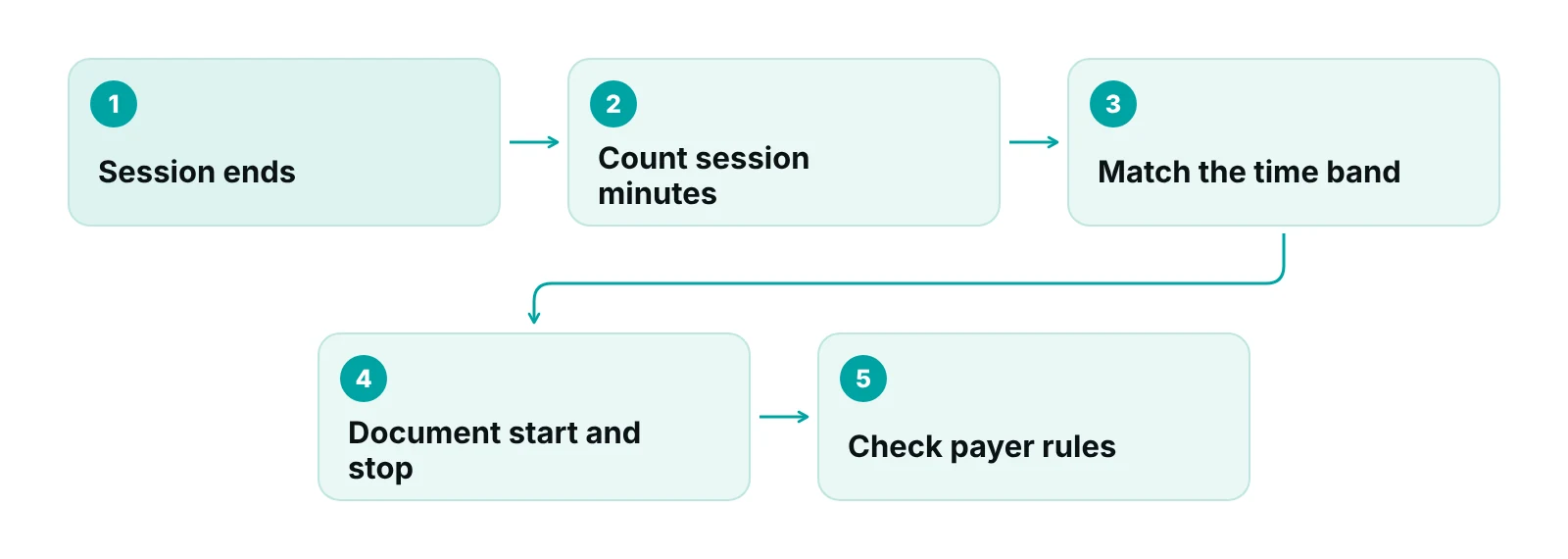
The 90832 CPT code reports a short individual psychotherapy session of 16 to 37 minutes with the patient, a family member, or both. Count only session minutes, record the start and stop times, and move to 90834 at 38 minutes. A session under 16 minutes does not support any psychotherapy code.
You finish a session, glance at the clock and see 28 minutes. It was not a full hour, and it was more than a hallway check-in. The question is which code the claim should carry, and whether your note can prove it.
This guide gives you the rule, the proof and the traps. It is written for therapists, group-practice owners and billing staff who are deciding how to handle short sessions. It stays on the stand-alone 30-minute code. For the add-on version used with a medical visit, see our 90836 CPT code guide, and for family sessions see the 90846 family psychotherapy time range post.
Key takeaways
- 90832 covers 16 to 37 minutes of psychotherapy. The 30-minute label is not an exact-minutes rule.
- At 38 minutes the session moves to 90834. Under 16 minutes, no psychotherapy code applies.
- Your note must show how long the session lasted, because missing time is a known Medicare review finding.
- Medicare contractors limit 90832 to one unit per date of service outside partial hospitalization.
- Fee ranges, telehealth and same-day rules vary by payer. Check each contract rather than a generic table.
What the 90832 CPT code reports
CPT 90832 is the code for an individual psychotherapy session in the 30-minute band, with the patient, a family member, or both in the session. The American Psychiatric Association’s CPT overview states that psychotherapy time is time spent with the patient and/or a family member, and it ties 90832 to 16 through 37 minutes (American Psychiatric Association). We describe the code in our own words here because the AMA owns the official CPT wording. Check the current CPT book when you build your charge master. For the wider code family, see our mental health CPT codes guide.
The code does not depend on your method. Cognitive behavioral work, supportive counseling and play-based work all report the same way. What the payer cares about is the service type, the face-to-face minutes and the support in your note.
Two nearby codes are easy to confuse with it. 90833 is the same 30-minute band, but it is an add-on reported alongside an evaluation and management (E/M) visit by a prescriber. Family psychotherapy has its own codes, 90846 and 90847. Both get their own guides on this site, linked above. Stay with 90832 when a therapist is providing a short individual session on its own.
The 90832 time range and how it compares
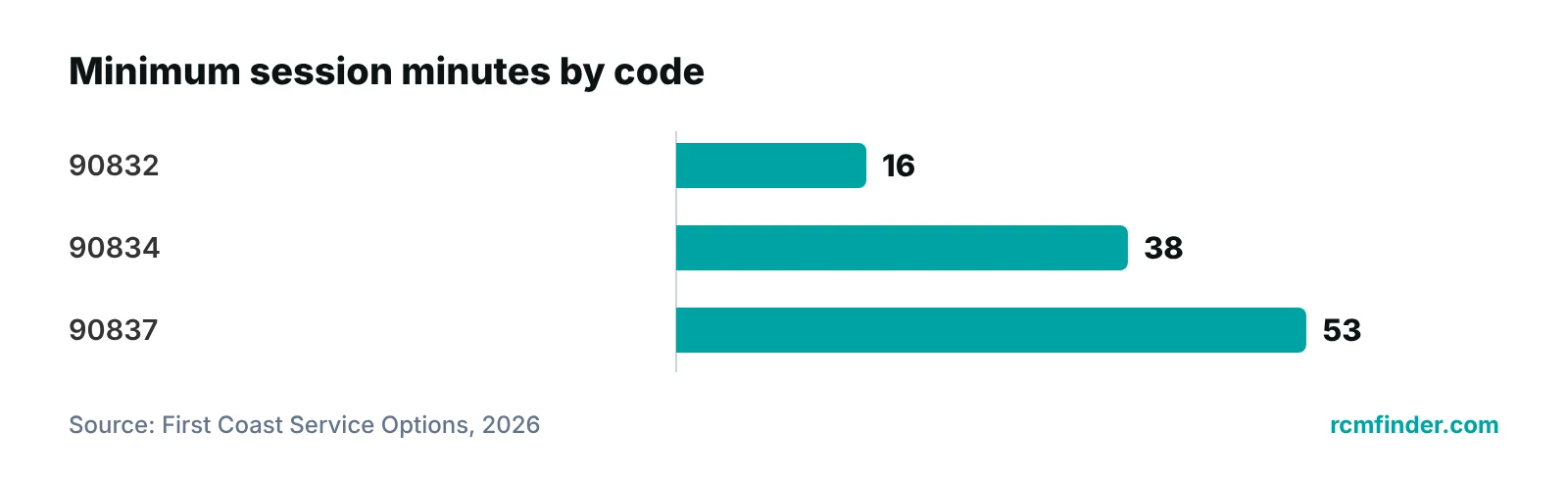
The 90832 time range is 16 to 37 minutes. First Coast, a Medicare contractor, publishes the same bands for all six psychotherapy time codes and tells providers to pick the code that most closely matches the actual time spent (First Coast Service Options). That is why a 28-minute session is a 90832 and a 37-minute session is too.
| Code | Session length | Reported how |
|---|---|---|
| 90832 | 16 to 37 minutes | Stand-alone individual psychotherapy |
| 90834 | 38 to 52 minutes | Stand-alone individual psychotherapy |
| 90837 | 53 minutes or longer | Stand-alone individual psychotherapy |
| 90833 | 16 to 37 minutes | Add-on to a qualifying E/M visit |
| 90836 | 38 to 52 minutes | Add-on to a qualifying E/M visit |
| 90838 | 53 minutes or longer | Add-on to a qualifying E/M visit |
Source: First Coast Service Options, Psychotherapy services (page dated August 6, 2026); American Psychiatric Association, CPT overview (2013 document; bands unchanged in the 2026 contractor page).
Two practical points follow from the table. First, 90832 is a range, not a promise of 30 minutes. A 20-minute crisis follow-up and a 35-minute child session both fit. Second, the same contractor page says not to report psychotherapy codes for a session under 16 minutes. If the clock shows 15, the time may still be clinically valuable, but it does not support a psychotherapy claim.
No rounding up
Minute 38 is the first minute of the 90834 band. Do not record 37 as “about 40” to reach it, and do not stretch a 14-minute check-in to 16. Time is the proof, so it has to be real.
When 90832 is the right code, and when it is not
90832 is the right code when the face-to-face psychotherapy time lands between 16 and 37 minutes, and the service is individual psychotherapy. The scenarios below are the ones we see most often in behavioral and mental health practices.
| Scenario | Likely code | What to check |
|---|---|---|
| Twenty-minute session with an established client in a crisis week | 90832 | Start and stop times, and a note that explains the focus |
| Thirty-seven-minute session | 90832 | Do not round up to the next code |
| Thirty-eight-minute session | 90834 | Time moved into the next band |
| Fifteen-minute check-in | No psychotherapy code | Below the 16-minute floor. Ask the payer whether another service fits |
| Prescriber adds 30 minutes of therapy to a medical visit | 90833 with an E/M code | Add-on rules, covered in the 90836 guide |
| Session with family only, patient not part of it | Family psychotherapy codes | See the 90846 guide and your payer policy |
Source: First Coast Service Options (2026) for time bands, the 16-minute floor and the add-on rule; scenario mapping is our own summary, not payer policy.
Why practices schedule short sessions on purpose
Short sessions are a clinical choice before they are a billing choice. A young child may not sustain a longer session. A client who is stable may want a brief monthly check-in. A mid-week crisis follow-up often does not need a full block. Booking those as 30-minute visits keeps the calendar honest, so the code you bill matches the care you gave.
What you should not do is design the schedule around the code. If every visit is booked at 38 minutes to reach the next band, a payer reviewing time stamps will see the pattern. Book for the clinical need, then code from the documented minutes.
“Pick the session length for the patient. Let the note and the clock tell you the code, never the other way round. – Awais Afzal”
— Awais Afzal, Healthcare Operations & Data Analyst
Medicare checkpoints that decide whether the claim pays
Medicare contractors set a handful of rules around 90832 that many commercial payers copy. They are worth knowing even if most of your volume is commercial, because they are the ones auditors test first. Your own payer contracts always control.
| Checkpoint | What it says | Why it matters |
|---|---|---|
| Minimum time | Do not report psychotherapy for a session under 16 minutes | Prevents a denial or recoupment on very short visits |
| Time in the record | The medical record must show the length of the psychotherapy encounter | The note is the proof of the band you billed |
| Units | Do not bill 90832 to 90838 above one unit, except in partial hospitalization (POS 52). Claims with more units outside POS 52 have been denied since July 1, 2022 | One unit on one line per date of service is the safe default |
| Same-day E/M | An E/M visit on the same day must be significant and separately identifiable from the psychotherapy | Applies to the add-on codes, not to stand-alone 90832 |
| Family members | 90832 to 90838 count family members as informants; family psychotherapy (90846, 90847) can be reported separately when it is a distinct service in a separate time interval | Keeps individual and family time from being mixed |
| Interactive complexity | 90785 can be reported with 90832 when the encounter is complicated by the need to involve other people, and the note must say what the complexity was | Extra work is supported only if you document it |
Source: First Coast Service Options, Psychotherapy services (2026); American Psychiatric Association, CPT overview (2013). Contractor rules apply to Medicare claims in that jurisdiction; confirm yours.
One more note on Medicare reviews. The same First Coast page names missing face-to-face time documentation as a recurring concern in Medicare’s CERT improper-payment findings, and it points providers to local coverage determination L33252 for the detailed requirements. If your practice bills Medicare, read the LCD for your own contractor, because jurisdictions can differ.
What to put in the note so the time holds up
A 90832 note should show how long the session lasted, what was done and why it was needed. The Medicare contractor rule is only that the record must show the length of the psychotherapy encounter. Everything else below is our recommended practice, so treat it as a minimum standard rather than a payer requirement.
- Start and stop times. “2:00 PM to 2:28 PM” is stronger than “30 minutes” and removes any argument about rounding.
- Who attended. Say whether the patient was present and whether a family member joined, because that affects which code fits.
- Focus and approach. Name the problem addressed and the method used, for example cognitive restructuring for work-related anxiety.
- Response and plan. Record how the client responded and when you will see them next.
- Interactive complexity, if billed. State exactly what made the session complex, since the APA guidance says the specific complexity must be documented.
A short template that follows the pattern: “Scheduled individual psychotherapy. Start 2:00 PM, stop 2:28 PM, 28 minutes. Client reported anxiety about a new job. Used cognitive restructuring to review negative predictions. Client reported feeling calmer by end of session. Continue weekly.” It is brief, it carries the time and it ties to the focus.
Clean notes also help the claim before it leaves the building. A pre-submission check should confirm that the time, code and diagnosis agree before the claim goes out. That is cheaper than correcting a denial later, and it is one of the steps our medical billing services team can run for you.
Telehealth and interactive complexity on a 90832 claim
The 90832 definition does not change for a video session, but the claim wrapper can. The Medicare contractor guidance says telehealth modifiers must be submitted with distant-site telehealth services, and it defines modifier 93 as audio-only synchronous telemedicine, allowed for patients at home who lack audio-video access or do not consent to it (First Coast Service Options). The same page restricts modifier GT to institutional claims from critical access hospitals billing under method II.
That is a Medicare reading. Commercial plans and Medicaid programs set their own modifier and place-of-service rules, and some still ask for modifier 95 on video visits. Medicare also updates its list of covered telehealth services each year, with changes effective January 1 (CMS). Check the current list and the payer’s behavioral health policy before you assume 90832 can be delivered by phone.
For a modifier-by-modifier walk-through, use our telehealth modifiers guide. We have not repeated the older advice to use telephone E/M codes for audio-only therapy. We could not confirm it against a primary source.
Adding 90785 for interactive complexity
90785 is an add-on that signals the session was more complicated because other people had to be involved. The APA overview says it is expected most often with children but can apply to any patient, and that it can be reported with 90832 through 90837. The rule that protects you is the documentation rule: name the specific complexity. “Difficult session” is not a reason. Review the CPT guidelines on what does not qualify before you add it to a claim.
What 90832 pays, and how to model it without guessing
There is no single payment for 90832. Medicare publishes its rates through the Physician Fee Schedule, and commercial plans pay under your contract. The old version of this post listed fee ranges and a 70 percent ratio to the next code. We removed them because we could not source them.
Here is a safer way to compare a 30-minute session with a longer one. Pull the allowed amount for each code from your three largest payers’ fee schedules or remittances. Multiply by the sessions you can realistically see in a clinical hour. Subtract no-shows and unpaid documentation time. If the numbers favor short sessions, check that your caseload actually fits them. Our revenue calculator can help you model the result once you have the rates.
Where 90832 claims go wrong
Most 90832 problems trace back to time, units or the wrong service type. Three patterns come up again and again.
- Time that does not match the code. A note that says 15 minutes, or no time at all, cannot support a psychotherapy claim. Read the start and stop times against the band before the claim is released.
- Too many units. The Medicare contractor limits 90832 to one unit per date of service outside partial hospitalization, so a line with two units invites a denial. If your system splits a visit into several lines, fix the template.
- Mixing services. A prescriber who adds therapy to a medical visit needs the add-on code, not 90832. A session with family members only needs the family psychotherapy codes. Mixing them is a frequent cause of rework.
If two sessions happen on the same day, the rules are payer specific. We could not verify a universal rule for combining times, so do not assume one. Ask the payer, record the answer, and put it in your billing policy.
When denials do arrive, treat them as data. Group them by reason, find the front-end cause, and fix that. Our denial management services follow that same loop, and the coding and billing for mental health services post covers the wider behavioral coding picture.
Not sure your short-session claims are clean?
Send us your current psychotherapy workflow and we will review how time, codes and notes line up. The audit is free and quoted pricing comes after.
Our recommendations
- Make start and stop times a required field. We would build the time into the note template so a session cannot be signed without it. It is the cheapest control against a time denial.
- Train staff on the three bands, not one code. Everyone who codes should know 16 to 37, 38 to 52 and 53 or more. Most mistakes happen at the edges.
- Cap units in your billing system. Set 90832 to one unit per date of service by default and flag exceptions, such as partial hospitalization, for manual review.
- Write a payer matrix for telehealth and same-day rules. For your top payers, record the modifier, place of service and same-day rule once, then reuse it. Our team can help you build that sheet.
- Review one sample of short-session claims each quarter. Pull ten 90832 claims, read the notes against the minutes and look for gaps. Fix the template if you see the same gap twice.
Bottom line
The 90832 CPT code is simple to state and easy to get wrong in the details: 16 to 37 minutes, one unit, documented times. If your billing is still catching up with the rules, our medical billing services team can review your psychotherapy claims, and our denial management services can work the ones that already came back. You can also talk to our team about your setup.
Frequently asked questions
What is the time range for the 90832 CPT code?
The 90832 time range is 16 to 37 minutes of psychotherapy with the patient, a family member, or both. At 38 minutes the session moves to 90834. Under 16 minutes, a Medicare contractor says not to report any psychotherapy code. Record start and stop times so the minutes are provable.
My session lasted exactly 37 minutes. Which code do I use?
Use 90832. The band runs through minute 37, and the next band starts at minute 38. Do not round up to reach 90834. If a payer questions it, your start and stop times in the note are the evidence.
Can I bill 90832 with interactive complexity?
Yes, when the session truly needed it. The American Psychiatric Association’s overview says 90785 can be reported with 90832 to 90837. Your note must say exactly what the complexity was. Review the CPT guidelines first, because not every challenging session qualifies.
Does 90832 work for audio-only sessions?
It depends on the payer and the current Medicare telehealth list. Medicare defines modifier 93 for audio-only visits for patients at home who lack video access or do not consent to it. Check the payer’s behavioral health policy before you book a phone session.
Can I bill two units of 90832 or two sessions on one day?
Not as two units on Medicare. A Medicare contractor says 90832 to 90838 should not be billed above one unit, except in partial hospitalization, and over-unit claims have been denied since July 1, 2022. For two separate sessions on one day, rules vary by payer, so ask in writing.
Can I use 90832 when the patient is not in the session?
Family members can be part of the session, and their time counts toward psychotherapy with the patient. When the work is family psychotherapy, Medicare treats it as a separate service with its own codes. Our 90846 guide explains that route, and your payer policy decides coverage.
Get your free practice audit
Tell us about your practice. We will contact you using the details you give.
- A review of your recent claims, denials and A/R aging
- Where your front desk and prior authorizations slow payment
- A prioritized fix list you keep, whether or not you hire us
Pricing is quoted after the audit, based on your volume and the services you choose. Prefer to talk? Call +1 (302) 556-2288.
Sources
- Psychotherapy services — First Coast Service Options (Medicare Administrative Contractor) (2026)
- CPT overview: psychotherapy and interactive complexity (2013) — American Psychiatric Association (2013)
- Telehealth service modifiers — First Coast Service Options (Medicare Administrative Contractor) (2026)
- Telehealth — CMS (2026)
Disclaimer: This article is educational and is not legal, coding or compliance advice. CPT is a registered trademark of the American Medical Association, and its official descriptors are not reproduced here. Payer rules and Medicare contractor policies differ and change, so confirm the current rule with your payer, your Medicare contractor and the current CPT book before you bill.
