
Behavioral health practice management software has to do more than schedule visits and send claims. It must keep psychotherapy notes and substance use records separate, capture session time for billing, control who sees what, and keep an audit trail. This guide lists the needs and the questions to ask any vendor before signing.
A group practice adds three clinicians and a substance use program. The old scheduling tool cannot handle recurring weekly slots, session notes live in a shared folder, and the biller keeps asking for start and stop times. The partners agree it is time to buy software, then find that every demo looks the same.
This guide gives owners and managers a neutral question list. It names no products and quotes no prices. For general background, see the practice management software overview. Here the focus is what is specific to behavioral health. The same practice may also want to read how software supports the whole revenue cycle, how clients find it through marketing, digital channels and local search.
Key takeaways
- Behavioral records are not all alike. Psychotherapy notes, substance use records and routine chart entries each follow different rules, and the software has to respect that.
- A vendor that stores protected health information is a business associate. A signed business associate agreement is required, even if the data is encrypted and the vendor holds no key.
- Session time has to be captured as a structured fact, because Medicare contractors expect it in the record and psychotherapy claims depend on it.
- Booking pages and portals can send visitor data to third parties through tracking tools. Ask what is installed.
- Ask about data exit before signing. Moving records out later is where many practices get stuck.
What does behavioral health practice management software need to do?
It needs to cover the practice’s daily flow: recurring appointments, intake forms and consents, notes tied to billing, claims and remittances, client payments, telehealth links and reporting. The behavioral difference is volume and sensitivity. Clients are often seen weekly, and the records are among the most sensitive in healthcare.
Practice management and clinical record functions are sometimes sold together and sometimes apart. Ask which parts of the workflow sit in which system, and where staff re-enter data. Re-entry is where errors and delays start.
RCM Finder builds its own portal, which practices and billing companies use for the revenue side. Today it provides a claim tracking pipeline by stage, specialty-aware billing logic, data-completeness checks before submission, underpayment detection against expected amounts, workflow rules that flag, hold or assign claims, role-based staff permissions, an audit log, a client portal for practices and for billing companies serving several practices, and reporting dashboards. Appointment booking with a calendar view, a provider credentialing module and automated real-time eligibility verification inside the portal are early access or coming next, not live today. The practice management system page describes it.
Which records need special handling in the software?
Three categories need different treatment: psychotherapy notes, substance use disorder records and ordinary chart entries. A system that treats them all the same can create privacy or billing problems.
HHS describes psychotherapy notes as a mental health professional’s notes on a counseling session, kept separate from the rest of the record. They exclude items such as medication monitoring, session times, test results and diagnosis summaries, and a patient’s authorization is generally required before disclosure, including for treatment by another provider (HHS OCR). The national health IT coordinator adds that the information-blocking exclusion for psychotherapy notes depends on the content of each note, not on the provider’s credentials (HealthIT.gov FAQ).
Substance use records add 42 CFR Part 2. HHS’s fact sheet on the 2024 final rule says covered persons must comply by February 16, 2026, that one consent can cover future treatment, payment and operations uses, that counseling notes need a separate, specific consent, and that segregating or segmenting Part 2 records is not required (HHS). Software still needs to show which records carry Part 2 limits.
| Record | Why it is special | Question to ask |
|---|---|---|
| Psychotherapy notes | Kept apart from the chart; authorization needed for most disclosures | Can notes be stored separately, with their own access rights, and excluded from routine record releases? |
| Progress notes and session times | Part of the regular record; needed for billing | Is start and stop time a structured field that billing can read? |
| Substance use disorder records | 42 CFR Part 2 consent and redisclosure limits | Can records be flagged, and is the consent type tracked per client? |
| Counseling notes (Part 2) | Separate, specific consent | Does the system keep a separate consent for them? |
| Minors and family contacts | Parents are usually personal representatives, with exceptions; state law may be stricter | Can access rights be set per contact and per record type? |
| Access requests | HIPAA gives 30 days to respond | Can the portal produce a complete record export on request? |
Source: HHS OCR (mental health guidance); HHS (Part 2 fact sheet, 2024); Crowell & Moring summary of OCR access guidance (2016). Check state law as well.
The 30-day access response time comes from OCR’s January 2016 guidance as summarized by Crowell & Moring, which also says fees must be cost-based. Confirm current rules with counsel.
Which security questions matter most?
Start with the legal basis: the vendor must sign a business associate agreement, and the software must support the controls the Security Rule names. The rest is detail.
The HHS summary of the Security Rule says it covers health plans, clearinghouses, providers that conduct standard electronic transactions and their business associates. It is flexible and technology neutral, requires a thorough risk analysis, and lists technical safeguards for access control, audit controls, integrity, authentication and transmission security (HHS). HHS cloud computing guidance says a cloud provider that creates, receives, maintains or transmits electronic protected health information is a business associate, a BAA is required, and this holds even when the provider stores only encrypted data and has no key (HHS).
| Safeguard | Plain meaning | Question for the vendor |
|---|---|---|
| Access control | Only authorized people see records; unique user IDs | Are roles configurable by job, for example front desk versus clinician versus biller? |
| Audit controls | Activity involving health information is recorded and reviewable | Can the practice see who opened or changed a record, and export the log? |
| Integrity | Records are protected from improper change | How are edits to signed notes tracked? |
| Authentication | Users are who they claim to be | What login protections are available? |
| Transmission security | Data in transit is protected | Is all traffic encrypted, including client portal and telehealth links? |
| Business associate agreement | Contract required before the vendor handles health information | Will the vendor sign before any client data is entered, and what about its subcontractors? |
Source: HHS, Summary of the HIPAA Security Rule; ASHA summary of the technical safeguards; HHS cloud computing guidance.
A proposed Security Rule update, published in January 2025, would remove the line between required and addressable specifications and add items such as multi-factor authentication and encryption, according to a Foley & Lardner summary. That summary said the rule’s future was unclear, so it is described here as proposed. See the HIPAA Security Rule and revenue cycle post and the HIPAA compliance checklist.
Ask about tracking tools on booking and portal pages
HHS OCR’s tracking technologies bulletin says tracking on pages where users book appointments, use a symptom checker or log in to a portal can involve protected health information, and that a vendor receiving it may be a business associate needing a BAA. A part of the bulletin was vacated by a federal court on June 20, 2024, so confirm the current position with counsel (HHS).
What should the billing side of the software handle?
It should capture what a psychotherapy claim depends on and warn before deadlines pass. Four items matter most.
- Session time. A Medicare contractor lists 90832 at 16 to 37 minutes, 90834 at 38 to 52 and 90837 at 53 or more, says the record must show the encounter length and that CERT data flagged missing time (First Coast Service Options, August 2026).
- Unit edits. The same page says more than one unit of these codes is denied outside partial hospitalization. Ask whether the system blocks the extra unit.
- Timely filing. Medicare requires claims within one calendar year of the service (CMS transmittal 12909). Ask for an aging alert before the limit.
- Remittance and claim status. Ask how electronic remittances post and how claim status is checked.
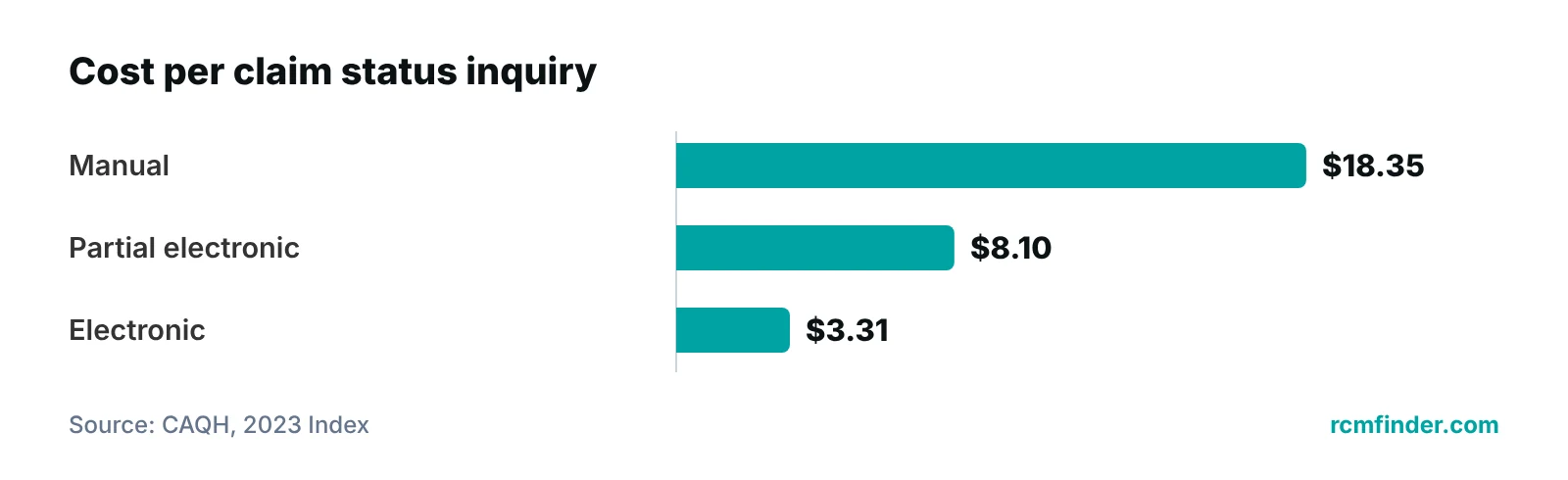
Status checks are a cost issue too. The 2023 CAQH Index reported that for behavioral health providers a manual claim status inquiry costs $18.35 per transaction, a partially electronic one $8.10 and a fully electronic one $3.31 (CAQH, 2023).
An HHS OIG audit of Medicare psychotherapy payments found that many sampled days failed requirements, including undocumented psychotherapy time and missing signatures (HHS OIG, 2023). Required fields before sign-off help. The whole-process view is in behavioral health revenue cycle management.
How do telehealth, scheduling and intake fit?
Software should handle the rules that change, not hard-code them. Medicare telehealth for behavioral health has changed repeatedly: Penn State’s rural health office reported in February 2026 that the Consolidated Appropriations Act, 2026 extended telehealth flexibilities through December 31, 2027 (Penn State Office of Rural Health).
Ask whether place of service and modifiers can be set per payer and updated without a vendor release. The telehealth billing guide explains the codes involved.
For intake, check that consents and forms can be e-signed and tied to the client record, that reminders can be turned on, and that a wait for the first visit can be seen. One review of open-access scheduling found no-show rates of about 8%, 16% and 22% in one study at lead times of 0 to 3, 4 to 6 and 28 to 30 days, though in non-behavioral settings (Health Science Reports, 2024).
Software does not remove the work around it. RCM Finder’s Virtual Medical Assistant service provides remote front-desk staff for scheduling, eligibility checks, prior authorizations and intake inside the practice’s own systems, in the practice’s time zone.
How should a practice compare options?
Compare by workflow fit and exit cost, not by feature count. Three common set-ups exist.
| Approach | Fits | Watch for |
|---|---|---|
| One suite for notes, scheduling and billing | Small and mid-sized practices that want one login | Weaker billing reports; harder to leave; check Part 2 and psychotherapy note handling |
| Separate clinical record and billing layer | Groups with an existing clinical record | Double entry between systems; clear data ownership; BAAs with each vendor |
| Billing company’s portal on top of the practice’s record | Practices outsourcing claims | Role limits for outside users; audit log; data return at contract end |
Source: RCM Finder summary of common set-ups; not a ranking. Fit depends on size, specialty mix and payer mix.
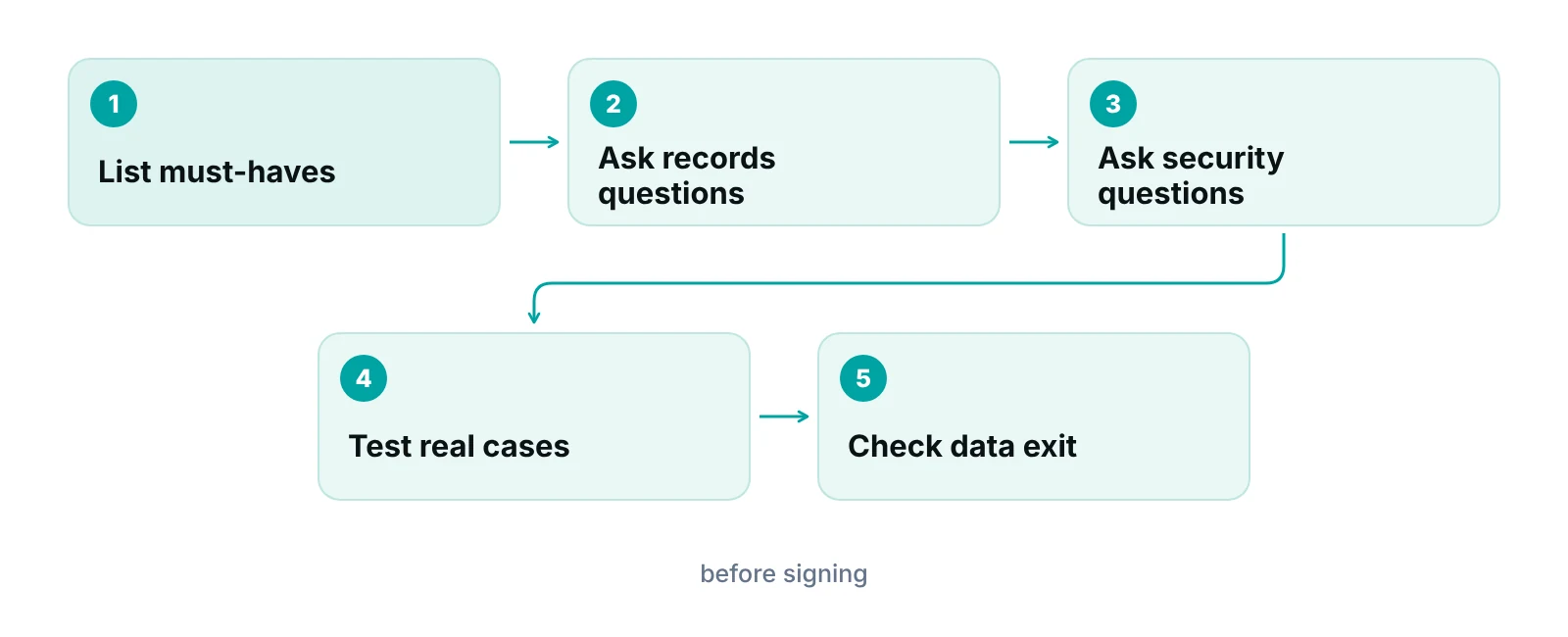
Run the demo with real cases: a recurring weekly client, a 52-minute session, a Part 2 client and a denied claim. Ask the vendor to show each one. Ask what happens to the data if the contract ends, and in what format it comes back.
“A demo shows what software can do on its best day. A trial with real cases shows what it will do on a busy Tuesday.”
— Awais Afzal, Healthcare Operations & Data Analyst
Map your workflow before you buy
A free practice audit can map how intake, notes, claims and payments move today, so the software question starts from the workflow. Pricing is quoted after the audit.
Our recommendations
- Write the workflow first. List how a client moves from inquiry to final payment, including who touches each step. Use it as the demo script.
- Insist on a BAA before any data. Have the signed agreement in hand before test data or real clients enter the system. Ask about subcontractors too.
- Test the records rules. Ask the vendor to show psychotherapy notes stored separately, a Part 2 flag and a role that cannot see either.
- Make session time structured. Choose software where start and stop time is a field billing can read, not free text in a note.
- Ask about tracking tools. Request a list of third-party scripts on booking and portal pages. Have counsel review it.
- Plan the exit. Get the export format, the timeline and the cost in writing before signing.
Bottom line
Behavioral health practice management software is a records, security and billing decision as much as a scheduling one. Ask how psychotherapy notes and Part 2 records are separated, who signs the business associate agreement, how session time reaches the claim and how data leaves. The practice management system page shows what RCM Finder’s portal offers today, and the behavioral and mental health RCM operations page shows how it fits a therapy practice.
Frequently asked questions
What is behavioral health practice management software?
It is software that runs a behavioral practice’s daily operations: appointments, intake, client records or links to them, billing, claims, payments and reports. The behavioral difference lies in recurring visits, time-based codes and extra privacy rules for psychotherapy notes and substance use records.
Is practice management software the same as an EHR?
Not always. Practice management software covers scheduling, billing and administration, while an EHR holds the clinical record. Some products combine both. Ask which functions the vendor actually provides and where staff must enter data twice, since double entry is a common source of errors and delay.
Does a software vendor need a business associate agreement?
If it creates, receives, maintains or transmits protected health information for the practice, yes. HHS cloud guidance says this holds even when the vendor stores only encrypted data without the key. Get the agreement signed before any client data is entered, and ask whether the vendor’s own subcontractors are covered by similar agreements.
How should software handle psychotherapy notes?
HHS describes them as notes kept separate from the rest of the record, usually needing patient authorization for disclosure. Ask the vendor to show them stored separately with their own access rights, and to confirm that session times and diagnosis summaries stay in the regular record.
What about substance use disorder records?
Practices treating substance use disorders face 42 CFR Part 2. HHS says covered persons must comply with the 2024 final rule by February 16, 2026, and counseling notes need a separate consent. Ask whether records can be flagged and the consent type tracked per client.
Is RCM Finder's portal a full practice management system?
The portal focuses on the revenue side today: claim tracking, billing checks, workflow rules, role-based permissions, an audit log and reporting. Appointment booking, a credentialing module and automated eligibility checks inside the portal are early access or coming next, not live.
Get your free practice audit
Tell us about your practice. We will contact you using the details you give.
- A review of your recent claims, denials and A/R aging
- Where your front desk and prior authorizations slow payment
- A prioritized fix list you keep, whether or not you hire us
Pricing is quoted after the audit, based on your volume and the services you choose. Prefer to talk? Call +1 (302) 556-2288.
Sources
- Mental health and HIPAA guidance — HHS Office for Civil Rights (2014)
- Does the EHI definition exclusion for psychotherapy notes apply to all notes? — HealthIT.gov (ONC) (2021)
- Fact Sheet: 42 CFR Part 2 Final Rule — HHS (2024)
- Summary of the HIPAA Security Rule — HHS (2013)
- HIPAA Security Technical Safeguards — American Speech-Language-Hearing Association (2024)
- Guidance on HIPAA and Cloud Computing — HHS (2016)
- HHS Proposes Changes to Strengthen the HIPAA Security Rule — Foley & Lardner LLP (2025)
- Use of Online Tracking Technologies by HIPAA Covered Entities and Business Associates — HHS Office for Civil Rights (2024)
- Key Takeaways from HIPAA Guidance on Individuals' Rights to Access Health Information — Crowell & Moring LLP (2016)
- Psychotherapy services — First Coast Service Options (Medicare) (2026)
- Transmittal 12909, Changes to the Time Limits for Filing Medicare FFS Claims — CMS (2024)
- Administrative Transaction Costs by Provider Specialty (2023 Index) — CAQH (2023)
- Medicare improperly paid providers for some psychotherapy services (A-09-21-03021) — HHS Office of Inspector General (2023)
- Medicare Telehealth Waivers Extended Through 2027 — Penn State Office of Rural Health (2026)
- Evaluation of no-show rate in outpatient clinics with open access scheduling: a systematic review — Health Science Reports (PubMed Central) (2024)
Disclaimer: This article is educational and is not legal, compliance or technology purchasing advice. CPT is a registered trademark of the American Medical Association. Rules on privacy, security, Part 2 records and Medicare telehealth change, so confirm current requirements with counsel and your Medicare contractor before you act. No products are recommended.
