
Behavioral health marketing works best when every claim, story and referral arrangement can be defended. Rules from HIPAA, the FTC, Google, professional ethics codes and, for addiction programs, federal anti-kickback law decide what a practice may say and who may say it. Modest, specific messaging also builds trust with people who are deciding whether to ask for help.
A group practice wants more clients. The website says the team gets results, a past client has offered a glowing story, and a marketer proposes a flat fee for every new patient. Each of those three ideas touches a different rule.
This guide is for practice owners and managers. It covers what to claim, how to handle stories and reviews, when client information becomes marketing, and what may be paid for. Channel choice is covered separately in behavioral health digital marketing and behavioral health SEO. The service view is on the behavioral health marketing services page.
Key takeaways
- A claim is only as safe as the evidence behind it. Guarantees, cures and rankings such as best or number one invite problems under ethics codes and ad platform rules.
- Professional ethics codes for psychologists and counselors bar soliciting testimonials from current therapy clients. Reviews cannot be bought, gated or hidden.
- HIPAA requires a written authorization before client information is used for marketing, with narrow exceptions. A reply to a review can be a disclosure.
- For addiction treatment, paying per referred patient can fall under federal law, and Google requires certification to advertise.
- A short pre-publish check catches most problems before they reach the public.
What makes behavioral health marketing different?
The audience is large, often hesitant and sharing sensitive information early. That raises the cost of a careless claim and the value of a clear one.
A June 2026 CDC data brief using 2024 National Health Interview Survey data found that 14.0% of US adults received counseling or therapy from a mental health professional in the past 12 months. The share was 16.9% for women and 10.9% for men, and it fell with age: 20.2% for adults 18 to 29, 18.7% for ages 30 to 44, 11.7% for ages 45 to 64, 7.5% for ages 65 to 74 and 5.0% for ages 75 and older (CDC NCHS Data Brief 564, 2026).
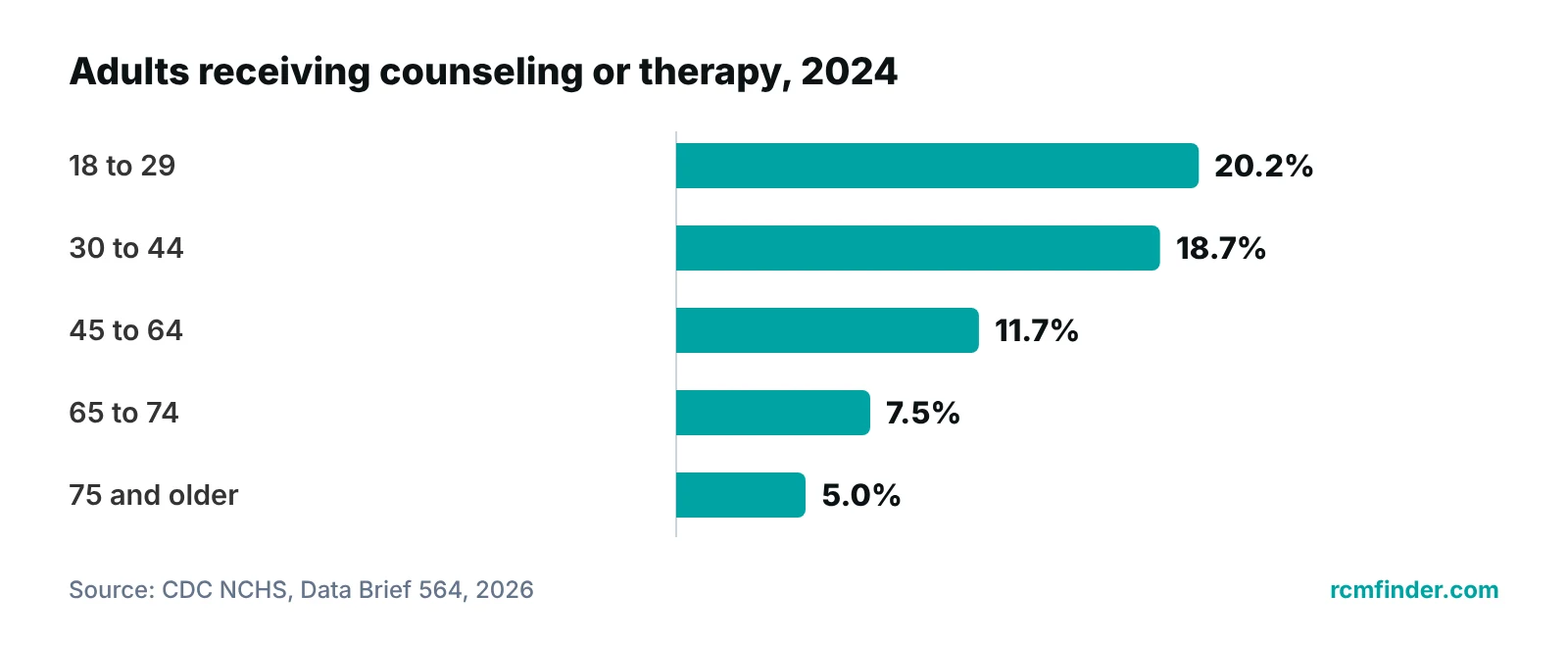
The numbers describe demand, not what a given practice will see. They show why messages need to fit the reader: a younger adult comparing providers online needs different information from an older adult who may arrive through a physician referral.
Which claims can a practice safely make?
Claims about credentials, services and fees are safest when they are factual and checkable. Claims about outcomes are where most risk sits.
The American Psychological Association’s Ethics Code (Standard 5) tells psychologists not to knowingly make false, deceptive or fraudulent public statements about training, credentials, fees or services, and holds them responsible for promotional statements others make for them (Standards 5.01 and 5.02, 2002 text hosted by University College Cork). The American Counseling Association’s Code of Ethics (Section C.3.a) requires advertising that is accurate and not false, misleading, deceptive or fraudulent, and Section C.4 limits titles such as Dr. to cases where the doctorate is in counseling or a related field (ACA Code of Ethics).
Google’s advertising policy adds that claims suggesting results that are improbable or cannot be guaranteed are prohibited, even when a result is possible but not typical (Google Ads policy help). State licensing boards set their own advertising rules for licensed professions, so confirm the board that governs each clinician.
| Language to avoid | Why it is a problem | Safer approach |
|---|---|---|
| Guaranteed recovery or a cure in a set time | Results cannot be guaranteed; Google bars improbable or unguaranteed claims | Describe the approach, who it is for and what a first visit involves |
| Outcome stories with a results-not-typical note | The FTC Endorsement Guides say that note is not an adequate disclosure | Skip outcome stories, or substantiate the typical result and disclose it clearly |
| Best therapist in town, number one | Not verifiable; ethics codes bar misleading public statements | State training, license, approaches and populations served |
| Titles or specialties not earned | Counseling code limits titles and requires current credentials | List the current license, the conferred degree and the state |
| All insurance accepted | Fee and coverage statements must be accurate (APA Standard 5.01) | Name the plans accepted and note the date checked |
Source: APA Ethics Code Standard 5 (2002 text); ACA Code of Ethics C.3 and C.4; Google Ads policy help; FTC Endorsement Guides as summarized by Davis Wright Tremaine (2023). Not legal advice.
Applied to the website, this means a plain description of services and fees beats a promise. See the medical marketing ROI guide for tracking results without overstating them.
How should testimonials and reviews be handled?
Do not solicit testimonials from current therapy clients, never pay for or filter reviews, and never reply with client details. Four sets of rules meet here.
Ethics codes come first. The APA code says psychologists do not solicit testimonials from current therapy clients or others vulnerable to undue influence (Standard 5.05), and the ACA code says counselors do not ask current or former clients for testimonials (C.3.b). Google permits asking customers to review, but bars incentives, discouraging negative reviews and selectively asking only satisfied customers (Google Business Profile policy; review tips).
The FTC announced a final rule on August 14, 2024 that bans fake or false reviews and testimonials, including AI-generated ones, paying for reviews conditioned on sentiment, undisclosed insider reviews and review suppression through groundless legal threats or intimidation (FTC).
Replying is the fourth risk. In 2023 HHS OCR announced a $30,000 settlement with Manasa Health Center, a New Jersey psychiatric provider, after it posted a response to a negative online review that included details of the patient’s diagnosis and treatment, plus a two-year corrective action plan. OCR also found it disclosed other patients’ information the same way (HHS OCR).
| Practice | Status | Basis |
|---|---|---|
| Ask a current therapy client for a testimonial | Avoid | APA 5.05; ACA C.3.b |
| Post a general invitation to review, without incentive | Allowed by Google; consider ethics codes first | Google review tips |
| Offer a discount or gift for a review | Prohibited | Google policy; FTC rule |
| Ask only happy clients, or discourage negative reviews | Prohibited | Google policy |
| Staff, family or contractors post reviews without disclosure | Prohibited or must disclose | FTC rule; Google conflict-of-interest policy |
| Reply confirming or discussing a client’s care | Prohibited | HHS OCR settlement (2023) |
Source: APA and ACA ethics codes; Google Business Profile policies; FTC (August 2024); HHS OCR (2023). Check each clinician’s licensing board.
A safe reply names no one and confirms nothing, for example: thank the reviewer in general terms and invite contact by phone. More on this topic is in online reputation management strategies for doctors.
When does client information become marketing?
As soon as client information is used to promote a service. HIPAA’s default is a written authorization, with a few exceptions.
HHS defines marketing as a communication that encourages recipients to purchase or use a product or service. A covered entity generally needs written authorization to use protected health information for marketing, except for face-to-face communications and promotional gifts of nominal value, and the authorization must state any payment from a third party. Treatment communications and care coordination fall outside the definition (HHS marketing guidance; HHS FAQ).
That is why a client story, a photo or a quote on the website needs a signed authorization, and why a list of current clients should not be uploaded to an ad platform. Google’s health policy does not support advertiser-curated audiences such as customer match or lookalike segments in sensitive health categories, and it names counseling for conditions like depression, anxiety and addiction (Google Ads policy help).
HHS also advises businesses to avoid badge-style claims about their HIPAA status, and to keep consent language simple, because the FTC Act applies to misleading statements about data practices (HHS). Tracking tools on a website raise a related question, covered in the digital marketing post. The HIPAA compliance checklist is a useful companion.
What about referral fees and advertising addiction treatment?
Paying for referrals is the sharpest risk for addiction programs. Federal law and Google both set special rules.
A law firm briefing summarizes the Eliminating Kickbacks in Recovery Act (18 U.S.C. 220): it prohibits knowingly and willfully paying or receiving remuneration for referrals to recovery homes, clinical treatment facilities or laboratories, with penalties of up to $200,000 and up to 10 years in prison per occurrence. It says paying outside call centers per patient based on the value or volume of referrals is illegal, while paying for marketing services at a commercially reasonable price is permitted (Epstein Becker Green, 2019).
On Google, a 2018 policy announcement says addiction services advertisers in the United States must be certified by LegitScript and then by Google, and that referral agencies and sober homes not eligible for certification cannot advertise (Google Ads policy help). Current terms may differ, so check the policy page before launching any campaign.
| Activity | Main rule | What to check |
|---|---|---|
| Client story or photo on the website | HIPAA marketing authorization; ethics codes on testimonials | Signed authorization; not a current therapy client |
| Email to a list of current clients about a new program | HIPAA marketing rule; treatment communications are excluded | Whether the message is treatment-related; privacy officer review |
| Uploading a client list to an ad platform | Google health policy; HIPAA | Do not upload; use contextual targeting |
| Per-patient fee to a marketer or call center (addiction treatment) | Eliminating Kickbacks in Recovery Act | Flat, fair-market fees; counsel review |
| Search ads for addiction treatment | Google certification requirement | LegitScript and Google certification |
| Public replies to reviews | HIPAA Privacy Rule | No client details, no confirmation of care |
Source: HHS (marketing guidance); Google Ads policy help; Epstein Becker Green (2019); HHS OCR (2023). Law firm summaries are secondary sources.
What should a clear, honest message include?
It should help a hesitant reader decide whether to book, using facts. A short list covers most pages.
- Who the practice serves and what it treats, in plain words.
- The clinicians, their licenses and the states they are licensed in.
- Insurance plans accepted, self-pay arrangements and how a first visit works.
- How to reach the practice and what happens after an inquiry.
- A note that the page is not a substitute for emergency care.
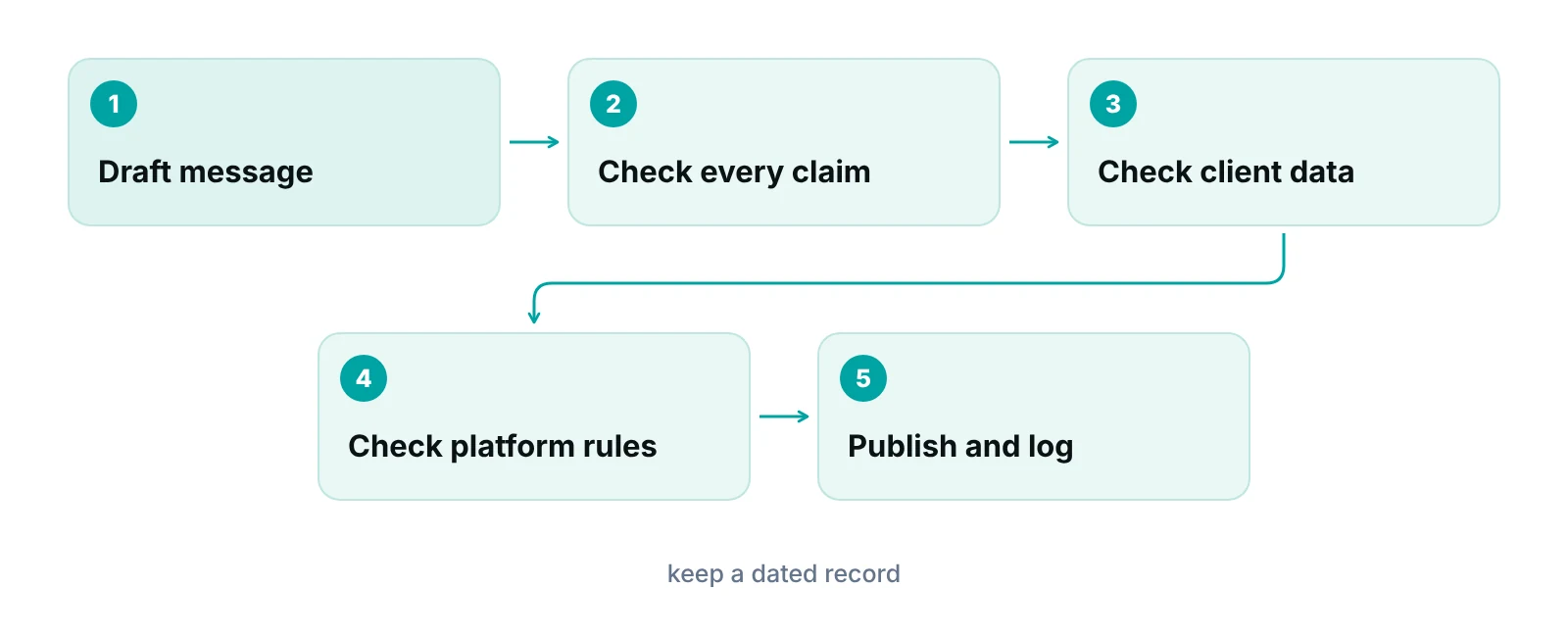
Keep a dated record of what was approved and who approved it. If a board or platform asks, that record shows the practice acted with care. A practice that is also thinking about the front end of its revenue process can see how marketing hands off to intake in behavioral health revenue cycle management, and about the software that supports it in behavioral health practice management software.
“Trust is the product. A modest claim the practice can prove does more than a bold claim it has to defend.”
— Awais Afzal, Healthcare Operations & Data Analyst
Some practices add help for the first contact. RCM Finder’s Virtual Medical Assistant service provides remote front-desk staff for scheduling, eligibility checks and intake, and the healthcare digital marketing and behavioral and mental health RCM operations pages describe the wider services.
Review your claims before they go live
A free practice audit can review how inquiries, intake and claims connect, so marketing promises match what the practice delivers. Pricing is quoted after the audit.
Our recommendations
- Write a one-page claims policy. List what the practice will and will not say about results, rankings, titles and fees. Give every new page and ad a quick check against it.
- Use authorizations, not assumptions. Get a signed HIPAA authorization before using any client story, photo or quote. Do not solicit them from current therapy clients.
- Set a review reply script. Approve a short reply that names no one and confirms nothing. Train anyone who has access to the review accounts.
- Pay marketers in flat, documented terms. For addiction programs, have counsel review any fee that varies with the number of patients referred.
- Check each clinician's board. Licensing boards set advertising rules for their professions. Keep a list of the boards and re-check yearly.
- Keep a dated approval log. Record what was published, who approved it and when. Update the log when the policy changes.
Bottom line
Behavioral health marketing earns trust when claims are modest and checkable, stories are authorized, reviews are earned and replies reveal nothing. For addiction programs, referral payments and ad certification need extra care. If marketing and intake need to work as one process, see the behavioral health marketing services page, the behavioral health SEO guide and the end-to-end RCM service.
Frequently asked questions
Can a therapy practice use client testimonials?
Only with care. The APA and ACA ethics codes say not to solicit testimonials from current therapy clients, and HIPAA generally requires a written authorization before client information is used for marketing. Confirm the rule for each clinician’s license with the licensing board, and keep the signed authorization on file.
Can a practice ask clients to leave Google reviews?
Google allows reminding customers to leave a review, but not incentives, selective asking or discouraging negative reviews. Ethics codes for psychologists and counselors add limits on soliciting testimonials from current therapy clients, so many practices avoid asking therapy clients directly and instead make the review link easy to find on the website for anyone who wishes to use it.
Is it a HIPAA violation to reply to a negative review?
A reply is not a violation by itself, but confirming or discussing a client’s care can be. HHS OCR announced a $30,000 settlement in 2023 with a psychiatric provider that posted client details in review responses. Keep replies generic, thank the reviewer without naming anything about their care, and invite contact by phone so the conversation moves out of public view.
Can behavioral health ads promise results?
They should not. Google prohibits claims suggesting improbable or unguaranteed results, and the FTC Endorsement Guides say a results-not-typical note is not enough. Describe the approach, the population served and what a first visit involves instead.
Can an addiction treatment program pay marketers per patient?
This is high risk. A law firm briefing on the Eliminating Kickbacks in Recovery Act says paying outside call centers per patient based on referral value or volume is illegal, while commercially reasonable marketing fees are allowed. Have counsel review any variable fee.
Do state boards have their own advertising rules?
Yes. Licensing boards for psychologists, counselors, social workers and marriage and family therapists set their own rules on titles, specialties and testimonials. Check the board for each clinician, keep a record of the review, and re-check when a clinician adds a new license or moves to another state.
Get your free practice audit
Tell us about your practice. We will contact you using the details you give.
- A review of your recent claims, denials and A/R aging
- Where your front desk and prior authorizations slow payment
- A prioritized fix list you keep, whether or not you hire us
Pricing is quoted after the audit, based on your volume and the services you choose. Prefer to talk? Call +1 (302) 556-2288.
Sources
- Mental Health Treatment Among Adults: United States, 2024 (Data Brief 564) — CDC National Center for Health Statistics (2026)
- Marketing (HIPAA Privacy Rule guidance) — HHS (2003)
- When is an authorization required before marketing? — HHS (2002)
- Collecting, Using, or Sharing Consumer Health Information? Look to HIPAA, the FTC Act, and the Health Breach Notification Rule — HHS (2023)
- Summary of the HIPAA Privacy Rule — HHS (2013)
- FTC announces final rule banning fake reviews and testimonials — Federal Trade Commission (2024)
- In a One, Two, Three Punch, the FTC Issues Updated Endorsement Guides — Davis Wright Tremaine LLP (2023)
- Ethical Principles of Psychologists and Code of Conduct (2002), Standard 5 — American Psychological Association (copy hosted by University College Cork) (2002)
- ACA Code of Ethics, Section C.3 and C.4 — American Counseling Association (2014)
- False, misleading, or unrealistic claims — Google Ads Policy Help (2026)
- Health in personalized advertising — Google Ads Policy Help (2026)
- Healthcare: Addiction services (April 2018) — Google Ads Policy Help (2018)
- Prohibited and restricted content (Business Profile) — Google Business Profile Help (2026)
- Tips to get more reviews — Google Business Profile Help (2026)
- HHS OCR reaches agreement with provider that disclosed PHI in response to negative online reviews — HHS Office for Civil Rights (2023)
- Behavioral Health Marketing Best Practices in Light of the SUPPORT Act — Epstein Becker Green (2019)
Disclaimer: This article is educational and is not legal, compliance or professional ethics advice. Professional codes, state licensing board rules, HIPAA, FTC rules and platform policies differ and change, so confirm the current requirements with counsel, your licensing board and each platform before you publish.