
Behavioral health SEO is mostly local search: a verified Google Business Profile that follows Google's naming and eligibility rules, location and service pages with real content, named clinician authorship, and review handling that never reveals client details. Rankings cannot be bought or guaranteed, and results take weeks to months.
A new client types a worry and a town into a search box. Three practices appear with a map. One has an incomplete profile, one has a name stuffed with keywords that Google may suspend, and one has clear hours, named clinicians and careful replies. The third gets the call.
This guide is for owners and managers of therapy, counseling and psychiatry practices. It covers what Google says about how local results are chosen, who can list, what pages a site needs, which technical items matter, and how to handle reviews. For the general version across specialties, see the healthcare SEO guide. Claims and wording are in behavioral health marketing, and channels in behavioral health digital marketing.
Key takeaways
- Google says local results are mainly based on relevance, distance and prominence, and there is no way to request or pay for a better local ranking.
- Eligibility rules matter: a virtual office or rented mailbox is not eligible, and names must not carry taglines or service descriptions.
- Pages should be real and local: one for each office, one for each clinician, and telehealth pages that match where each clinician is licensed.
- Review markup is not eligible when a practice reviews itself, and a reply that discusses a client’s care can be a HIPAA disclosure.
- SEO is not guaranteed. Google’s own guide suggests waiting a few weeks before judging changes.
How does local search work for a therapy practice?
Local results are mainly based on relevance, distance and prominence, according to Google. Relevance is how well a profile matches what someone searched for, distance is how far the business is from the searcher, and prominence is how well known the business is, including links from other sites and the number of reviews (Google Business Profile Help).
Google adds that businesses with complete and accurate information are more likely to appear, that positive reviews and helpful replies can help a business stand out, and that verification tells Google you are authorized to represent it. It also states there is no way to request or pay for a better local ranking.
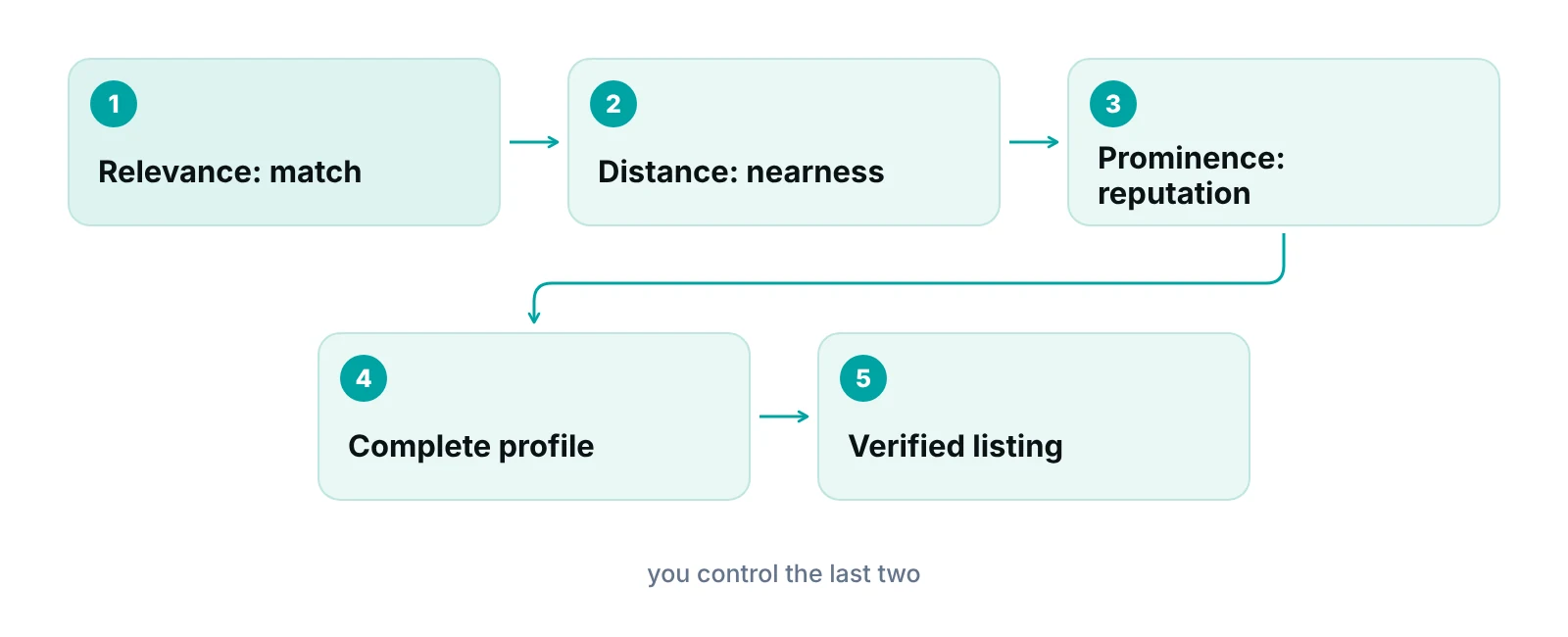
A practice cannot change distance. It can make the profile complete, keep it accurate and earn real reviews. The rest of this guide covers how.
Who can have a Business Profile, and how should it be named?
A profile is for a business with a physical location customers can visit, or one that travels to them. A rented mailing address does not qualify, and Google’s guidelines say a virtual office location is not eligible (Google Business Profile guidelines).
Naming is a common mistake. The name should match the real-world name used on signs, the website and stationery. Google bars taglines, service or product descriptions, location details, hours, phone numbers and URLs in the name. A practice called Smith Counseling should not list itself as Smith Counseling | Anxiety Therapy Boston.
Practitioners can have their own listings if they are public-facing and reachable at the verified location. When several practitioners share a location, the organization gets the location profile and each practitioner’s listing uses only that person’s name. A sole practitioner at a branded location should share one profile in the format brand: practitioner name. Support staff should not create profiles.
| Situation | Approach | Check |
|---|---|---|
| Solo clinician with an office | One profile with the verified office address | Staffed hours; name matches the sign |
| Group practice, several clinicians, one office | One organization profile; optional practitioner listings using only the person’s name | No duplicate profiles for specialties |
| Clinician in a shared or rented office | Eligible only if the location is staffed and signed as required | Read the co-working rules before listing |
| Virtual office or rented mailbox | Not eligible for a profile at that address | Do not list it |
| Telehealth only, no office | The guidelines fetched do not describe an online-only listing type; eligibility rests on a physical location or travel to customers | Confirm with Google before relying on a listing |
| Two offices | A profile per staffed location | Separate pages on the website for each |
Source: Google Business Profile guidelines. Service-area rules (about two hours of driving time) apply to businesses that travel to customers; confirm applicability.
The profile and the website must agree on name, address, hours and services. Differences confuse readers and Google alike.
What pages should a therapy practice website have?
It should have a page for each purpose a reader has: what is treated, who treats, where, how to pay and how to start. Thin pages repeated for every town do not help anyone.
| Page type | What belongs | What to avoid |
|---|---|---|
| Home | Services in plain words, location, how to book, a note that it is not emergency care | Promises of results |
| Service pages | One per main service, such as individual therapy, couples therapy or medication management | Copying the same text for each page |
| Location page, one per office | Address, hours, parking, transit, clinicians, a map | Listing offices that do not exist |
| Clinician pages | Name, license, degrees conferred, states licensed, approaches | Titles or specialties not earned |
| Telehealth page | States where each clinician is licensed; how a session works | Implying service in states without a license |
| Insurance and fees | Plans accepted, self-pay information, date last checked | Statements such as all insurance accepted |
| Articles | Plain-language topics written or reviewed by a named clinician | Individual clinical advice; client stories |
Source: RCM Finder suggestions, consistent with the accuracy rules in the ACA Code of Ethics C.3 and C.4 and Google Search Central.
Licensure sets the real boundary for telehealth pages. For psychologists, the Psychology Interjurisdictional Compact (PSYPACT) lets doctoral-level licensed psychologists provide telepsychology across member states, but only after applying for authority to practice and obtaining a certificate from ASPPB (American Telemedicine Association). Other professions follow their own state rules, so a clinician page should say where that person is licensed and nothing broader.
The ACA Code of Ethics requires counselors to claim only licenses that are current and in good standing and not to use the title Dr. unless the doctorate is in counseling or a related field (ACA Code of Ethics). For layout ideas, see medical website designs for healthcare.
How can content show expertise on a sensitive topic?
Make authorship clear and the content accurate. Google says topics that affect health and well-being get extra weight for expertise and trust, and that accuracy should match established expert consensus.
Its guidance recommends bylines that link to information about the author, an explanation of how content was created, and a purpose of helping people rather than attracting search visits. It warns against fabricated creators or false credentials (Google Search Central).
Google’s SEO starter guide adds basics that matter for a small site: unique, clear titles for every page; descriptions that summarize the page; words in URLs that help users; alt text for images; and descriptive link text. It says keywords in the domain or URL path have little ranking effect (Google Search Central).
“A therapy website is read by someone deciding whether to ask for help. Write for that person, sign it with a real name and let search follow.”
— Awais Afzal, Healthcare Operations & Data Analyst
Which technical items are worth doing?
Structured data, accurate business details and an accessible site are worth doing. Tracking code is not, unless it is justified.
Google’s LocalBusiness structured data requires a name and address and recommends fields such as telephone, URL, opening hours and geographic coordinates; it advises using the most specific subtype available (Google Search Central). One restriction applies to many practices: when the entity being reviewed controls the reviews about itself, its pages using LocalBusiness or Organization markup are ineligible for review stars, including reviews pulled in through a widget (Google Search Central). Do not mark up the practice’s own reviews.
Accessibility may become a legal duty for some practices. An HHS interim final rule published on May 11, 2026 extended compliance dates for web and mobile app accessibility to May 11, 2027 for recipients of HHS financial assistance with 15 or more employees and May 10, 2028 for those with fewer than 15 (Federal Register). Whether a particular practice is a recipient depends on its funding, so ask counsel.
Privacy affects SEO work too. Analytics and ad tags on booking and intake pages can involve protected health information, per HHS OCR’s tracking bulletin, which is covered in the digital marketing post.
How should reviews and replies be handled?
Earn real reviews, reply briefly and never confirm that someone is a client. Reviews feed prominence, but the same reviews carry rules.
Google bans incentives and discouraging negative reviews, and its guidance says replies should stay professional, short and free of a reviewer’s private information. The FTC’s 2024 rule bans fake reviews and review suppression. Ethics codes add limits on soliciting testimonials from current therapy clients, as covered in the marketing post.
The privacy risk is real. HHS OCR announced a $30,000 settlement in 2023 with Manasa Health Center, a psychiatric provider that disclosed patients’ diagnosis and treatment details in replies to negative online reviews, along with a two-year corrective action plan (HHS OCR).
| Do | Avoid | Why |
|---|---|---|
| Thank the reviewer in general terms | Confirming the person is or was a client | Confirmation can itself disclose health information |
| Invite contact by phone or email | Arguing the facts of the case in public | Keeps details out of public view |
| Keep it short and professional | Offering discounts or promotions in replies | Google asks for conversational replies, not offers |
| Flag content that breaks Google’s policies | Threatening reviewers | FTC rule on suppression |
| Reply on a schedule | Bulk generic replies | Google suggests useful, specific replies |
Source: Google Business Profile Help (review tips); FTC (August 2024); HHS OCR (2023). Check each clinician’s licensing board rules.
The reputation management post gives general reply practices across specialties.
How long does it take, and what should be measured?
Expect weeks to months, and no guarantee. Google’s SEO starter guide says there is no guarantee that any particular site will be indexed or ranked first, that changes can show effects within hours or take months, and suggests waiting a few weeks before judging results.
Measure with tools that do not touch client information: Business Profile calls and direction requests, Search Console impressions and clicks, and a question at intake about how the client found the practice. Count inquiries answered the same day, since a fast answer matters as much as a rank. RCM Finder’s Virtual Medical Assistant service provides remote front-desk staff for scheduling, eligibility checks and intake, and the practice’s wider options are on the behavioral health marketing services page and the healthcare digital marketing page. After the call comes the billing process, mapped in behavioral health revenue cycle management, with software questions in behavioral health practice management software.
Make sure local inquiries get answered and paid
A free practice audit can review how local search inquiries turn into booked, verified and paid visits. Pricing is quoted after the audit.
Our recommendations
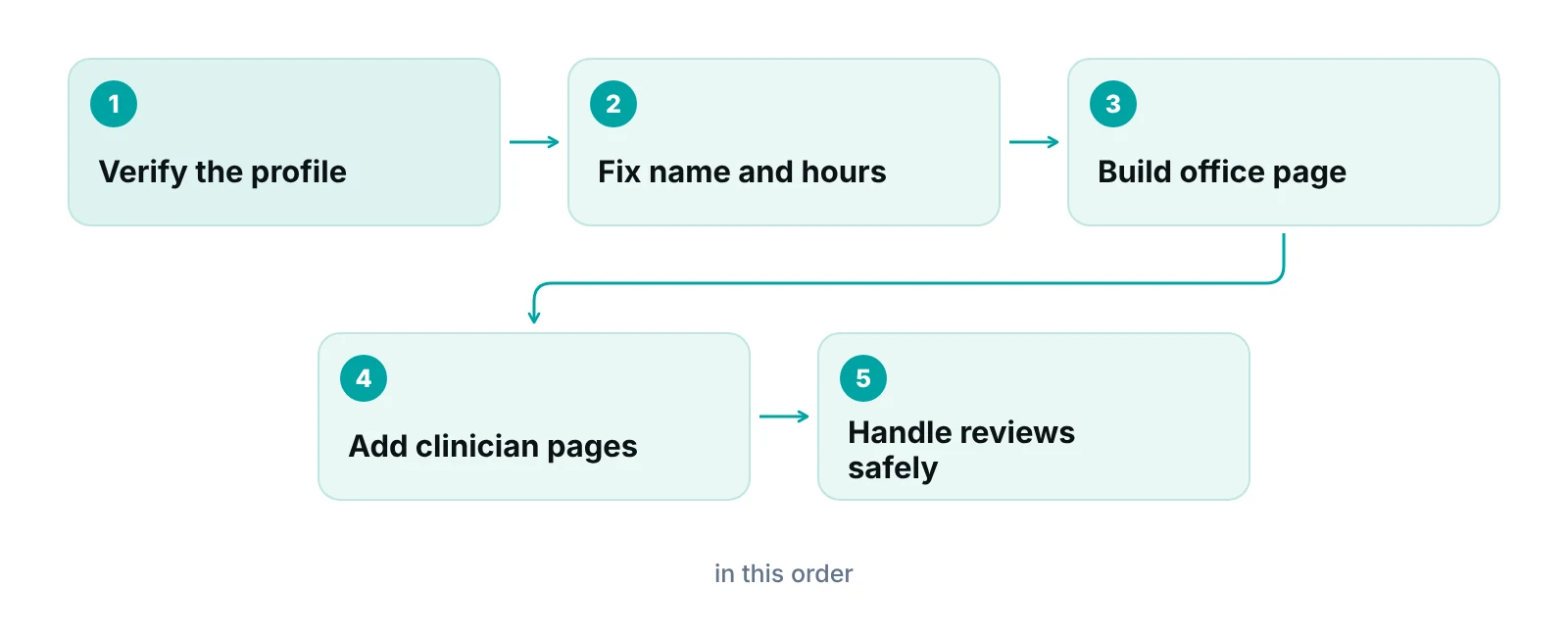
- Verify and complete the profile first. Confirm eligibility, use the real business name, add accurate hours and services, and keep the website in agreement.
- Build one real page per office and clinician. Include addresses, hours, licenses and states. Avoid near-duplicate pages for towns without an office.
- Match telehealth pages to licensure. State where each clinician is licensed and no more. Review the list when a license or compact status changes.
- Do not mark up the practice's own reviews. Use LocalBusiness markup for name, address, phone and hours, and leave out review stars for self-controlled reviews.
- Write one safe review reply. Agree a short template that names no one and confirms nothing, and train whoever has access.
- Measure at the front desk. Ask every new client how they found the practice and review the answers monthly with the profile insights.
Bottom line
Behavioral health SEO rewards accuracy more than tricks: a verified, correctly named profile, real office and clinician pages, careful review replies and patience. Rankings cannot be bought, and privacy mistakes can cost more than any gain. For help with the wider plan, see the behavioral health marketing services page and the behavioral health marketing rules post.
Frequently asked questions
What is behavioral health SEO?
It is improving how a therapy, counseling or psychiatry practice appears in search, mostly local search. The work covers the Google Business Profile, the website’s pages and structured data, the accuracy of hours and addresses, and the way reviews are earned and answered.
Can a telehealth-only therapist have a Google Business Profile?
Google’s guidelines say a profile is for a business with a physical location customers can visit or one that travels to customers. They do not describe a separate type for online-only businesses, and a virtual office is not eligible. Confirm with Google before relying on a listing.
Can a practice add star markup to its own Google reviews on its site?
Google says that when the entity being reviewed controls the reviews about itself, its pages using LocalBusiness or Organization markup are ineligible for review stars, including widget-fed reviews. Showing reviews on the page is a separate choice; adding review markup is the problem.
Can a practice add keywords to its Google name, such as Smith Counseling Anxiety Therapy?
Google’s naming rules bar service descriptions, taglines and location details in the business name, and unnecessary information can lead to suspension. Use the real-world name shown on your sign and website, and put services and locations in the website text and profile fields.
How long does SEO take for a new therapy practice?
Google’s guide says changes can show effects within hours or take months, and suggests waiting a few weeks before judging results. It also says there is no guarantee of being indexed or ranked first. Treat any promise of a ranking date with caution.
Is it safe to reply to a negative review?
Yes, if the reply is general. Do not confirm the person is a client or mention their care. HHS OCR announced a $30,000 settlement in 2023 with a psychiatric provider that disclosed diagnosis details in review replies. Invite the reviewer to call instead.
Get your free practice audit
Tell us about your practice. We will contact you using the details you give.
- A review of your recent claims, denials and A/R aging
- Where your front desk and prior authorizations slow payment
- A prioritized fix list you keep, whether or not you hire us
Pricing is quoted after the audit, based on your volume and the services you choose. Prefer to talk? Call +1 (302) 556-2288.
Sources
- How to improve your local ranking on Google — Google Business Profile Help (2026)
- Guidelines for representing your business on Google — Google Business Profile Help (2026)
- Tips to get more reviews — Google Business Profile Help (2026)
- Prohibited and restricted content (Business Profile) — Google Business Profile Help (2026)
- Local Business (LocalBusiness) structured data — Google Search Central (2026)
- Review snippet structured data — Google Search Central (2026)
- Creating Helpful, Reliable, People-First Content — Google Search Central (2026)
- SEO Starter Guide: The Basics — Google Search Central (2026)
- Psychology Interjurisdictional Compact (PSYPACT) — American Telemedicine Association (2021)
- ACA Code of Ethics, Sections C.3 and C.4 — American Counseling Association (2014)
- Extension of Compliance Dates for Nondiscrimination on the Basis of Disability; Accessibility of Web Content and Mobile Applications — Federal Register (HHS) (2026)
- HHS OCR reaches agreement with provider that disclosed PHI in response to negative online reviews — HHS Office for Civil Rights (2023)
- FTC announces final rule banning fake reviews and testimonials — Federal Trade Commission (2024)
- Use of Online Tracking Technologies by HIPAA Covered Entities and Business Associates — HHS Office for Civil Rights (2024)
Disclaimer: This article is educational and is not legal, privacy or SEO advice. Google's policies, HIPAA enforcement and accessibility rules change, so confirm the current requirements with counsel and Google's published guidelines before you act. Nothing here promises search rankings or patient volume.