
Third-party medical billing means an outside company prepares, submits and follows up your claims as your agent under a written contract. It can lift collections where claims stall, but only if you sign a business associate agreement, keep payments in your name and measure results against your own baseline.
Revenue-lift percentages are easy to find on this topic and hard to verify. We do not quote any, because how much outsourcing helps depends on your claims, payers and current process, and no one can know it before looking at your data. This guide explains how the arrangement works, where it can and cannot move revenue, what federal rules say about money and contracts, and what to expect after you decide. For a vendor checklist, use our ten questions to ask before hiring a medical billing company.
Key takeaways
- Third-party billing moves revenue where claims are late, rejected or unworked, not where documentation or contracts are weak.
- Baseline five measures (net days in A/R, cash collection, denial rate, final denial write-off, clean claim rate) before handover.
- Sign the business associate agreement before sharing patient data; HHS requires written assurances.
- Medicare lets an agent receive payment only under 42 CFR 424.73 conditions, so keep deposits in your name.
- Never accept a fixed percentage promise; ask for formulas and a sample-claim test instead.
What does third-party medical billing include?
Third-party medical billing means an outside company handles some or all of your billing work, usually charge entry, coding support, claim submission, payment posting, denial follow-up and A/R, while your practice keeps responsibility for documenting care.
Scope varies a great deal. One vendor may only send claims. Another may also work denials, call payers on unpaid claims and report on your numbers. That is why the contract, not the label, tells you what you are buying. The HHS Office of Inspector General (OIG) advises that billing company and provider responsibilities be formalized in a written contract that lists which functions are shared and which belong to one party. The same guidance says proper documentation is the health care provider’s responsibility.
| Task | Who usually does it | What to write down |
|---|---|---|
| Documenting the visit and the services provided | Your providers | How the vendor queries unclear documentation, and how fast you answer |
| Coding | Either side | Who assigns codes, who reviews them, and who responds to a payer audit |
| Registration and insurance data | Usually your front desk | Who fixes missing or wrong insurance information found at billing |
| Claim scrubbing and submission | Billing partner | Which clearinghouse is used and whose name the account is under |
| Payment posting and denial follow-up | Billing partner | Which denials are appealed, and who signs appeal letters |
| Patient statements and balance calls | Either side | Who speaks to patients, and with what script |
| Reports | Billing partner | Which metrics, with written definitions, and how often |
Source: HHS Office of Inspector General, Compliance Program Guidance for Third-Party Medical Billing Companies, Federal Register, December 18, 1998 (written contract and provider documentation responsibility). The split shown is our description of common practice.
Where can third-party billing raise revenue, and where can it not?
It can raise revenue where money is lost to delay and rework: late or rejected claims, unworked denials and aging A/R. It cannot fix missing documentation, weak payer contracts or low patient volume.
Deadlines are a good example. Under 42 CFR 424.44, a Medicare claim for services furnished on or after January 1, 2010 must be filed no later than the close of the period ending one calendar year after the date of service, with limited exceptions. Other payers set their own limits in your contracts. A claim that sits in a queue because nobody has time to fix an edit can age past those limits. A partner whose staff work the queue daily protects that revenue.
| Lever | What a billing partner can do | What stays with you |
|---|---|---|
| Clean claims | Check claims against payer edits before submission and send gaps back to you | Capturing complete registration and documentation at the visit |
| Denials | Work each denial by reason, appeal where warranted and report patterns | Fixing the front-desk or clinical cause once it is found |
| A/R follow-up | Follow up on a schedule by payer and age | Answering record requests quickly |
| Filing deadlines | Track claims approaching payer limits and flag them | Sending charges promptly after the visit |
| Payer contracts | Compare payments with your contracted rates if you provide them | Negotiating rates and signing contracts |
Denials and A/R are where most practices run short of hours. Our guide to medical billing denial management shows how denial work is organized, and the medical billing services we offer cover claim scrubbing, denial management and A/R follow-up inside your existing EHR (for example PrognoCIS, eClinicalWorks or athenahealth).
Be careful with fixed percentage promises
A promise of a set revenue increase cannot be checked before the vendor has seen your claims. Ask instead how the vendor will set your baseline, which metrics it will report, and how each one is defined.
Specialty matters too. Payer edits, authorization rules and modifier habits differ between, say, pain management and behavioral health, so ask any vendor to show experience in your field. See the specialties we support for how we group them.
How do you measure whether a billing partner is working?
Measure against your own baseline, using written metric definitions, and review the numbers monthly. A rate that sounds good is not useful until you know how it is calculated and what it was before the handover.
Pull the same measures for the last three to twelve months before anyone takes over. The HFMA MAP Keys give standard definitions you can copy into the contract. Our revenue cycle KPI guide explains more of them.
| Measure (HFMA code) | How HFMA defines it | What it tells you |
|---|---|---|
| Net days in A/R (FM-1) | Net A/R divided by average daily net patient service revenue, using the most recent three months | Whether claims turn into cash at a steady pace |
| Cash collection as % of net patient service revenue (FM-2) | Patient service cash collected, net of refunds, divided by average monthly net patient service revenue | Whether billed work becomes money in the bank |
| Denial rate (AR-5) | Claims denied divided by claims remitted, from remittance advice | How often payers reject claims once sent |
| Final denial write-off (AR-6) | Net dollars written off as denials divided by average monthly net patient service revenue | Money lost after appeals are exhausted |
| Clean claim rate (CL-1) | Claims that pass edits with no manual intervention divided by claims accepted into the claims processing tool | Quality of claims before they reach the payer |
Source: HFMA, MAP Keys, 2023 Edition. Definitions summarized in our words; check the current edition before copying formulas into a contract.
Two cautions. HFMA says its clean claim rate counts a claim the first time it is scrubbed, so a vendor that reports only after rework is reporting a different number. And a vendor’s “denial rate” may be calculated differently from HFMA’s, so ask for the formula in writing.
What should the money flow and contract look like?
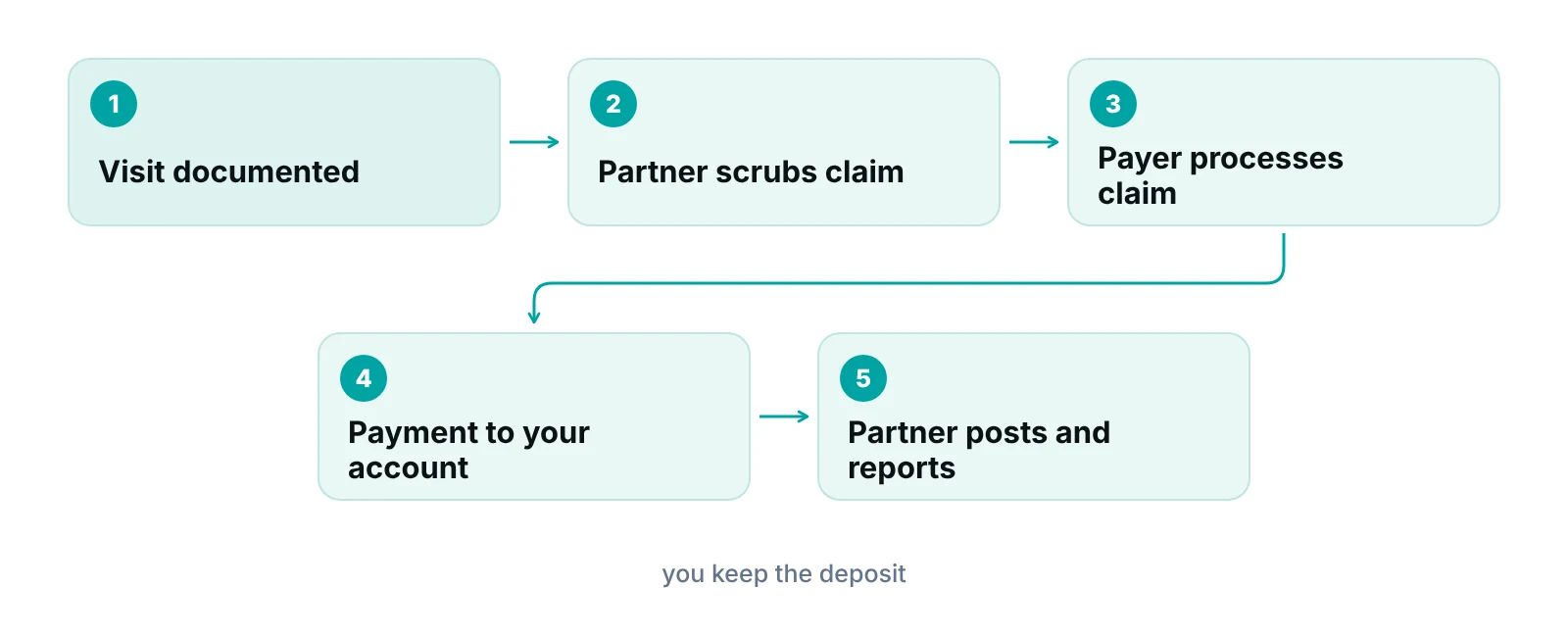
Payers should pay into an account your practice controls, a business associate agreement should be signed before patient data is shared, and the contract should say who does what. Our ten questions to ask before hiring cover the full checklist; here are the rules behind the three points that matter most.
1. A business associate agreement comes first
The HHS Office for Civil Rights lists billing among the activities that can make a vendor a business associate. A covered entity may disclose protected health information to a business associate only after getting satisfactory assurances in a contract or other written arrangement. HHS says the agreement must describe the permitted uses and disclosures, bar other use, and require the business associate to report security incidents, including breaches of unsecured PHI. Under 45 CFR 164.410, a business associate must notify the covered entity of a breach without unreasonable delay and no later than 60 calendar days after discovery. We would ask for a shorter reporting window in writing. See our guide to HIPAA compliance in medical billing for the rest.
2. Know who receives the money and how the vendor is paid
Medicare generally does not pay amounts owed to a provider to anyone else. 42 CFR 424.73 makes an exception for an agent that furnishes billing and collection services, but only if all of these hold:
- the agent is paid under an agency agreement with you;
- the agent’s compensation is not tied in any way to the dollar amounts billed or collected;
- the agent’s compensation does not depend on actually collecting payment;
- the agent follows payment disposition instructions that you can change or revoke at any time; and
- the agent acts only on your behalf when it receives payment.
That is a reason to ask where payments land and how fees are calculated, and to have counsel read the fee clause. Separately, OIG’s 1998 guidance records a longstanding concern that percentage billing arrangements may increase the risk of upcoding, so ask who reviews coding and how often. Our simplest advice is to keep deposits in an account in your name.
3. Put shared responsibility in writing
OIG warns that an ineffective billing-company compliance program can expose provider clients to liability when they rely on the company’s expertise. In practice that means you still read reports, sample claims and keep documentation current. Our checklist of ten questions to ask before hiring a medical billing company gives the wording to request. If you are a smaller practice weighing in-house, outsourced and hybrid options, read medical billing services for small practices first.
“If you cannot read your own deposits and your own denial reasons every month, you have handed over more than billing.”
— Awais Afzal, Healthcare Operations & Data Analyst
What should you expect after you decide?
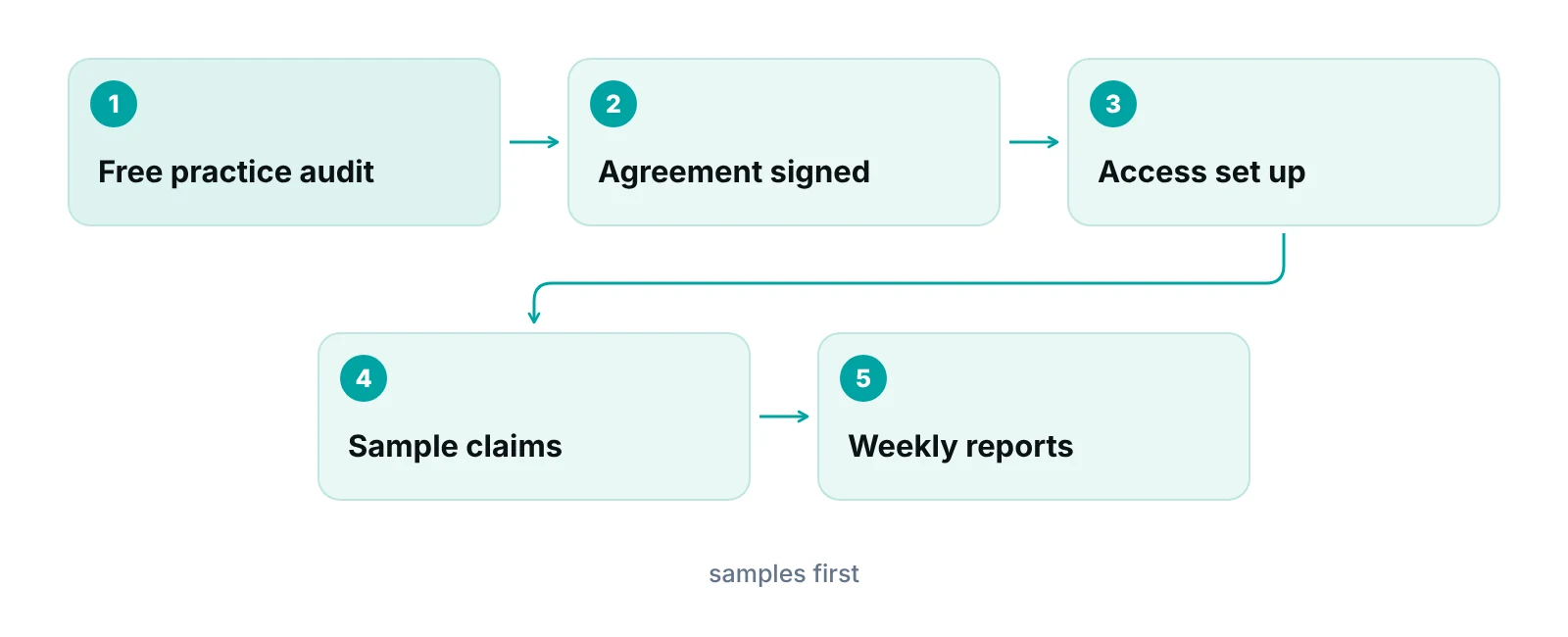
Expect a baseline, a signed agreement and sample claims before anyone talks about improvement. The sequence below is our recommendation, not a regulatory requirement, and a good partner will agree to it.
- Pull your baseline: the five measures above, plus denial reasons and an A/R aging report.
- Sign the business associate agreement and agree the scope table, including who codes and who answers payer audits.
- Set up access and confirm that remittances and deposits go to accounts in your name.
- Run sample claims through the new process and compare them with how your team would have handled them.
- Start weekly reporting with written definitions, then review the baseline comparison monthly.
See what your open claims are tying up
Use the revenue calculator for a rough view of stalled A/R before you compare options.
When outsourcing is not the right move yet
- You have a trained biller, a backup and monthly reports you trust.
- Most of your lost revenue starts with missing documentation or front-desk errors, which a vendor can flag but not fix alone.
- You want a guarantee. No honest vendor can give one before reading your claims.
- You are not ready to review reports and sample claims each month.
If those fit, fix the cause first. If they do not, end-to-end revenue cycle management may be worth comparing, and our free practice audit gives you a baseline to hold any billing company to, including us. Pricing is quoted after the audit.
Start with your own numbers
Our free practice audit gives you a baseline for any billing company to meet. Pricing is quoted after the audit.
Our recommendations
- Get your numbers before any sales call. We would not talk to a vendor, including ourselves, before pulling denial reasons, A/R aging and the five baseline measures. Every answer you hear is then testable.
- Decide scope before price. Write down what stays at the front desk and what moves. Two quotes are only comparable if they cover the same work.
- Keep deposits in your name. Ask for payer payments to land in an account you control and read the payment-instruction clause with counsel.
- Sign the BAA first. No patient data should reach a vendor before the agreement is in place, and the breach-notice window should be in the text.
- Define every metric in writing. A denial rate or clean claim rate means nothing without the formula. Copy HFMA definitions into the contract.
- Test before volume moves. Start with sample claims and a clean-up of old A/R before you hand over the full workload.
If you hand billing to a third party, ask how you will see the work.
The portal supports client portals for single practices and for billing companies that serve several, so each practice sees its own claims.
See how the RCM Finder portal works · Create a portal account
Disclosure: RCM Finder builds and sells this portal. It is a practice management system, not an EHR.
Bottom line
Third-party medical billing pays when it is aimed at stalled claims, written down in scope and measured against your own baseline. If you want to compare it with a full outsourced model, read how our revenue cycle management service works, start with a free practice audit, or reach us through the contact page.
Frequently asked questions
What is third-party medical billing?
It is billing handled by an outside company acting as your agent, usually covering claim submission, payment posting, denial follow-up and A/R reporting. Your providers still document the care. The scope, the fee method and who holds the payments should all be written into the contract before work starts.
Does outsourcing medical billing increase revenue?
It can, where claims are late, rejected or left unworked, because a dedicated team follows up on a schedule. It cannot promise a set percentage. Measure net days in A/R, cash collection, denial rate and clean claim rate against your own baseline, with written formulas, before and after the handover.
Who should receive the insurance payments?
Your practice. We recommend payer payments go to a bank account in your name. For Medicare, 42 CFR 424.73 lets an agent receive payment only under specific conditions, including that its pay is not tied to dollars billed or collected. Have counsel review the fee and payment clauses.
Do I need a business associate agreement with a billing company?
Yes, before you share patient data. HHS lists billing among the activities that can make a vendor a business associate, and a covered entity may disclose protected health information to one only with satisfactory assurances in a written contract. The agreement should include security incident and breach reporting.
How long do we have to file claims?
For Medicare, 42 CFR 424.44 requires filing within one calendar year after the date of service for services on or after January 1, 2010, with limited exceptions. Commercial payers set their own limits in contracts, so list each payer’s deadline in the scope document and ask the vendor how it tracks them.
Are we still responsible if the billing company makes an error?
Do not assume the vendor carries all of it. OIG’s guidance says proper documentation is the provider’s responsibility and that an ineffective billing-company program can expose provider clients to liability. Read monthly reports, sample claims, and ask your attorney how your contract allocates responsibility.
Get your free practice audit
Tell us about your practice. We will contact you using the details you give.
- A review of your recent claims, denials and A/R aging
- Where your front desk and prior authorizations slow payment
- A prioritized fix list you keep, whether or not you hire us
Pricing is quoted after the audit, based on your volume and the services you choose. Prefer to talk? Call +1 (302) 556-2288.
Sources
- Compliance Program Guidance for Third-Party Medical Billing Companies — HHS Office of Inspector General (Federal Register) (1998)
- Business Associates — HHS Office for Civil Rights (n.d.)
- 45 CFR 164.410 Notification by a business associate — eCFR (current)
- 42 CFR 424.44 Time limits for filing claims — eCFR (current)
- 42 CFR 424.73 Prohibition of assignment of claims by suppliers — Legal Information Institute (Cornell) (current)
- MAP Keys, 2023 Edition — HFMA (2023)
Disclaimer: This article is general educational information for medical practices. It is not legal, HIPAA-compliance, coding or billing advice. Payer rules, contract terms and regulations vary and can change. Confirm requirements with qualified counsel and your payers before acting.