
Hip fracture icd 10 coding starts in category S72, fracture of femur. Pick the site of the break, the side, and displaced or nondisplaced, then add a 7th character for the visit, such as A for active treatment or D for routine healing. A break caused by osteoporosis uses M80, and one around an implant uses M97.
A claim for a hip fracture can fail on one missing letter. The S72 codes are never complete at six characters, and the 7th character changes as the patient moves from the emergency visit to surgery to follow-up.
This guide is for coders, billers and practice managers. It gives the lookup table first, then the rules for choosing between the codes, the documentation each one needs, the denial patterns to scrub for and a worked example. It covers ICD-10-CM diagnosis codes only. For hip arthroplasty procedure coding, read our joint replacement billing and coding guide.
Key takeaways
- Hip fracture icd 10 codes sit in S72; a fracture of the hip not otherwise specified goes to S72.00-.
- S72.00, S72.14 and S72.21 are not billable; each needs more characters, ending in a 7th character.
- The 7th character follows active treatment, not who sees the patient first: A while treating, D for routine healing.
- M80.05- (osteoporosis-related) and M97.0- (around a hip implant) take over from S72 when the record supports them.
- Scrub every S72 claim for a missing 7th character, the wrong encounter letter and an unspecified side.
What is the ICD-10 code for a hip fracture?
There is no single hip fracture code. Hip fracture icd 10 coding means category S72, fracture of femur, and the hip codes sit in S72.0 to S72.2. The category carries an instruction that the 7th character is added to every code in it. The code set in force is FY 2027 (October 1, 2026 to September 30, 2027), per the CMS ICD-10 page.
The record often says only “hip fracture.” The inclusion terms under S72.00 are “fracture of hip NOS” and “fracture of neck of femur NOS,” so an unspecified hip fracture lands at S72.001, S72.002 or S72.009 plus a 7th character. A specific site is better when the provider documents it.
| Code | What it describes | Use it when |
|---|---|---|
| S72.001-, S72.002-, S72.009- | Break of the neck of the femur, part not specified: right, left, unspecified side | The note says hip fracture or femoral neck fracture and gives no more detail |
| S72.041- to S72.046- | Break at the base of the femoral neck: displaced (041-043) or nondisplaced (044-046), by side | The provider names the base of the neck |
| S72.141- to S72.146- | Intertrochanteric break: displaced (141-143) or nondisplaced (144-146), by side | The provider documents an intertrochanteric fracture |
| S72.21X- to S72.26X- | Subtrochanteric break: displaced (21X-23X) or nondisplaced (24X-26X), by side | The provider documents a subtrochanteric fracture; the X holds the sixth place |
| S72.0, S72.00, S72.1, S72.14, S72.2 | Parent categories and subcategories | Never on a claim alone; each needs more characters |
| M80.051-, M80.052-, M80.059- | Age-related osteoporosis with a current pathological fracture of the femur | The provider ties the break to osteoporosis |
| M97.01X-, M97.02X- | Periprosthetic fracture around an internal hip prosthesis, right or left | The break is around an existing hip implant |
Source: icd-10codes.com FY 2027 code pages (secondary cross-check); CMS ICD-10 page (2026); allicd10codes.com and rapidclaims code pages for M80 and M97 (year not shown).
Billable status
A six-character code such as S72.141 or S72.001 is a category on the FY 2027 pages and is flagged non-billable. The billable code adds the 7th character: S72.141A, S72.001D and so on. Check your encoder against the official FY 2027 tabular list before you load a build table.
How do you build a hip fracture code step by step?
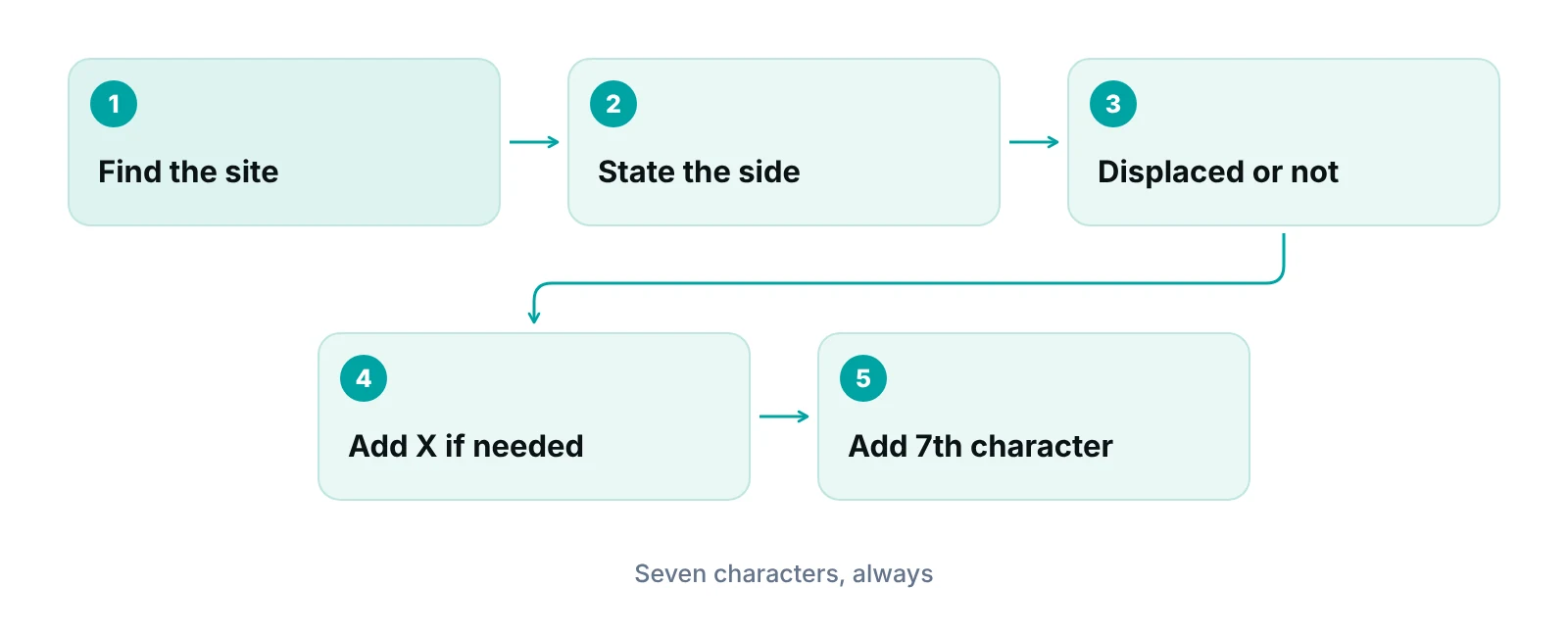
Build the code in five moves: site, side, displacement, placeholder if needed, then the encounter character. The guideline rule is plain: a code that has an applicable 7th character is invalid without it, and an X fills any empty place before it (CDC/NCHS FY 2027 guidelines, Section I.A).
- Site. Femoral neck and head fall under S72.0, trochanteric breaks under S72.1 and subtrochanteric breaks under S72.2.
- Side. Right, left or unspecified is built into the fifth or sixth character.
- Displacement. If the record does not say displaced or nondisplaced, the S72 note sends the code to displaced.
- Placeholder. Subtrochanteric codes such as S72.21 have no sixth-place detail, so the X holds it: S72.21XA.
- Encounter character. Add A, D, G, K, P, S or their open-fracture partners, as the next section explains.
Defaults to know before you query
The S72 notes set two defaults. A fracture not indicated as open or closed is coded to closed. A fracture not indicated as displaced or nondisplaced is coded to displaced. Open fractures follow the Gustilo classification. A default is a fallback, not a reason to skip a query when the provider can state the facts, because the bill should reflect the patient’s actual injury.
How do you read the site from the record?
Site wording in the note maps to a code range, and the break location decides the 4th and 5th characters. Outsource Strategies groups the hip sites into two families: intracapsular breaks of the femoral head and neck in S72.0, and extracapsular breaks in S72.1 (pertrochanteric) and S72.2 (subtrochanteric).
- “Hip fracture” or “broken hip” only: S72.00- (fracture of hip NOS). Ask whether the provider can name the site before finalizing.
- “Femoral neck,” “subcapital” or “transcervical”: look in S72.0. The base of the neck has its own subcategory, S72.04.
- “Intertrochanteric” or “pertrochanteric”: S72.1, with intertrochanteric breaks at S72.14.
- “Subtrochanteric”: S72.2, where the code carries an X in the sixth place.
- “Pelvic” or “acetabular” fracture: not S72. The S32 category carries an Excludes2 note for fracture of hip NOS (S72.0-), so the two sit in different families.
Do not code from the radiologist’s wording when it conflicts with the treating provider’s. Section I.B.14 of the guidelines says conflicting documentation should go to the patient’s provider as a query. Build the query around the facts you need: site, side and displacement.
Sequela and late effects
The S character is for a condition that results from the fracture, such as a gait problem after healing. UTMB’s newsletter explains that you report both the injury code with S and the sequela condition, with the sequela condition sequenced first. That is a different job from a routine follow-up: the patient is no longer in a healing phase, and the visit is about the late effect.
Which 7th character fits the visit?
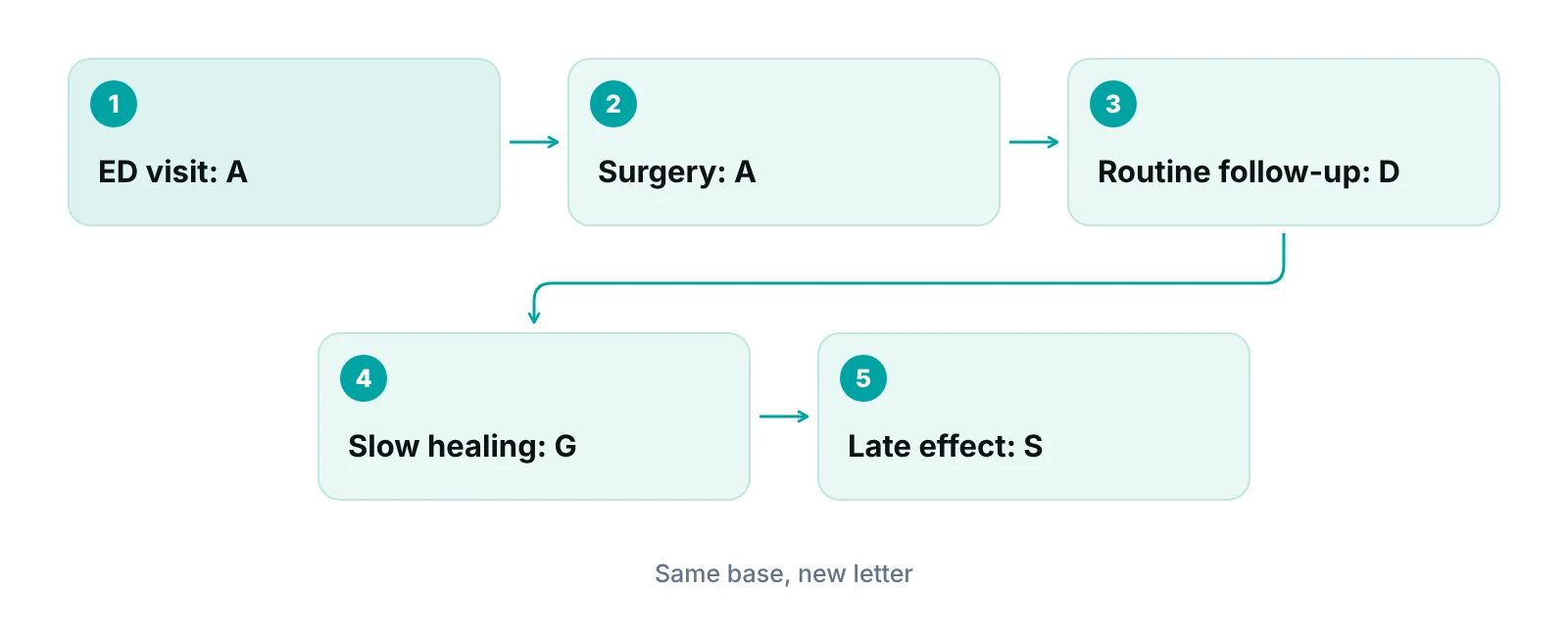
The 7th character follows the stage of care, not who sees the patient first. A means the patient is receiving active treatment. D to R describe the healing phase after active treatment, and S is for a late effect. UTMB’s faculty practice newsletter states that a new or different provider can still use A while the patient is in active treatment.
| Letters | Meaning | Typical visit |
|---|---|---|
| A, B, C | Initial encounter: closed; open type I or II; open type IIIA, IIIB or IIIC | ED treatment, surgery, evaluation and treatment by a new physician |
| D, E, F | Subsequent encounter, routine healing (same open or closed split) | Follow-up visits, wound or hardware checks, other aftercare during healing |
| G, H, J | Subsequent encounter, delayed healing | The provider documents healing slower than expected |
| K, M, N | Subsequent encounter, nonunion | The provider documents that the fracture has not mended |
| P, Q, R | Subsequent encounter, malunion | The provider documents healing in an abnormal position |
| S | Sequela | A late effect of the fracture, with the sequela condition sequenced first |
Source: icd-10codes.com FY 2027 code pages for S72.001, S72.141, S72.21 (2026); UTMB Faculty Group Practice (2025); AAPC (undated); Norwood (undated).
Three rules cause most of the mistakes:
- Active treatment, not first visit. Training slides built on the 2026 guidelines say A applies to staged treatment, several episodes of care and more than one physician. A surgeon who first sees the patient after the ED still reports A.
- No aftercare Z codes for a traumatic fracture. The same slides say to assign the fracture code with the right 7th character instead of an aftercare Z code.
- Late presentation is still A. AAPC’s radiology alert notes that a patient who delays care and presents with a malunion or nonunion is still coded with the initial-encounter character if active treatment begins then. K to R fit only when the complication is treated as a subsequent encounter.
If the Gustilo type of an open fracture is not documented, the same slides say the default is type I or II. Query the surgeon before leaning on a default for an open injury.
When does M80 or M97 replace S72?
S72 is for a traumatic break. If the provider documents that osteoporosis caused the fracture, the combination code from M80 applies. If the break is around a hip implant, M97.0 applies. The S72 category lists periprosthetic fracture of a hip implant (M97.0-) as an Excludes2 note, so the two can be reported together only when both conditions are present and documented.
Osteoporosis and the fall that did not need much force
A patient with known osteoporosis who breaks a hip after a minor fall raises the question every coder knows. One education source, IKS Health, advises M80 rather than a traumatic code when a fall would not usually break healthy bone. Its hip example is M80.051A for the right femur. A Coding Clinic question on the same issue exists on Find-A-Code, but the answer sits behind a login, so we did not read it. The practical rule: do not choose between M80 and S72 yourself. Query the provider to state whether osteoporosis caused the fracture.
Cancer-related breaks
For a pathologic fracture in neoplastic disease, the FY 2027 guidelines (Section I.C.2.l) direct a code from subcategory M84.5 first when the fracture is the focus of the encounter. When the neoplasm is the focus, the neoplasm code is first and M84.5- follows.
Other Excludes notes on S72
- Excludes1: traumatic amputation of the hip and thigh (S78.-). These are not reported together unless the conditions are unrelated.
- Excludes2: fractures of the lower leg and ankle (S82.-) and foot (S92.-), plus periprosthetic hip fracture (M97.0-).
- Excludes2 at S72.0: physeal fractures of the upper and lower femur (S79.0-, S79.1-).
Under the guidelines, an Excludes1 note means “not coded here,” and an Excludes2 note means “not included here,” so both codes may be reported when the patient has both conditions.
What must the provider document for each code?
Each S72 code stands or falls on six facts in the note. If any is missing, the coder either defaults or sends a query. The guidelines say code assignment is generally based on the patient’s provider (Section I.B.14), so a coder should not settle these facts from an imaging report alone.
- Anatomic site: head, neck, base of neck, intertrochanteric or subtrochanteric.
- Side: right or left. Unspecified-side codes are for records that cannot be clarified.
- Displaced or nondisplaced: otherwise the code defaults to displaced.
- Open or closed, with the Gustilo type for open breaks: otherwise closed.
- Stage of care: active treatment, routine healing, delayed healing, nonunion, malunion or late effect.
- Cause: traumatic, osteoporotic, neoplastic or around an implant.
Chapter 19 also tells coders to add secondary codes from Chapter 20 for the cause of injury, and training slides on the 2026 guidelines say the place and activity codes (Y92, Y93) are reported at the initial encounter only. Whether a payer requires external cause codes varies, so check each payer’s rule. For fall coding, see our ground-level falls ICD-10 guide.
Why do hip fracture claims get rejected or denied?
Most S72 problems are structural, so a scrubber can catch them. CMS Q&A guidance states that a submitted code not recognized as valid is rejected, and that a valid code can still be denied when it conflicts with a coverage policy or edit. State Medicaid guidance from NCTracks adds that claims may deny when codes lack specificity or use an edition not in effect on the date of service.
| Pattern | Why it fails | Fix | Owner |
|---|---|---|---|
| Code ends at six characters (S72.141) | The category is not a valid code; the claim is rejected | Scrub for S72 codes shorter than seven characters | Coder |
| Subtrochanteric code without the X | S72.21A has no X placeholder, so the 7th character sits in the wrong place | Build subtrochanteric codes as S72.21XA and so on | Coder |
| A at the follow-up, or D during surgery | The letter does not match the stage of care in the note | Show the stage of care on the encounter; scrub for A after discharge | Coder |
| S72.009 or S72.143 when the side is known | Unspecified side drops specificity and can fail side-specific edits | Query the provider; use unspecified side only when the record cannot be clarified | Coder, provider |
| S72 reported for an osteoporotic break | M80 and S72 describe different causes; payers may question the mismatch | Query on cause before final coding | Provider |
| Prior code-set year on a new date of service | Codes change each October 1; use the edition in effect on the service date | Update build tables each October; retest the scrubber | Billing manager |
Source: CMS Clarifying Questions and Answers (rev. Aug 2016) via Michigan DHHS copy; NC Medicaid NCTracks (2018); CDC/NCHS FY 2027 guidelines Section I.A.
For the wider scrub and denial process, our clean claims guide and denial management services page show how these checks fit the claim cycle.
Are hip fracture claims coming back with code edits?
Send us a sample of recent orthopedic denials. A free practice audit shows whether the gap is the 7th character, the side or the documentation.
Worked example: one fracture, three encounters
Example only. This scenario is invented and de-identified. It shows how the 7th character moves across the course of care. Confirm every code against your encoder and your payers.
- Day 1, emergency visit and surgery. The provider documents a displaced intertrochanteric fracture of the left femur, closed, after a fall from standing height. No osteoporosis is documented. Code S72.142A for the surgeon and the ED provider, since treatment is active, plus an external cause code from Chapter 20 for the fall.
- Week 3, surgical follow-up. The note says healing is progressing normally and the wound is clean. Code S72.142D. An aftercare Z code is not used for this traumatic fracture.
- Month 6, still painful. The provider documents delayed healing but no nonunion. Code S72.142G. If the provider later documents a nonunion, the code becomes S72.142K.
- If osteoporosis had been documented as the cause on Day 1. The coder would query the provider, and the combination code M80.052A would replace S72.142A only if the provider confirmed the link.
The base code S72.142 never changed. Only the 7th character did. A rule that blocks the same letter from carrying across encounters on an episode will catch most errors.
How should a practice build this into its workflow?
Treat the 7th character as a data field, not a typing task. A hip fracture touches the ED, the surgeon, rehab and the practice that provides follow-up, so each team may report a different letter for the same injury. The risk grows for orthopedic groups, where one patient generates many encounters.
- Add an encounter-stage field to the charge screen, with A, D, G, K, P and S as the choices.
- Build the base code from the first note, then change only the 7th character for later visits.
- Re-read your build tables every October. The FY 2027 files on the CDC/NCHS site include addenda and a conversion table.
- Pair this guide with the orthopedic coding guide for procedure codes and the orthopedic specialty page for how we support orthopedic billing.
What to check in a quarterly fracture audit
A short audit finds most S72 problems. Pull a sample of hip fracture encounters across settings and compare the claim to the note on the same five points each time:
- The code is seven characters long, and the X placeholder sits in the right place for subtrochanteric codes.
- The side on the claim matches the side in the note and on any linked procedure.
- The encounter letter matches the stage of care documented that day.
- A cause query exists wherever osteoporosis, a tumor or an implant appears in the record.
- The code-set year matches the date of service, which matters across the October 1 change.
Log each miss by owner, whether coder, provider or front desk, so the fix goes to the person who can change the habit. Repeated misses on one point usually mean a template or charge screen needs a change, not more training.
“A hip fracture claim is one injury billed across many visits. If the base code and the encounter letter live in separate fields, the errors stop being random.”
— Awais Afzal, Healthcare Operations & Data Analyst
Our recommendations
- Make the 7th character a required field. We would not let an S72 charge leave the building at six characters. A hard stop in the charge screen is cheaper than a rejection and a resubmission.
- Query on cause before M80 or S72. We would ask the provider whether osteoporosis caused the break whenever the patient is older and the fall is minor. The answer decides which chapter the code comes from.
- Track the stage of care in the encounter. We tie the letter to what the provider is doing: treating (A) or checking healing (D). Write that on the encounter so a coder does not guess.
- Retest the scrubber each October. We would run a test batch of S72 claims every October 1 to confirm that the edit tables, not just the code list, are current. See our claim scrubbing guide for the checks.
- Audit a sample of fracture claims. We suggest pulling twenty fracture encounters and checking side, displacement and 7th character against the note. If the sample shows a pattern, our medical billing services team can review the whole process.
Bottom line
Hip fracture icd 10 coding is a build, not a lookup: S72 plus site, side, displacement and a 7th character that follows the stage of care, with M80 and M97 taking over when the cause is osteoporosis or an implant. Fix the 7th-character field and the cause query first. If edits keep returning, start with a free audit, or read our shoulder pain ICD-10 guide for the symptom-code side of orthopedic coding.
Frequently asked questions
What is the ICD-10 code for a hip fracture?
Hip fractures are coded in category S72, fracture of femur. A hip fracture with no further detail goes to S72.00-, with the side and a 7th character, such as S72.001A for the right side at the initial encounter. A documented site, such as intertrochanteric, uses a more specific S72 code.
Is S72.00 a billable code?
No. On the FY 2027 pages S72.00 is a category with S72.001, S72.002 and S72.009 beneath it, and those need a 7th character as well. The billable code is, for example, S72.001A. Check your encoder for the exact set.
Which 7th character do I use after hip surgery?
Use A while the patient is in active treatment, including surgery and a new surgeon’s evaluation. Use D for routine healing follow-up, G for delayed healing, K for nonunion, P for malunion and S for a late effect. Open fractures use the paired letters, with the Gustilo type from the provider’s note. Match the letter to the stage of care on the date of service, not to the diagnosis alone.
When do I use M80 instead of S72 for a hip fracture?
Use the M80.05- femur combination code when the provider documents that osteoporosis caused the current pathological fracture. Do not decide this yourself from age or the fall. Query the provider if the note does not link the two conditions.
What if the note does not say displaced or open?
The S72 notes default the code to displaced when displacement is not stated and to closed when open or closed is not stated. These are fallbacks. Query the provider if the facts are likely known.
Do I need an external cause code with a hip fracture?
Chapter 19 directs coders to add secondary Chapter 20 codes for the cause of injury. Whether a payer requires them can vary, so check each payer’s policy. Place and activity codes are reported at the initial encounter only.
Get your free practice audit
Tell us about your practice. We will contact you using the details you give.
- A review of your recent claims, denials and A/R aging
- Where your front desk and prior authorizations slow payment
- A prioritized fix list you keep, whether or not you hire us
Pricing is quoted after the audit, based on your volume and the services you choose. Prefer to talk? Call +1 (302) 556-2288.
Sources
- FY 2027 ICD-10-CM Official Guidelines for Coding and Reporting — CDC/NCHS (2026)
- ICD-10-CM FY 2027 release folder — CDC/NCHS (2026)
- ICD-10 codes (FY 2027 update page) — CMS (2026)
- S72.0 Fracture of head and neck of femur (FY 2027) — icd-10codes.com (secondary) (2026)
- S72.00 and S72.001 pages (FY 2027) — icd-10codes.com (secondary) (2026)
- S72.1 and S72.14 pages (FY 2027) — icd-10codes.com (secondary) (2026)
- S72.2 and S72.21 pages (FY 2027) — icd-10codes.com (secondary) (2026)
- S72.04 base of neck page (FY 2027) — icd-10codes.com (secondary) (2026)
- S72.0 Fracture of head and neck of femur — RapidClaims code reference (secondary) (2026)
- M97.0 Periprosthetic fracture around internal prosthetic hip joint — RapidClaims code reference (secondary) (2026)
- Age-related osteoporosis with current pathological fracture, femur — allicd10codes.com (secondary) (2026)
- Coding Osteoporosis — IKS Health (2024)
- Osteoporosis fracture: traumatic versus pathologic (Coding Clinic question) — Find-A-Code (2018)
- When Is an Injury Initial, Subsequent, or Sequela? — AAPC (undated)
- Breaking Down ICD-10-CM 7th Characters for Traumatic Fracture Care — Norwood (undated)
- Choosing the correct ICD-10 7th digit — UTMB Faculty Group Practice (2025)
- ICD-10-CM 7th character fracture coding confusion — AAPC Radiology Coding Alert (undated)
- Untangling Trauma coding handouts — NWOHIMA (2026)
- ICD-10 Coding for Hip Fractures — Outsource Strategies International (undated)
- CMS Clarifying Questions and Answers on the CMS/AMA ICD-10 guidance (Michigan DHHS copy) — CMS (2016)
- Use Highly Specific Diagnosis Codes to Prevent Claim Denial — NC Medicaid (NCTracks) (2018)
Disclaimer: This article is educational and is not legal, coding, billing, medical or compliance advice. ICD-10-CM codes and guidelines change each October 1, payer rules vary, and the examples are invented. Verify current requirements with the official code set, your payers and your counsel before you act.
