
Medical coding turns what the clinician documented into standard codes: diagnoses in ICD-10-CM, services in CPT or HCPCS. Medical billing uses those codes to build a claim, submit it and follow it until the payer and patient have paid. Coding comes first and decides what the claim says. Billing carries it to payment.
Practice owners and managers usually ask this question when something is going wrong: claims keep coming back, or a hire is on the table. The two jobs sit next to each other on the same claim, so errors in one often show up as problems in the other. This guide separates them, shows the handoff on a real visit, and ends with how to decide who should do what. If you are asking about a career instead, jump to the career section.
Key takeaways
- Coding assigns the codes; billing turns them into a claim and collects the payment.
- A coder can only code what the provider documented, so documentation quality sets the ceiling for both jobs.
- Three code sets carry most claims: ICD-10-CM for diagnoses, CPT for professional services, HCPCS Level II for supplies and equipment.
- Medicare measured a 6.55% improper payment rate for fee-for-service in FY 2025, so coding and documentation are audit topics, not just billing topics.
- Practices can keep both in house, outsource both, or split them. The split works only if someone owns the handoff.
What is the difference between medical billing and medical coding?
Coding translates the visit into codes. Billing turns those codes into a claim and gets it paid. The Bureau of Labor Statistics describes coders as the workers who assign diagnosis and procedure codes used for patient care, population health statistics and billing, and who act as liaisons between providers and billing offices (BLS Occupational Outlook Handbook, 2026). Billing is the work that begins once those codes exist.
Think of coding as the translation step and billing as the delivery step. A claim with perfect delivery and a wrong translation still gets denied or paid incorrectly.
| Question | Medical coding | Medical billing |
|---|---|---|
| Main job | Assign standard codes to the diagnoses, procedures and services the clinician documented | Build claims from coded charges, submit them, post payments, work denials and bill patients |
| Starts from | The clinical note, orders and procedure documentation | Coded charges plus registration and insurance data |
| Rulebooks it follows | ICD-10-CM Official Guidelines, CPT guidelines, HCPCS Level II rules | Payer policies, claim form and electronic claim rules, appeal deadlines |
| What it produces | The set of codes the claim carries | A paid claim, or a denial that has been worked |
| Typical errors | A code that the note does not support, or a code that lacks specificity | Wrong patient or insurance data, rejected claims, denials nobody follows up |
| Question it answers | What happened at this visit, in code? | Who owes what, and has it been paid? |
Sources: BLS Occupational Outlook Handbook (2026); HHS code set rule, 45 CFR 162.1002; our own description of billing tasks.
In a small practice one person often does both jobs. That is workable, but the two skills are different. Coding rewards knowledge of code rules and clinical documentation. Billing rewards persistence with payers and clean data entry. A person strong at one is not automatically strong at the other.
This guide covers professional billing, the kind a practice does on a CMS-1500 paper claim or its electronic version, the 837P. CMS says non-institutional providers and suppliers use that format. Hospitals and other facilities bill on different claim types, which this post does not cover.
How do coding and billing work together on one visit?
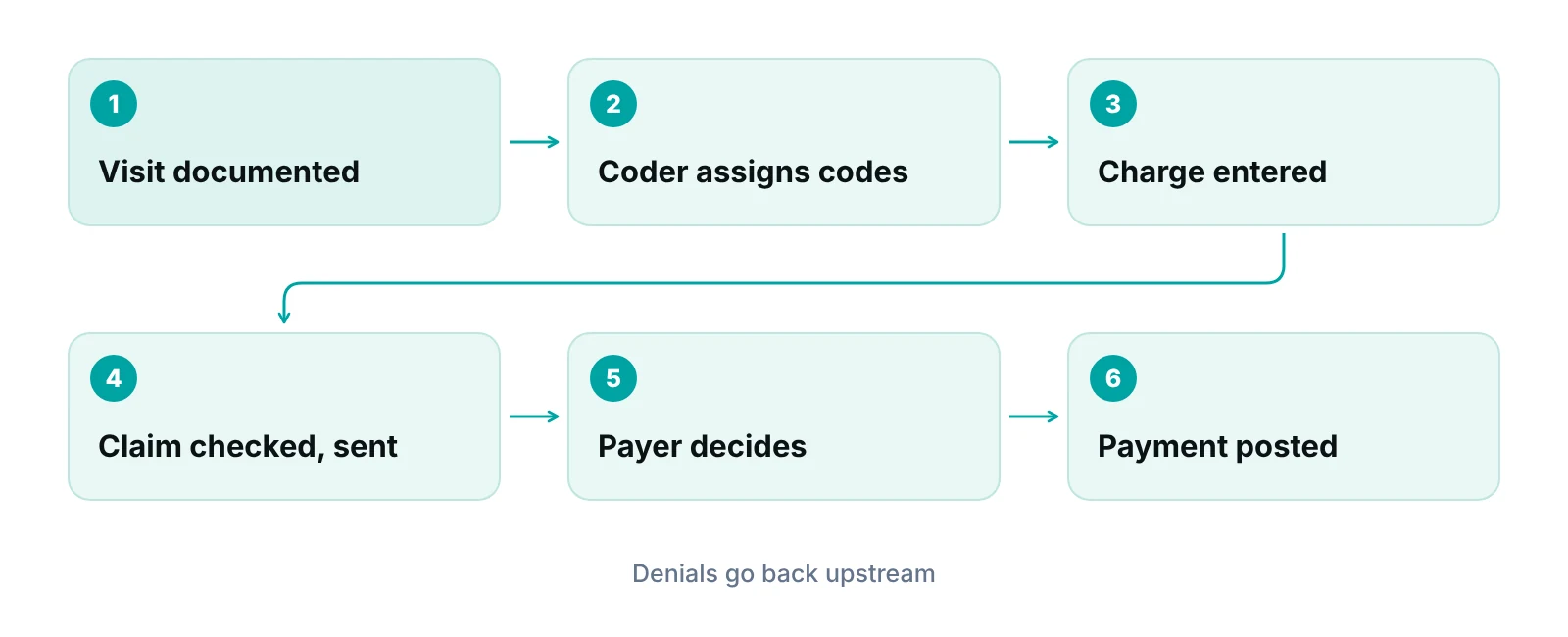
They work as a relay. Documentation goes to the coder, codes go to the biller, and the claim goes to the payer. A mistake that enters early travels with the claim until a payer catches it.
Here is an illustration only, not coding advice. An established patient comes in for a follow-up on type 2 diabetes, and the provider documents that the diabetes has no complications. The steps look like this:
- Documentation. The provider writes the note with the diagnosis and the work done. Everything downstream depends on it.
- Coding. The coder reads the note and assigns the diagnosis code and the service code. In this example the diagnosis could be E11.9 and the visit could be 99213, if the note supports them. Our guide to medical coding examples and our 99213 code guide show how those choices are made.
- Charge entry. The biller enters the charge with the right provider, date of service and place of service. See our guide to charge entry in medical billing.
- Claim build and check. The claim ties each service line to a diagnosis. On the CMS-1500, item 24E points to a diagnosis listed in item 21. A scrubber or a person checks the claim before it goes out.
- Submission and payer decision. The claim goes to the payer, which pays, denies or asks for more information.
- Posting and follow-up. The biller posts the payment, bills the patient the balance, and works any denial back to the coder or the front desk if the cause was upstream.
A coder cannot add what the note does not say
The ICD-10-CM Official Guidelines for FY 2027 say code assignment rests on the provider’s diagnostic statement, and that conflicting documentation should be queried. A coder who has to guess is a sign the note needs fixing, not the code. See the CDC and CMS guidelines.
What do ICD-10-CM, CPT and HCPCS codes cover?
ICD-10-CM describes the diagnosis, CPT describes the professional service, and HCPCS Level II covers supplies, equipment and items CPT does not. HIPAA’s code set rule names each one as the national standard for its job, per 45 CFR 162.1002.
| Code set | What it describes | Maintained by | Example |
|---|---|---|---|
| ICD-10-CM | Diagnoses, diseases, injuries and related health problems | HHS (the guidelines come from CMS and CDC’s NCHS) | E11.9, type 2 diabetes mellitus without complications |
| CPT (HCPCS Level I) | Services and procedures by physicians and other health professionals | American Medical Association | 99213, an established patient office visit at low medical decision making |
| HCPCS Level II | Products, supplies and services CPT does not cover, such as durable medical equipment and ambulance services | CMS | E1399, a miscellaneous durable medical equipment code |
Sources: 45 CFR 162.1002; CMS HCPCS page; AMA CPT overview and 99213 page; AAPC code page for E11.9; Anthem provider news on E1399.
Each set has its own owner and its own update cycle. The ICD-10-CM guidelines for FY 2027 run from October 1, 2026 through September 30, 2027. The AMA’s CPT Editorial Panel meets three times a year to review new and revised codes. CMS also publishes a quarterly HCPCS update file, as described on its HCPCS page.
One example shows why specificity matters. Level II code E1399 is a miscellaneous equipment code. One regional payer’s provider notice says a more specific code should be used when one exists, and that it reviews E1399 claims after payment and may recoup if a better code applied. Other payers set their own rules, so check each payer’s policy.
Which codes dominate your claims depends on specialty. A pain practice leans on procedures and injections, a primary care practice on office visits, and a DME supplier on Level II codes. Our specialty pages show how billing patterns differ, and our portal applies specialty-aware billing logic to each claim, not to the whole practice.
What does medical billing do after the codes are set?
Billing moves the claim from coded charge to cash. That means building the claim, submitting it, tracking it, posting the payment and chasing what is left. Almost all of this runs electronically now.
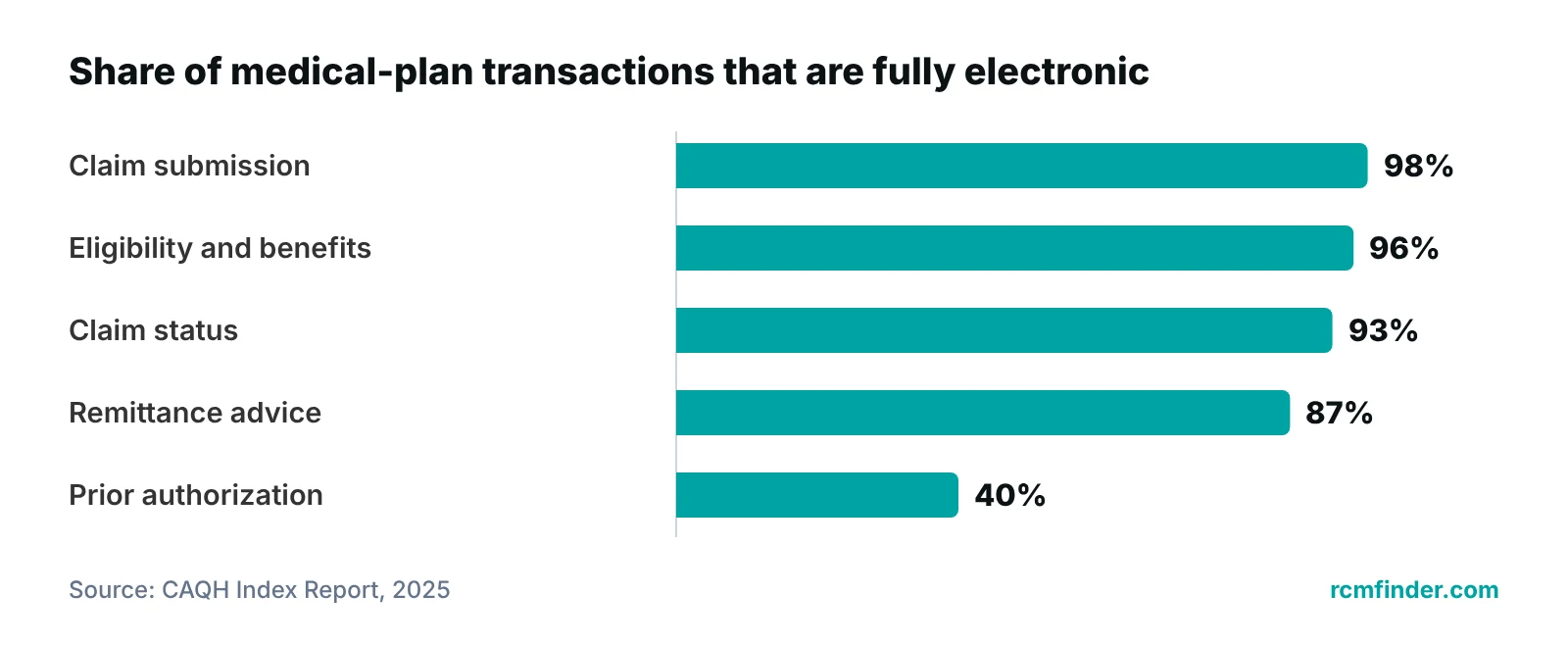
In CAQH’s 2025 Index report, 98% of medical-plan claim submissions were fully electronic. Prior authorization was the outlier at 40%. For Medicare, the Administrative Simplification Compliance Act (ASCA) generally requires electronic claims, with exceptions such as small providers with fewer than 10 full-time equivalent employees, which may choose to submit all, some or none electronically.
What stays manual is judgment: reading a denial, deciding whether to appeal, and finding the cause. That is where billing experience shows. Our guide to how billers and coders fit into the revenue cycle covers the wider workflow.
Where do coding and billing errors start, and why do they matter?
Most errors start upstream of the claim form, in documentation or code selection, and surface later as denials or incorrect payments. Medicare data shows the scale on the payer side.
CMS’s CERT program reported a Medicare fee-for-service improper payment rate of 6.55%, or $28.83 billion, for FY 2025 (claims from July 1, 2023 through June 30, 2024). Part B providers had an 8.44% rate, or $9.62 billion. CMS defines an improper payment as one made in an incorrect amount, and says both overpayments and underpayments count. Its FY 2025 fact sheet adds that the measure is not a measure of fraud.
CERT sorts errors into categories, and one of them is incorrect coding: the records support a different code, a different provider, unbundled billing or a different site of service than the one billed. That figure belongs to Medicare, not to your commercial payers, and it is not your denial rate. It does tell you that payers check codes against records.
A practical way to sort the problems
- Documentation problems (note is vague or missing a detail): fix with provider education and a query process.
- Coding problems (code does not match the note): fix with coder review and periodic audits. See our guide to medical coding audits.
- Front-end data problems (wrong insurance or demographics): fix at registration and eligibility checks.
- Billing follow-up problems (denials sit unworked): fix with ownership, queues and deadlines.
“Most of the billing problems I look at were decided upstream, when the note was written. Cleaning up the claim without fixing the handoff just moves the work around.”
— Awais Afzal, Healthcare Operations & Data Analyst
Should a practice do coding and billing in house, outsource, or split them?
There is no single right answer. It depends on visit volume, how complex your specialty’s coding is, whether you can hire and supervise skilled staff, and whether anyone can audit the work. Whichever model you pick, one person has to own the handoff between coding and billing.
| Model | Works when | Watch for | Ask first |
|---|---|---|---|
| Both in house | You have steady volume, trained staff and a supervisor who can review work | Single points of failure when one person is out or leaves | Who audits the coder, and how often? |
| Both outsourced | You want one team accountable from coded charge to posted payment | Weak feedback to providers if the vendor never talks to clinicians | Who sees the claim data, and how often? |
| In-house coding, outsourced billing | Your providers want coding close to the chart, and follow-up is the bottleneck | Handoff gaps when coded charges arrive late or incomplete | What is the turnaround from visit to coded charge? |
| Outsourced coding review, in-house billing | Your billers are strong but coding accuracy is uncertain | Coding feedback that never reaches providers | Who corrects the note, and who corrects the code? |
Source: RCM Finder’s framework for comparing operating models. No external statistics.
We do not claim one model costs less. The numbers depend on your payer mix, specialty and current error rate, so any promise of a fixed saving needs data from your own practice behind it. A free audit of your claims is the honest way to compare.
If you outsource any part, ask about the paperwork first. HHS lists billing among the functions a business associate performs, and says a covered entity needs satisfactory assurances in a contract or written arrangement (a business associate agreement) before disclosing patient information. Also ask who actually performs the coding, what credentials they hold, how you can see claim status, and how you can leave.
Our team works inside your existing EHR (for example PrognoCIS, eClinicalWorks or athenahealth), and our medical billing services cover charge entry, coding support, claim submission and follow-up. Pricing is quoted after a free audit.
See where your claims break
Our free practice audit looks at your coding-to-billing handoff, your top denial reasons and your follow-up queue. You get a written summary, with no obligation.
Thinking about a career in medical billing or coding?
If this is a career question, the public data we found is for medical records specialists, an occupation that includes coders. The BLS reports a median pay of $51,140 a year in May 2025, projects 8% growth from 2025 to 2035, and expects about 14,000 openings a year. A postsecondary nondegree award is the typical entry-level education. See the BLS occupation page.
The BLS also notes that employers may prefer certified candidates or expect certification soon after hire. Two widely known credentials are the AAPC’s Certified Professional Coder (CPC) and AHIMA’s Certified Coding Associate (CCA). AHIMA requires a high school diploma or equivalent for the CCA, and recommends coding experience or an approved coding program. AHIMA also lists a Certified Coding Specialist (CCS).
These figures describe the coding side. We do not have a comparable public dataset for billing roles, so we leave billing pay out rather than guess. Check job postings and credential requirements in your area before committing to a program.
Estimate what your claims are worth
If you run a practice, enter your monthly claim volume, average claim value and denial rate in our revenue calculator to estimate what denials cost you each month.
Our recommendations
- Name an owner for each handoff. We write down who owns documentation, coding, charge entry, claim submission and denial follow-up. When two people think the other one owns a step, claims stall.
- Give coders a way to query providers. A coder who cannot ask a question will guess. We set up a simple query path and track which providers get queried most, because that tells you where documentation needs work.
- Audit a sample of coded charges against the notes. We compare codes with the clinical note on a schedule, not only after a denial. Start with your highest-volume codes.
- Sort denials by where they started. We tag each denial as documentation, coding, front-end data or follow-up. Fixing the right layer is faster than reworking claims one by one.
- Track code set updates on a calendar. ICD-10-CM, CPT and HCPCS each update on their own cycle. We assign someone to review each release and update superbills and scrubber edits.
- Compare operating models with your own data. Before you hire or outsource, pull a sample of recent claims and see where they stalled. Our revenue calculator can estimate what denials cost you each month.
Bottom line
Billing and coding are two halves of one job: getting a documented visit paid correctly. Coding sets what the claim says, and billing carries it to payment, so good results depend on a clear handoff between them. If you want a second pair of eyes on yours, see how our end-to-end revenue cycle management service works, or contact our team.
Frequently asked questions
Which comes first, medical coding or medical billing?
Coding comes first. The coder assigns diagnosis and service codes from the provider’s documentation, and the biller then builds the claim from those codes. Registration and insurance checks happen even earlier, before the visit, so the biller depends on both the front desk and the coder to get the claim right.
Can one person do both billing and coding?
Yes, and many small practices do. The risk is that the same person who codes also checks the claim, so errors go unnoticed. A periodic outside review of coded charges helps whichever way you staff it, and so does a written checklist for the claim check before submission.
Does a coder need to be certified?
The BLS says employers may prefer certified candidates or expect certification soon after hire. Two common credentials are the AAPC’s CPC and AHIMA’s CCA. Ask any coder or vendor which credentials they hold, who reviews their work, and how they keep up with annual code updates.
What is the difference between a CMS-1500 and an 837P?
The CMS-1500 is the standard paper claim form for non-institutional providers and suppliers, and the 837P is the electronic version of the same professional claim. Medicare generally requires electronic submission under ASCA, with exceptions. Facilities bill on different claim types, which this guide does not cover.
Are ICD-10-CM and CPT the same thing?
No. ICD-10-CM codes describe diagnoses and are maintained under HHS. CPT codes describe the services and procedures that providers perform and are maintained by the AMA. A professional claim normally carries both, with each service line tied to a diagnosis.
Is billing or coding the better career?
We cannot rank them. The public data we found covers medical records specialists, which includes coders: a median pay of $51,140 in May 2025 and 8% projected growth from 2025 to 2035. Compare local job postings for billing roles, and check which credentials employers ask for before you choose a program.
Get your free practice audit
Tell us about your practice. We will contact you using the details you give.
- A review of your recent claims, denials and A/R aging
- Where your front desk and prior authorizations slow payment
- A prioritized fix list you keep, whether or not you hire us
Pricing is quoted after the audit, based on your volume and the services you choose. Prefer to talk? Call +1 (302) 556-2288.
Sources
- Medical Records Specialists (Occupational Outlook Handbook) — U.S. Bureau of Labor Statistics (2026)
- 45 CFR 162.1002 Medical data code sets — eCFR / Cornell LII (2026)
- CPT code set overview — American Medical Association (2026)
- CPT 99213 established patient office visit — American Medical Association (2026)
- Healthcare Common Procedure Coding System — CMS (2026)
- ICD-10-CM Official Guidelines for Coding and Reporting, FY 2027 — CDC NCHS and CMS (2026)
- ICD-10-CM E11.9 — AAPC (2026)
- Durable medical equipment miscellaneous code E1399 reminder — Anthem provider news (Maine) (2026)
- CAQH Index Report 2025 — CAQH (2025)
- Administrative Simplification Compliance Act (ASCA) — Noridian Healthcare Solutions (Medicare contractor) (2026)
- Medicare Billing: Form CMS-1500 and the 837P (MLN006976) — CMS (2025)
- CMS-1500 Billing Details (item 24E) — CMS MLN (2026)
- Comprehensive Error Rate Testing (CERT) — CMS (2025)
- Introduction to the CERT program — CMS (2026)
- Fiscal Year 2025 Improper Payments Fact Sheet — CMS (2026)
- Business Associates — HHS Office for Civil Rights (2026)
- Certified Coding Associate (CCA) — AHIMA (2026)
- Certified Professional Coder (CPC) — AAPC (2026)
Disclaimer: This article is educational and is not legal, coding or compliance advice. Code sets, payer rules and Medicare requirements change and vary by payer and state. Confirm current rules with your payers, official code books and a qualified compliance professional.
