
Medical billers and coders turn a patient visit into a paid claim. Coders translate the documented visit into diagnosis and procedure codes. Billers build and submit the claim, post payments, work denials and bill patients. Front-desk, A/R and management roles surround them, and a weak handoff anywhere delays payment.
Most practices say “the billing team” as if it were one job. It is several, and a claim passes through all of them. If you already know the basic split, our medical billing vs medical coding guide defines each term and the code sets. This post goes one level up. It shows every role inside the revenue cycle, what each hands to the next person, and where a claim most often stalls.
Key takeaways
- A paid claim passes through at least six roles, not two: front desk, provider, coder, biller, payment poster and A/R or denial specialist.
- Coders assign codes from the documentation. They do not change the documentation. Billers build, send and chase the claim.
- Most revenue cycle errors start at a handoff, so each handoff needs a named owner.
- Denials are information. The best teams send them back to the coder and the front desk.
- Choose in-house, outsourced or hybrid by who can own each handoff, not by job title.
Who does what between the visit and the payment?
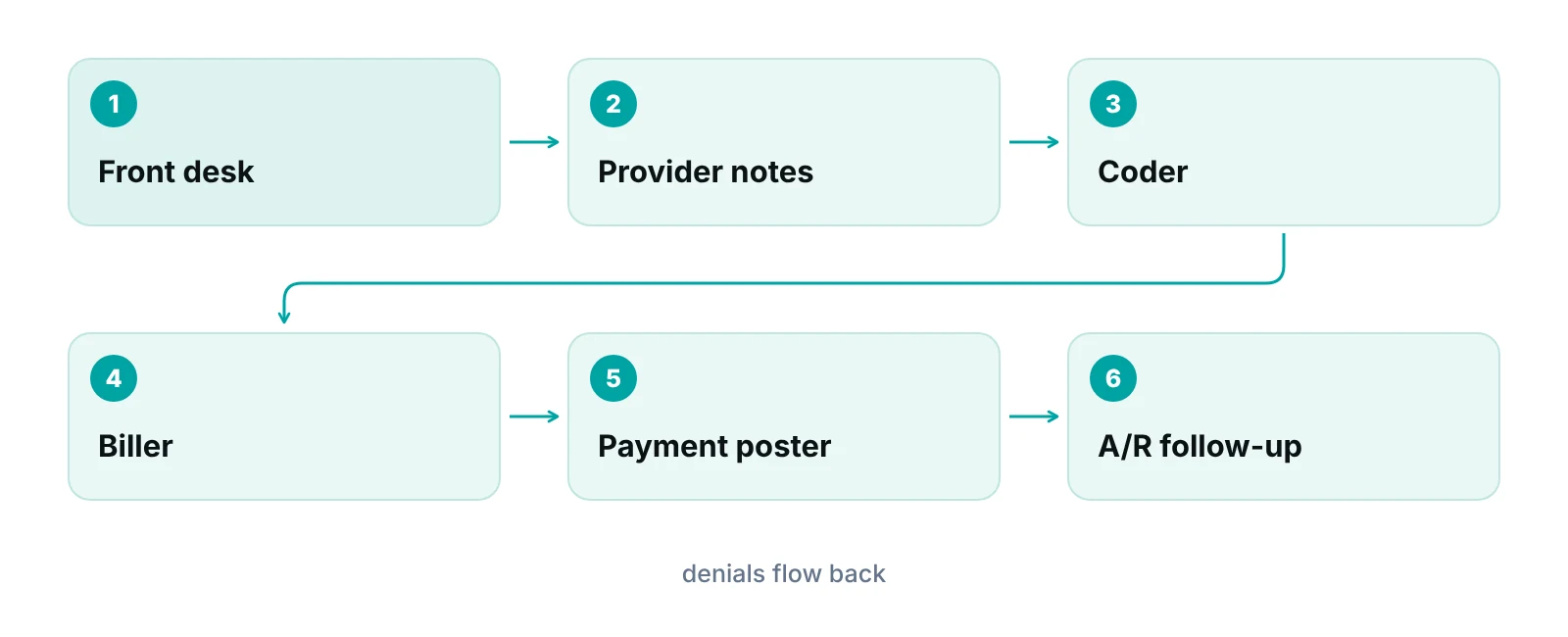
At least six roles touch every claim, and each one produces something the next role needs. Small practices often give several roles to one or two people. The work still has to happen, so it helps to name the roles even when one person holds three of them.
| Role | Main job | Hands off to |
|---|---|---|
| Front desk / registration | Captures patient demographics and insurance details, and checks coverage before the visit. | Provider and biller |
| Provider and clinical staff | Document the visit and the services given. Documentation is the source for every code. | Coder |
| Medical coder | Reads the record and assigns diagnosis and procedure codes. Queries the provider when documentation is unclear. | Biller |
| Medical biller | Builds the claim, checks it, sends it, and handles rejections. | Payer, then payment poster |
| Payment poster | Records payer payments and adjustments from the remittance, and flags denials and underpayments. | A/R and denial specialist |
| A/R and denial specialist | Follows up on unpaid claims, appeals denials and reports the causes. | Coder, front desk and manager |
| Practice manager | Owns the targets, the staffing and the rules for each handoff. | All roles |
Notice the last column. Every role except the manager hands work forward, and the A/R role is the one that sends information backward. That feedback loop is what separates a billing team that fixes claims from one that prevents them. For a close look at the first role, see our post on how front-desk staff affect the revenue cycle.
What does a medical coder do?
A medical coder reads the clinical record and assigns standard codes for the diagnoses and services documented. The coder works from the documentation, so the coder cannot add a service that the provider did not record. The U.S. Bureau of Labor Statistics lists assigning clinical codes and reviewing records for timeliness, completeness and accuracy among the duties of medical records specialists (BLS Occupational Outlook Handbook).
AHIMA describes the work in terms of reimbursement: coding specialists create coded data that hospitals and medical providers use to obtain payment from insurers and government programs such as Medicare and Medicaid (AHIMA).
| Code set | What it describes | Who maintains it |
|---|---|---|
| ICD-10-CM | Diagnoses. Updated each year, with new codes effective October 1. | CDC |
| CPT (HCPCS Level I) | Procedures and services performed by clinicians. Republished and updated each year. | American Medical Association |
| HCPCS Level II | Products, supplies and services that CPT does not cover. | CMS |
Source: CMS, ICD-10 and HCPCS pages (retrieved October 2026). Payers may add their own edits and policies on top of these code sets.
Because the code sets change every year, a coder’s work is never finished learning. CMS also notes that ICD-10 applies to all parties covered by HIPAA, not only providers who bill Medicare or Medicaid (CMS). In practice, every payer expects valid, current codes.
The query is the coder's most important tool
When the record is unclear, a good coder asks the provider a question instead of guessing. A written query process protects the practice. The OIG’s physician-practice compliance guidance names proper coding and billing and proper documentation as areas of compliance risk (HHS OIG, 2000). A coder who guesses to keep a claim moving creates exactly that risk.
Coding differs by specialty, because the procedures and the documentation habits differ. Review our specialty billing pages if your practice has coding patterns that general coding training does not cover well.
What does a medical biller do?
A medical biller takes the coded visit and turns it into a clean claim, sends it to the payer and keeps it moving until it is paid. The coder decides what the codes are. The biller decides whether the claim is ready to send and fixes what stops it.
- Charge entry: matches the coded services to the right patient, provider, date and payer.
- Claim review: checks demographics, insurance data, modifiers and required fields before submission.
- Submission: sends the claim, usually through a clearinghouse, and reads the acknowledgments.
- Rejection handling: corrects data errors and resubmits.
- Patient billing: sends statements and answers balance questions once insurance has paid.
Timing matters here. For Medicare fee-for-service, CMS says claims for services on or after January 1, 2010 must be filed within one calendar year of the date of service (CMS). Other payers set their own limits, so a biller needs a current list of each payer’s deadline.
The next step after the claim is paid is posting the payment correctly. See our payment posting steps for how that role works. If you would rather hand this chain to a team, our medical billing services cover charge entry, claim submission and follow-up inside your existing EHR.
Who owns denials and A/R follow-up?
Someone must own every unpaid claim. In many practices that is a dedicated A/R or denial specialist. In smaller practices it is the biller on top of everything else, which is how follow-up gets postponed.
This role does three things. It works unpaid claims by age and payer. It appeals denials that are worth appealing. It reports the cause of each denial to the person who can prevent it. A denial for a missing authorization goes to the front desk. A denial for a diagnosis that does not support the service goes to the coder and provider. A denial for bad patient data goes back to registration.
Our A/R follow-up guide shows how to work an aging report step by step.
Make denials a weekly meeting item
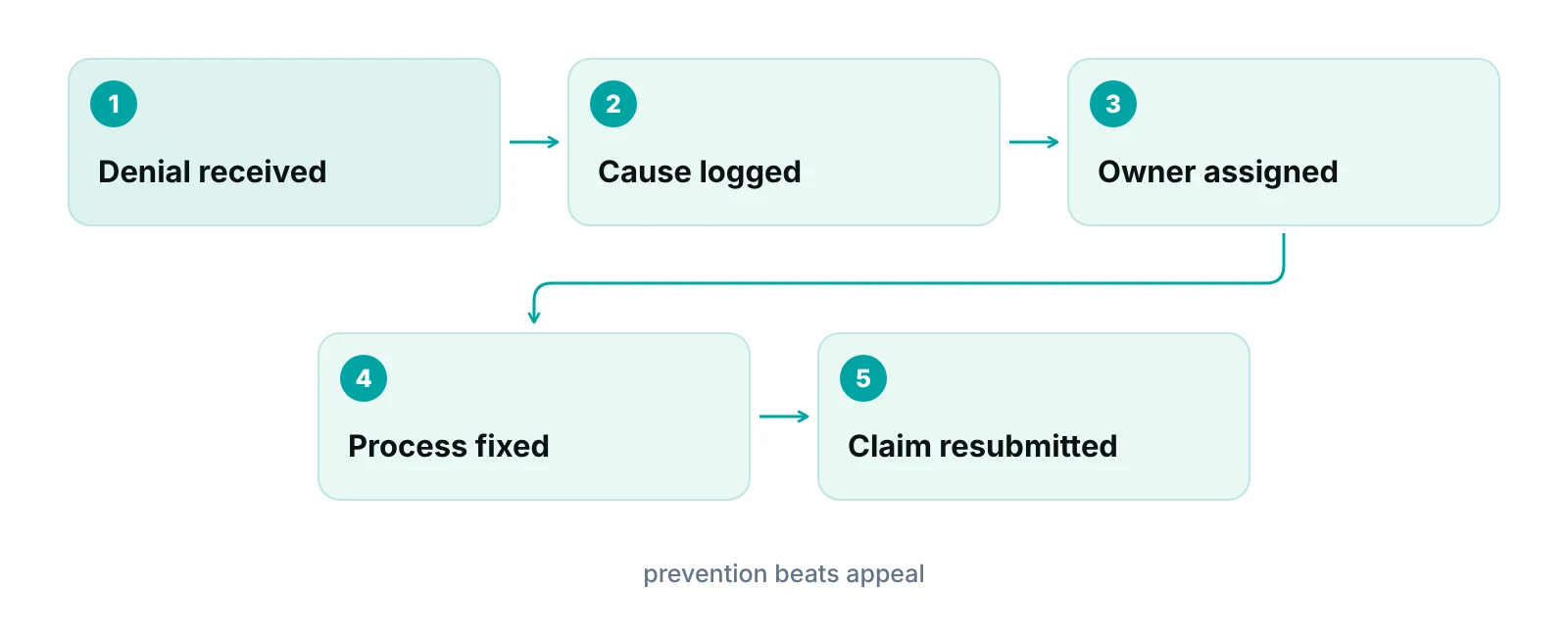
Ask the A/R role for the top three denial reasons each week and assign each one to a named owner. Without a named owner, a denial gets paid once and returns next month.
Where do handoffs between roles fail?
Claims usually stall at the point where one role assumes another role checked something. Each failure below has a simple fix, and each fix is a rule about who owns the item.
- Registration to biller: insurance details were entered once and never confirmed. The claim is rejected or denied for coverage.
- Provider to coder: a note lacks the detail needed to support a code. The coder either queries the provider or codes lower than the visit deserved.
- Coder to biller: a code is valid but the payer needs a modifier or a linked diagnosis. The claim goes out and is denied.
- Biller to payment poster: a partial payment is posted as paid in full, and the underpayment is never seen.
- A/R back to everyone: denial reasons are recorded but never shared, so the same error repeats.
None of these are skill problems. They are ownership problems. For a closer look at preventing the first group, see our clean claims guide.
One practical aid is a tool that shows every claim by stage with a named owner. Our a practice management system that tracks claims by stage does this, so a claim stuck with one role is visible to the manager instead of hidden in an inbox.
What skills and credentials should these roles have?
Credentials help, but they do not replace a tested process. For medical records specialists, BLS says certification may be required or preferred, and most workers need a postsecondary certificate to enter the occupation (BLS). BLS reported a median annual wage of $51,140 for medical records specialists in May 2025, and projects 8 percent employment growth from 2025 to 2035. That occupation is a related category, not a perfect match for every biller or coder, so treat it as a rough guide.
AHIMA’s Certified Coding Specialist (CCS) credential is one example of a coding credential. AHIMA recommends experience before the exam, including a minimum of two years of related coding experience directly applying codes for one eligibility route (AHIMA).
When you hire or outsource, ask the following questions instead of relying on titles:
- How do you keep coders current when ICD-10-CM and CPT change each year?
- What is your process when documentation is unclear? Who gets the query, and how fast?
- Who owns denials, and how do denial reasons get back to coding and registration?
- How are payer filing deadlines tracked?
- Who can see patient data, and how is access recorded? Ask for a Business Associate Agreement before any vendor touches patient data.
Our post on questions to ask a medical billing company extends this list for vendor selection.
Should billers and coders be in house, outsourced or hybrid?
The right model depends on who in your practice can own each handoff reliably. Volume matters less than coverage: a single biller on leave leaves every claim without an owner.
| Model | Works well when | Watch out for |
|---|---|---|
| In-house team | You have enough volume to keep each role busy and a manager who reviews work weekly. | Single points of failure when someone is out, and the cost of training for yearly code changes. |
| Fully outsourced | You want billing, coding support and follow-up handled together and can share access to your EHR. | Unclear ownership of front-desk errors and denial causes, unless the vendor reports them back. |
| Hybrid | The front desk and clinical documentation stay on site, while coding support, claims and A/R go to specialists. | Handoffs between your staff and the vendor need written rules and a shared status view. |
Under any model, keep two things in house: documentation quality and the final say on policy. Everything else can be shared if the handoffs are clear.
Not sure which handoff is costing you?
Our free practice audit reviews who owns each step from registration to A/R, shows where claims stall, and recommends a staffing model. Pricing is quoted after the audit.
Our recommendations
- Write down the seven roles, even in a three-person office. We recommend a one-page list showing which person holds which role. Gaps and overlaps show up immediately.
- Give every handoff a named owner. Registration to biller, provider to coder, biller to poster and A/R back to the team each need one person responsible. Shared ownership usually means no ownership.
- Set up a written coder query process. We suggest a short form or EHR message and a response time. This keeps coders from guessing and keeps providers from being interrupted in the middle of clinic.
- Send denial reasons back every week. We recommend a short weekly review of the top denial reasons, each assigned to a role. It is the cheapest prevention step available.
- Cross-train for absences. Pick a backup for each role and test the backup on a normal day. The first time you find a gap should not be during a leave.
- Plan for the yearly code update. ICD-10-CM changes take effect each October 1, and CPT is updated each year. Schedule training and a system update review before the change date.
Claims stall at handoffs, and a stage-based tracker makes them visible.
The RCM Finder portal is a claim-centered practice management system, not an EHR. It tracks each claim by stage with a named owner, runs data-completeness checks before submission, flags underpayments against expected amounts and keeps an audit log of who changed what.
See how the RCM Finder portal works · Create a portal account
Disclosure: RCM Finder builds and sells this portal. It is a practice management system, not an EHR.
Bottom line
Bottom line: medical billers and coders are the center of the revenue cycle, but a paid claim depends on every role around them. Name the roles, name an owner for each handoff, and feed denials back to the source. If you would rather have a team own the chain, see our end-to-end revenue cycle management service or use the revenue calculator to see what unpaid claims may be costing your practice.
Frequently asked questions
What is the difference between a medical biller and a medical coder?
A coder reads the clinical record and assigns diagnosis and procedure codes. A biller builds the claim from those codes, sends it, posts payment and follows up on rejections and denials. Some practices combine both jobs in one person, but the two skills are different.
Do medical coders talk to patients?
Usually not. BLS notes that medical records specialists have no direct hands-on patient care. Coders work with records and talk to providers when documentation needs clarification. Billers and front-desk staff are more likely to speak with patients about insurance and balances.
Can one person do both billing and coding?
Yes, in small practices it is common. The risk is that no one checks the work. If one person codes and bills, add a periodic review by a second person or an outside reviewer, so errors are caught before they repeat.
Who fixes a denied claim, the biller or the coder?
It depends on the cause. A coding or documentation issue goes to the coder and provider. A data or authorization issue goes to the biller or front desk. The A/R or denial role should sort each denial by cause and assign it to the right owner.
How long do we have to submit a claim?
It varies by payer. For Medicare fee-for-service, CMS says claims for services on or after January 1, 2010 must be filed within one calendar year of the date of service. Other payers have their own limits, so check each contract.
Should a small practice outsource billing and coding?
It can make sense if you cannot cover every role reliably. Keep documentation and policy decisions in house, and require written handoffs and denial reporting from any vendor. A free audit can show which steps are causing delays before you decide.
Get your free practice audit
Tell us about your practice. We will contact you using the details you give.
- A review of your recent claims, denials and A/R aging
- Where your front desk and prior authorizations slow payment
- A prioritized fix list you keep, whether or not you hire us
Pricing is quoted after the audit, based on your volume and the services you choose. Prefer to talk? Call +1 (302) 556-2288.
Sources
- Medical Records Specialists (Occupational Outlook Handbook) — U.S. Bureau of Labor Statistics (2025)
- Healthcare Common Procedure Coding System (HCPCS) — CMS (2026)
- ICD-10 Codes — CMS (2026)
- Timely Filing Requirements for Medicare Fee-For-Service Claims — CMS (2010)
- Certified Coding Specialist (CCS) — AHIMA (2026)
- Compliance Program Guidance for Individual and Small Group Physician Practices (news release) — HHS Office of Inspector General (2000)
Disclaimer: This post is general educational information about revenue cycle operations. It is not legal, coding, billing-compliance or financial advice. Code sets, payer rules, filing limits and wage figures change over time and vary by payer and location. Confirm requirements with the payer and qualified advisors before acting.
