Ophthalmology website design works when large type, strong contrast and keyboard access serve low-vision visitors, procedure pages state candidacy and risks accurately, and booking forms collect only what scheduling needs. Add separate medical and vision-plan pages, fast mobile pages and verifiable surgeon credentials, and keep tracking tags off forms.
Most advice on this topic comes from agencies and concentrates on how an eye practice site should look. This guide concentrates on what the site must do for people who often have trouble reading it, and on the rules behind accessibility, procedure claims and patient data. It is one of the supporting guides in the ophthalmology practice management guide.
Key takeaways
- Build to WCAG 2.2 AA with large default type, 4.5:1 text contrast, 200 percent zoom and keyboard access, because many eye patients have low vision.
- The DOJ web rule covers state and local governments; the HHS Section 504 rule covers recipients of HHS funding. Ask counsel what applies to you.
- Use one procedure-page template with limits, risks and alternatives so that claims such as ‘safe’, ‘painless’ or ‘throw away your glasses’ never appear.
- Keep public booking forms minimal and tag-free; collect history behind a login with a vendor that has signed a BAA.
- Publish separate, dated pages for medical coverage and routine vision care, since Original Medicare does not cover routine eye exams.
Why is an eye practice website different from other medical sites?
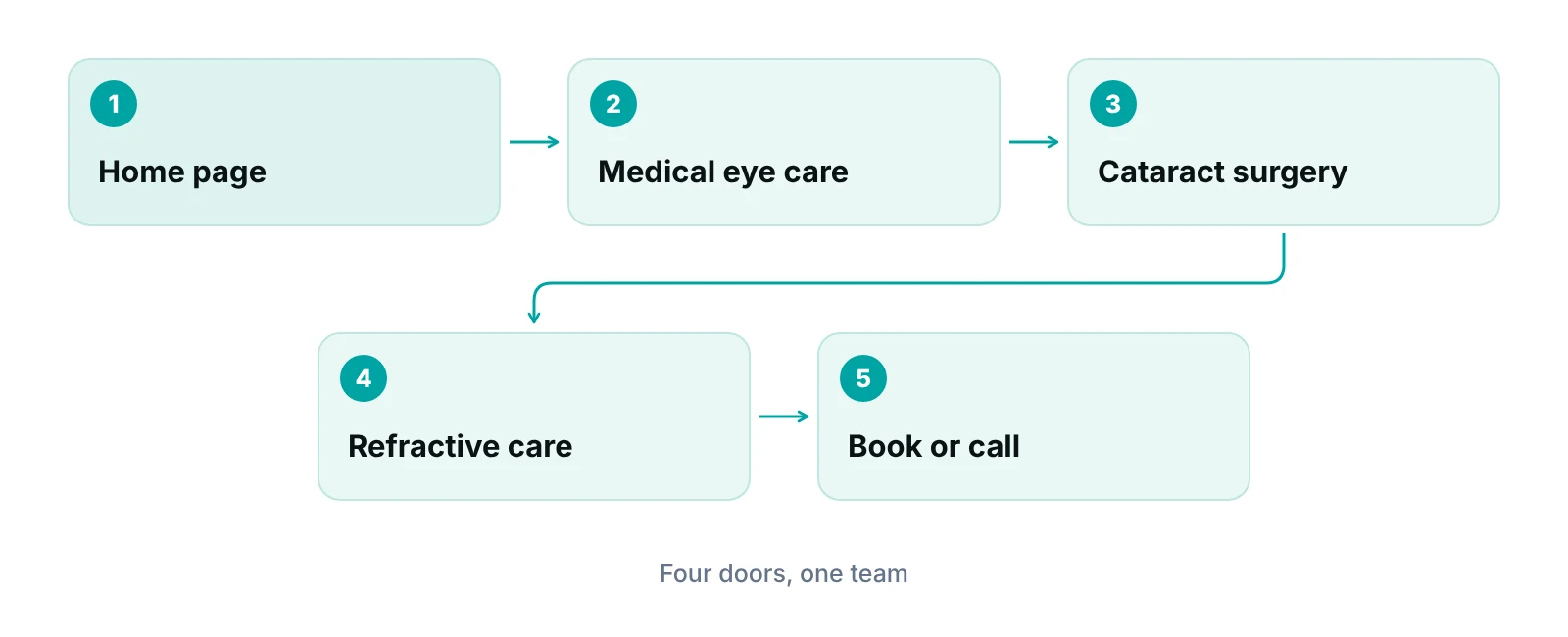
Because some visitors cannot read a normal web page comfortably, and others are choosing between insurance-paid surgery and self-pay vision correction. The site must work for low vision first, then route each visitor to the right service line.
This post is the build brief. Search work is in the ophthalmology SEO guide and service-line marketing is in the ophthalmology marketing post.
| Visitor | What they need first | Design response |
|---|---|---|
| Patient or caregiver with low vision | Readable text and a phone number they can reach | Large default type, strong contrast, zoom-safe layout, tap-to-call |
| Medical eye care patient | Do you treat my condition, and do you take my plan? | Condition list, dated plans accepted, what to bring |
| Cataract or refractive prospect | What happens, who operates, who pays | Procedure page with limits, risks and a coverage statement |
| Referring optometrist or physician | How to send a patient and what you need | Referral page with fax or portal route, urgency guidance and a contact name |
Source: RCM Finder editorial framework; no external statistics.
What do the accessibility rules say today?
Two federal rules set web accessibility dates, and both were pushed back in 2026. The Justice Department rule covers state and local governments. The HHS Section 504 rule covers recipients of HHS federal financial assistance, which includes health care providers. Both use WCAG 2.1 Level AA.
DOJ’s Title II fact sheet lists April 26, 2027 for governments serving 50,000 or more people and April 26, 2028 for smaller ones. Duane Morris reports that an interim final rule published on April 20, 2026 moved those dates by one year. HHS’s interim final rule, filed May 7, 2026, set May 11, 2027 for recipients with 15 or more employees and May 10, 2028 for those with fewer than 15.
| Rule | Who is covered | Standard | Compliance date |
|---|---|---|---|
| DOJ ADA Title II web rule | State and local governments, including public agencies | WCAG 2.1 AA | April 26, 2027 (population 50,000 or more); April 26, 2028 (smaller entities) |
| HHS Section 504 web rule | Recipients of HHS financial assistance, including health care providers | WCAG 2.1 AA | May 11, 2027 (15 or more employees); May 10, 2028 (fewer than 15) |
Source: ADA.gov (2026); Federal Register, HHS Office for Civil Rights (May 11, 2026); Duane Morris (April 2026).
Two limits matter. The DOJ fact sheet does not address private businesses under Title III. Whether your practice is a recipient of HHS financial assistance is a legal question. A clinic run by a public university or county health district is a government entity.
Dates can move again
Both extensions are interim final rules with comment periods. Confirm current dates on ADA.gov and in the Federal Register, and ask counsel whether either rule reaches your practice.
How do you design for low vision: type, contrast and zoom?
Build to WCAG 2.2 Level AA and test with real zoom and a keyboard. The W3C published WCAG 2.2 as a Recommendation in October 2023. Its AA criteria give a developer measurable targets, and they are the ones that matter most for readers with low vision.
- Contrast. Normal text needs a contrast ratio of at least 4.5:1 against its background; large-scale text needs at least 3:1.
- Resize. Text must resize up to 200 percent without assistive technology and without losing content or function.
- Reflow. Content should work at a width equivalent to 320 CSS pixels without two-way scrolling, which is what a zoomed phone or desktop window looks like.
- Text spacing. Users must be able to set line height to 1.5 times the font size, paragraph spacing to 2 times, letter spacing to 0.12 times and word spacing to 0.16 times without losing content.
- Controls. Buttons, form fields and icons need a 3:1 contrast ratio against adjacent colors, and the keyboard focus indicator must be visible.
- Target size. Pointer targets should be at least 24 by 24 CSS pixels unless a spacing or other exception applies, per the W3C’s target size guidance.
In practice: a larger default body size than taste alone would pick, dark text on a plain light background, and no important wording baked into an image. Phone numbers, hours and instructions should be real text.
A text-size widget does not replace a layout that survives browser zoom. Test at 200 percent zoom, tab through every page without a mouse, and complete one booking.
How should procedure pages be built so the claims stay accurate?
Give every procedure page the same fixed template: what it is, who may not be a candidate, the risks, the alternatives, who performs it, how coverage works and the next step. A template makes it hard to publish a benefit without its limits. The AAO, ASCRS and ISRS refractive advertising guidelines say ads must be truthful and must not mislead through implied claims or omissions.
- What it is. A plain description that does not call surgery by a softer name.
- Who it suits and who it may not. Do not promise candidacy before an exam.
- Risks and alternatives. The AAO code of ethics says a communication promoting a procedure with significant risks must include a realistic view of safety and efficacy and mention alternatives (AAO Code of Ethics, Rule 13).
- Who performs it. Link the surgeon bio.
- Cost and coverage. State whether insurance or the patient pays.
- Next step. One consultation button.
| Pattern on the page | Why it is a problem | Safer approach |
|---|---|---|
| “Throw away your glasses” | Implies permanent freedom from all glasses | Say a procedure may reduce dependence on glasses or contacts for many activities |
| “Safe and easy” or “painless” | Overstates safety and comfort; patients typically have some discomfort | State that, like all surgery, it has risks, and link the risk section |
| “Leave with 20/20 vision” | Implies a guaranteed outcome | Report ranges only if you can substantiate them from your own outcomes |
| “Best results” or “most experienced surgeon” | Superiority without comparative evidence or current counts | Describe the technology and training factually |
| Device brand named with no warnings | Brand-name device ads need intended uses and warnings | Include a brief statement of intended uses, warnings and contraindications |
| Promoting an off-label use | The guidance prohibits advertising it | Discuss it in the consultation, not on the page |
Source: AAO, ASCRS and ISRS, Guidelines for Refractive Surgery Advertising (2008 revision); AAO Code of Ethics Rule 13.
The FTC’s substantiation policy says an advertiser needs a reasonable basis for objective claims before making them, whether they are stated or implied.
Patient photos and stories
A patient testimonial with a name or full-face photo on your site is a marketing use of health information. HIPAA requires a written authorization for marketing uses (45 CFR 164.508), and OCR’s Complete P.T. settlement (February 12, 2016, $25,000) involved testimonials with full names and full-face photos posted without valid authorizations. The FTC’s 2024 rule on reviews and testimonials also bars fake reviews and undisclosed insider reviews. AAO’s guidelines add that a testimonial implies a typical result.
How should online booking and intake forms handle patient data?
A public booking form should collect the least information that lets staff call the patient back, and tracking tags should stay off it. HHS’s online tracking bulletin says that if tracking on a scheduling page collects information such as an email address or a reason for care, the HIPAA Rules apply (HHS OCR).
A federal court vacated part of that bulletin on June 20, 2024: the part about an IP address tied to a visit to a public page about conditions or providers. HHS says it is evaluating next steps, and the page says it does not have the force of law. Treat the form and the portal as the places where care is highest.
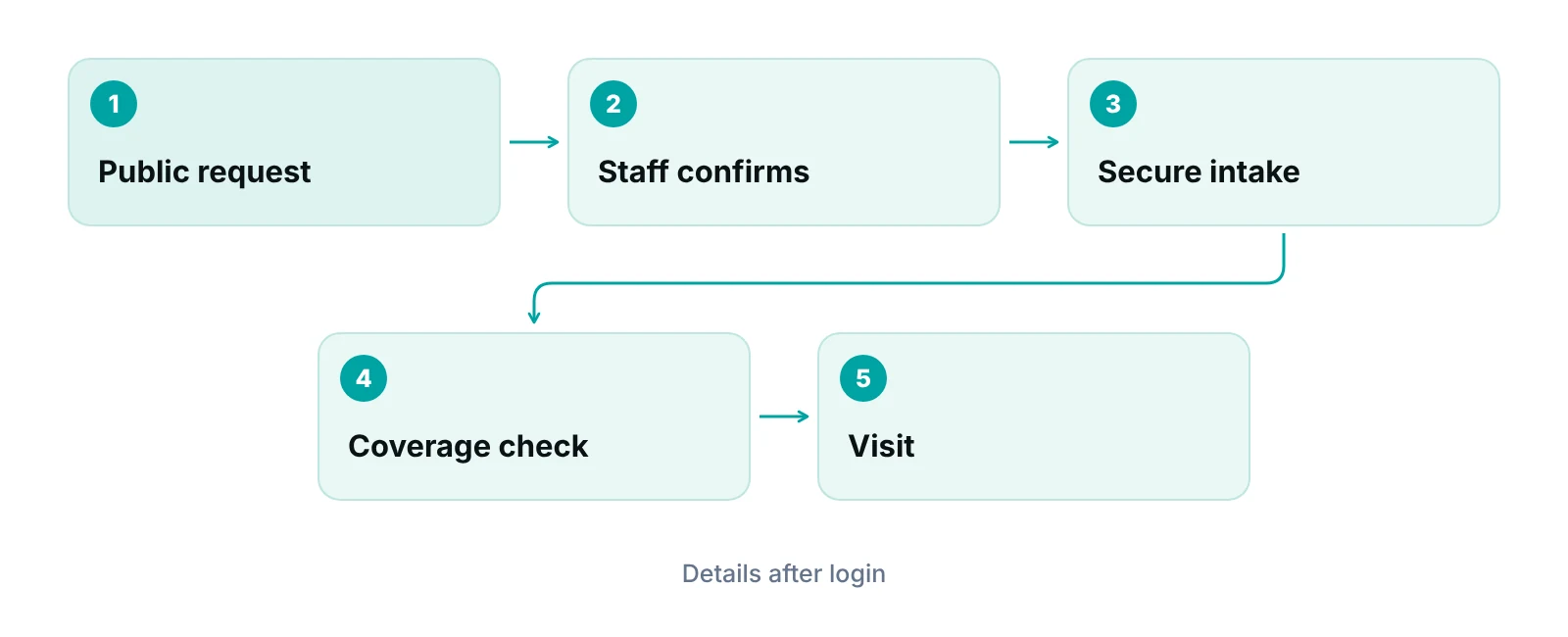
A booking path that keeps health details behind a login
- The public form asks for name, phone, preferred time and visit type (for example, eye exam, cataract consultation or refractive consultation). It does not ask for symptoms or history.
- Staff call or send a confirmation with no health details.
- The patient completes history and insurance cards in a logged-in intake step run by a vendor that has signed a Business Associate Agreement.
- Staff verify medical and vision-plan coverage before the visit.
- The reminder says when to arrive and what to bring, in large plain text.
HHS states that a cookie banner or a privacy policy is not a HIPAA authorization, and that a vendor needing a Business Associate Agreement does not escape that duty by promising to strip identifiers after receipt. A business associate is a vendor that creates, receives, maintains or transmits protected health information for you, and that includes cloud providers that store or process it. Keep a list of every script on every page. Our HIPAA compliance checklist covers the wider program.
Behind the form, the Security Rule requires unique user identification, audit controls and transmission security, with encryption addressable (45 CFR 164.312). Ask vendors how they meet each.
Does your booking form pass a privacy check?
Send us the form, the tag list and the confirmation message. A free practice audit reviews the path from click to kept visit.
What should insurance and vision-plan pages say?
Say which services are billed to medical insurance and which are routine vision care, and keep those two lists on separate pages. Patients bring two cards and assume one covers both. Medicare shows why the split matters.
- Original Medicare does not cover routine eye exams, including exams to check for glasses or contact lenses (Medicare.gov).
- Part B covers one pair of eyeglasses with standard frames, or one set of contact lenses, after cataract surgery that implants an intraocular lens. The patient pays 20 percent of the Medicare-approved amount after the Part B deductible, and Medicare pays only when the supplier participates (Medicare.gov).
- Some Medicare Advantage plans offer extra vision benefits, so the page should tell patients to check with their own plan.
Use three blocks: medical eye care billed to medical insurance, routine exams and glasses under a vision plan or self-pay, and the optical shop. List plans with a visible “last checked” date, and do not list a plan staff have not confirmed this quarter.
Premium lens options and refractive procedures vary by plan, so say they may be self-pay. Benefit checks are covered in our guide to patient insurance verification, and medical versus vision claims in the ophthalmology medical billing post and the ophthalmology medical billing guide.
What do speed, mobile and credentials add?
They decide whether a patient can finish the task. Google’s Core Web Vitals set “good” targets of 2.5 seconds or less for Largest Contentful Paint, 200 milliseconds or less for Interaction to Next Paint and 0.1 or less for Cumulative Layout Shift, measured at the 75th percentile of page loads and segmented by mobile and desktop.
- Compress photos and give them set dimensions so the layout does not jump.
- Put tap-to-call and booking buttons where a thumb reaches, at 24 pixels or larger.
- Mark up the practice with the most specific LocalBusiness subtype available, with name, address, telephone and opening hours, as Google recommends. Page-level markup choices are in the SEO guide linked above.
Trust comes from showing who is responsible. Google’s guidance on helpful content says trust matters most for topics that affect health, that readers should be able to tell who created the content, and that false credentials count as deception. Each surgeon bio should name the license, board status and training, and be rechecked when the site changes. The AAO code bars misrepresenting credentials or training.
For general layouts, see our roundup of medical website designs.
Our recommendations
- Make readable the default. We would set large type and strong contrast for every visitor and test at 200 percent zoom before launch.
- Write the procedure template first. Draft limits, risks and alternatives before anyone writes promotional text.
- Keep the public form short. Name, phone, preferred time and visit type are enough. Move history behind a login with a vendor that has signed a BAA.
- Separate medical and vision-plan pages. Give patients two plain, dated lists so the front desk stops fielding the same coverage call.
- Keep a tag inventory. List every script on every page each quarter, and remove tracking from forms and logins unless a BAA and a permitted use are in place.
- Verify credentials at the source. Check each bio against the state license record and certifying board whenever the site changes.
- Track the rules by date. Calendar the DOJ and HHS dates and the HHS tracking bulletin, and ask counsel what applies to you.
Bottom line
A strong ophthalmology site is readable by the patients who need it most, honest about every procedure, and careful with every form. Use the build brief above with your web team, then connect the site to search, ads and the front desk through our healthcare digital marketing services. For the staff side of booking and benefit checks, see our virtual medical assistant services, our practice management system and our revenue cycle management service.
Frequently asked questions
Does a private ophthalmology practice have to meet WCAG?
The DOJ rule covers state and local governments, and the HHS Section 504 rule covers recipients of HHS financial assistance. Whether your practice is covered is a legal question, so ask counsel. Many practices still build to WCAG 2.2 AA because it gives measurable targets and eye patients include many with low vision.
What are the current Section 504 web dates?
HHS’s interim final rule, filed May 7, 2026, set May 11, 2027 for recipients with 15 or more employees and May 10, 2028 for those with fewer than 15. The standard is WCAG 2.1 AA. It was an interim rule with a comment period, so check the Federal Register for any later change.
What text size and contrast should the site use?
WCAG 2.2 AA requires 4.5:1 contrast for normal text and 3:1 for large text, and text that resizes to 200 percent without losing content. There is no single required font size, so choose a generous default and test at 200 percent zoom on a phone.
Can we say a procedure is safe or painless on the website?
Avoid it. The AAO, ASCRS and ISRS refractive advertising guidelines advise against calling LASIK safe and easy, against claiming the experience is painless, and against implying a guaranteed result. Say that like all surgery it has risks, and link a risk section. Have your attorney review final wording.
Is an online booking form covered by HIPAA?
If the practice is a covered entity and the form collects information such as an email address or a reason for care, HHS says the HIPAA Rules apply to tracking on that page. Keep the public form minimal, keep tags off it, and use a vendor with a signed Business Associate Agreement for intake.
Should the site list the vision plans we accept?
Yes, if staff confirm the list and date it. Keep medical insurance and routine vision coverage on separate pages, since Original Medicare does not cover routine eye exams, and tell Medicare Advantage patients to check their plan for vision benefits.
Get your free practice audit
Tell us about your practice. We will contact you using the details you give.
- A review of your recent claims, denials and A/R aging
- Where your front desk and prior authorizations slow payment
- A prioritized fix list you keep, whether or not you hire us
Pricing is quoted after the audit, based on your volume and the services you choose. Prefer to talk? Call +1 (302) 556-2288.
Sources
- DOJ Title II web accessibility rule fact sheet — ADA.gov (2026)
- DOJ extends ADA Title II digital accessibility deadlines by one year — Duane Morris LLP (2026)
- Extension of Compliance Dates, Nondiscrimination on the Basis of Disability: Accessibility of Web Information and Services — Federal Register / HHS OCR (2026)
- Web Content Accessibility Guidelines (WCAG) 2.2 — W3C (2023)
- Understanding SC 2.5.8 Target Size (Minimum) — W3C WAI (2023)
- Use of Online Tracking Technologies by HIPAA Covered Entities and Business Associates — HHS OCR (2024)
- 45 CFR 164.508 Uses and disclosures for which an authorization is required — eCFR (2026)
- 45 CFR 164.312 Technical safeguards — eCFR (2026)
- Business Associates — HHS OCR (2026)
- HHS OCR settlement: Complete P.T., Pool & Land Physical Therapy — HHS OCR (2016)
- FTC final rule banning fake reviews and testimonials — FTC (2024)
- FTC Policy Statement Regarding Advertising Substantiation — FTC (2009)
- Guidelines for Refractive Surgery Advertising — AAO / ASCRS / ISRS (2008)
- Code of Ethics, Rule 13: Communications and advertising — American Academy of Ophthalmology (2026)
- Advertising Your Refractive Practice — American Academy of Ophthalmology (2026)
- Eyeglasses and contact lenses — Medicare.gov (2026)
- Eye exams (routine) — Medicare.gov (2026)
- Core Web Vitals — web.dev (Google) (2026)
- LocalBusiness structured data — Google Search Central (2026)
- Creating helpful, reliable, people-first content — Google Search Central (2026)
Disclaimer: This article is educational and is not legal, compliance, coding or medical advice. Accessibility, privacy and advertising rules vary by state and by practice, and they change. Confirm your own obligations with a qualified attorney before publishing procedure claims, patient photos or forms, or relying on any rule described here.