Ophthalmology practice management is the daily operation of an eye care practice: patient flow from technician work-up to imaging to the doctor, device connections, ASC and surgery scheduling, the optical shop and contact lenses, authorizations and staffing. Software should be judged on how well it supports each of those workflows.
Eye care operations differ from a general office. A single visit can involve a technician, two or three devices, a physician and an optical shop, and surgery brings its own scheduling and authorization rules. This guide is for owners and administrators who want a working model of those moving parts, and a vendor-neutral way to test an ophthalmology EHR or practice management software against them.
Partner governance and compensation, covered by Healio (2019), are out of scope, and no products are named. Claim coding and medical-versus-vision billing are in the ophthalmology medical billing guide; the general practice management software guide covers the category.
Key takeaways
- Map patient flow first: check-in, technician work-up, imaging and testing, doctor, checkout. Software should follow that path.
- Delegated tests need a physician order in the chart that names the test, the eye and the medical necessity.
- Ask every device vendor how images and measurements reach the chart, and who maintains that connection.
- Surgery needs three clocks run together: the ASC’s own assessment policy, the authorization window and the lens or implant order.
- Run the optical shop and medical contact lens fits as separate workflows with their own payer rules.
What does ophthalmology practice management cover?
It covers everything that makes the clinical work possible: scheduling, patient flow, equipment, the surgery calendar, the optical shop, authorizations, staffing and reporting. A consultant guide from the Practice Management Education and Consulting Association (PECAA, December 2021) lists the roles involved as owner physician, office manager, front desk, billing and coding, ophthalmic technicians and outside consultants.
Eye care has many handoffs inside one visit and several separate payer rules around it. The table shows where it differs from a general office.
| Area | What changes | Question to ask |
|---|---|---|
| Patient flow | Technician work-up and testing come before the physician | Who owns each next step? |
| Diagnostic devices | Devices produce data the chart must receive | How does output reach the record? |
| Surgery | Cases run through an ASC or hospital department | Who schedules, authorizes and orders the implant? |
| Optical and contact lenses | A retail-style shop sits beside a medical practice | Which payer applies to which item? |
| Authorization | Some procedures need prior authorization | Who submits and tracks it? |
| Staffing | Technicians, opticians and schedulers differ in skill | Which tasks need certification? |
Source: RCM Finder analysis; sourced details appear in the sections below.
How should patient flow work from technician to imaging to doctor?
Design the flow around who owns each handoff and where each test order is recorded.
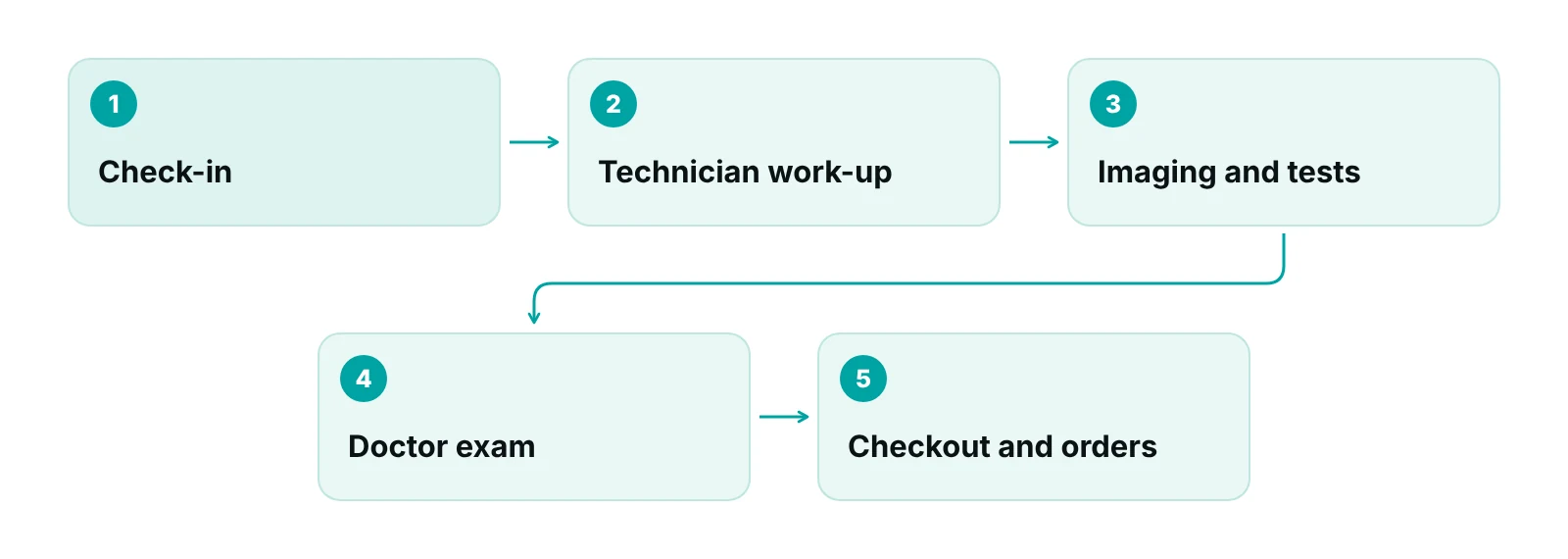
The American Academy of Ophthalmology (AAO, 2024) explains that a physician can direct clinical staff to perform tests that have a designated supervision level, and that these delegated services require a physician order in the medical record. The order should say which test, which eye (right, left or both), when it should be done and why it is medically necessary. Under 42 CFR 410.32, tests must be ordered by the treating physician, and the ordering practitioner must keep documentation of medical necessity in the record.
The same regulation requires at least general supervision, meaning the physician’s overall direction and control without being in the room; some tests need direct or personal supervision. The AAO notes that non-Medicare payers typically recognize only direct supervision. A 2008 article in Review of Ophthalmology adds that the physician should document an interpretation and that standing orders are generally not reimbursed. Because it is dated, confirm with your Medicare Administrative Contractor (MAC); other MACs may differ.
Four rules for the flow:
- Build test orders into the visit template, not verbal requests.
- Record the eye, the reason and the ordering physician.
- Route each result to the physician for interpretation, or flag it pending with an owner.
- Track waits at each stage so a busy device shows up in the data.
How should diagnostic equipment connect to the ophthalmology EHR?
Each device should send its images and measurements into the chart through a connection someone owns. A missing interface turns a technician into a data-entry clerk.
A standard exists for much of this. The DICOM working group on ophthalmology (DICOM WG-09) lists finalized supplements for ophthalmic photography, ophthalmic tomography (OCT), axial length measurements, static perimetry (visual fields), thickness maps, corneal topography maps, wide-field photography and OCT angiography. Whether a given device and EHR use those formats is a question for the vendors.
Ask for every device:
- Do results reach the chart automatically, or does staff export and upload files?
- Is the image stored in the record or linked to a separate viewer?
- Who maintains the connection when either vendor updates software?
- What happens to the images if the practice leaves the EHR?
Registries are another interface. The AAO’s IRIS Registry page says EHR systems not meeting certain criteria are ineligible for integration, including 2015 Edition ONC Health IT Certification. The page describes a transition through 2023, so confirm current rules with the Academy and your vendor.
Make a device inventory
List each device, its vendor, how data leaves it, where it lands and who supports it.
How do you schedule the OR or ASC without losing cases?
Treat surgery scheduling as a checklist completed before the date is confirmed, not a calendar slot.
Under 42 CFR 416.52, an ambulatory surgery center must have a policy identifying patients who need a history and physical before surgery, and that policy must set the timeframe for completing it. On admission the surgeon or another qualified practitioner completes a pre-surgical assessment that documents drug allergies, and the H&P, if required, must be in the record before the procedure. Discharge requires written instructions, a surgeon-signed discharge order and, generally, a responsible adult. The regulation sets no fixed H&P window, so get the facility’s current policy.
Checklist for a surgical case:
- Confirm the surgeon’s block time and open facility slots.
- Check whether the procedure needs prior authorization and who will submit it (see the authorization section).
- Order the lens or implant and record the order date.
- Send the facility the H&P within its own timeframe.
- Book post-operative visits and confirm a responsible adult.
- Confirm financial responsibility with the patient.
The ASC and the hospital outpatient department are paid under different rules; the ASC vs HOPD billing guide explains the difference, and the cataract surgery CPT code guide covers claim rules for the case itself.
How do optical dispensary and contact lenses differ from medical care?
Keep the optical shop’s workflow, inventory and patient estimates separate from the medical practice, because the payers and rules differ.
For Medicare, the starting point is narrow. Medicare.gov says Part B covers one pair of eyeglasses with standard frames, or one set of contact lenses, after each cataract surgery that implants an intraocular lens, and that routine vision care is generally not covered under Part B. Items must come from a participating supplier; Medicare Advantage plans may add benefits.
The CMS Medicare compliance tips on lenses (page modified February 2026) add detail. Replacements are not covered after an inserted lens, lenses for diagnoses other than pseudophakia, aphakia or congenital aphakia are denied, and tinted lenses used as sunglasses are denied. Anti-reflective coatings, tints and oversize lenses need documented medical necessity. Check your MAC’s policy articles.
Enrollment is an operations task. Cataract & Refractive Surgery Today (CRST, November and December 2025 issue) reports that post-operative cataract eyewear is billed as durable medical equipment, each dispensary must enroll separately as a DMEPOS supplier under its own NPI, and suppliers must revalidate every three years. Confirm with the enrollment contractor.
Medical contact lens fits versus elective fits
Elective contact lens fits may fall under a vision or refractive benefit, while medical fits for conditions such as aphakia, ocular surface disease or keratoconus are often billed to the medical plan. A 2013 article in Review of Optometry notes that medical coverage is not guaranteed, so verify with the carrier first, tell the patient the total cost in advance and use an Advance Beneficiary Notice where needed.
Opticianry also varies by state. The Bureau of Labor Statistics (BLS, page modified August 2026) says some states require dispensing opticians to be licensed, so check your state board.
Which eye procedures need prior authorization, and who owns it?
Assign one owner for each authorization and check the requirement before the surgery date is set. Rules differ by site of service and payer, and changed in 2026.
| Program | Who it covers | What it requires |
|---|---|---|
| Hospital outpatient department (OPD) program | Hospital outpatient departments; blepharoplasty has been on the list since July 1, 2020 | Request before service; standard review 7 calendar days (from January 1, 2025); expedited 2 business days |
| ASC demonstration | ASCs in CA, FL, TN, PA, MD, GA and NY (from January 19, 2026); TX, AZ and OH (from February 16, 2026) | Five-year project; includes blepharoplasty and botulinum toxin injections; ASC submits to its MAC |
| Approval and claim | ASC claims | Approval valid 120 days; one tracking number per claim; no retroactive requests |
| Non-affirmed requests | ASC and related professional claims | Procedure and related professional services denied |
| Medicare Advantage and commercial plans | Not covered by the programs above | Demonstration is fee-for-service only; ask each plan |
Source: CMS OPD prior authorization page (modified September 2026); CMS ASC demonstration FAQs (2026).
The CMS OPD page and ASC FAQs say the ASC submits and practitioners bill as usual. The AAO (2022) reports that CMS removed one corrective lid surgery code from the OPD list effective January 7, 2022, so codes change; verify the current list. Ophthalmology Management (May 2026) advises deciding whether the office or the ASC submits and documenting functional impairment for functional blepharoplasty. Local coverage rules differ by MAC.
The AMA’s 2024 survey of 1,000 physicians (AMA) found an average of 39 prior authorizations per physician per week, 13 hours of physician and staff time, and 40 percent of physicians with staff working only on them. The prior authorization guide covers the general process.
How should an eye care practice staff the front, the floor and the optical shop?
Match tasks to skill: work-up to technicians, dispensing to trained opticians, and scheduling, eligibility and authorization to people who can own a queue.
For technicians, the Joint Commission on Allied Health Personnel in Ophthalmology (JCAHPO) lists three certification levels: Certified Ophthalmic Assistant (entry level), Certified Ophthalmic Technician (intermediate) and Certified Ophthalmic Medical Technologist (advanced). State rules on what staff may do vary.
“An ownership problem usually comes before a staffing problem. When nobody owns the authorization queue or the device interface, every new hire inherits the confusion.”
— Awais Afzal, Healthcare Operations & Data Analyst
Front-office tasks such as scheduling, eligibility checks, intake and prior authorizations can be handled by a trained remote team working in the practice’s time zone. RCM Finder’s virtual medical assistants work inside your existing EHR (for example PrognoCIS, eClinicalWorks or athenahealth). The front desk and revenue cycle post explains why that desk matters.
Clinical judgment and test interpretation stay with licensed clinicians. If billing is outsourced, the ophthalmology medical billing guide explains what to ask.
How do you evaluate ophthalmology EHR and practice management software?
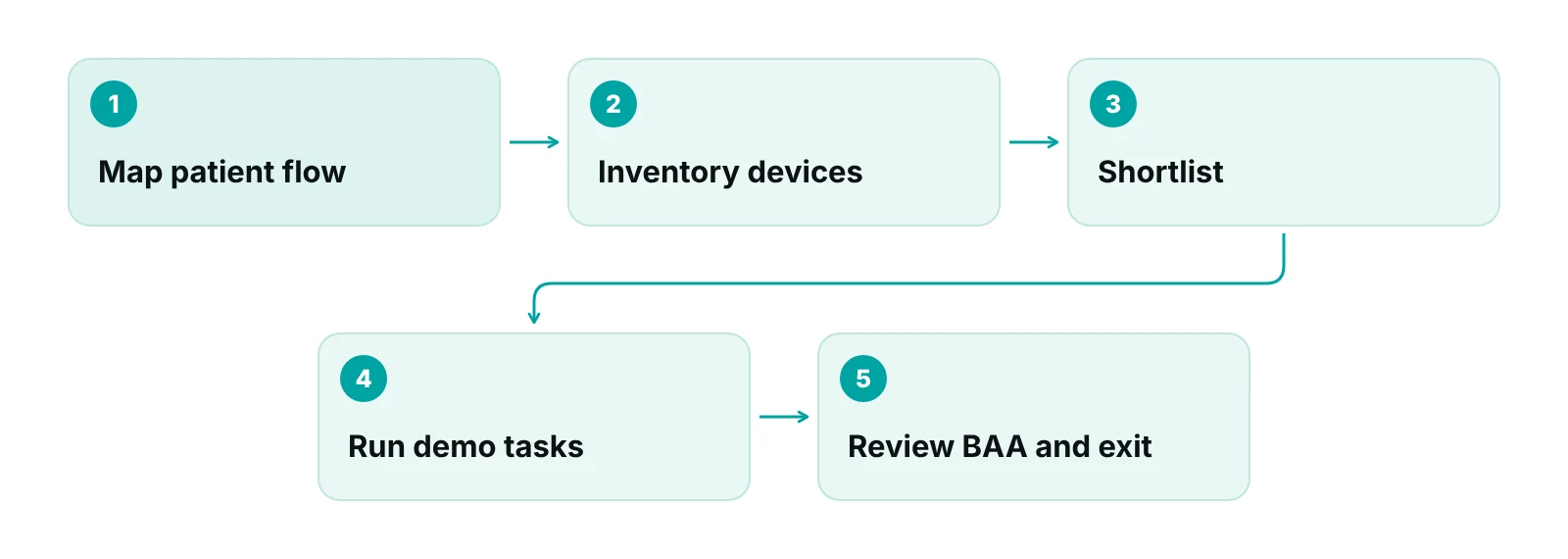
Test ophthalmology EHR and practice management software on your own workflow with real tasks, and ask about the exit before you sign.
An ophthalmology EHR holds the clinical record and often the imaging; practice management software handles scheduling, claims and reporting. The practice management software guide explains the category.
| Area | Test in the demo | Evidence to request |
|---|---|---|
| Technician work-up | Complete a dilated exam work-up with an order and results from two devices | Screen walk-through on your own template |
| Device connections | Send a study from each device you own into a test chart | Written list of supported devices and formats |
| Orders and documentation | Place a delegated test order naming the eye and the reason | Sample audit trail showing signature |
| Surgery scheduling | Book a cataract case with authorization status, implant order and H&P | Report of cases missing a step |
| Optical and contact lenses | Sell glasses and a medical contact lens fit on separate payers | Separate inventory and ledger views |
| Authorization tracking | Log a request, an approval number and an expiry date | List of items expiring in 30 days |
| Security and exit | Review the business associate agreement and a sample export | BAA terms; export format; return or destruction clause |
Source: RCM Finder analysis; delegated order elements from AAO (2024); BAA and exit terms from HHS cloud computing guidance.
On security, HHS says a cloud service provider that stores electronic protected health information for a covered entity is a business associate and must sign a business associate agreement (HHS). Encryption alone is not enough, and the agreement should require return or destruction of data at termination where feasible.
RCM Finder is not an ophthalmology EHR. Its portal is a claims-side practice management system with claim tracking by stage, data-completeness checks before submission, underpayment detection, workflow rules, role-based permissions, an audit log, a client portal and reporting dashboards. Appointment booking with a calendar view is in early access, and the credentialing module and in-portal eligibility checks are coming next. We put a Business Associate Agreement in place before accessing patient data.
See where the work gets stuck
A free practice audit reviews your claims, denials and handoffs, and shows which problems need software and which need a process change.
Our recommendations
- Write the patient flow on one page first. Name an owner for each handoff and judge every system against it.
- Put delegated test orders in the template. Name the test, eye, timing and reason, with a physician signature.
- Keep a device inventory. Record how data reaches the chart and who supports it.
- Run surgery scheduling from a checklist. Check authorization, implant order and H&P timing before confirming the date.
- Separate the optical shop from the medical practice. Use separate estimates and payer checks, and confirm supplier enrollment.
- Name one owner for authorizations. Track each request through to the approval number and report expiring approvals weekly.
- Test the exit before you sign. Get the BAA, a sample export and return terms in writing.
Bottom line
Ophthalmology practice management is a set of handoffs: technician to device to doctor, clinic to ASC, medical practice to optical shop. Map them, assign owners and test software on those tasks. For the money side, read the ophthalmology medical billing guide, and see how RCM Finder’s practice management system tracks claims from submission to payment; for patient growth, see ophthalmology marketing, ophthalmology SEO and ophthalmology website design.
Frequently asked questions
What is ophthalmology practice management?
It is the daily running of an eye care practice: patient flow, scheduling, diagnostic equipment, surgery and ASC coordination, the optical shop, authorizations, staffing and reporting. It is separate from clinical care and from claim coding, though each depends on it.
What should an ophthalmology EHR connect to?
At minimum, the diagnostic devices that produce images and measurements, the scheduling and billing system, and any registry the practice reports to. Ask each vendor how data moves, who maintains the connection and what happens to images if you switch systems.
Does Medicare cover glasses or contact lenses?
Part B covers one pair of glasses with standard frames, or one set of contact lenses, after each cataract surgery that implants an intraocular lens, from a participating supplier. Routine vision care is generally not covered under Part B. Medicare Advantage plans may add benefits, so check the plan.
Who can order diagnostic tests in an eye practice?
Under 42 CFR 410.32, tests must be ordered by the treating physician. Staff may perform delegated tests when the order is in the chart, names the test and the eye, shows medical necessity and carries a compliant signature. Supervision rules vary by test and payer.
Does prior authorization apply to eyelid surgery in an ASC?
Since January and February 2026, a CMS demonstration requires ASCs in ten states to request prior authorization for categories including blepharoplasty and botulinum toxin injections for Medicare fee-for-service patients. Medicare Advantage and commercial plans have their own rules, and the program details can change.
What is the difference between an ophthalmology EHR and practice management software?
An EHR holds the clinical record, orders, results and often the images. Practice management software covers scheduling, claims, payments and reporting. Some products combine both. Decide which you are buying, then test each workflow with real tasks before you sign.
Get your free practice audit
Tell us about your practice. We will contact you using the details you give.
- A review of your recent claims, denials and A/R aging
- Where your front desk and prior authorizations slow payment
- A prioritized fix list you keep, whether or not you hire us
Pricing is quoted after the audit, based on your volume and the services you choose. Prefer to talk? Call +1 (302) 556-2288.
Sources
- Our Comprehensive Guide to Ophthalmology Practice Management — PECAA (2021)
- Ophthalmologists face unique practice management challenges — Healio (2019)
- Eyeglasses and contact lenses — Medicare.gov (undated, read 2026)
- Medicare Provider Compliance Tips: Lenses — Centers for Medicare & Medicaid Services (2026)
- Guidance on Providing Postoperative Cataract Eyewear — Cataract & Refractive Surgery Today (2025)
- Coding Contact Lens Fits — Review of Optometry (2013)
- Opticians, Dispensing — Bureau of Labor Statistics (2026)
- Prior Authorization for Certain Hospital Outpatient Department (OPD) Services — Centers for Medicare & Medicaid Services (2026)
- ASC Prior Authorization Demonstration FAQs — Centers for Medicare & Medicaid Services (2026)
- CMS Removes Lid Surgery Code From Hospital Prior Auth — American Academy of Ophthalmology (2022)
- Prior Authorization Strategies to Prevent Surgical Payment Delays — Ophthalmology Management (2026)
- Fixing prior auth: nearly 40 prior authorizations a week — American Medical Association (2025)
- 42 CFR 416.52 Patient admission, assessment and discharge — eCFR (current)
- 42 CFR 410.32 Diagnostic tests — eCFR (current)
- Focus on the Fundamentals: Delegated Testing Orders — American Academy of Ophthalmology (2024)
- Medicare's guidelines for diagnostic tests — Review of Ophthalmology (2008)
- WG-09: Ophthalmology — DICOM Standards Committee (current)
- EHR Systems (IRIS Registry) — American Academy of Ophthalmology (undated, read 2026)
- Certifications — JCAHPO (current)
- Guidance on HIPAA & Cloud Computing — HHS Office for Civil Rights (2026)
Disclaimer: This article is educational and is not legal, coding, billing or compliance advice. Medicare rules vary by MAC, and payer, state and facility policies differ and change, so confirm current requirements with your MAC, each payer, your state board and your attorney before acting. CPT is a registered trademark of the American Medical Association; official code descriptors are not reproduced here.