
Ophthalmology SEO is the work of making an eye practice easy to find when patients search for an eye doctor, a condition or a procedure near them. It rests on an accurate Google Business Profile, one useful page per condition and procedure, surgeon pages with verifiable credentials, honest reviews, and tracking that reaches booked visits.
Most of what ranks for this topic is written by agencies selling the service. This guide is for the owner or administrator who has to set it up, or check someone else’s work. It follows Google’s own documentation and keeps to what a practice controls.
It is a how-to, not a strategy paper. For service-line planning across cataract, refractive and medical eye care, see ophthalmology marketing. For the site build itself, see ophthalmology website design. For the general version, see the healthcare SEO guide. Nothing here promises a ranking or a timeline.
Key takeaways
- Eye care patients search by provider type, symptom, condition or procedure, and surgeon name. Each needs a different page.
- Google says local ranking rests on relevance, distance and prominence, and that no one can pay for a better local ranking.
- Multi-surgeon practices follow a specific Google rule: the organization has its own profile, and each practitioner’s profile is named for that practitioner.
- Location pages must represent real offices. Pages made only to target cities fall under Google’s doorway-page spam policy.
- Review rules, privacy rules and credential claims sit outside SEO. Check them before they reach a page.
How do patients search for an eye doctor?
Eye care patients search four ways: by provider type, by symptom, by condition or procedure, and by surgeon or practice name. Each one needs a different page. Many searchers also do not know which kind of eye professional they need.
The American Association for Pediatric Ophthalmology and Strabismus describes an ophthalmologist as a medical doctor (M.D. or D.O.) who can treat all kinds of eye problems and perform eye surgery. It describes an optometrist as someone who checks vision, prescribes glasses or contacts and can provide some eye medications, and an optician as someone who helps people choose and fit glasses or contacts (AAPOS).
Say plainly which one you are and what you treat. Table 1 pairs each search with the page that should answer it.
| Search mode | Example search | What the patient is asking | Page that should answer |
|---|---|---|---|
| Provider type | “eye doctor near me” | Is this the right kind of eye doctor, and is it close? | Home and location pages stating practice type, services and hours |
| Symptom | “eyes feel dry and gritty” | What is this, and should I be seen? | Condition page with when to call and a clinician-approved urgent path |
| Condition | “glaucoma treatment” | What are the options and who treats it? | Condition page that links to procedure pages and to the surgeons who treat it |
| Procedure | “cataract surgery” | What happens, who does it, how do I start? | Procedure page, surgeon pages and a booking route |
| Surgeon or practice name | “Dr. [name] eye surgeon” | Is this person credentialed, and where do they practice? | Surgeon page with verifiable credentials |
Source: RCM Finder editorial framework. Search examples are illustrative, not measured volumes.
What should the Google Business Profile say?
The profile should state the real name, a few accurate categories, a real address, regular hours and a phone number that reaches the office. Google says local results rest on relevance, distance and prominence, and that “there’s no way to request or pay for a better local ranking” (Google Business Profile Help). Prominence draws on signals such as links from other websites and review counts. So the work is accuracy and completeness.
Table 2 sets the main rules from Google’s guidelines (Google) next to what they mean for an eye practice. Multi-surgeon groups should read the practitioner row closely.
| Setting | What Google's guidelines say | Eye care application |
|---|---|---|
| Business name | Use the real-world name. No taglines or service descriptions. | Do not add “Cataract and LASIK Specialists” to the name. |
| Categories | Use as few categories as possible. Categories say what the business is, not what it offers. | Pick the category that fits the practice. Procedures belong on website pages. |
| Individual surgeons | With several practitioners at one location, the organization has its own profile and each practitioner’s profile is named only for that practitioner. Support staff should not create profiles. No multiple profiles for different specializations. | One location profile, plus one per qualifying surgeon. No separate profiles for one surgeon’s cataract and retina work. |
| Address | Use a real-world address. Virtual offices are not eligible. One profile per physical location. | Each staffed office gets one profile. |
| Hours | Give regular, customer-facing hours. Appointment-only businesses should not provide hours. | Show front-desk hours, not operating-room schedules. |
| Phone | Use a local number that connects to the location, not a central call center, whenever possible. | Route each number to staff who can book. |
| Description | No links, promotions, prices or sales offers. | No procedure prices or “free consultation” lines. |
Source: Google Business Profile Help, “Guidelines for representing your business on Google” (pages read October 2026). Eye care applications are RCM Finder’s reading.
Check the optical shop and surgery center questions first
Many eye practices run an optical shop or surgery center under the same roof. Google tells businesses not to add categories for co-located businesses. Whether yours qualifies for its own listing is a judgment call, so read the live guidelines first.
Then link the profile to the page that matches the location, not always the home page. Keep hours, phone numbers and practitioner names identical on the profile, the site and every directory.
How should condition and procedure pages be built?
Build one page for each condition and procedure, and open each with the answer a patient came for. Cataract, glaucoma, retina, dry eye and refractive care are separate searches. One “Services” page gives each a thin answer.
Google’s helpful-content guidance asks whether a page is written for people first, and says Google has no preferred word count (Google Search Central). Completeness matters, not length. A useful procedure page covers:
- A plain-language answer first: what it is and who it is for.
- What a visit involves, from consultation to follow-up.
- Which surgeons perform it and at which locations.
- When to call, with an urgent-symptom route a clinician has approved.
- How to start, on a phone.
- A named clinical reviewer and a review date.
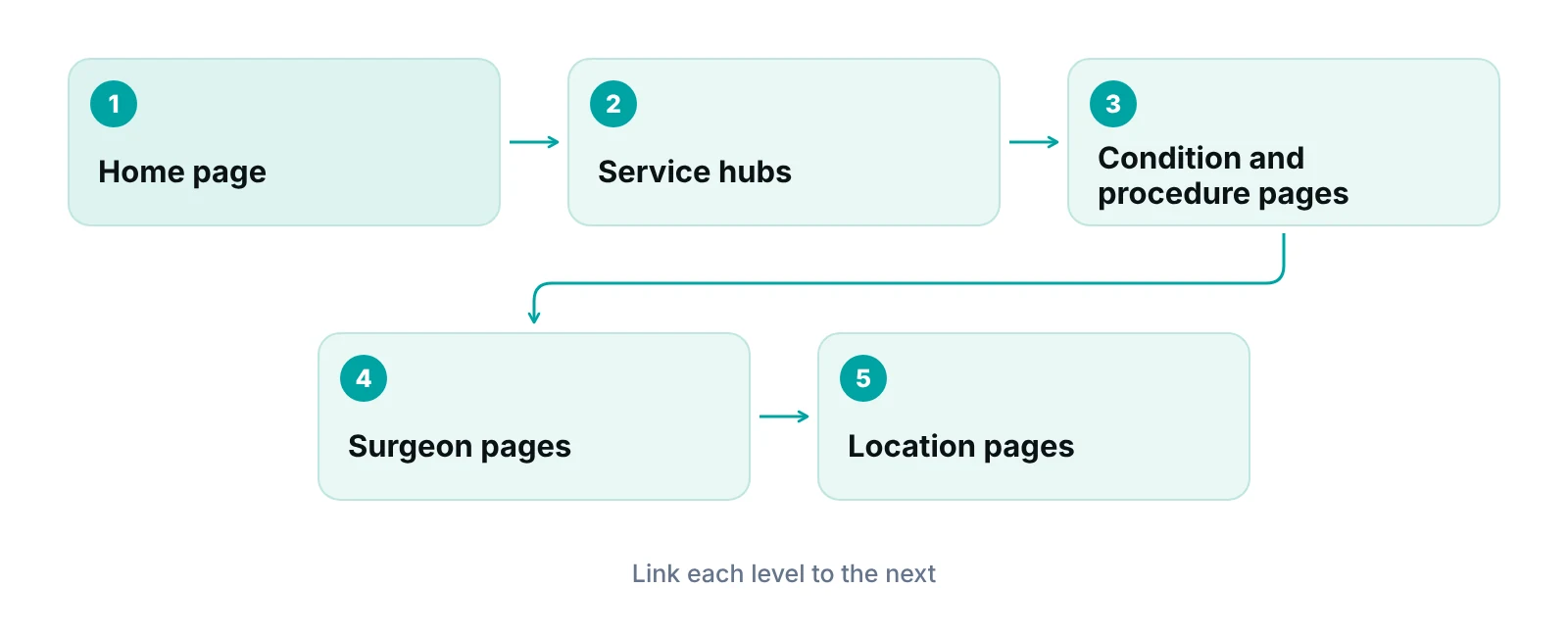
Avoid dozens of near-identical pages. Google’s spam policies describe scaled content abuse as many pages generated mainly to manipulate rankings (Google Search Central). Figure 1 shows a structure that mirrors how patients search.
What belongs on a surgeon bio?
A surgeon bio should let a patient check who is behind the care. Google says its systems give even more weight to strong E-E-A-T for health topics, that E-E-A-T is not a specific ranking factor, and that trust matters most (Google Search Central). It also asks that visitors can tell who wrote the content, and warns against fabricated authors and false credentials.
- Name and degree, as on the medical license.
- Training and fellowship, only when documented.
- Board certification, only when true, with a verification link. The American Board of Ophthalmology calls certification voluntary and lets the public verify it online, by phone or through the American Board of Medical Specialties (American Board of Ophthalmology).
- Conditions and procedures treated, each linked to its page.
- Offices where the surgeon sees patients.
- A real, recent photograph.
The Board’s FAQ notes that a state license is the legal minimum, and that license status and discipline sit with the state medical board (American Board of Ophthalmology). Have each surgeon approve the final bio in writing, and re-check it yearly.
“An eye surgeon's page is a clinical document with a phone number on it. Treat every claim like one.”
— Awais Afzal, Healthcare Operations & Data Analyst
Which schema markup does an eye practice need?
Start with LocalBusiness structured data for each location, in JSON-LD, and add nothing the visible page does not show. Google says the required properties are the business name and address, and recommends telephone, URL, coordinates and opening hours (Google Search Central).
- Mark up each real location on its own page, matching the profile.
- Schema.org’s Physician and MedicalClinic types accept a medicalSpecialty property, and its list includes Ophthalmology (Schema.org).
- Do not mark up reviews of your own practice on your own site. Google says review properties are for sites that collect reviews of other local businesses.
- Test with Google’s Rich Results Test and fix critical errors.
Markup is a label, not a lever
Google does not guarantee that features using structured data will show in results. Markup helps a search engine read a page. It does not replace an accurate profile or useful pages.
How do reviews fit into ophthalmology SEO?
Reviews feed prominence, and Google says replying to them can help a business stand out (Google). They also carry the strictest rules. Write the rules into your process before anyone asks a patient.
- Google prohibits paid or incentivized reviews, including discounts and free goods or services (Google Maps policy).
- Google also prohibits review gating: discouraging negative reviews, asking only for positive ones, or requiring staff to collect a set number.
- Asking for genuine reviews without an incentive is allowed. Google suggests a review link or QR code (Google Business Profile Help).
- The FTC’s reviews rule took effect October 21, 2024. As summarized by Hogan Lovells, it bars fake reviews, buying reviews tied to a rating, undisclosed insider reviews and review suppression, with civil penalties up to $51,744 per violation (Hogan Lovells).
Reply from a template your privacy officer has approved. A reply that confirms someone was a patient is a privacy question, not a marketing one. The online reputation management guide for doctors covers the process, and the HIPAA compliance checklist for medical practices the privacy side.
How should location pages work for a multi-office practice?
Give each real office its own page, and create none for places where you have no office. A location page earns its place with details true only for that office: address, hours, phone, parking, the surgeons seen there and the services offered.
Google’s spam policies describe doorway abuse as pages that target similar queries and funnel users to a less useful page. Its examples include multiple pages aimed at specific regions or cities (Google Search Central). A page for every nearby town with the town name swapped fits that pattern.
- One page per physical office, matched to one profile per office.
- Different content on each page: that office’s staff, hours and local details.
- Links from each location page to condition and procedure pages, and back.
- A local number answered by staff who can book. A virtual medical assistant service is one way to cover calls.
How do you track ophthalmology SEO without chasing the wrong numbers?
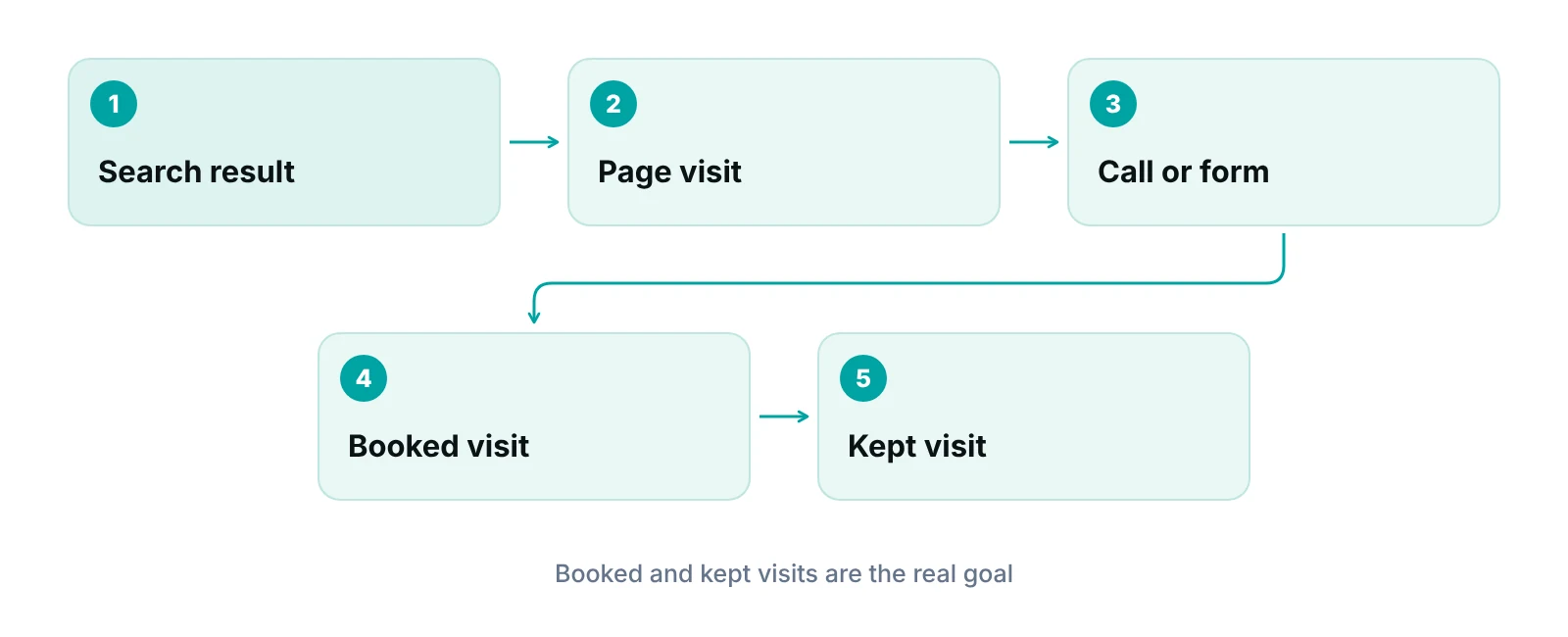
Track the whole path from search to kept visit. Search Console shows clicks, impressions, click-through rate and average position by query and by page (Google Search Console Help). Business Profile performance shows calls, direction requests and website clicks (Google Business Profile Help). Neither one shows a booked visit.
| Measure | Where it comes from | What it tells you | How it misleads |
|---|---|---|---|
| Queries and pages | Google Search Console Performance report | Which searches reach which pages (clicks, impressions, position) | Impressions can rise without a single booked visit |
| Profile actions | Business Profile performance | Calls, direction requests, website clicks and, with a booking provider, bookings | Counts are clicks, not conversations. Data includes Google Ads. Search terms update monthly. |
| Booked consultations by service | Scheduling records | Visits by service traced to a source | Needs the front desk to ask and record how patients found you |
| Kept visits and procedures | Practice management records | Whether the booked visit happened | Weeks pass between search and surgery |
Source: Google Search Console Help (Performance report) and Google Business Profile Help (performance and insights), read October 2026. Interpretation is RCM Finder’s.
The last two rows live in your own records. Ask every new patient how they found you, record the answer, and report booked and kept visits by service monthly. Figure 2 shows the path.
Scheduling pages and tracking tools need a privacy review
HHS OCR’s guidance says appointment scheduling pages can expose protected health information to a tracking vendor, which may then need a Business Associate Agreement. A court vacated part of the guidance in June 2024, and HHS says it is evaluating next steps (HHS OCR). Have your privacy officer review every analytics tag on booking pages.
Not sure what your eye practice is missing in search?
Send your website and Google profile. A free practice audit reviews the listing, pages and intake path against the points above.
Our recommendations
- Fix the listings before the website. We start with each office’s profile: name, categories, address, hours and phone. Errors there undo later content work.
- Decide the surgeon profile question once. Decide in writing which surgeons get a profile under Google’s practitioner rule, and who owns each login.
- Write one page per patient question. Give each condition, procedure and surgeon a page. Open with the answer.
- Verify credentials and name a reviewer. Check each board certification against the Board’s page. Put a clinician’s name and review date on every medical page.
- Write review rules into the front-desk process. Ask every patient the same way, offer no incentive, and reply from an approved template.
- Report booked and kept visits, not just rankings. Review Search Console, profile actions and scheduling records together monthly.
Bottom line
Ophthalmology SEO works when the listing is accurate, each patient question has a page, and every claim on those pages can be defended. Start with the profile, build the page types in Table 1, and measure kept visits. For help turning this into a plan, see the healthcare digital marketing service, then ask for a free practice audit. Related reading: ophthalmology medical billing, ophthalmology practice management and the ophthalmology medical billing guide, plus our revenue cycle management service.
Frequently asked questions
What is ophthalmology SEO?
Ophthalmology SEO is the work of making an eye practice’s website and Google listing easy to find when patients search for an eye doctor, a condition or a procedure. It combines an accurate Google Business Profile, condition and procedure pages, surgeon bios, honest reviews and tracking, and it is measured by booked and kept visits.
How is SEO for ophthalmologists different from other specialties?
Searchers often cannot tell an ophthalmologist from an optometrist, so the site has to state which it is. Practices also have several surgeons, procedure-led searches such as cataract surgery, and sometimes an optical shop or surgery center on site. Each raises a separate Google profile or page question.
Should each surgeon have a Google Business Profile?
Google’s guidelines allow a doctor who serves the public at the verified location to have a profile. With several practitioners at one location, the organization has its own profile and each practitioner’s profile is named for that practitioner. Support staff should not create profiles, and one surgeon should not create several.
Can we pay Google for a better local ranking?
No. Google states that there is no way to request or pay for a better local ranking. Local results rest on relevance, distance and prominence. Paid ads are a separate channel and appear separately. A profile that is complete, accurate and well reviewed gives Google the most to work with.
Can we offer patients a discount for a review?
No. Google prohibits incentivized reviews, including discounts and free goods or services, and the Federal Trade Commission’s rule bars buying reviews tied to a rating. A practice may ask every patient for a genuine review in the same way, without an incentive and without steering the rating or the content.
How long does ophthalmology SEO take to work?
No one can give a reliable timeline, and Google does not publish one. Results depend on competition, the state of the listing and the site, and how the practice handles the calls it receives. Track Search Console, profile actions and booked visits monthly, and judge the work on the trend in kept visits.
Get your free practice audit
Tell us about your practice. We will contact you using the details you give.
- A review of your recent claims, denials and A/R aging
- Where your front desk and prior authorizations slow payment
- A prioritized fix list you keep, whether or not you hire us
Pricing is quoted after the audit, based on your volume and the services you choose. Prefer to talk? Call +1 (302) 556-2288.
Sources
- Guidelines for representing your business on Google — Google Business Profile Help (2026)
- Tips to improve your local ranking on Google — Google Business Profile Help (2026)
- Prohibited and restricted content: fake engagement, incentivized reviews, review gating — Google Maps User Contributed Content Policy (2026)
- Local business structured data — Google Search Central (2026)
- Creating helpful, reliable, people-first content — Google Search Central (2026)
- Use of Online Tracking Technologies by HIPAA Covered Entities and Business Associates — HHS Office for Civil Rights (2026)
- Spam policies for Google web search — Google Search Central (2026)
- Performance report (Search) — Google Search Console Help (2026)
- MedicalSpecialty — Schema.org (2026)
- The Importance of Certification — American Board of Ophthalmology (2026)
- Verify a Physician FAQs — American Board of Ophthalmology (2026)
- FTC publishes final rule banning fake consumer reviews and testimonials — Hogan Lovells (secondary summary of 16 CFR Part 465) (2024)
- Understand your Business Profile performance and insights — Google Business Profile Help (2026)
- Difference between an ophthalmologist, optometrist and optician — American Association for Pediatric Ophthalmology and Strabismus (2026)
- Reply to reviews and ask for reviews — Google Business Profile Help (2026)
Disclaimer: This article is educational and is not legal, medical, coding or compliance advice. Advertising, privacy and medical board rules differ by state and change, and Google edits its guidelines often, so confirm current requirements with your attorney, privacy officer and the live Google pages before acting.