
Lab review ICD 10 coding has no single code, because reviewing a result is a task, not a diagnosis. Report the reason the provider documents: the symptom that prompted the test, an abnormal finding code such as R79.89 or R89.9, or the confirmed condition. Z01.89 is a special-examination code, not a default for result review.
Practices search for a lab review code because the task feels like it should have one. It does not, and the tempting shortcut, Z01.89 on a test ordered for a symptom, conflicts with the Z01 Excludes1 note.
This guide sorts the real situations: the lab order, the result visit and the stand-alone examination. It covers the Z01 notes, abnormal finding codes, the confirmed-diagnosis rule and the Medicare order and edit rules that decide medical necessity. It is for practice owners, lab billing managers and billers.
Key takeaways
- Lab review ICD 10 is a task, not a code; the documented reason picks the code.
- Z01.89 is a special-examination code and is excluded when a lab is done for a symptom.
- R79.89 and R89.9 describe a result with no diagnosis; a confirmed condition replaces them.
- Medicare requires the treating practitioner’s order and records, and applies national lab edits by diagnosis.
- Match the claim diagnosis to the order before release.
What does lab review ICD 10 actually mean?
Lab review ICD 10 is a search phrase, not a code. None of the ICD-10-CM codes examined for this guide carries “lab review” in its title. The phrase describes a task: a clinician reads a result, and the practice must choose diagnosis codes that match what the record shows. The right codes depend on three questions: why the test was ordered, what the result showed and what the provider documented afterward.
Some pages that rank for the phrase answer with a list of loosely related codes, such as chest pain, syncope and hypothyroidism, under one “lab review” heading. A list like that cannot tell a biller which code belongs on a claim, because the code follows the documentation, not the task. This guide works from the documented reason instead.
In billing practice the phrase usually points to one of three situations:
- The lab order. The test is billed with the diagnosis that justified the order. This is where medical necessity is decided.
- The result visit. The provider reviews the result and addresses a finding or a condition. The visit is coded from what the provider documents.
- A stand-alone special examination. The encounter exists to perform an examination, and a Z01 code gives the reason.
Scope of this guide
This post covers ICD-10-CM diagnosis codes only. For test codes, the Clinical Laboratory Fee Schedule and CLIA, read the laboratory billing and coding guide. For the records Medicare contractors ask lab claims to carry, see lab claim documentation rules.
Which ICD-10 code fits which lab review situation?
The code that fits is the one that matches the documented reason for the encounter. Code assignment is based on the documentation by the patient’s provider, according to the FY 2027 ICD-10-CM Official Guidelines (Section I.B.14), which apply to services from October 1, 2026 through September 30, 2027. A coder cannot pick a code from a lab value alone.
Category Z01 holds codes for the reason for an encounter, and a separate procedure code is still needed to show which exam or procedure was performed (RapidClaims code reference, FY2026). The Z01 notes also steer many lab situations away from Z01 altogether, as the table shows.
| Situation | Code family to consider | Why |
|---|---|---|
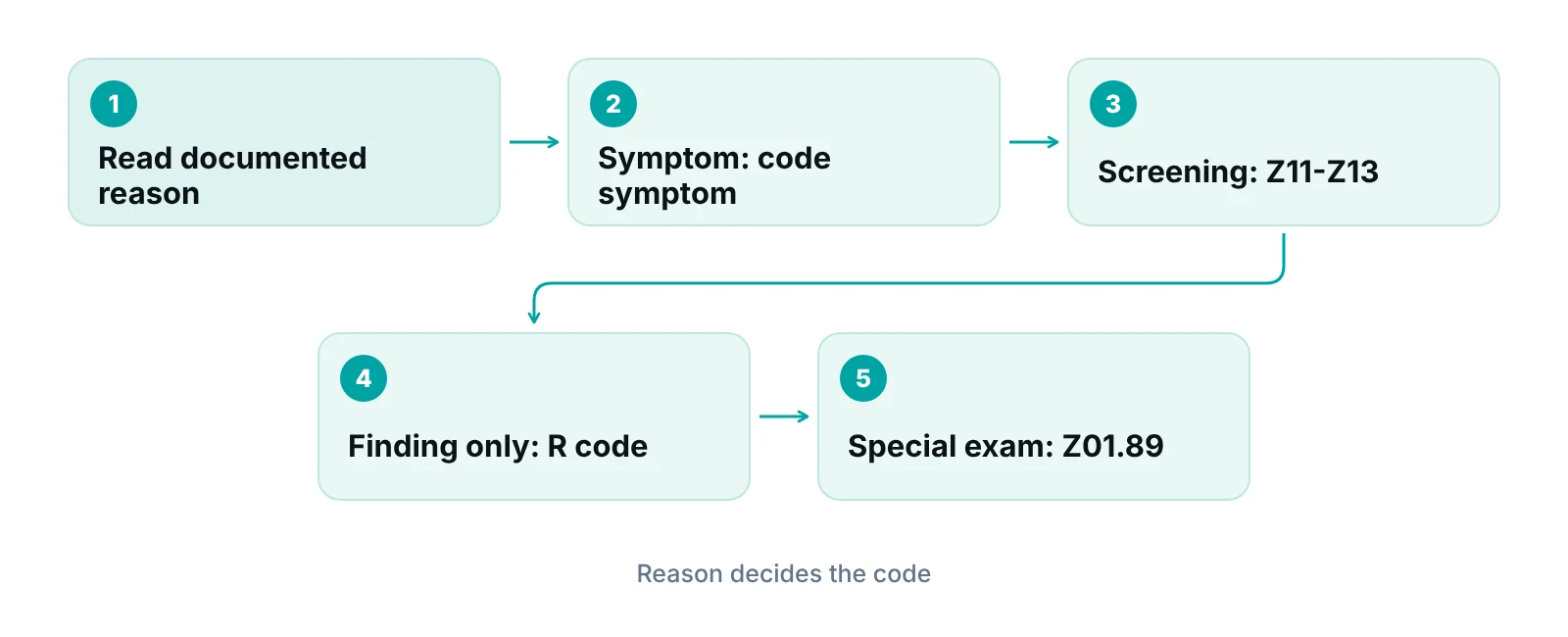
| The test was ordered because of a sign or symptom | The sign or symptom code | Z01 Excludes1 note: laboratory, radiologic and imaging examinations for signs or symptoms are coded to the sign or symptom |
| The result is abnormal and no diagnosis is documented yet | A finding code from R70-R79 (blood), R80-R82 (urine) or R83-R89 (other specimens) | These blocks are titled abnormal findings without diagnosis |
| The provider confirms a condition | The confirmed condition | Signs and symptoms are acceptable only when a definitive diagnosis has not been established |
| Labs are part of a general medical examination | Z00.0- | Z01 Excludes2 note points general-exam labs to Z00.0- |
| The lab is a screening test | Z11-Z13 | Z01 Excludes2 note points screening examinations to Z11-Z13 |
| Labs before a procedure | Z01.812, preprocedural laboratory examination | Part of subcategory Z01.81, preprocedural examinations |
| A special examination with none of the above | Z01.89 | Encounter for other specified special examinations |
Source: AAPC Codify, Z01.8 page (2026); RapidClaims ICD-10-CM reference, Z01.89 (FY2026) and Z01.81; CDC/NCHS FY 2027 Official Guidelines (I.B.4, I.B.18).
When is Z01.89 the right code, and when is it not?
Z01.89 is right only for an other specified special examination that no more specific path covers. Its title is “Encounter for other specified special examinations,” with the inclusion term “routine examination of specific system.” One code reference lists it as billable for FY2026 (RapidClaims). Confirm its status in the FY2027 tabular list before you load it into a template.
Z01.89 sits beside Z01.82 (allergy testing), Z01.83 (blood typing), Z01.84 (antibody response examination) and the Z01.81 preprocedural group (AAPC Codify, 2026). Z01.81 splits into Z01.810 (cardiovascular), Z01.811 (respiratory), Z01.812 (laboratory) and Z01.818 (other) (RapidClaims). Pre-surgery labs are covered in the pre-op ICD-10 codes guide.
Why the Excludes1 note matters
An Excludes1 note means “not coded here”: the two codes are not reported together, unless the conditions are unrelated, per Section I.A.12 of the FY 2027 guidelines. The Z01 note therefore blocks the common shortcut of putting Z01.89 on a lab ordered for a complaint. An Excludes2 note works differently: the conditions can be reported together when both apply.
Z01.89 is not a default for a result-review visit. If the visit exists to manage a symptom or a known condition, the claim carries that condition. A related question, the diagnosis for a visit after treatment is finished, belongs to the follow-up ICD-10 codes guide.
How do abnormal result codes such as R79, R82 and R89 work?
Abnormal finding codes describe a result when no diagnosis has been documented. The R70-R79 block covers abnormal findings on examination of blood without diagnosis, and R80-R82 does the same for urine; R89 covers abnormal findings in specimens from other organs, systems and tissues, and R97 covers abnormal tumor markers (Kodex ICD-10-CM, R89).
| Code or range | Title or scope | Note for the biller |
|---|---|---|
| R70-R79 | Abnormal findings on examination of blood, without diagnosis | Excludes2 note under R83-R89 points blood findings here |
| R79.89 | Other specified abnormal findings of blood chemistry | Shown as billable on a 2026 reference page |
| R80-R82 | Abnormal findings on examination of urine, without diagnosis | Urine findings |
| R89.0 to R89.5 | Abnormal level of enzymes, hormones, other drugs, other substances; abnormal immunological and microbiological findings, in specimens from other organs, systems and tissues | Specimens other than blood and urine |
| R89.6 and R89.7 | Abnormal cytological and histological findings in specimens from other organs, systems and tissues | Pathology-type findings |
| R89.8 and R89.9 | Other abnormal findings, and unspecified abnormal finding, in those specimens | Unspecified is a fallback, not a goal |
| R97 | Abnormal tumor markers | Excluded from R83-R89 by an Excludes2 note |
Source: Kodex ICD-10-CM, R89 entry; Unbound Medicine ICD-10-CM, R79.89 (2026). Block titles are as shown on those pages; check the FY2027 tabular list.
Two guideline points shape the choice. Codes that describe symptoms and signs are acceptable for reporting when a definitive diagnosis has not been established (Sections I.B.4 and I.B.18). Signs and symptoms that routinely go with a disease are not reported as extra codes (Section I.B.5), per the FY 2027 guidelines. Once the provider names the condition, the claim follows the diagnosis, not the number on the report.
How does the diagnosis support medical necessity for the lab order?
The diagnosis on a lab claim has to match an order that was written for a specific problem. Under 42 CFR 410.32, diagnostic tests must be ordered by the physician who is treating the beneficiary, and tests not ordered that way are not reasonable and necessary. Qualified nonphysician practitioners can order within their state and Medicare scope (eCFR, 42 CFR 410.32, current October 19, 2026).
The ordering practitioner must keep documentation of medical necessity in the patient’s record. The entity that submits the claim must keep the order documentation it received and be able to show the claim reflects that order. If Medicare asks and the record is not supplied, the claim is denied (paragraphs (d)(2) and (d)(3), same source).
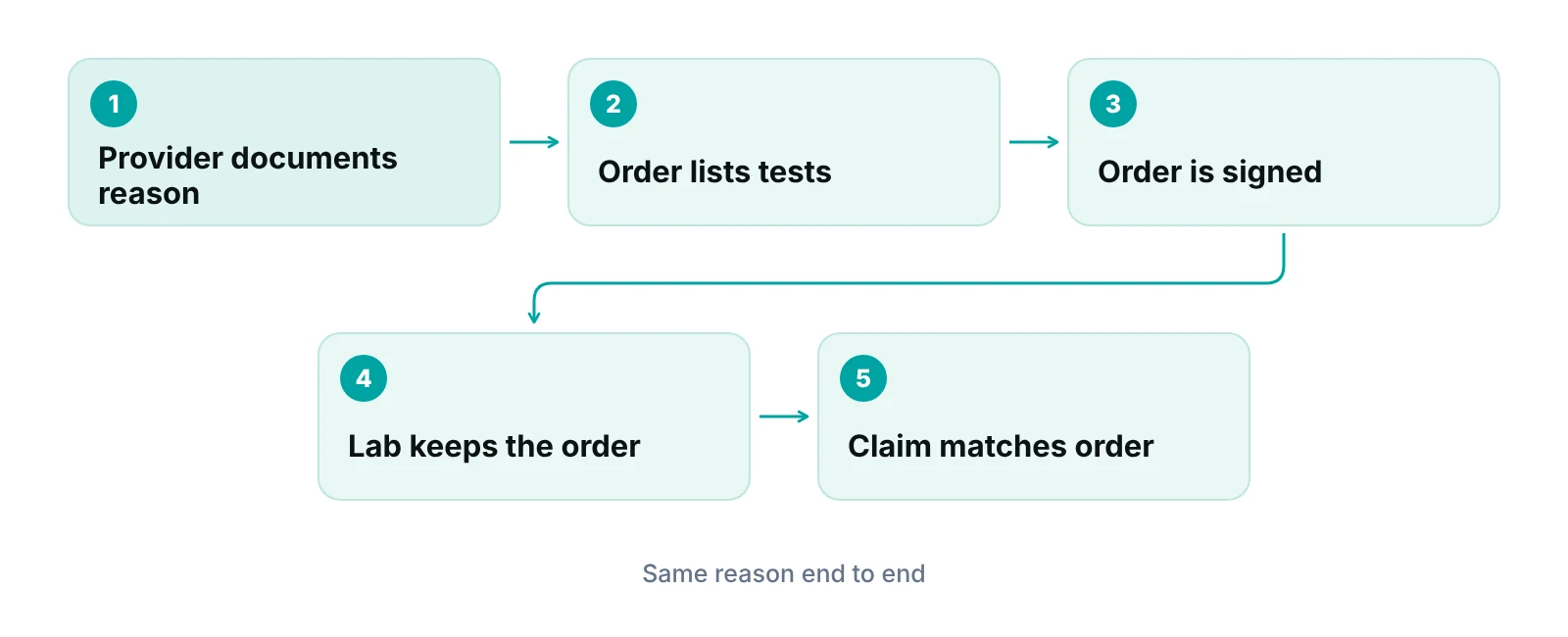
A CMS compliance fact sheet (December 2020) adds practical limits: vague phrases such as “run labs” do not show intent to order, orders and requisitions should be signed, and standing orders must be documented and individualized to each patient (CMS ICN MLN909221).
Medicare's national lab edits
Medicare checks many lab claims against national coverage rules. CMS processes 23 laboratory NCDs (Pub. 100-03, sections 190.12 through 190.34) in uniform edit software, with ICD-10-CM code lists that are covered or not medically necessary. A September 16, 2026 transmittal adds codes to several lists effective October 1, 2026, in the January 2027 release, with an implementation date of January 4, 2027 (CMS Change Request 14614). The Blood Counts NCD (190.15) is among those changed; the CBC ICD-10 code guide covers that test.
Medicare rules are not every payer's rules
The NCD edits and 42 CFR 410.32 describe Medicare. Other payers set their own lab policies and diagnosis lists, so check each payer’s current policy before you build a code list.
Where do lab diagnosis claims fail, and who fixes them?
Most failures trace to a gap between the order and the claim. The fix usually sits with the ordering provider or the front-end workflow, not with the biller at the end. The table maps common patterns to an owner.
| Pattern | Why it fails | Fix | Owner |
|---|---|---|---|
| Order says “run labs” | Vague phrasing does not show intent to order specific tests | Require named tests and a reason on every order | Ordering provider |
| Unsigned order or requisition | An unsigned requisition alone does not establish intent | Sign orders; use an attestation only for an unsigned note that shows intent | Ordering provider |
| Z01.89 on a test ordered for a symptom | Z01 Excludes1 sends symptom-driven labs to the symptom code | Build a rule that blocks Z01.89 when a symptom is documented | Coder |
| Diagnosis on the claim differs from the order | The submitting entity must show the claim reflects the order information | Compare claim diagnosis to order diagnosis before release | Billing |
| Diagnosis not on the Medicare NCD list | National edits check the ICD-10-CM list for that test | Review the NCD list for the test before the claim is released | Billing and provider |
| Record not produced on request | Insufficient documentation leads to denial | Keep order, note and result retrievable together | Practice manager |
Source: eCFR 42 CFR 410.32 (current October 19, 2026); CMS ICN MLN909221 (2020); CMS Change Request 14614 (September 2026); AAPC Codify, Z01.8 (2026).
A recurring pattern is worth working by cause. Denial work such as denial management services should sort denied lab lines into order, diagnosis and policy buckets before anyone appeals.
Are lab claims coming back on diagnosis?
Send a sample of denied lab claims with the orders behind them. A free practice audit shows whether the gap is the order, the code or the payer list.
How should a practice run lab review coding day to day?
A reliable workflow fixes the diagnosis at order time and revisits it when the result changes the picture. These steps keep the order, the visit and the claim aligned, and they sit inside medical billing services whether done in house or outsourced.
- Record the reason for the test in the order itself, in words the coder can map to a code.
- Send the lab the diagnosis that was documented at ordering, not a code assigned later.
- When a result changes the working diagnosis, have the provider document it in the visit note before coding.
- Keep screening, symptom-driven and preprocedural orders on separate templates so the right family is chosen up front.
- Review a small sample of lab claims each quarter against their orders.
None of this replaces payer policy. The same result can be a covered diagnostic test for one plan and a screening exclusion for another.
What do diagnosis-related denials cost you?
Use the revenue calculator to estimate the effect of denied and delayed claims before choosing where to start.
Our recommendations
- Make the reason for the test a required order field. Orders with a named reason are the starting point for every later code. Block orders that read only “labs” or “per protocol.”
- Code from the provider's words. Teach billers to code from documented reasoning and confirmed diagnoses, not from the lab value. Where the note is silent, send a query.
- Add a scrub rule for Z01.89. Hold any lab claim carrying Z01.89 when a sign or symptom appears in the same encounter. This applies the Z01 Excludes1 note automatically.
- Match claim diagnosis to order diagnosis. Compare the two before release. A mismatch is easier to fix at the desk than on appeal.
- Track NCD list updates each quarter. The Medicare lab edit lists change in quarterly releases. Assign one person to review each update and the tests your practice orders most.
- Keep a payer rule sheet for lab policies. Record each payer’s lab policy, the source and the review date, so a denial is checked against a written rule.
Bottom line
The lab review ICD 10 question is answered by documentation: the reason on the order, the finding in the note and the diagnosis the provider confirms. Fix the order template and a Z01.89 scrub rule first, then match claim diagnoses to orders. If lab denials keep returning, our medical billing services and denial management services can work them by cause, or you can talk to our team and ask for a free practice audit.
Frequently asked questions
Is there an ICD-10 code for lab review?
No code examined here is titled lab review. Code the documented reason for the encounter: the symptom, an abnormal finding such as R79.89, the confirmed condition, or a Z01 examination code when it applies. The result review itself is a task, so the diagnosis comes from the provider’s documentation.
Can I use Z01.89 for reviewing lab results?
Only when the encounter is an other specified special examination. Z01 has an Excludes1 note for laboratory examinations done for signs or symptoms, which are coded to the sign or symptom. Z01.89 is not a default for result-review visits. Check the current FY tabular list before loading it.
Which code applies to an abnormal lab result with no diagnosis?
An abnormal finding code from R70-R79 for blood, R80-R82 for urine or R83-R89 for other specimens, for example R79.89 or R89.9. Use it when the provider documents the finding but has not named a condition. Once a diagnosis is confirmed, report that diagnosis.
How does the diagnosis support medical necessity for a lab test?
The order must come from the treating practitioner and the record must show why the test was needed. Under 42 CFR 410.32, tests not ordered by the treating physician are not reasonable and necessary, and the claim must reflect the order information. Medicare also applies national lab edits by diagnosis code.
What is the difference between a screening lab and a diagnostic lab for coding?
A screening examination is coded to Z11-Z13 under the Z01 Excludes2 note, while a lab done because of a sign or symptom is coded to that sign or symptom. Coverage differs by payer and by test, so check the policy for each test before billing.
Who picks the diagnosis code, the practice or the lab?
The ordering practice documents the reason, and the lab bills with the order information it receives. Under 42 CFR 410.32 the submitting entity must keep the order documentation and show the claim reflects it. Set an agreed hand-off so the lab does not guess a diagnosis.
Get your free practice audit
Tell us about your practice. We will contact you using the details you give.
- A review of your recent claims, denials and A/R aging
- Where your front desk and prior authorizations slow payment
- A prioritized fix list you keep, whether or not you hire us
Pricing is quoted after the audit, based on your volume and the services you choose. Prefer to talk? Call +1 (302) 556-2288.
Sources
- FY 2027 ICD-10-CM Official Guidelines for Coding and Reporting — CDC/NCHS (2026)
- Z01.8 Encounter for other specified special examinations — AAPC Codify (2026)
- ICD-10-CM Z01.89 — RapidClaims code reference (2026)
- ICD-10-CM Z01.81 — RapidClaims code reference (2026)
- ICD-10-CM R89 — Kodex (Kode Health) (2026)
- R79.89 Other specified abnormal findings of blood chemistry — Unbound Medicine ICD-10-CM (2026)
- 42 CFR 410.32 Diagnostic x-ray tests, diagnostic laboratory tests, and other diagnostic tests — eCFR (National Archives/GPO) (2026)
- Provider Compliance Tips for Laboratory Services (MLN909221) — CMS (2020)
- Transmittal 13952, CR 14614: Laboratory NCD edit software, January 2027 update — CMS (2026)
- Lab Review ICD-10-CM Codes — Carepatron (2026)
- ICD-10-CM Official Guidelines (FY2026 table of contents) — RapidClaims (2026)
Disclaimer: This article is educational and is not legal, coding, billing, medical or compliance advice. ICD-10-CM codes, guidelines and Medicare coverage lists change each fiscal year and by quarter, and payer rules vary. Verify current requirements with the official code set, your payers and your counsel before you act.
