

Chiropractic marketing should match how the clinic is paid. Cash, commercial and Medicare patients need different offers, and every claim in an ad needs evidence behind it. Check the FTC substantiation rule, your state board's advertising rule, HIPAA marketing limits and Medicare's narrow coverage before a campaign goes live.
A new patient calls after seeing an ad that promised relief. The front desk finds the patient has Medicare, the offer was a free exam, and the ad used a patient story nobody signed off on. One campaign has now touched advertising law, privacy law and Medicare coverage. This guide is for chiropractic owners and office managers who want growth without that kind of surprise.
It covers the mix of payers that should shape the plan, what an ad may claim, how to handle testimonials, and how to test offers such as free exams and care packages. Channel detail sits in the cluster posts on chiropractic SEO and chiropractic digital marketing.
Key takeaways
- Plan around the payer mix. A trade summary of a 2020 national practice analysis put private pay at 36.3% of cases, so one message rarely fits every patient.
- Every health claim needs evidence on file. The FTC told one chiropractic clinic to stop claims it could not support and to review all of its other claims.
- State boards add their own limits. Texas, Minnesota and Florida texts bar guarantees, require patient consent for testimonials, or limit free-service ads.
- Medicare covers only manual manipulation of the spine to correct a subluxation, so offers must not imply broader coverage.
- Treat each offer as a rule check before launch: claims, fees, copayments, consent and tracking.
Which patients should chiropractic marketing be built around?
The clinic’s payer mix should set the plan. A message built for cash-pay wellness patients does not suit a Medicare patient with a covered diagnosis, and the reverse is also true. One trade summary of the 2020 NBCE practice analysis reported private pay or cash as the largest payment source at 36.3% of cases, followed by non-managed health insurance at 25.4%, Medicare or Medicaid at 14.3% and managed care at 9.3%. The summary did not explain the remaining 14.7%, and it is a trade-press account rather than the NBCE report, so treat the figures as a rough national picture and use the clinic’s own ledger.
| Payment source | Share of cases | What it means for marketing |
|---|---|---|
| Private pay or cash | 36.3% | Price, packages and membership terms are the offer; claim and fee-ad rules matter most |
| Health insurance (non-managed care) | 25.4% | Benefits checks and visit limits shape what can be promised |
| Medicare or Medicaid | 14.3% | Coverage is narrow; offers must not imply more than manipulation is covered |
| Managed care | 9.3% | Network rules and authorization steps apply before care begins |
Source: MPA Media summary of the NBCE Practice Analysis 2020; the remaining 14.7% of cases was not explained.
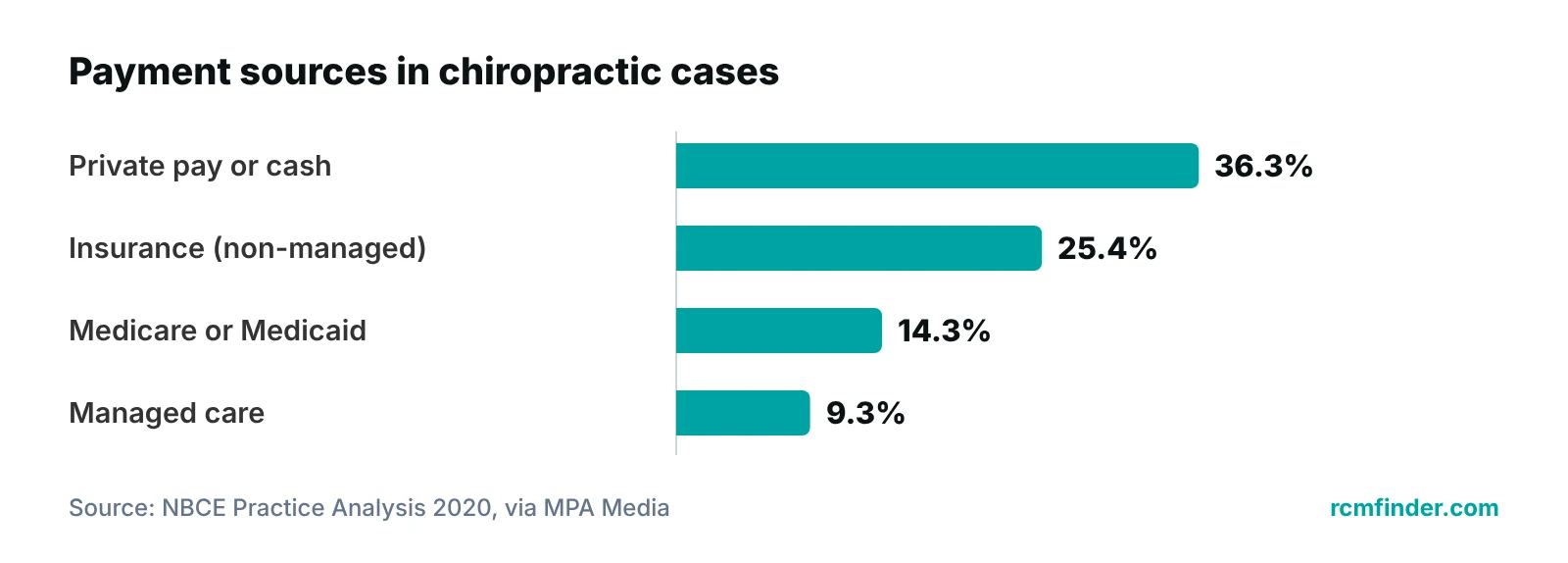
Pull the same split from the practice’s own reports before spending on ads. If most visits are cash, the front desk needs a clear fee conversation and the ad needs a fee statement that holds up. If the mix leans toward insurance, a benefits check before the first visit protects both the patient and the claim. The patient insurance verification guide explains that step.
What can a chiropractic ad claim?
An ad can claim only what the clinic can support with evidence, and the FTC treats claims about treating or preventing disease as the clearest example. In a February 5, 2021 warning letter, FTC staff told a chiropractic clinic to stop advertising chiropractic as preventing or treating COVID-19, to review all of its other service claims, and to drop any that lacked competent and reliable scientific evidence (FTC warning letter). The letter also listed possible court action. A guide from the Illinois Chiropractic Society makes the same point for ordinary service ads: express and implied claims both need support, and the overall impression counts.
State boards add rules. Texas rule 22 TAC 77.4 bars claims that chiropractic can cure any condition, claims that results are guaranteed, and claims not supported by scientific proof beyond testimonials. Minnesota rule 2500.0200 requires the licensee’s name in advertising and a signed patient release before a testimonial runs. Florida statute 460.413 lists false or misleading advertising and advertising discounted or free services without prominently stating the usual fee. Check your own state’s text, because these three differ.
| Claim in an ad | Why it is risky | Safer approach |
|---|---|---|
| Chiropractic prevents or treats a disease | FTC expects competent and reliable scientific evidence for disease claims | Describe the service and who it is for; leave out disease claims you cannot support |
| Results are guaranteed | Named as prohibited in the Texas rule | Describe the process and what the clinic will assess |
| Patient story with a result | Consumer endorsements are not evidence, and readers may take them as typical | Add what results are generally expected, or leave the story out |
| Free or discounted service | Florida text requires the usual fee to be stated | Show the regular fee beside the offer |
| Stock photo of a recovered patient | Can mislead if it misstates who the person is or what happened | Use real, consented images or clearly generic art |
Sources: FTC warning letter (2021); Texas 22 TAC 77.4; Florida Statutes 460.413; eCFR 16 CFR Part 255.
Evidence file
Keep a folder of the support behind each claim, with a date and a reviewer. If a board or the FTC asks, that folder is the answer.
How should testimonials and patient stories be handled?
Treat a testimonial as an advertisement with its own rules. Under the FTC’s Endorsement Guides, 16 CFR Part 255, a consumer endorsement about performance implies that the service works for that purpose, consumer endorsements are not themselves scientific evidence, and an ad that shows one person’s experience on a key point will likely be read as typical. The advertiser must either substantiate that experience or clearly disclose what results are generally expected.
Three more checks apply. First, the same guides say a connection between an endorser and the seller, such as free care or a discount, must be clearly disclosed when readers would not expect it. Second, the FTC’s consumer reviews rule, announced August 14, 2024 and effective October 21, 2024 per the Federal Register, prohibits fake reviews and buying reviews tied to a positive or negative sentiment, and it covers services. Third, privacy: HHS says the Privacy Rule generally requires written authorization before protected health information is used for marketing (HHS marketing guidance, last reviewed July 26, 2013). A patient story, photo or video that identifies someone belongs under a signed authorization, and the clinic’s HIPAA program should cover it. See the HIPAA compliance checklist for the wider program.
“A patient story is a promise someone else is making for the clinic. If the clinic cannot stand behind it, it should not run.”
— Awais Afzal, Healthcare Operations & Data Analyst
Are free exams, care packages and memberships safe to market?
They are safe only after each offer passes a short rule check, and the Medicare patient is the case that most often breaks the offer. Under 42 CFR 410.21, Medicare Part B pays for a chiropractor’s manual manipulation of the spine to correct a subluxation, and the CHIRO-001 billing guideline states that office visits, including history and physical, are non-covered when performed by a chiropractor. The CMS MLN chiropractic tool (March 2022) adds that active treatment is flagged with the AT modifier and maintenance therapy is not. The Medicare billing guide for chiropractors covers those rules.
Copayments are the second trap. The OIG has described a longstanding concern with routine waivers of Medicare copayments, noting that they may implicate the anti-kickback statute and the False Claims Act (OIG statement to the Practicing Physicians Advisory Council, December 13, 1999). An ad that says insurance copays are waived invites that question, so get counsel’s view before using one.
| Offer | Check first | Why |
|---|---|---|
| Free or low-cost exam | State fee-ad rule; Medicare coverage of the visit | Florida requires the usual fee; Medicare does not cover chiropractor E/M visits per CHIRO-001 |
| Prepaid visit package | Refund terms; insurance billing rules; state rules on advertised fees | Advertised fees that differ from fees billed to payers can breach state rules |
| Monthly membership | What is included; whether insured patients are billed differently | Keep the same fee structure visible to patients and payers |
| Waived copay or deductible | Counsel’s review; payer contract; Medicare rules | OIG has long flagged routine waivers |
| Medicare patient promotion | Whether care is active or maintenance; ABN process | ABN is issued only when a service is expected to be denied, not to everyone |
Sources: CMS CHIRO-001 guideline; CMS MLN1232664; CMS Claims Processing Manual ch. 30 s. 50; OIG (1999); Florida Statutes 460.413.
For Medicare patients, the CMS Claims Processing Manual, chapter 30, section 50 says the Advance Beneficiary Notice is issued before care that is expected to be denied and is not issued to every beneficiary as a blanket form. Marketing should not promise coverage the notice process contradicts.
What does a clinic-fit marketing plan include?
A workable plan is short enough for a small office to run. It names the patients the clinic wants, the message that fits each group, the proof behind that message, and the person who owns each step. Keep it to one page so it gets used.
- Audience by payer. Cash wellness, insured musculoskeletal, Medicare and injury-related patients each get a plain-language page and offer.
- Message and proof. Each claim is paired with its evidence, its reviewer and a review date.
- Offers. Each offer has written terms, a fee statement and a rule check on file.
- Channels. Pick a few and run them well; see the posts on local search and on ads, social and referrals.
- Owner and cadence. One named person reviews results monthly and signs off on new copy.
This is also where a practice decides what it will not do. Saying no to a guarantee, a cure claim or an unconsented photo is a marketing decision as much as a legal one, because it protects the licence the whole business depends on.
How does the plan turn an inquiry into a first visit?
Most marketing losses happen after the click, at the phone and the intake form. A short, written first-contact process fixes more than another ad does. The path is: capture the inquiry, answer within a set time, confirm the payer or cash terms, collect intake, and book the visit.
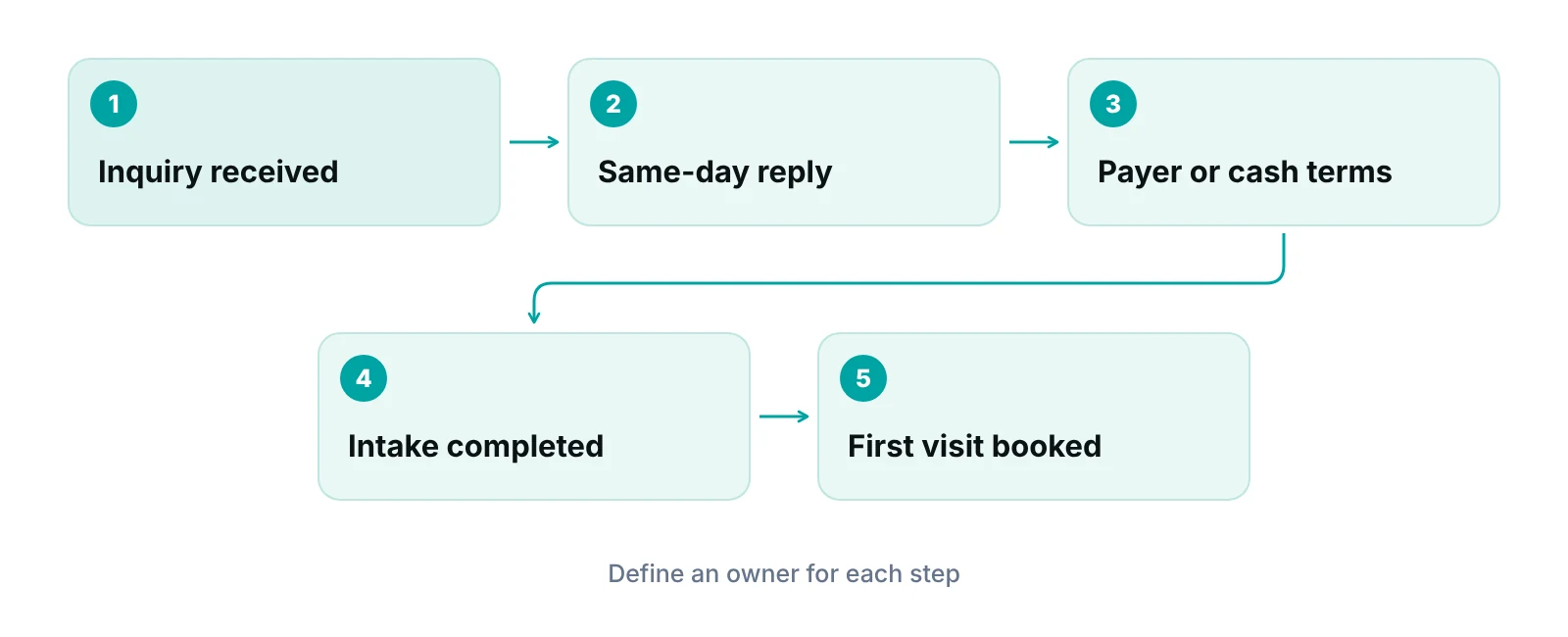
- Reply time. Set a target for answering calls, forms and messages, and review missed ones weekly.
- Terms up front. Say whether the visit is cash or insurance and what the first visit covers.
- Benefits check. Run it before the visit so the patient hears about limits first.
- Consent and intake. Send forms in advance through a secure method.
A Virtual Medical Assistant can staff this step: remote front-desk staff handle calls, scheduling, eligibility checks and intake in the practice’s own time zone. The front desk and revenue cycle post shows why that desk matters for revenue.
How should chiropractic marketing be measured?
Measure the full path from inquiry to a kept first visit, split by payer type. Counting calls and clicks alone hides the cost of a cash patient against a Medicare patient. Track a small set of numbers monthly and compare them with the practice’s own history, not a national benchmark.
- New-patient inquiries by source
- Inquiries that became booked first visits
- Booked visits that were kept
- Patients still in care at a set review point
- Payer type for each new patient
Pair that view with revenue. The medical marketing ROI guide explains how to connect spend to collected revenue, and the revenue calculator helps model what an added visit per week is worth. Whatever tools gather the data, keep patient details out of ad platforms unless a vendor has signed a Business Associate Agreement, as the digital marketing post explains.
See where new patients are being lost
A free practice audit reviews your inquiry-to-visit path, front-desk process and claim flow. Pricing is quoted after the audit.
Where does RCM Finder fit?
RCM Finder offers patient-growth marketing, Virtual Medical Assistants, end-to-end revenue cycle management and a practice management portal. For this topic, the healthcare digital marketing service is the matching page. The marketing work covers local SEO, Google Ads and reputation, and the same team looks at how the front desk converts the inquiries that arrive.
RCM Finder puts a Business Associate Agreement in place before accessing patient data. A marketing plan that sits on a clean billing process also avoids the situation where a campaign brings in patients whose claims then deny. The chiropractic billing services guide and practice management software guide cover those sides.
Our recommendations
- Start from the payer mix. Pull the last twelve months of visits by payer type and build one message per group before writing any ad.
- Keep an evidence file. Store the support for every health claim with a date and a reviewer, and review it when an ad is renewed.
- Read your state board's advertising rule. Print the section, mark testimonial, fee and guarantee language, and give it to whoever writes the copy.
- Get written authorization for patient stories. Use a signed authorization and, where your state requires it, a signed release before any testimonial, photo or video runs.
- Run each offer through the rule check. Test free exams, packages and memberships against fee-ad rules, payer contracts and Medicare before launch.
- Time the first reply. Set a response target for every inquiry channel and review misses weekly.
- Measure to the kept visit. Report inquiry to booked to kept to retained, split by payer type.
Bottom line
Chiropractic marketing works when the offer, the claim and the payer mix agree. Build around the patients the clinic actually serves, keep evidence for every claim, and check each offer against state board, FTC, HIPAA and Medicare rules. To review how your inquiries become kept visits, start with the healthcare digital marketing service page or request a free practice audit.
Frequently asked questions
What is the most important rule in chiropractic marketing?
Support every claim with evidence you can produce. The FTC expects competent and reliable scientific evidence for claims about treating disease, and state boards add their own limits on guarantees, cure claims and testimonials. Keep an evidence file and have someone other than the writer review each ad.
Can a chiropractor use patient testimonials in ads?
Yes, with controls. The FTC Endorsement Guides say consumer experiences are likely read as typical, so results need substantiation or a clear statement of expected results. Some states, such as Minnesota, require a signed release. Identifiable patient stories also need HIPAA authorization.
Does Medicare cover free exams or maintenance visits?
Medicare Part B covers manual manipulation of the spine to correct a subluxation, and CMS says the AT modifier marks active treatment, not maintenance. A CMS billing guideline says chiropractor office visits are non-covered. Do not advertise coverage that Medicare does not provide.
Are prepaid visit packages allowed?
Often yes, but rules vary by state and payer. Florida, for example, requires the usual fee when discounted or free services are advertised, and bars advertising a fee different from the one billed to payers. Have counsel review package terms and refund language.
Should the plan differ for cash and insured patients?
Yes. Cash patients respond to clear fees, terms and packages. Insured and Medicare patients need benefits checks and honest coverage statements. A national practice analysis summary put private pay at 36.3% of cases, but the clinic’s own ledger should decide the split.
Who handles the first call from an ad?
Assign an owner. A trained front-desk team member or a remote Virtual Medical Assistant can answer, confirm payer terms, collect intake and book the visit. Review missed calls weekly, because lost inquiries cost more than most ad adjustments save.
Get your free practice audit
Tell us about your practice. We will contact you using the details you give.
- A review of your recent claims, denials and A/R aging
- Where your front desk and prior authorizations slow payment
- A prioritized fix list you keep, whether or not you hire us
Pricing is quoted after the audit, based on your volume and the services you choose. Prefer to talk? Call +1 (302) 556-2288.
Sources
- Warning letter to Freedman Chiropractic Center (COVID-19 claims) — Federal Trade Commission (2021)
- Guides Concerning the Use of Endorsements and Testimonials, 16 CFR Part 255 — eCFR (current)
- FTC announces final rule banning fake reviews and testimonials — Federal Trade Commission (2024)
- Trade Regulation Rule on the Use of Consumer Reviews and Testimonials — Federal Register (2024)
- Texas Administrative Code 22 TAC 77.4, Misleading Claims — Texas Board of Chiropractic Examiners (via Justia) (2025)
- Minnesota Rules 2500.0200, Professional Standards for Advertising — Minnesota Board of Chiropractic Examiners (via Justia) (current)
- Florida Statutes 460.413, Grounds for disciplinary action — Florida Senate (2023)
- HIPAA Privacy Rule: Marketing — HHS Office for Civil Rights (2013)
- Statement to the Practicing Physicians Advisory Council — HHS Office of Inspector General (1999)
- NBCE Practice Analysis 2020: New Trends in Chiropractic — MPA Media (2020)
- MLN1232664 Chiropractic Services educational tool — CMS (2022)
- CHIRO-001 Chiropractic Services billing guideline — CMS Medicare Coverage Database (2015)
- Medicare Claims Processing Manual, Chapter 30, Section 50 (ABN) — CMS (current)
- Chiropractic Marketing Pitfalls: A Guide to FTC Compliance — Illinois Chiropractic Society (2023)
Disclaimer: This article is educational and is not legal, coding, tax or compliance advice, and it does not tell any clinician how to treat a patient. State board rules, payer policies and Medicare contractor policies differ and change, so confirm the current rule with your state board, your payers, your Medicare contractor and qualified counsel before you act. CPT is a registered trademark of the American Medical Association.