
Chiropractic digital marketing covers paid ads, social media, email and referral programs, and each channel has its own rules. Ad claims need evidence, tracking tools on booking pages need a privacy check, paid or free-care connections need disclosure, and referral rewards need legal review before launch.
A clinic runs a social ad for a spinal care offer, adds a tracking tag to the booking page to see what works, and thanks a local influencer with a free month of care. Each of those choices has a rule attached, and none of the rules is obvious from the ad dashboard. This guide is for chiropractic owners and managers who want to use digital channels on purpose.
It sorts the main channels by what they do well and which rules apply, explains how tracking technology meets HIPAA, and covers referral tools. The plan and the claims behind it are in the chiropractic marketing guide, and local search is in the chiropractic SEO post.
Key takeaways
- Pick channels by job: paid ads capture demand, social builds familiarity, email keeps patients, referrals bring trust.
- OCR treats appointment-page information as protected health information, so tags on booking pages need a Business Associate Agreement or authorization.
- Free care or discounts given to an endorser are a material connection that the FTC says must be clearly disclosed.
- HHS says marketing uses of patient information generally need written authorization; treatment communications are treated differently.
- Referral rewards and waived copays need legal review; OIG has long flagged routine copay waivers.
Which digital channels fit a chiropractic clinic?
Choose a channel for the job it does, then check the rule that goes with it. Paid search captures a patient who is already looking. Social media builds familiarity and shows the clinic’s character. Email keeps current patients in touch, and referrals bring trust from a person the patient already knows. The table pairs each with the main rule to check.
| Channel | Best use | Main rule to check |
|---|---|---|
| Paid search ads | Reach patients searching now | Claims need evidence (FTC); state board advertising text |
| Paid social ads | Reach an audience by area and interest | Same claim rules; tracking tags and audiences built from patient data raise HIPAA issues |
| Organic social posts | Show staff, care approach and community work | Endorsement disclosure; patient images need authorization |
| Email and text | Recalls, education and news to current patients | HIPAA marketing rules; consent rules for texts need counsel |
| Patient referral program | Encourage word of mouth | Reward design needs legal review; do not tie rewards to reviews |
| Professional referrals | Relationships with other clinicians | Payment for referrals is a legal risk; document clinical reasons |
Sources: FTC warning letter (2021); eCFR 16 CFR Part 255; HHS OCR tracking bulletin and marketing guidance; FTC reviews rule (2024); OIG (1999). Platform ad policies were not verified.
Each ad platform publishes its own health-advertising policy and changes it often. This article does not summarize them, so read the current policy inside the ad account before building a campaign. For the sections that follow, the regulators’ texts apply whatever the platform allows. The small practice marketing strategies post gives a general channel overview.
What can chiropractic ads and landing pages say?
They can describe the service, the clinic and how to book, and they cannot make claims the clinic cannot support. The FTC warned one chiropractic clinic in 2021 that claims about preventing or treating disease need competent and reliable scientific evidence (FTC warning letter). Texas rule 22 TAC 77.4 also bars guarantee and cure claims. Because an ad is short, it is easy to imply more than the clinic means, and the overall impression is what counts, as the Illinois Chiropractic Society guide notes.
Images need the same care. The FTC’s Endorsement Guides give examples in which stock photos that misstate who a person is, or before-and-after photos that imply typical results, mislead. For a clinic, use real, consented images or clearly generic art, and keep the claim support in an evidence file. The claim and offer rules are covered in the marketing guide, so this post does not repeat them.
A landing page should do one job: get the patient to book or call. Put the clinic name, location, phone number and booking link where a patient sees them first, keep the fee statement beside any offer, and avoid forms that ask for more health detail than the first contact needs. Every extra health question on a form is information the clinic must now protect, and any tag on that page may collect it.
How do tracking tags and remarketing meet HIPAA?
Treat every tag on a booking or intake page as a possible disclosure of protected health information. The HHS OCR bulletin on online tracking technologies (November 2022) says information collected when someone schedules an appointment is treated as protected health information whether or not the page requires a login, and that a tracking vendor receiving it for a covered function may be a business associate that needs a Business Associate Agreement. A disclosure without a permission or agreement may be a breach.
The bulletin also says cookie banners and privacy policy notices do not count as valid authorizations, and that asking a vendor to remove or de-identify information after receiving it is not enough. On June 20, 2024, a federal court vacated the part of the bulletin that treated a visit to an unauthenticated page about a specific condition or provider as triggering HIPAA, and HHS said it was evaluating next steps. The appointment-page language remains on the HHS page, so counsel should confirm the current position.
| Page or data | OCR position | Practical control |
|---|---|---|
| General information page (hours, staff, policies) | Generally not PHI | Standard analytics with a privacy review |
| Appointment scheduling page | Information collected is treated as PHI | Business Associate Agreement or authorization before any tag; or no third-party tags |
| Patient portal login and registration | Credentials and registration details are PHI | No third-party tracking |
| Symptom checker or intake form | Reason for care and contact details can be PHI | Keep tags off; use secure form delivery |
| Service page visited by someone seeking care | Position partly vacated June 20, 2024 | Counsel review before remarketing on these pages |
Source: HHS OCR, Use of Online Tracking Technologies by HIPAA Covered Entities (page last reviewed June 26, 2024).
A practical approach is to measure what happens outside patient pages: call counts, form submissions counted by a system the clinic controls, and booked and kept visits from the schedule. The HIPAA compliance checklist gives the wider program, and the practice management software post covers how booking and intake tools should be reviewed.
How should social media be handled?
Social posts follow the same advertising rules as any other ad, plus disclosure and consent rules. Under the FTC Endorsement Guides, a connection between an endorser and the clinic, such as free or discounted care, must be clearly and conspicuously disclosed when the audience would not expect it, and the guides say the advertiser can be liable for an endorser’s misleading statements and should monitor and correct them. If the clinic reposts an endorsement, the example in the guides says the clinic must disclose its relationship if the original did not.
The FTC consumer reviews rule (announced August 14, 2024; effective October 21, 2024 per the Federal Register) also bars buying fake indicators of influence, such as bot-generated followers or views, when the buyer knew or should have known they were fake. Buying followers does not build patient trust and creates legal exposure.
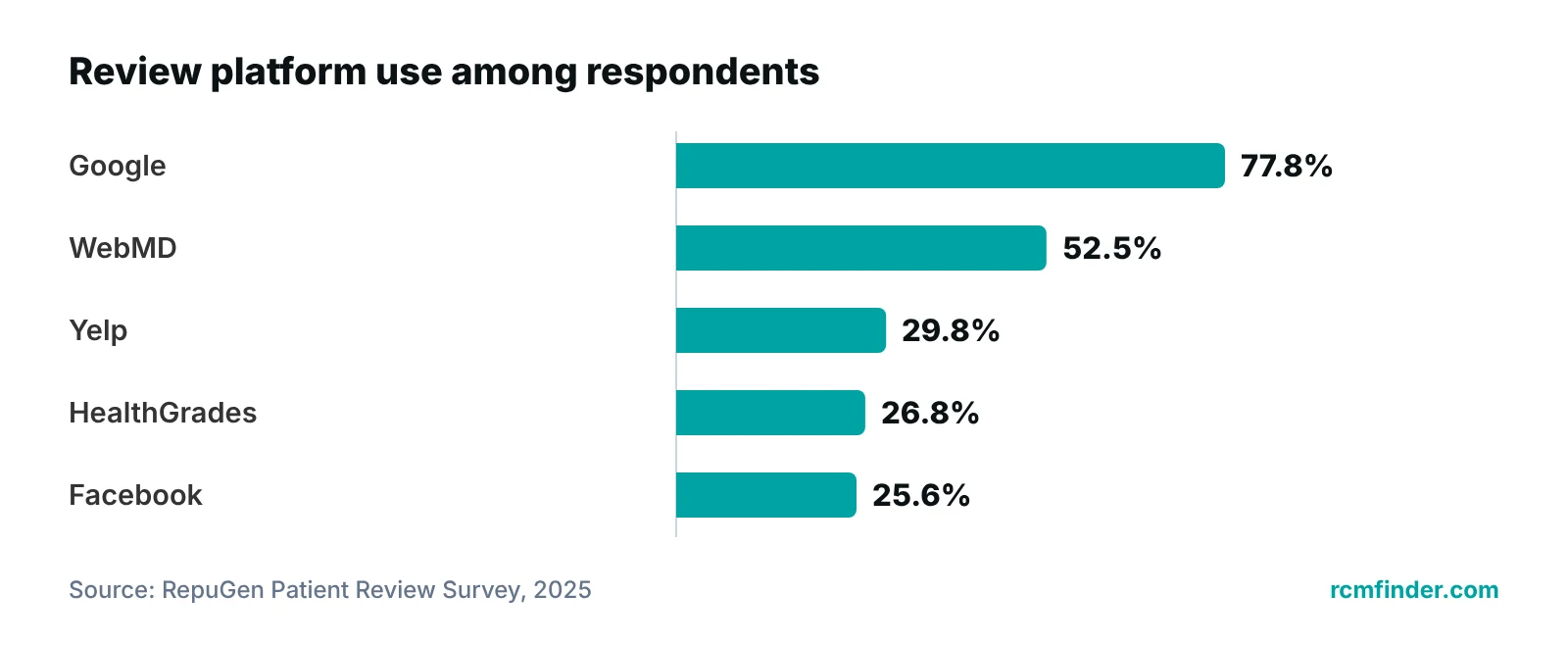
The same RepuGen survey of 1,212 U.S. respondents found Google was the most used review platform (77.78%) and Facebook the least of the five listed (25.56%). RepuGen sells reputation software, so treat it as one vendor’s data. The practical point is that social media supports the clinic, but the review profile and local search carry more weight when a patient is choosing, as the chiropractic SEO post explains. Keep patient names, photos and stories out of posts and replies unless a signed authorization is on file.
Do HIPAA marketing rules limit email and text?
Yes, depending on what the message says and who benefits. HHS explains in its marketing guidance (page last reviewed July 26, 2013) that marketing generally requires the patient’s written authorization before protected health information is used, and that the authorization must disclose any payment from a third party. Communications about the covered entity’s own health-related services, treatment communications and recommendations of alternative treatments are described as outside the definition. Face-to-face communications and promotional gifts of nominal value need no authorization.
In practice, a recall reminder or a message about care the patient already receives is a different matter from a message promoting a product that a vendor pays the clinic to push. Texting adds consent questions under telephone-marketing law that this article did not research, so get counsel’s review of the opt-in language and the message list. Keep message content minimal, and do not put a diagnosis in a reminder.
How can referral tools be used safely?
Referral programs are legitimate and common, and the risk sits in the reward and in the relationship. OIG has described a longstanding concern with routine waivers of Medicare copayments, saying they may implicate the anti-kickback statute and the False Claims Act (OIG statement, December 13, 1999), and the OIG’s third-party billing guidance notes that percentage arrangements for marketing services may implicate the anti-kickback statute (Federal Register, 1998). State rules add limits: Florida lists soliciting patients personally or through an agent, outside board-approved categories, as a ground for discipline (s. 460.413).
| Idea | Risk to consider | Check before launch |
|---|---|---|
| Reward for referring a friend | Anti-kickback and state solicitation rules, especially with federal program patients | Counsel review; keep rewards out of any Medicare-patient promotion |
| Reward tied to a review | FTC rule bars buying reviews tied to sentiment; Google removes rewarded reviews | Do not link rewards to reviews |
| Discount or waived copay | OIG flags routine copay waivers | Counsel and payer contract review |
| Thank-you note to a referring clinician | Low if no payment or value is tied to referrals | Keep it a note; record the clinical reason for the referral |
| Paid arrangement with another professional | Referral payments are a legal risk | Do not pay for referrals without counsel |
Sources: OIG (1999); FTC reviews rule (2024); Google contribution policy; Florida Statutes 460.413. This article did not verify a specific safe harbor.
Referral relationships with other clinicians work best when they rest on patient need: a primary care office sends a patient with spinal pain, or a chiropractor refers a patient whose symptoms call for medical evaluation. Keeping a written note of the clinical reason protects both sides if the relationship is ever questioned, and it keeps the focus on the patient instead of on the benefit to either office.
Referral tracking is a separate, safer tool. Add a ‘how did you hear about the clinic’ field to intake, record professional referrals in the chart’s referral field, and report new patients by source monthly. Referring a patient to another clinician for care is a treatment communication under HIPAA, not marketing, per the HHS guidance, so ordinary clinical referrals are not the concern here.
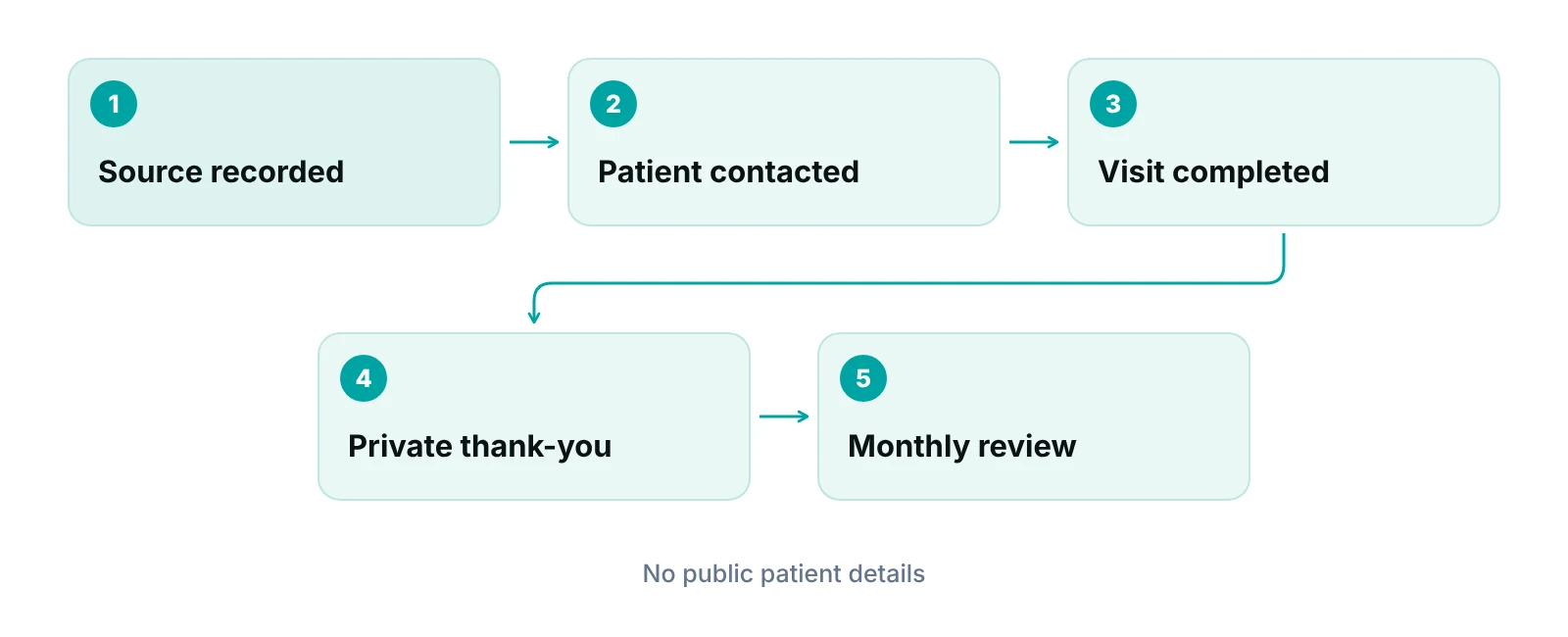
A safe loop records the source, thanks the referrer without rewards that raise legal questions, and keeps patient details out of public view.
How should the results be measured and who answers the calls?
Measure cost per kept new-patient visit by channel, not clicks. Digital channels create calls and forms, and the front desk decides how many become visits. Once the visit happens, the claim has to be clean, which the chiropractic billing services guide covers. A Virtual Medical Assistant can answer calls and forms in the practice’s time zone, handle scheduling and intake, and run eligibility checks, so inquiries are not lost after hours. The front desk and revenue cycle post explains why.
- Inquiries by channel and by payer type
- Booked, kept and retained visits by channel
- Spend divided by kept new-patient visits
- Share of inquiries answered within the clinic’s target time
- Complaints or opt-outs from email and text
Connect these numbers to revenue with the marketing ROI guide and test what extra visits are worth in the revenue calculator. RCM Finder’s healthcare digital marketing service covers local SEO, Google Ads and reputation, and RCM Finder puts a Business Associate Agreement in place before accessing patient data.
Check your funnel before adding spend
A free practice audit reviews how inquiries from ads and referrals become kept visits and where the front desk loses them. Pricing is quoted after the audit.
Our recommendations
- Choose channels by job. Assign each channel one goal and one owner, and drop channels that cannot be measured to a kept visit.
- Audit tags on every patient page. List each script on booking, intake and portal pages, and remove any that lack a Business Associate Agreement or authorization.
- Measure outside patient pages. Use call counts, schedule data and kept visits from a system the clinic controls.
- Disclose connections. State clearly when an endorser received free or discounted care, and monitor what endorsers post.
- Keep patient details out of public posts. Use signed authorizations for any identifiable story, photo or reply.
- Take referral rewards to counsel. Have counsel review any reward, discount or paid arrangement before launch.
- Answer every inquiry fast. Set a reply target, staff it after hours, and review missed contacts weekly.
Bottom line
Chiropractic digital marketing works when each channel has one job, one owner and one rule check. Keep ad claims supported, keep tracking tools off pages that collect health details unless a Business Associate Agreement is in place, disclose endorsements, and send referral rewards to counsel. For help with ads, local search and reputation, see the healthcare digital marketing service or request a free practice audit.
Frequently asked questions
Can a chiropractic clinic use a tracking pixel on its booking page?
Only with care. OCR’s bulletin treats appointment information as protected health information, so a vendor receiving it may need a Business Associate Agreement. Cookie banners are not valid authorizations. A court vacated part of the bulletin in 2024, so confirm the current position with counsel before adding any tag.
Do chiropractors have to disclose free care given to an influencer?
Yes, when the audience would not expect the connection. The FTC Endorsement Guides say free or discounted services are a material connection that must be clearly and conspicuously disclosed, and the advertiser can be liable for the endorser’s misleading statements. Monitor posts and ask for corrections.
Can a clinic text appointment reminders?
Often yes, but the rules depend on the content and consent. HHS describes treatment communications as outside the HIPAA definition of marketing. Texting also raises consent questions under telephone-marketing law that this article did not research, so have counsel review opt-in language and message templates.
Is a refer-a-friend reward allowed?
It depends on the state and the patients involved. State solicitation rules and the federal anti-kickback statute can apply, and OIG has long flagged routine waivers of Medicare copayments. Do not link rewards to reviews, and have counsel review the program before launch.
Which channel should a small clinic start with?
Start with the one closest to booking, usually a complete local profile and a simple paid search campaign to a booking page, then add email recalls. Measure cost per kept new-patient visit. Add social and referral tools once the front desk converts inquiries reliably.
What should be measured first?
Measure inquiries, booked visits, kept visits and payer type by channel, then spend per kept new-patient visit. Clicks and impressions do not pay bills. Gather the numbers from systems the clinic controls instead of third-party tags on patient pages.
Get your free practice audit
Tell us about your practice. We will contact you using the details you give.
- A review of your recent claims, denials and A/R aging
- Where your front desk and prior authorizations slow payment
- A prioritized fix list you keep, whether or not you hire us
Pricing is quoted after the audit, based on your volume and the services you choose. Prefer to talk? Call +1 (302) 556-2288.
Sources
- Use of Online Tracking Technologies by HIPAA Covered Entities — HHS Office for Civil Rights (2024)
- HIPAA Privacy Rule: Marketing — HHS Office for Civil Rights (2013)
- Guides Concerning the Use of Endorsements and Testimonials, 16 CFR Part 255 — eCFR (current)
- FTC announces final rule banning fake reviews and testimonials — Federal Trade Commission (2024)
- Trade Regulation Rule on the Use of Consumer Reviews and Testimonials — Federal Register (2024)
- Warning letter to Freedman Chiropractic Center — Federal Trade Commission (2021)
- Texas Administrative Code 22 TAC 77.4 — Texas Board of Chiropractic Examiners (via Justia) (2025)
- Florida Statutes 460.413 — Florida Senate (2023)
- Statement to the Practicing Physicians Advisory Council — HHS Office of Inspector General (1999)
- Compliance Program Guidance for Third-Party Medical Billing Companies — Federal Register / HHS OIG (1998)
- RepuGen Patient Review Survey 2025 — RepuGen (2025)
- Prohibited and restricted content (contribution policy) — Google Maps Help (2026)
- Chiropractic Marketing Pitfalls: A Guide to FTC Compliance — Illinois Chiropractic Society (2023)
Disclaimer: This article is educational and is not legal, coding, tax or compliance advice, and it does not tell any clinician how to treat a patient. State board rules, payer policies and Medicare contractor policies differ and change, so confirm the current rule with your state board, your payers, your Medicare contractor and qualified counsel before you act. CPT is a registered trademark of the American Medical Association.