
Urgent care digital marketing is the set of paid, owned and messaging channels that move a patient from a search to a front-desk check-in. Two choices carry most of the risk: how health-related paid search is targeted and measured, and what an online check-in or text tool collects before the patient arrives.
Most digital campaigns for urgent care are judged by how many people click. The more useful question is how many arrive, and the answer depends on three things the clinic controls: the ad rules it follows, the check-in step that sits between the click and the door, and the messages it sends once a patient has signed up.
This guide covers those three. It reads Google’s health advertising policies, the HHS pages on tracking technologies and marketing, and a law-firm summary of the FCC’s texting rules, and it applies them to paid search and online check-in. Wait-time wording and review rules sit in the urgent care marketing guide, and the Business Profile and location pages in the urgent care SEO guide.
Key takeaways
- Google treats health as a sensitive interest category, so advertiser-curated audiences such as customer lists and lookalikes cannot be used for health-related ads.
- Location targeting and predefined audiences remain available, which suits a walk-in business with a service radius.
- An online check-in or scheduling tool may have access to PHI, so it needs a privacy review before any ad pixel is placed near it.
- Texts to wireless numbers carry consent rules, and promotional texts are treated more strictly than operational ones.
- Campaign settings should follow posted hours and clinic capacity, and the wait claim in the ad has to be one the clinic can prove.
What does urgent care digital marketing include?
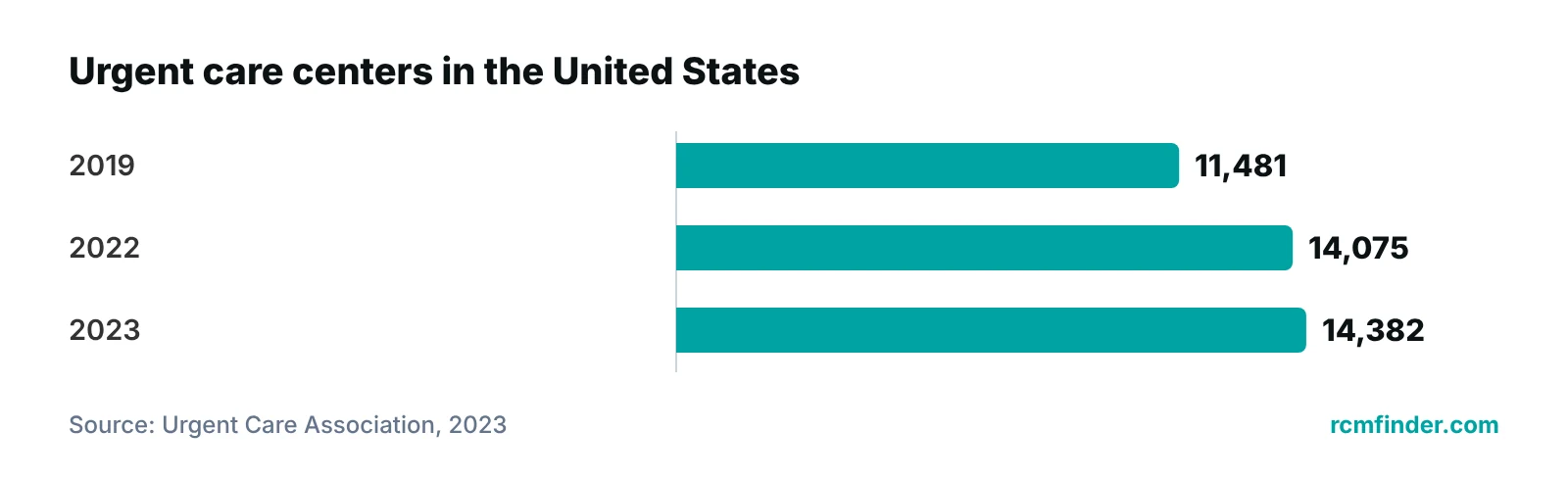
It covers every channel that can move a patient from a search to a check-in: paid search, the Business Profile, the website, an online check-in or queue step, and text or email messages. The Urgent Care Association’s 2023 white paper counted 14,382 centers in July 2023, up from 11,481 in 2019 (Urgent Care Association), so more sites now compete for the same nearby searches.
Digital channels differ from other clinic marketing in one respect: the decision window is short and the patient is often already unwell. That raises the cost of a misleading ad and of a clumsy check-in. Local search mechanics are covered in the urgent care SEO guide; this guide starts where the click does.
What do Google's rules mean for urgent care paid search?
Google’s healthcare and medicines policy does not mention urgent care by name, and it restricts a defined list of categories. As read for this guide, the page requires certification or accreditation for categories such as online pharmacies and telemedicine, addiction services, prescription drug services and health insurance in the United States, and it does not allow promotion of speculative or experimental treatments or marketing of non-approved products as safe or effective (Google Ads policy). A clinic that advertises only walk-in care, X-rays and everyday illness and injury sits outside most of that list, but a virtual visit offer, a medication or an addiction service on the same landing page can bring a restricted category into play.
The second policy matters more day to day. Google’s page on health in personalized advertising says health content, including physical or mental health conditions and related treatments, is a sensitive interest category, and that advertiser-curated audiences cannot be used when promoting in it. Customer match, your data segments, audience expansion and lookalike segments are listed. Predefined Google audiences, including in-market segments and location targeting, remain available (Google Ads policy). For a walk-in clinic, location targeting is the natural fit anyway.
| Setting | What the policy pages say | What it means for urgent care |
|---|---|---|
| Customer lists (customer match, your data segments) | Not usable when promoting in a sensitive interest category such as health | Do not upload patient lists for health-related ads |
| Lookalike segments and audience expansion | Listed as advertiser-curated audiences that cannot be used | Rely on keywords and location instead |
| In-market and affinity audiences, location targeting | Predefined audiences remain available | Target a radius around each site |
| Telemedicine or addiction service offers | Need accreditation and certification in the United States, as read | Check before advertising a virtual visit or addiction care |
| Speculative or unproven treatments | Not allowed | Keep ad copy to ordinary services the clinic provides |
| Ad claims such as wait times | Not covered by these pages; FTC substantiation applies | Keep proof on file, as in the marketing guide |
Source: Google Ads policy, Healthcare and medicines; Google Ads policy, Health in personalized advertising; FTC advertising substantiation statement (1983). Policy pages are undated.
Ad copy deserves the same discipline as the landing page. Headlines should describe services the clinic provides on site, the posted hours and the plans it accepts, and should leave out the word emergency, superlatives with no comparison behind them and any quoted patient story that is not typical. The FTC’s Endorsement Guides page says an endorsement describing exceptional results will be read as typical, and that a disclosure of a material connection belongs close to the endorsement (FTC). Short ads leave little room for disclosure, which is a good reason to quote no patients at all.
The claim side is the FTC’s. A promised or posted wait is an objective claim, and the FTC’s substantiation policy says an advertiser needs a reasonable basis before the ad runs (FTC). The urgent care marketing guide sets out the proof to keep, and a 2019 trade commentary on advertised waits explains why the measure needs a definition (JUCM).
How should campaigns follow clinic capacity?
Settings should follow the clinic’s hours and its ability to see people, not just the budget. An ad that sends ten people to a waiting room already at capacity creates the bad review that the next ad has to overcome. The controls below are operational, and none depends on a particular platform feature.
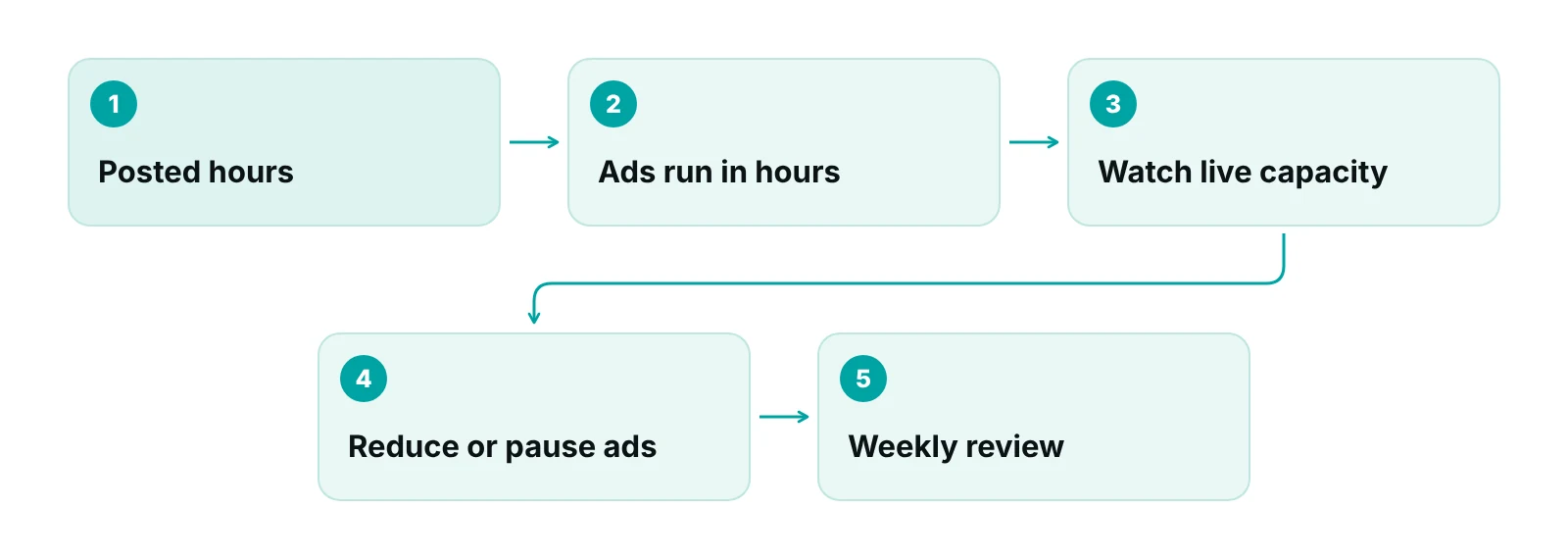
- Run ads only when the clinic is open and staffed, and make the hours in ads identical to the Business Profile, which Google says should show regular customer-facing hours (Google guidelines).
- Agree a trigger, such as a waiting room above a set size, at which spend is reduced or paused, and name who can do it.
- Use location targeting around each site and send each ad to that location’s page, not a generic one.
- Keep ads and landing pages for each site on the same insurance list the front desk uses.
- Review the weekly pattern of clicks, check-ins started and patients arrived, and adjust the schedule.
Google also notes that there is no way to pay for a better local ranking (Google Business Profile Help), so paid search and the Business Profile are separate levers and should not be treated as substitutes. For measurement across channels, the medical marketing ROI guide sets out a general approach.
What does an online check-in step collect, and is it PHI?
It can collect information that identifies a person and shows a health need, and HHS says tools of this kind may have access to PHI. The HHS tracking technologies bulletin, last reviewed June 26, 2024, says tracking technologies on many unauthenticated pages do not have access to PHI, but that appointment scheduling or symptom-checker tools that need no login may have access to PHI in certain circumstances. The same page notes that a federal court vacated the part of the guidance on linking IP addresses to visits to unauthenticated pages on specific conditions or providers, and that HHS was evaluating its next steps (HHS OCR).
| Step | What may be collected | Control to put in place |
|---|---|---|
| Landing page with hours and address | Visit data only | General information page; keep it simple and accurate |
| Reserve a spot | Name, phone, arrival time | Treat as potentially PHI; sign a business associate agreement with the tool vendor; no ad pixels on the page |
| Reason for visit or symptom entry | Health information | Highest sensitivity; no third-party tracking; minimum data needed |
| Insurance card upload | Identity and coverage details | Encrypted transfer; role-based access; retention rule |
| Confirmation or queue text | Phone number, message content | Consent captured first; operational content only |
| After-visit review request | Contact details | Same invitation to every patient, no incentive |
Source: HHS OCR online tracking bulletin (page reviewed June 26, 2024); HHS sample business associate agreement provisions (2013); Google contributed content policy.
A business associate agreement is the usual instrument for a vendor that handles PHI for the clinic. HHS’s sample provisions cover permitted uses, safeguards, breach reporting, subcontractors, return or destruction of information and termination (HHS, January 25, 2013). Marketing use of that information is a separate question: HHS describes marketing as a communication encouraging use of a product or service and says it generally needs written authorization, with exceptions for the clinic’s own services and for face-to-face communication (HHS). The practice’s HIPAA compliance checklist is the place to record who approved each tool.
How can texting be used without creating a consent problem?
By keeping messages operational and capturing consent first. A law-firm summary of the FCC’s July 2015 order says autodialed or prerecorded calls and texts to wireless numbers generally need prior express consent, that advertising and telemarketing messages need prior express written consent, and that a narrow healthcare exemption allows certain HIPAA-covered messages without consent when strict conditions are met, including a free-to-recipient message, 160 characters or fewer, no more than one message a day and an immediate honored opt-out by replying stop. The exemption does not cover marketing, billing or payment messages (Kutak Rock). That summary is secondary and ten years old, so counsel should confirm the current rule.
Consent is collected at check-in, not after
Capture agreement to receive texts in the same step that takes the phone number, say what messages will be sent, keep promotions out of operational texts and honor stop requests at once. Review the flow with counsel before launch.
How should results be measured?
Measure arrivals, not clicks, and write down each definition. Table 3 lists the measures that tie a campaign to the front desk.
| Measure | Definition to write down | Caution |
|---|---|---|
| Calls from ads | Answered calls lasting more than a set time | Missed calls in busy hours understate demand |
| Check-ins started | Number of check-in forms begun | Count events without names, symptoms or other identifiers |
| Patients arrived | Check-ins that became registered visits | Needs a match to the registration record handled under privacy rules |
| Wait shown to patients | The measure and time of the last update | Use the same definition as the ad claim |
| Cost per arrived patient | Spend divided by arrived patients for the same period | Use one period and one rule for attributing visits |
Source: editorial framework; definitions should be agreed in writing before a campaign starts.
Conversion tracking is where measurement meets privacy. Aggregate counts of events are usually easier to defend than data sent to ad platforms with identifiers, and any tag on a check-in page belongs in the review described above. The small practice marketing strategies guide and the healthcare SEO guide offer broader context.
“A click is a promise the clinic has not kept yet. The arrival is the only number that proves it was.”
— Awais Afzal, Healthcare Operations & Data Analyst
Calls from ads reach the front desk first. RCM Finder’s Virtual Medical Assistant service supplies remote front-desk staff who answer from the clinic’s script, check eligibility and take intake details, in the clinic’s own time zone and inside its existing EHR. The healthcare digital marketing service page describes how campaigns are planned around that front desk.
How does digital demand connect to the back office?
Every arrival from a campaign becomes a registration and, if coverage is wrong, a denial later, so the digital side and the billing side share the same facts. The urgent care revenue cycle management guide follows an arrival to payment, and the guide to urgent care practice management software covers the data the systems must carry.
Want the front desk and the campaign to say the same thing?
Request a free practice audit and RCM Finder will review how calls, check-ins and registrations line up with the ads. The audit is free.
Our recommendations
- Use location targeting and keywords for health-related ads. Do not upload patient lists or build lookalike audiences for health-related campaigns, in line with Google’s sensitive interest rules.
- Match ad hours to the Business Profile. Run ads only when the clinic is open and staffed, and keep the hours identical everywhere.
- Agree a capacity trigger. Decide the waiting room level at which spend is reduced or paused, and name the person who can act.
- Review the check-in flow before launch. Have the privacy officer approve the tool vendor agreement and every tag on the check-in pages.
- Capture text consent at the same step as the phone number. Say what will be sent, keep promotions apart from operational messages and honor stop requests at once.
- Report arrivals, not clicks. Write down definitions for calls, check-ins started and patients arrived, and review them weekly.
Bottom line
Urgent care digital marketing works best when the ads, the check-in step and the messages are built around what the clinic can serve and what the rules allow: location-based health ads, a privacy-reviewed check-in flow, consented texts and arrivals as the measure. RCM Finder’s healthcare digital marketing service page explains how that planning is done, and the guide to urgent care marketing covers the claims that go in the ads.
Frequently asked questions
Can an urgent care use remarketing lists in Google Ads?
For health-related ads, no. Google lists health as a sensitive interest category and says advertiser-curated audiences such as customer match, your data segments, audience expansion and lookalikes cannot be used. Predefined audiences and location targeting remain available. Check the live policy page before building a campaign.
Does Google Ads restrict urgent care advertising?
Google’s healthcare policy does not name urgent care, but it restricts categories such as telemedicine, addiction services and prescription drugs, and bans speculative treatments. A clinic advertising walk-in care is usually outside those lists, but an offer for a virtual visit or addiction service can bring a restricted category into play.
Is an online check-in form covered by HIPAA?
It can be. HHS says appointment scheduling and symptom-checker tools that need no login may have access to PHI in some circumstances, and it expects regulated entities to review tracking on such pages. Part of that guidance was vacated in 2024, so confirm the current position with counsel.
Can an urgent care text patients about their place in line?
Operational texts are treated differently from promotions, but consent rules apply to autodialed texts to wireless numbers. A summary of the FCC’s 2015 order describes a narrow exemption with strict conditions. Collect consent when the phone number is taken and have counsel confirm the current rule.
What should an urgent care measure first in digital marketing?
Patients arrived, with a written definition. Clicks and calls are inputs. Count check-ins started without identifiers, match arrivals under privacy rules and divide spend by arrivals for one period.
Is urgent care digital marketing worth doing separately from SEO?
They serve the same patient at different moments. Local search captures people who are looking now, and paid search can fill gaps in hours or locations. The channels share the same hours, insurance list and wait claims, so a single owner and a single fact sheet keep them consistent.
Get your free practice audit
Tell us about your practice. We will contact you using the details you give.
- A review of your recent claims, denials and A/R aging
- Where your front desk and prior authorizations slow payment
- A prioritized fix list you keep, whether or not you hire us
Pricing is quoted after the audit, based on your volume and the services you choose. Prefer to talk? Call +1 (302) 556-2288.
Sources
- Healthcare and medicines — Google Ads policy help (2026)
- Health in personalized advertising — Google Ads policy help (2026)
- Use of Online Tracking Technologies by HIPAA Covered Entities and Business Associates — HHS Office for Civil Rights (2024)
- Marketing — HHS Office for Civil Rights (2026)
- Sample Business Associate Agreement Provisions — HHS Office for Civil Rights (2013)
- FCC clarifies TCPA robocall rules for health care (summary of the 2015 FCC order) — Kutak Rock LLP (2015)
- FTC Policy Statement Regarding Advertising Substantiation — Federal Trade Commission (1983)
- Advertised ED Wait Times Negatively Skew Patient Perceptions Regarding Nonemergent Encounters — Journal of Urgent Care Medicine (Alan Ayers) (2019)
- 2023 Urgent Care Industry White Paper — Urgent Care Association (2023)
- Guidelines for representing your business on Google — Google Business Profile Help (2026)
- How to improve your local ranking on Google — Google Business Profile Help (2026)
- The FTC's Endorsement Guides: What People Are Asking — Federal Trade Commission (2026)
Disclaimer: This article is educational and is not legal, compliance or advertising advice. Platform policies change often and HIPAA, FCC and state rules vary. Confirm current requirements in the platform's own pages and with qualified counsel before running a campaign or launching a messaging feature.