
Urgent care marketing works when every promise is one the clinic can prove on a busy Saturday. The limits are narrow but real: objective claims such as wait times need a reasonable basis before they run, the word emergency can trigger state and federal rules, reviews carry disclosure duties, and HIPAA limits patient messages.
Urgent care is chosen in minutes, often by someone already worried, and the whole offer is speed and access. A few claims do most of the selling in an ad: how long the wait is, how late the doors stay open, whether the clinic takes the caller’s plan and whether it can handle the problem. Each of those can be tested by a regulator, a search platform or a patient who waited longer than the ad said.
This guide is for urgent care owners and marketing managers. It sets out the rules that reach those claims, what proof to keep and how to word them more safely. Channel tactics are covered in the companion posts on urgent care SEO and urgent care digital marketing.
Key takeaways
- A wait time, an hours claim or a plan list is an objective claim and needs evidence on file before it runs.
- There is no standard definition of wait time, so the ad should say what is being measured.
- Illinois bars facilities from holding themselves out as emergency care centers but allows urgent care branding; hospital-owned sites face a federal definition tied to how they are presented.
- Selective review requests, incentives and undisclosed staff reviews break Google policy and FTC rules.
- HIPAA lets a clinic describe its own services, but replying to a review with patient details has already cost a dental practice $23,000.
What makes urgent care marketing different from other clinic marketing?
The offer is access, so the claims are about time and availability. The Urgent Care Association’s 2023 industry white paper defines an urgent care center as one that accepts unscheduled, walk-in patients during all posted hours, and it counted 14,382 centers in the United States as of July 2023 (Urgent Care Association). With that many sites competing for the same searches, the pull to promise more than a busy day allows is strong.
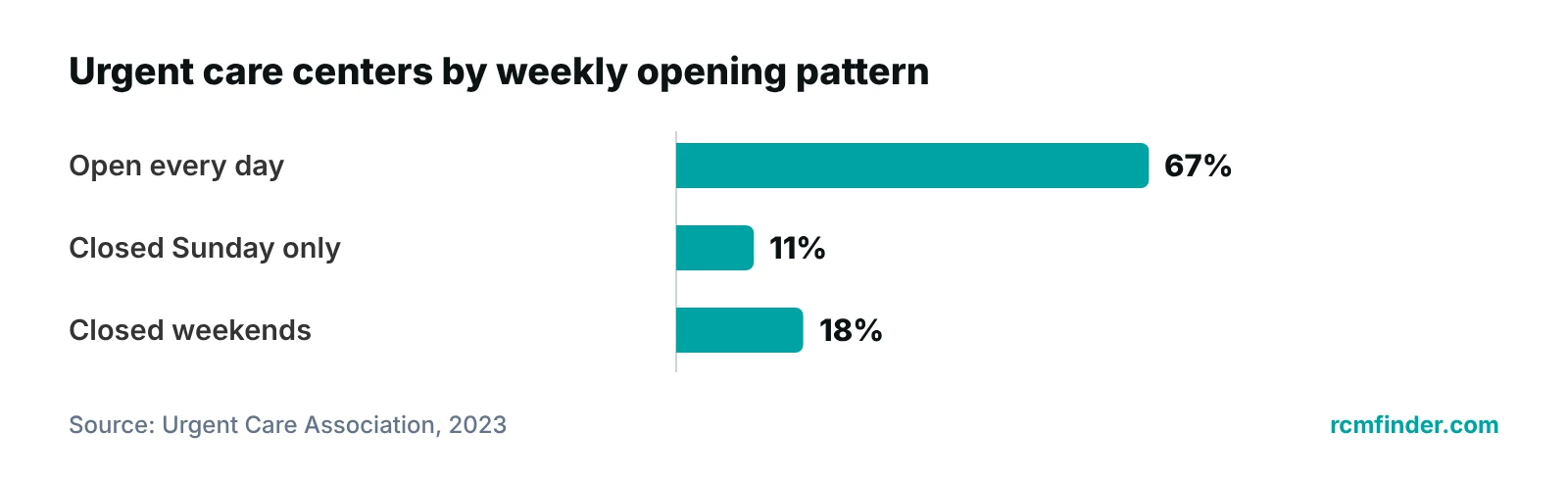
Hours show the problem well. The same white paper reports that 67% of centers are open every day of the week, 11% are open every day except Sunday and 18% close on weekends. A clinic that advertises seven-day care while shortening Sunday hours has made a claim it can be held to.
The rest of this guide follows the claims in the order a patient meets them: the wait, the word emergency, the reviews and stories, and the messages sent after the visit.
Can an urgent care advertise a wait time?
Yes, if the number is true, defined and current. The FTC’s policy statement on advertising substantiation says an advertiser needs a reasonable basis for an objective claim before the ad runs, and that evidence gathered afterward does not cure the gap (FTC, statement dated 1983). A promised or posted wait is an objective claim.
Definition is the weak point. A 2019 commentary in the Journal of Urgent Care Medicine by Alan Ayers, written about emergency department wait-time displays, notes that there is no standard definition of wait time and that a posted figure may cover only arrival to triage, so the real visit is longer than the number suggests. It points to the American College of Emergency Physicians measure, door to qualified medical provider, and recommends clear notices that patients with an emergency should not wait (JUCM). The piece is opinion, not a study, but the measurement problem applies to any clinic that advertises a time.
What to have on file before a time claim runs
- A written definition, for example check-in to first contact with a provider rather than check-in to triage.
- Timestamped data from the clinic’s own system covering the whole period the claim runs, including peak hours.
- A rule for retiring or changing the claim when waits rise, because a live display frozen at the best number is the usual failure.
- A short notice that anyone with an emergency should call 911 instead of waiting.
| Claim | Proof to keep | Safer wording |
|---|---|---|
| No wait, or walk right in | Wait data showing the claim holds at peak times, not only on quiet days | Walk-ins welcome during posted hours |
| See a provider in 15 minutes | A written definition of the measure and timestamped data for the campaign period | Typical wait to see a provider over the last 30 days, with the measure explained |
| Live wait-time display | The data feed, how often it refreshes and the definition shown beside the number | Show the definition and the time of the last update |
| Open seven days, or open late | Posted hours for every location, holidays included | State exact hours and change special hours the same day |
| We take your insurance | A current list of contracted plans with the date it was checked | Check your plan on our list, updated on a stated date |
| Fastest, best or most trusted | A comparison source; without one there is no reasonable basis | Describe verifiable services, such as on-site X-ray or lab |
Source: FTC advertising substantiation policy statement (1983); Ayers, Journal of Urgent Care Medicine (2019). The proof and wording columns are editorial suggestions, not legal requirements.
When does the word emergency cause trouble?
It can in two ways. The first is state law. Illinois bars any person or facility from holding itself out to the public as an emergi- or emergent care center, with exceptions for licensed hospital emergency rooms and licensed freestanding emergency centers, and the same section says it does not prohibit urgi- or urgent care branding. The reported penalty is a minimum fine of $5,000 plus $1,000 for each day a violation continues, up to $25,000 (210 ILCS 70/2). Other states word their rules differently.
The second is federal and bites on hospital-owned sites. In the Medicare rule on hospital emergency cases, a dedicated emergency department includes any department of a hospital, on or off the main campus, that is licensed as an emergency department, is held out to the public as treating emergency medical conditions on an urgent basis without a scheduled appointment, or meets a one-third visit test (42 CFR 489.24(b)). Because the middle test turns on how a site presents itself, ad copy and signs matter. Whether a particular site meets the definition is a question for the hospital’s compliance team.
Check before the sign goes up
Naming, signage, ad copy, website headings and the Google listing all count as how a site is presented. Have the state health department rules, or counsel, reviewed before launch and keep a dated record of the review.
What do reviews and patient stories require?
Reviews and stories are claims about someone else’s experience, and three sets of rules reach them. The FTC’s Endorsement Guides question-and-answer page says a material connection, such as payment, free services or an employment tie, must be disclosed close to the endorsement, and that staff who post about the clinic must disclose their relationship. It also says an endorsement describing exceptional results will be read as typical, and that a line such as results may vary does not change that (FTC). The page is written for products and does not spell out medical services.
The FTC’s final rule on consumer reviews and testimonials took effect on October 21, 2024. It covers fake or purchased reviews, undisclosed insider reviews, company-controlled sites presented as independent, certain review suppression and fake social media indicators (Federal Register, August 22, 2024). Google’s policy adds that businesses may not selectively solicit positive reviews, offer incentives or set review quotas for staff (Google).
| Practice | Status | Basis |
|---|---|---|
| Ask every patient for a review with the same message | Permitted | Google allows inviting genuine reviews with no incentive |
| Ask only patients who rated the visit highly | Not permitted | Google bars selective solicitation; FTC says selective use can mislead |
| Offer a discount or gift for a review | Not permitted | Google bars incentives; FTC rule covers buying reviews |
| Staff or relatives post five-star reviews | Not permitted without disclosure | FTC rule on insider reviews; Google conflict-of-interest policy |
| Set a review quota for front desk staff | Not permitted | Google policy on quotas for staff |
| Reply to a review with visit details | High risk | HHS OCR dental practice settlement, 2022 |
Source: Google Maps contributed content policy; FTC Endorsement Guides Q&A; Federal Register, August 22, 2024; HHS OCR press release, December 2022.
The last row has a price tag. In December 2022, HHS OCR announced that a California dental practice paid $23,000 and accepted a two-year corrective action plan after answering patient reviews with names, treatment details and insurance information, and the agency said plainly that providers cannot disclose patient information when answering negative reviews (HHS OCR). A reply that avoids confirming the reviewer was a patient is the usual safeguard.
“A review reply is public. Treat it like a statement to a stranger, because the reviewer's neighbors are reading it too.”
— Awais Afzal, Healthcare Operations & Data Analyst
What does HIPAA allow when marketing to patients?
HIPAA defines marketing as a communication about a product or service that encourages recipients to buy or use it, and marketing generally needs the patient’s written authorization. HHS lists exceptions: describing the covered entity’s own health-related services, communications for treatment, and care coordination or alternatives. Face-to-face communications and promotional gifts of nominal value need no authorization even when they are marketing, and the exceptions apply only if the underlying use of information is otherwise permitted (HHS).
| Communication | How the guidance reads it | Check |
|---|---|---|
| A text asking a patient to return for a wound recheck | Treatment communication | Keep the content to the care need |
| A newsletter on the clinic’s new occupational health service | Own-services exception | Confirm no outside company pays for or shapes the message |
| A flyer handed over at check-in | Face-to-face; no authorization needed even if marketing | Keep it to what was handed over in person |
| A drug maker pays the clinic to send its offer to the patient list | Marketing; payment for disclosure has no exception | Needs authorization; avoid the arrangement |
| A tracking tool on a scheduling or check-in page | HHS says such tools may have access to PHI in some cases | Have the privacy officer review before launch |
Source: HHS OCR, Marketing guidance; HHS OCR, Use of Online Tracking Technologies bulletin (page last reviewed June 26, 2024).
The tracking bulletin’s status needs a check at publication. HHS’s page, last reviewed June 26, 2024, carries a notice that a federal court in the Northern District of Texas vacated the part of the guidance on linking IP addresses to visits to unauthenticated pages about specific conditions or providers, and that HHS was evaluating its next steps. The same page still says appointment scheduling or symptom-checker tools that do not require a login may have access to PHI in certain circumstances (HHS OCR).
Where can Virtual Medical Assistant support help without adding risk?
Marketing creates calls and visits, and the front desk turns them into registered patients. Remote front-desk staff can answer the which-plans-do-you-take question from one maintained list, run eligibility checks before arrival and handle intake paperwork, which keeps the ad promise and the registration desk saying the same thing. How check-in data flows into the chart and the claim is covered in the guide to urgent care practice management software. RCM Finder’s Virtual Medical Assistant services work inside the practice’s existing EHR and follow the practice’s own time zone. Review replies should stay with a trained person who knows the privacy limits above.
The insurance question also links marketing to billing: a plan list that is out of date becomes a denied claim later, which the guide to patient insurance verification explains. For general channel and measurement guidance, see the healthcare SEO guide and the medical marketing ROI guide, and for reputation work beyond the rules here, online reputation management for doctors.
How should an urgent care review its marketing claims?
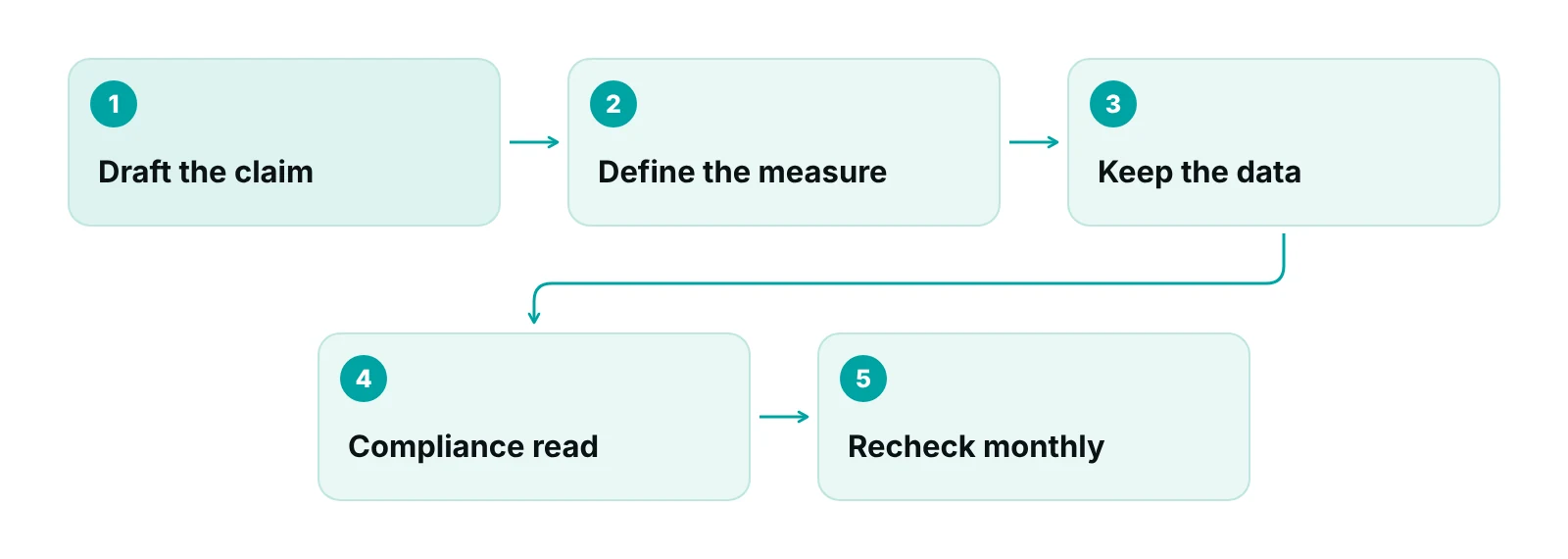
Run the review monthly and whenever hours, locations or contracted plans change. The aim is a single dated record showing that each claim was checked against evidence, not a long policy.
- List every claim in ads, the website, the Google listing, signs and scripts.
- Match each claim to its proof, using Table 1 as the template.
- Read names, headings and signs against state rules and, for hospital-owned sites, the federal definition.
- Compare the review request process with Table 2.
- Date the review, name the owner and keep the record.
Want a second set of eyes on the front-desk side of the promise?
Request a free practice audit and RCM Finder will review how registration, eligibility and billing line up with what the marketing says. The audit is free.
Our recommendations
- Define wait time in writing before using a number. Pick one measure, such as check-in to first contact with a provider, and print it next to the figure.
- Keep one claims register. Record each claim, its proof, the date checked and the owner. Review it monthly and after any change in hours or plans.
- Treat emergency as a regulated word. Check names, signs, ads and the listing against state rules, and have hospital-owned sites ask their compliance team about the federal definition.
- Run one review process for every patient. Send the same invitation to all patients, offer nothing in return and disclose staff relationships.
- Limit who can reply to reviews. Give the task to a trained person, use a standard reply that discloses nothing about care, and never confirm the reviewer was a patient.
- Keep tracking tools off scheduling and check-in pages until reviewed. Ask the privacy officer to review each tool and the current HHS position before it goes live.
Bottom line
Urgent care marketing is a promise about time and access, and the safest campaigns are the ones whose claims are defined, evidenced and dated. Start with the wait, the hours and the plan list, then check names, reviews and patient messages. RCM Finder’s healthcare digital marketing service page explains how marketing is planned around the front desk, and the guides to urgent care SEO and urgent care revenue cycle management cover the next steps in search and billing.
Frequently asked questions
Can an urgent care advertise no wait or a specific wait time?
Yes, if the claim is true and can be shown to be true. The FTC expects a reasonable basis before an objective claim runs. Define the measure, such as check-in to first provider contact, keep timestamped data that covers peak hours, and retire the claim when waits rise.
Can an urgent care use the word emergency in its name or ads?
It depends on the state. Illinois, for example, bars non-hospital facilities from holding themselves out as emergency care centers while allowing urgent care branding. Hospital-owned sites also face a federal definition that looks at how a department is held out to the public. Check local rules before using the word.
Are reviews from real patients covered by the FTC review rule?
The rule targets fake or purchased reviews, undisclosed insider reviews, company-run review sites posing as independent and certain suppression. Honest patient reviews are not the target, but what the clinic asks, offers and hides is. Staff and relatives must disclose their connection.
Can staff reply to a Google review with details of the visit?
No. HHS OCR has said providers cannot disclose patient information when answering negative reviews, and a dental practice paid $23,000 in 2022 after doing so. Use a general reply that does not confirm the reviewer was a patient and invite them to call.
Does HIPAA stop an urgent care from promoting its own services?
Not generally. HHS lists an exception for describing the clinic’s own health-related services, and face-to-face communications need no authorization. Messages paid for by a third party, or that disclose patient information for another company’s promotion, are treated differently. Texting also has separate consent rules.
How often should urgent care marketing claims be reviewed?
Monthly is a workable rhythm, plus a check whenever hours, locations or contracted plans change. Keep one dated register listing each claim, its proof and the person responsible, so a regulator, a platform or a patient complaint can be answered from a record rather than from memory.
Get your free practice audit
Tell us about your practice. We will contact you using the details you give.
- A review of your recent claims, denials and A/R aging
- Where your front desk and prior authorizations slow payment
- A prioritized fix list you keep, whether or not you hire us
Pricing is quoted after the audit, based on your volume and the services you choose. Prefer to talk? Call +1 (302) 556-2288.
Sources
- 2023 Urgent Care Industry White Paper — Urgent Care Association (2023)
- FTC Policy Statement Regarding Advertising Substantiation — Federal Trade Commission (1983)
- Advertised ED Wait Times Negatively Skew Patient Perceptions Regarding Nonemergent Encounters — Journal of Urgent Care Medicine (Alan Ayers) (2019)
- 42 CFR 489.24 Special responsibilities of Medicare hospitals in emergency cases — eCFR (2026)
- 210 ILCS 70/2 Emergency Medical Services Systems Act — Illinois General Assembly (2026)
- The FTC's Endorsement Guides: What People Are Asking — Federal Trade Commission (2026)
- Trade Regulation Rule on the Use of Consumer Reviews and Testimonials (final rule) — Federal Register (2024)
- Prohibited and restricted content — Google Maps contributed content policy (2026)
- Marketing — HHS Office for Civil Rights (2026)
- Use of Online Tracking Technologies by HIPAA Covered Entities and Business Associates — HHS Office for Civil Rights (2024)
- HHS Civil Rights Office enters settlement with dental practice — HHS (2022)
- Guidelines for representing your business on Google — Google Business Profile Help (2026)
Disclaimer: This article is educational and is not legal, compliance or advertising advice. State and federal rules differ by location and change, and platform policies are updated often. Confirm current requirements with qualified counsel, your state health department and the platform before running a campaign.