
Dermatology telehealth means live video visits, store-and-forward photo review, or a mix of both. Medicare pays for live video, including at the patient's home, through December 31, 2027. It pays store-and-forward only in Alaska and Hawaii demonstration programs. A practice also needs state licensure, patient consent, usable photos and a platform vendor that signs a business associate agreement.
Most pages that rank for this topic speak to patients or sell a platform. This guide is for the owner or manager who must decide whether to run teledermatology and how: which model fits, which visits to route where, what Medicare and state rules say today, and what the platform contract must cover. It is a narrow companion to our dermatology practice management guide.
Procedure coding and the claim path are covered in dermatology billing services and dermatology revenue cycle management. Dates below were checked on October 22, 2026, and Medicare rules are still moving.
Key takeaways
- Pick the model first; Medicare pays store-and-forward only in Alaska and Hawaii demonstration programs.
- Medicare’s home-based telehealth flexibilities run through December 31, 2027, and the CY 2027 fee schedule rule is still proposed.
- Licensure follows the patient’s location, so record where the patient is on every visit.
- Patient photos fail often, so give instructions, prompts and one approved channel.
- Sign a business associate agreement with any vendor that handles images or video before the first visit.
Which teledermatology model fits a practice: live video, store-and-forward or both?
Live video suits visits that need a conversation, and store-and-forward suits visits that depend on images. Medicare’s rule defines an interactive telecommunications system as equipment with at least audio and video that allows two-way, real-time interaction, and defines asynchronous store and forward as sending a patient’s medical information to a practitioner who reviews it without the patient present (42 CFR 410.78).
| Model | How it works | Typical fit | Check before launch |
|---|---|---|---|
| Live video | Patient and clinician meet in real time on audio and video | Established-patient follow-up, medication checks, pre-procedure consults | Medicare pays when the service is on the telehealth list; confirm each commercial payer |
| Store-and-forward | Patient or referring clinician sends images and history; the clinician reviews later | Triage, second opinions, referral screening | Medicare: Alaska and Hawaii demonstration programs only (modifier GQ); other payers vary |
| Hybrid | Images arrive before a short live visit | Most medical dermatology follow-up | Needs both a secure image channel and a video platform |
| Recorded-image review | Clinician reviews images or video sent by an established patient and replies within about a day | Brief check-ins | Established patients only; CMS described code G2010 in 2020; confirm the current rule |
Source: eCFR, 42 CFR 410.78 (2026); Center for Connected Health Policy (updated Aug. 10, 2026); CMS Medicare Telemedicine Health Care Provider Fact Sheet (Mar. 17, 2020).
The American Academy of Dermatology’s standards say live-interactive communication should be used to establish a relationship with a new patient when an in-person visit first is not possible, and that store-and-forward consultations across state lines are permitted where state law allows (AAD teledermatology standards). Use that for your new-patient policy, and check your state’s rules.
Which dermatology visits suit telehealth, and which belong in the clinic?
Your physicians decide this, in writing, before the schedule opens. A routing table lets the front desk book the right visit type. The table below is an example policy for physicians to adapt and sign off, not a clinical standard.
| Visit type | Example routing | Decide in advance |
|---|---|---|
| Rash, acne or eczema follow-up, established patient | Telehealth candidate | Photo requirements and what triggers an in-person visit |
| Medication or treatment check-in | Telehealth candidate | Who reviews labs or side-effect questions |
| Pre-procedure consult or post-procedure check | Telehealth candidate | Photo of the site; wound-concern escalation path |
| Pathology result review | Telehealth candidate | Who calls, how the call is documented |
| New patient with a lesion of concern | In-person unless a physician approves an exception | Who may approve, and how it is recorded |
| Full skin exam; biopsy, destruction, excision, Mohs, lasers or injectables | In-person | Whether a telehealth consult comes first |
Source: RCM Finder example policy; not a clinical standard. Each practice’s physicians set routing.
Give the front desk scripts for offering telehealth, explaining photo requirements and sending a caller to the clinic. Our team can run that scheduling and intake step as virtual medical assistants working inside your existing EHR (for example PrognoCIS, eClinicalWorks or athenahealth), which the virtual medical assistant service page describes.
How do you get usable photos, and what consent do you need?
Usable photos come from instructions, prompts and a fixed channel, not from hoping patients know what to do. A 2022 narrative review of 47 studies in JMIR Dermatology found clinician-taken images rated low or poor in roughly 5% to 20% of cases, while low-quality patient-submitted photos ran roughly 10% to 40%. Its advice: standardize how conditions are photographed, use EHR prompts for lighting, field of view and focus, and give patients clear instructions.
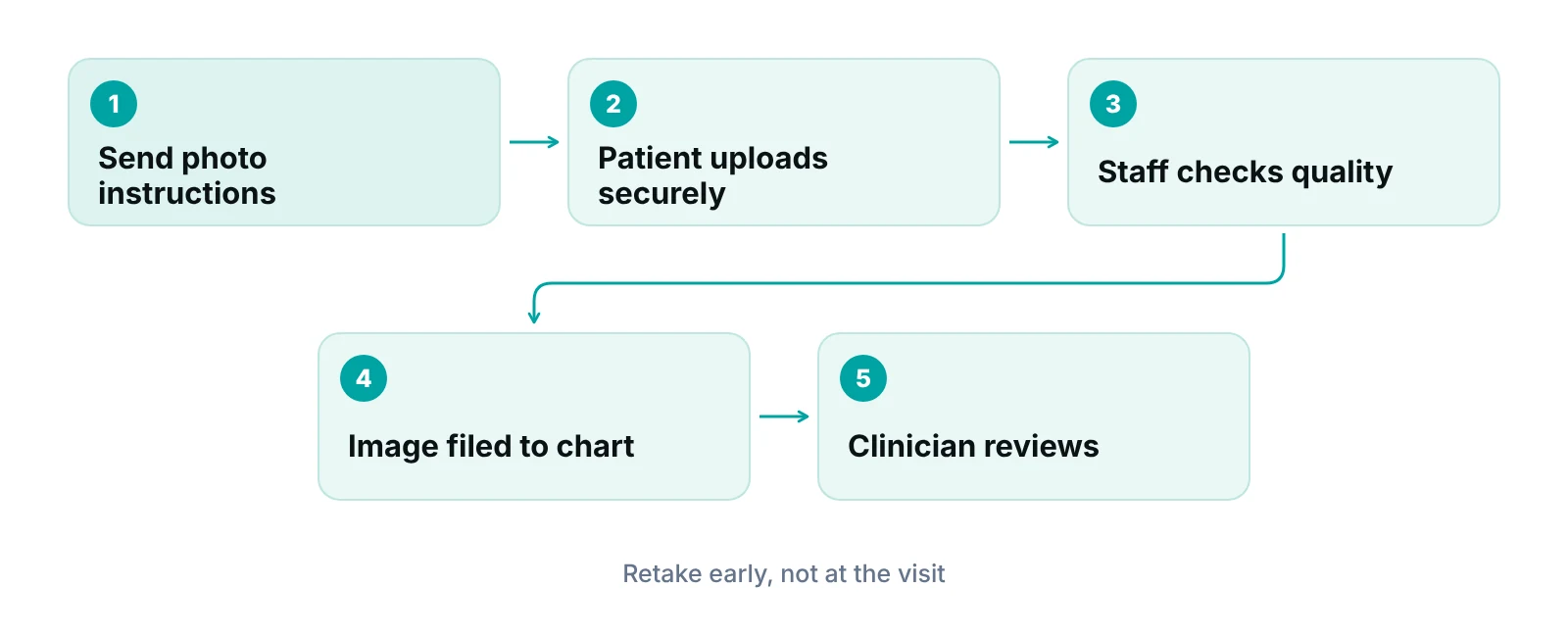
- Send written and picture instructions at booking: lighting, distance, focus, a close-up and a wider shot.
- Set a floor for image quality. The AAD standards cite a minimum camera resolution of 800 x 600 pixels for patient photos (AAD).
- Have trained staff review each image before the visit and request retakes early.
- Accept images only through a channel your privacy officer approved, and file them in the chart, not a personal camera roll or email.
- Treat full-face photographs as identifiable. HIPAA’s de-identification list names “full face photographic images and any comparable images” (45 CFR 164.514), so a photo used for teaching or marketing needs separate permission.
On consent, HHS’s telehealth resource notes that most states require informed consent before telehealth treatment, which can be written, electronic or verbal at the start of each session, and that anyone else joining the visit must consent too (Telehealth.HHS.gov). That page is written for behavioral health, so use it as a model, not as the dermatology rule. Your form should cover the visit model, the photo channel, who sees images, retakes and the option of an in-person visit. Have your attorney review it.
Which state licensure rules apply?
The clinician generally needs a license in the state where the patient is located during the visit. The AAD standards say clinicians should hold licensure in the state in which the patient receives virtual services (AAD), and Telehealth.HHS.gov adds that rules vary by state and that providers should verify the patient’s location and obtain consent before the appointment (Telehealth.HHS.gov).
- Temporary practice laws let a provider treat an existing patient for a limited time while the patient is in another state.
- Reciprocity lets neighboring-state providers offer telehealth in some border states.
- Some states let licensed out-of-state providers register to practice telehealth, often with conditions such as an unrestricted license, liability insurance and an annual fee.
- Compacts can shorten the path to a second license. HHS notes the Interstate Medical Licensure Compact authorizes physicians to practice in multiple states, and its compacts page does not list a physician assistant compact (Telehealth.HHS.gov). Check each state board for PAs and NPs.
Build the rule into scheduling: ask where the patient will be on the day of the visit, record it, and block the booking if no clinician holds a license there. Travelers and patients near state lines are where practices slip. Confirm with counsel before offering cross-state visits.
Where does Medicare telehealth stand as of October 22, 2026?
Medicare’s home-based telehealth flexibilities run through December 31, 2027, according to CMS’s telehealth FAQ, updated in October 2026 (CMS). Set a review date rather than assume it will hold.
| Item | Status | What to do |
|---|---|---|
| Patient location | Anywhere in the U.S., including home, through Dec. 31, 2027. From Jan. 1, 2028, outside behavioral health, patients generally must be in a rural medical facility. | Record location each visit |
| Store-and-forward | Allowed only for federal telemedicine demonstration programs in Alaska or Hawaii | Do not bill Medicare for photo-only review elsewhere |
| Audio-only | Allowed at home through Dec. 31, 2027; modifier 93 | Document why audio-only was used |
| Place of service | POS 02 away from home; POS 10 at the private residence | Build both into charge screens |
| Payment for home visits | Paid at the non-facility rate since Jan. 1, 2024 | Check your fee schedule |
| Modifiers BB and BC | CMS FAQ: required from Jan. 1, 2027; BB for a contracted entity’s virtual platform, BC for incident-to | Ask your vendor and MAC |
| CY 2027 fee schedule | Proposed July 14, 2026, effective on or after Jan. 1, 2027; no final rule seen | Update the policy at the final rule |
Source: CMS Medicare Telehealth FAQ (updated Oct. 2026); eCFR, 42 CFR 410.78; CMS CY 2027 Physician Fee Schedule proposed rule fact sheet (July 14, 2026).
CMS also publishes a yearly list of services payable when furnished by telehealth, and changes take effect each January 1 through the physician fee schedule rule (CMS). Confirm your visit code is on the 2027 list. A proposed-rule summary from Applied Policy (a secondary source) calls BB and BC proposals while the FAQ lists them as required, so confirm the final wording before changing claim forms.
Commercial payers and Medicaid differ
The Center for Connected Health Policy’s state tracker shows Medicaid programs treat store-and-forward differently: for example, Arizona covers asynchronous care in dermatology and other specialties, and California covers teledermatology with modifier GQ (CCHP). Get each payer’s policy in writing.
What are the documentation and billing basics?
A telehealth claim stands on the same note as an office visit, plus the facts that make it a telehealth visit. This section covers only what changes when the visit is remote.
- Confirm the service type is covered by the payer for telehealth, then check eligibility before the visit.
- Document the modality (live video, audio-only or store-and-forward), where the patient was, where the clinician was, and who else took part.
- Document consent, including the photo channel, and attach reviewed images to the chart.
- Choose the place of service from the patient’s location (POS 02 or 10 for Medicare) and add the modifiers the payer requires. The POS 10 telehealth guide and the telehealth modifiers guide give background; check each against the payer’s current policy.
- Record why a patient was sent to in-person care.
- Bill under the rendering clinician, licensed where the patient was.
The AAD page also tells members that from October 1, 2026, rural health clinics and federally qualified health centers must report individual CPT or HCPCS codes, the revenue code and modifier 93 or 95 for non-behavioral distant-site telehealth (AAD). Other practices should not assume the same rule. The CMS FAQ does not address modifier 95, so ask your Medicare contractor and each payer which modifier applies. The telehealth billing guide covers general coding background.
What privacy and platform checks must a practice make?
Any vendor that stores or transmits patient images or video for you is a business associate, so a signed agreement comes before the first visit. HHS says a cloud service provider that stores electronic protected health information is a business associate and must sign a BAA, even if it holds only encrypted data (HHS). Without one, the customer is in violation.
Do not rely on pandemic-era leniency. HHS reports that the notifications of enforcement discretion for telehealth ended at 11:59 p.m. on May 11, 2023, with a transition period through August 9, 2023 (HHS OCR). HHS describes what a BAA must contain: permitted uses, safeguards, breach reporting, subcontractor flow-down, return or destruction of data, and termination rights (HHS).
Put these questions to every video or image vendor, and keep the written answers:
- Will you sign a business associate agreement before we load any patient data, and does it cover subcontractors?
- Where are images and recordings stored, for how long, and can we export or delete them?
- Who at your company can see our images, and is access logged?
- Do images reach the chart in our EHR, or do staff download and re-upload them? See the dermatology EHR evaluation checklist for the handoff questions.
- Are recordings off by default?
- What happens to our data if we end the contract?
Include patient-side privacy in the consent talk: a private room and a plan if the call drops. For wider security, use the HIPAA compliance checklist for medical practices., and for booking forms see the dermatology website design guide.
How should a practice roll out dermatology telehealth?
Start with one physician, a few visit types and one payer mix, then widen. A pilot shows where photos fail and which claims return while mistakes are cheap.
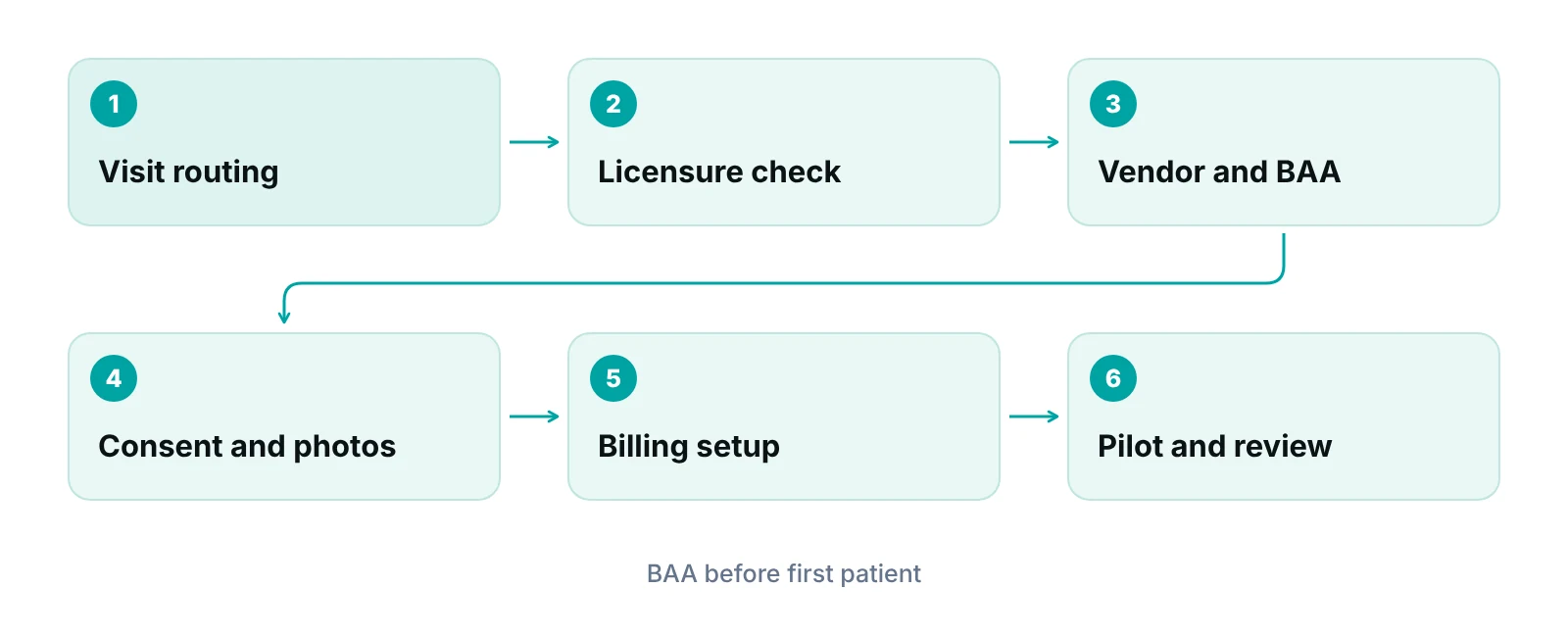
- Name a policy owner, a privacy sign-off and a billing owner.
- Adopt the visit routing table, the licensure check and the consent form.
- Sign the BAA, configure the platform, and test the photo path with staff as patients.
- Train the front desk on scripts, and the clinical team on documentation prompts.
- Run a short pilot; review no-shows, retakes and denials.
- Set a recheck date for the Medicare dates and any state rule changes.
“A telehealth program is a set of small rules that people can follow on a busy Tuesday. Write the rules first, then buy the tool.”
— Awais Afzal, Healthcare Operations & Data Analyst
Want a second pair of eyes on your telehealth workflow?
A free practice audit looks at how visits, eligibility checks and claims flow today, so a telehealth pilot starts on a clean base.
Our recommendations
- Decide the model before the vendor. Choose live video, store-and-forward or hybrid from your visit mix and payer rules.
- Make visit routing a physician-signed policy. Give the front desk a table so booking does not need a clinical call.
- Ask where the patient will be, every time. Licensure and place of service both follow location.
- Get the BAA signed first. No images or video reach a vendor until the agreement and written answers are in place.
- Calendar Medicare's dates. Review in early 2027 and before the end of 2027, and re-read the CMS FAQ when the final fee schedule rule appears.
Bottom line
Dermatology telehealth works when the model, the licensure check, the consent, the photos, the platform contract and the claim all line up before the first visit. Use the dermatology practice management guide to see where telehealth fits among scheduling, billing and software, and the practice management system page if you want claim tracking and reporting around the new visit type.
Frequently asked questions
Does Medicare pay for teledermatology?
Medicare pays for live video visits for services on its telehealth list, including at the patient’s home, through December 31, 2027, per CMS’s October 2026 FAQ. It pays store-and-forward only for federal demonstration programs in Alaska and Hawaii. Check each commercial payer and your state Medicaid program separately.
Can a dermatologist treat a patient in another state by video?
Generally the clinician needs a license in the state where the patient is during the visit. Some states allow temporary practice, reciprocity or registration, and licensure compacts can help. Rules vary, so confirm with the state board and your attorney, and record the patient’s location each time.
What is the difference between store-and-forward and live video?
Live video is a real-time visit with audio and video. Store-and-forward means images and history are sent and reviewed later, without the patient present. Many practices combine them: photos before a short live visit. Payers treat the two differently, so billing rules should drive the choice.
Do we need a business associate agreement with our video platform?
Yes, if the vendor creates, receives, maintains or transmits protected health information for you. HHS says a cloud provider storing ePHI is a business associate, even if the data are encrypted. Get the BAA signed before any patient data are loaded.
Which dermatology visits should stay in person?
Your physicians decide. Many practices keep procedures, full skin exams and new lesions of concern in the clinic, and use telehealth for follow-up, medication checks and result reviews. Write the routing as a signed policy so staff apply it the same way each time.
What should the consent form for teledermatology include?
Most states require informed consent for telehealth. Cover the visit model, how photos are sent and stored, who can see them, what happens if images are unusable, and the option of an in-person visit. Have your attorney review the form for your state.
Get your free practice audit
Tell us about your practice. We will contact you using the details you give.
- A review of your recent claims, denials and A/R aging
- Where your front desk and prior authorizations slow payment
- A prioritized fix list you keep, whether or not you hire us
Pricing is quoted after the audit, based on your volume and the services you choose. Prefer to talk? Call +1 (302) 556-2288.
Sources
- Telehealth — CMS (2026)
- Medicare Telehealth FAQ (updated Oct. 2026) — CMS (2026)
- List of Medicare Telehealth Services — CMS (2026)
- CY 2027 Medicare Physician Fee Schedule Proposed Rule fact sheet — CMS (2026)
- CY 2027 PFS Proposed Rule First Night Summary — Applied Policy (2026)
- 42 CFR 410.78 Telehealth services — eCFR (2026)
- Store-and-forward (Medicaid and Medicare) — Center for Connected Health Policy (2026)
- Medicare Telemedicine Health Care Provider Fact Sheet — CMS (2020)
- HIPAA and Telehealth — HHS Office for Civil Rights (2023)
- Guidance on HIPAA and Cloud Computing — HHS Office for Civil Rights (2026)
- Sample Business Associate Agreement Provisions — HHS Office for Civil Rights (2017)
- Licensing across state lines — Telehealth.HHS.gov (2025)
- Licensure compacts — Telehealth.HHS.gov (2025)
- Teledermatology Standards — American Academy of Dermatology (2026)
- Teledermatology resources — American Academy of Dermatology (2026)
- Store-and-Forward Images in Teledermatology: Narrative Literature Review — JMIR Dermatology (2022)
- Informed consent for telebehavioral health — Telehealth.HHS.gov (2024)
- 45 CFR 164.514 De-identification — eCFR (2026)
Disclaimer: This article is educational and is not legal, coding, clinical or compliance advice. CPT is a registered trademark of the American Medical Association, and its official descriptors are not reproduced here. Licensure, consent, privacy and payer rules differ by state and payer and change often, and Medicare telehealth policy is time-limited, so confirm current requirements with your attorney, privacy officer, payers and Medicare contractor before acting.
