
A chiropractic EHR should make the Medicare record easy to complete: exam findings, plan of care, re-evaluations, imaging dates and signatures. It should track visits against the plan, hand clean data to billing, and export the full record. Test each point with real cases, and check certification claims before signing.
Most chiropractic EHR demos show a perfect new patient. A real week is different: a plan that runs out at visit twelve, a Medicare patient whose last exam is stale, a cash patient on a prepaid package and a payer that wants the chart before it approves more care. This guide is for owners and managers who want to judge the clinical record on those days. It is part of our chiropractic practice management guide.
It does not repeat the chiropractic practice management software checklist, which covers scheduling, claims, security contracts and the billing layer. This one stays on charting. It names no products and ranks none.
Key takeaways
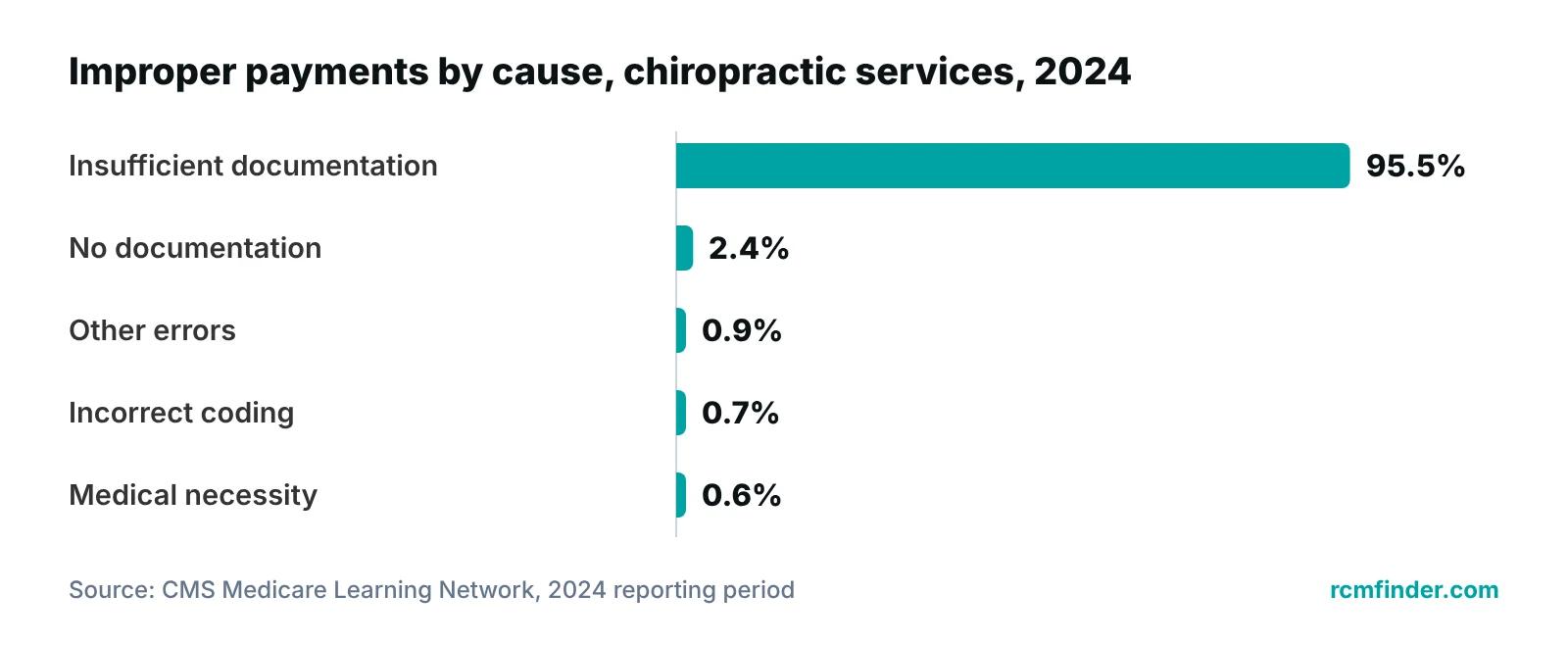
- Start from the chart. CMS reported that 95.5% of improper Medicare chiropractic payments in its 2024 period came from insufficient documentation.
- Test the plan, not just the note. The EHR should carry the plan of care into each visit and prompt a re-evaluation.
- Certification is voluntary and narrow. Ask for the product listing and test your own cases.
- Billing handoff is a charting feature. Dates, diagnosis order, care type and notices must reach the claim.
- Ask for the exit in writing: single-patient and full export, a documented format and return of protected data.
What is the difference between a chiropractic EHR and practice management software?
The EHR holds the clinical record. Practice management software runs the schedule, front desk and claims. Many chiropractic products bundle both, which is why the two evaluations get mixed up.
Here the question is narrower: can clinicians finish a defensible note quickly, and can the practice prove the care followed a plan? Scheduling, authorization and claim-scrubbing questions sit in the software features post. For plain-language definitions of the terms, see our EMR versus EHR guide. Patient intake forms and online booking belong to the website, so see the chiropractic website design guide for those.
Documentation is where the money is at risk. In its 2024 reporting period, CMS reported an improper payment rate of 33.6% for Medicare chiropractic services, projected at $178.3 million, and said insufficient documentation accounted for 95.5% of improper payments (CMS Medicare Learning Network). The chart shows the split.
Which SOAP and exam templates should a chiropractic EHR have?
It needs separate templates for the first visit, a routine visit and a re-evaluation, each built around what Medicare contractors and payers say a chart must show. A generic SOAP form pushes clinicians to free-type required items, and gaps appear there.
The table maps each encounter to the elements in the sources and to a feature you can test.
| Encounter | What the sources say the chart shows | Template feature to test |
|---|---|---|
| Initial visit | History and present illness, musculoskeletal and nervous system exam, subluxation as primary diagnosis with the spinal level, treatment plan, date of initial treatment (CGS; CMS) | Required fields that block signing; level picker tied to the diagnosis; initial treatment date stored once |
| Subluxation evidence | Two of four PART findings, one being asymmetry or range-of-motion abnormality; or qualifying imaging (CGS; CMS) | Structured P, A, R and T fields with a rule check, not a text box |
| Routine visit | Interval history, exam of the involved area, that day’s treatment with levels, and fit with the plan, such as “visit 4 of planned 7” (CGS; MLN1232664) | Visit note that pulls the plan forward and shows visit count automatically |
| Re-evaluation | Changes in status and progress recorded; effectiveness assessed against objective measures; unmet goals explained at episode end (CGS) | Re-exam template that repeats the baseline measures side by side |
| Signatures | All services signed; use an attestation process, not a late signature (CGS; MLN1232664) | Electronic signature capture, lock after signing, addendum and attestation log |
Sources: CGS Medicare chiropractic fact sheet (revised December 12, 2017); CMS MLN1232664 (March 2022); CMS Medicare Learning Network chiropractic compliance tips (page modified February 11, 2026).
One detail to settle before you build or buy templates. The CGS fact sheet says a full repeat PART exam is not expected at each subsequent visit, while the CMS documentation job aid lists a PART exam among subsequent-visit items. Contractors differ, and policies change. A flexible template lets you follow your own Medicare contractor’s current text rather than a default.
Watch the copy-forward button
Ask each vendor how a note is carried from the last visit and what the clinician must change before signing. A template that lets yesterday’s note close unchanged defeats the interval-history requirement.
How should a chiropractic EHR track treatment plans and re-exams?
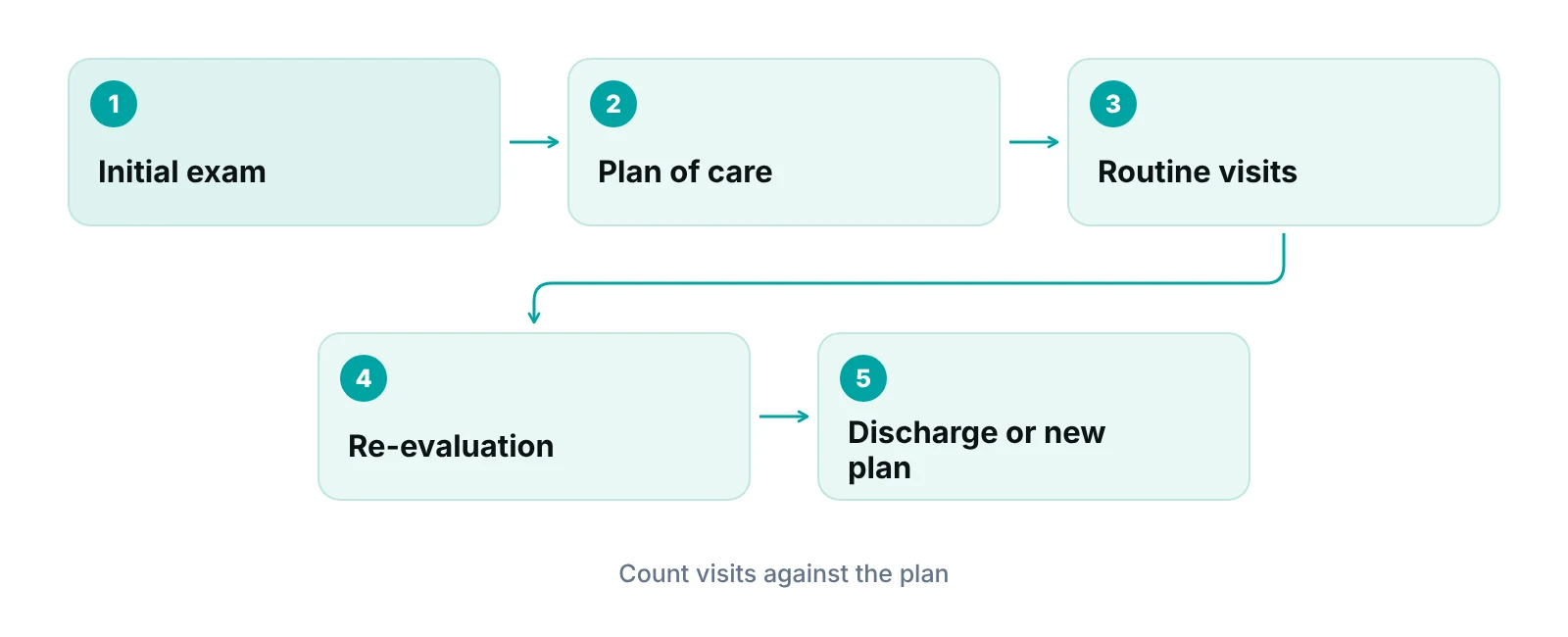
It should store the plan as data: recommended frequency and duration, goals and objective measures, with a visit counter and a re-evaluation prompt. CGS lists exactly those three plan elements, and the Optum Medicare policy repeats them (Optum policy 496, effective February 11, 2026).
Payer rules add a second layer. Optum says ongoing care is reviewed, with documentation of changes since the last visit, an exam of the involved area and an evaluation of treatment effectiveness. A Kaiser Permanente clinical review says continuation requires expected functional improvement and a patient record sent with the request (Kaiser Permanente clinical review). It also describes a recurrence as symptoms returning after being quiet for 30 days or more. One payer’s wording is not a universal rule.
Plan and visit-count features to test
- A plan object with start date, frequency, duration, goals and measures, editable only by the treating clinician.
- A visit counter that shows planned versus completed visits on every note and on the schedule.
- A configurable re-exam trigger by visit count, by days since the last exam, or by payer request.
- A flag when care continues past the plan end date without a new plan or re-evaluation.
- A per-payer visit limit and authorization date field that warns before the last approved visit.
What should the EHR do with x-rays and other imaging?
It should store the images or reports with dates, link them to the episode, and warn when imaging falls outside the window a payer uses. For Medicare, CMS says an x-ray is not required to show subluxation, because a physical exam can do it, but when x-ray is used the date must fall no more than 12 months before or 3 months after treatment starts. Earlier CT or MRI showing subluxation is acceptable (CMS Medicare Learning Network).
Check these points in a demo:
- Image date and ordering provider are fields, not file names.
- The EHR flags an x-ray outside the 12-before and 3-after window for Medicare patients.
- Reports and images open from the encounter that relied on them.
- Images and reports come out in the export, and the vendor says in what form.
How should cash, insurance and Medicare flows reach billing?
The chart must hand billing the right facts without re-keying, and it must handle patients who pay by different routes. The Medicare items below are the ones that make or break the claim. For code-level detail, see our guides to Medicare billing for chiropractors and chiropractic CPT codes and modifiers.
| Patient type | What the record or claim must carry | Feature to test |
|---|---|---|
| Medicare fee-for-service | Initial treatment date in Item 14; subluxation with level as primary diagnosis and the neuromusculoskeletal condition as secondary; AT only for active or corrective care; GA with a signed ABN when Medicare may deny (CHIRO-001) | Care-type field that controls the AT modifier; diagnosis-order rule; ABN date stored with the visit |
| Medicare Advantage | Plan-specific rules; the ABN is not used under Medicare Advantage (CMS ABN manual) | Payer-type field that switches notices and rules |
| Commercial insurance | Plan authorization, visit limits and the payer’s own re-evaluation requests | Authorization and limit fields tied to the plan of care |
| Cash or package patient | No claim, but a record that meets your clinical standard and a ledger of prepaid visits used | Separate payment type, balance ledger and receipt; same note templates |
Sources: CMS CHIRO-001 billing guideline (revised December 1, 2015); CMS Claims Processing Manual Chapter 30 s. 50 (ABN); CMS Medicare Learning Network chiropractic compliance tips (2026).
Two further points from the CMS texts. The ABN must be given before the service, and CMS says one ABN for an extended course can remain effective up to a year, but care changes need a new one and an ABN cannot be dated after the fact (CMS Claims Processing Manual). And CMS says that where an ABN is given and Medicare may deny, the GA modifier is applied (CHIRO-001). Build those into the visit workflow.
CMS says the AT modifier marks active or corrective treatment, and that using it does not prove medical necessity (MLN1232664). The OIG audit that found $358.8 million, about 82%, of $438.1 million paid in 2013 unallowable also recommended better education on AT use. The EHR can prompt; the clinician decides. If your claims go to an outside team, the chiropractic billing services guide covers the handoff.
Does ONC certification matter for a chiropractic EHR?
It is evidence that a product passed tested criteria, not proof it suits chiropractic work. The ONC Health IT Certification Program, run by ASTP/ONC, is voluntary. ONC does not test or certify products itself. Authorized labs test them, authorized certification bodies certify them, and certified modules are posted on the Certified Health IT Product List, or CHPL (ONC Health IT Certification Program overview, updated January 2026).
The same page says federal programs such as CMS Promoting Interoperability require certified health IT. Whether that touches your practice depends on the programs you report to. With any vendor claim, ask which certified module applies, ask for the CHPL listing, and ask what chiropractic workflow certification does not test. The ONC certification FAQ confirms products are posted to the CHPL only after testing and certification.
Do not treat certification as a security audit either. The HHS risk analysis guidance says the practice must assess risks to all electronic protected health information it creates, receives, maintains or transmits, and that the process should be ongoing (HHS Office for Civil Rights). A vendor’s certificate does not replace that work. Our HIPAA compliance checklist for medical practices covers the wider routine.
How do you test data export and the exit before you sign?
Ask for the full record in a documented format, for one patient and the whole practice, and ask what happens to your data at termination. A chart you cannot take with you is a lock-in cost that does not show up in the price.
For certified products, ONC’s Cures Update added the EHI export criterion, 45 CFR 170.315(b)(10) (ONC Cures Update overview). Its fact sheet says users must be able to export a single patient’s electronic health information at any time without developer assistance, that developers must support a patient-population export, and that the export format documentation must be publicly accessible. Affected modules were due to customers by December 31, 2023 (ONC EHI export fact sheet). The criterion applies to developers who certify a module, so a product that is not certified is not covered; put the export terms in the contract instead.
| Topic | What the source says | Question to ask |
|---|---|---|
| Certification status | Voluntary program; CHPL lists certified modules (ONC) | Which certified module applies, and what is its CHPL listing? |
| Single-patient export | User can export one patient’s EHI at any time without developer help (ONC (b)(10)) | Show me the export from a test chart, in front of me. |
| Population export | Developers must support whole-population export (ONC (b)(10)) | How do we export every chart if we leave, and at what cost? |
| Format documentation | Export format must be publicly accessible (ONC (b)(10)) | Where is the format documentation, and can our next vendor read it? |
| Access and audit | Unique user ID required; audit controls required (45 CFR 164.312) | Does every user have a login, and can we see who changed a note? |
| Return of data | Sample HHS terms: return or destroy PHI at termination if feasible; report breaches; bind subcontractors (HHS) | What does the BAA say about return, destruction and incident reporting? |
Sources: ASTP/ONC Health IT Certification Program overview (2026); ONC (b)(10) EHI export fact sheet (2023); eCFR 45 CFR 164.312 (current); HHS OCR sample business associate agreement provisions (January 25, 2013).
The HHS sample provisions are optional wording, not required text, but they list what a contract should address, including incident reporting, subcontractors and the return or destruction of protected data. Section 164.312 requires unique user identification and an emergency access procedure, and adds audit controls as a standard (eCFR).
“Before we trust any system with a clinic's records, we ask how the records leave. If the answer is vague, the demo is not finished.”
— Awais Afzal, Healthcare Operations & Data Analyst
How should the practice run the evaluation?
Run every vendor through the same real cases and score them on one sheet. Include a clinician, the front desk and whoever handles billing, because each sees different gaps. If a remote Virtual Medical Assistant will handle intake, include that role in the test.
- Pick ten real, de-identified cases: a new Medicare patient, a plan that ends mid-week, a re-exam, a cash package, a recurrence and a patient who leaves.
- Have a clinician complete each note live in the demo, timing it, and check every required field against the table above.
- Create a plan, run it to its last visit and watch the re-exam prompt and the visit counter.
- Send a test claim path: from the signed note to the charge, with the care type, diagnosis order and notices intact.
- Request the CHPL listing, the export demo and the written BAA, and have counsel read the termination terms.
- Run one pilot provider for two weeks before converting everyone.
See where your documentation breaks down
A free practice audit reviews how a visit note becomes a claim in your office and where documentation, plan tracking or handoff gaps sit. Pricing is quoted after the audit.
Our recommendations
- Build a ten-case demo script. Use the same de-identified cases with every vendor.
- Require the Medicare fields. Treatment date, subluxation level, exam findings, plan and signature should block note closure.
- Check your contractor's current text. Follow your contractor’s current policy for subsequent visits.
- Store the plan as data. Insist on a visit counter, re-exam prompt and payer limit warning.
- Tie AT and notices to the care type. The modifier and the ABN should follow the care type, never a default.
- Verify certification yourself. Ask for the CHPL listing and the criteria the module covers.
- Test the exit in the demo. Watch a single-patient export and read the return-of-data terms.
Bottom line
A chiropractic EHR earns its place when clinicians can complete a defensible note quickly, the plan travels with every visit, and the record can leave when you do. Test it with real cases and read the export and business associate terms before signing. For the wider operating picture, see the chiropractic practice management guide. For a billing-side workflow layer that works alongside your existing EHR, see our practice management system page or request a free practice audit.
Frequently asked questions
What should a chiropractic EHR include for Medicare?
It should capture the initial treatment date, subluxation level, PART findings, plan of care, visit notes, imaging dates, signatures and the care type that drives the AT modifier. Contractor policies differ, so check your own Medicare contractor’s current text.
Is a certified chiropractic EHR required?
ONC says the certification program is voluntary, though federal programs such as CMS Promoting Interoperability require certified health IT. Whether that applies to you depends on the programs you report to. Confirm with your advisers, and check any claim against the CHPL listing.
Does the AT modifier mean treatment is medically necessary?
No. CMS says the AT modifier marks active or corrective treatment and that using it does not prove medical necessity. Contractors can still deny claims after review. The clinician chooses the care type; the EHR should prompt and block AT on maintenance visits.
Do Medicare chiropractic patients need an x-ray?
No. CMS says an x-ray is not required because a physical exam can demonstrate subluxation. If an x-ray is used, its date should fall within 12 months before or 3 months after treatment starts. Earlier CT or MRI showing subluxation is acceptable.
How do I get my data out of an EHR?
For certified products, ONC’s EHI export criterion requires single-patient export without developer help, population export and public format documentation. For others, put export formats, timing, cost and return of protected data in the contract before signing.
Should cash patients use the same notes as insurance patients?
Using the same clinical templates is a practical choice, since the record serves the patient’s care either way. Keep payment type separate so the system does not apply insurance rules to cash visits or lose the prepaid balance. Ask counsel about your state’s record and retention rules before deciding.
Get your free practice audit
Tell us about your practice. We will contact you using the details you give.
- A review of your recent claims, denials and A/R aging
- Where your front desk and prior authorizations slow payment
- A prioritized fix list you keep, whether or not you hire us
Pricing is quoted after the audit, based on your volume and the services you choose. Prefer to talk? Call +1 (302) 556-2288.
Sources
- Chiropractic Services Fact Sheet (L37254) — CGS Medicare (2017)
- MLN1232664 Medicare Documentation Job Aid for Chiropractic Doctors — CMS (2022)
- Chiropractic Services (Medicare Provider Compliance Tips) — CMS Medicare Learning Network (2026)
- CHIRO-001 Chiropractic Services billing guideline — CMS Medicare Coverage Database (2015)
- ONC Health IT Certification Program Overview — ASTP/ONC (HealthIT.gov) (2026)
- Certification FAQs Overview — ASTP/ONC (HealthIT.gov) (current)
- (b)(10) EHI Export Factsheet — ONC (HealthIT.gov) (2023)
- 2015 Edition Cures Update Overview — ONC (HealthIT.gov) (2020)
- 45 CFR 164.312 Technical safeguards — eCFR (current)
- Medicare Chiropractic Services Utilization Management Policy 496 — Optum (2026)
- Clinical review criteria: chiropractic — Kaiser Permanente (2026)
- Medicare Claims Processing Manual, Chapter 30, Section 50 (ABN) — CMS (current)
- Hundreds of Millions in Medicare Payments for Chiropractic Services Did Not Comply With Medicare Requirements (A-09-14-02033) — HHS OIG (2016)
- Sample Business Associate Agreement Provisions — HHS Office for Civil Rights (2013)
- Guidance on Risk Analysis — HHS Office for Civil Rights (2026)
Disclaimer: This article is educational and is not legal, coding, tax or compliance advice, and it does not tell any clinician how to treat a patient. State board rules, payer policies and Medicare contractor policies differ and change, so confirm the current rule with your state board, your payers, your Medicare contractor and qualified counsel before you act. CPT is a registered trademark of the American Medical Association.
