

Chiropractic social media marketing works when each post teaches, shows the team or invites a question, without promising results or showing a patient. Keep health claims modest and supportable, get a signed authorization before any patient appears, move comments and direct messages to the phone or portal, and judge posts by booked visits.
Most advice on this topic is a list of post ideas. Trouble usually starts elsewhere: a patient happy to be photographed, a comment about a specific injury, or a thank-you reply that confirms someone is a patient. This guide covers the content that fits a clinic and the rule behind each type. It sits inside the chiropractic practice management guide, which routes the rest of the front office, billing and software work.
Paid social, tracking tags and referral tools are covered in the chiropractic digital marketing guide; claim substantiation and offers are in the chiropractic marketing post. This post stays with organic content, people in your posts, and the inbox.
Key takeaways
- Give each post a job (teach, show the team, answer a question, invite a booking) and check the rule that goes with it before it goes out.
- A patient’s face, name or story in a clinic post needs a signed HIPAA authorization, plus truthful, representative claims under the FTC Endorsement Guides.
- Reply to comments and messages in general terms and move the conversation to the phone or portal; never confirm that someone is a patient.
- Free care, discounts or prizes tied to a post must be clearly disclosed, and staff posting about the clinic need a disclosure too.
- Start with three posts a week on one or two platforms, and judge them by booked and kept first visits, not likes.
Which content types fit a chiropractic clinic?
Posts that teach, introduce the team or answer a common question fit a clinic best, because they build familiarity without claims about any one patient. Each type below has a rule to check first.
| Content type | Example | Rule to check first | Job it does |
|---|---|---|---|
| General education | A short video on desk-break movement | Label as general information; no guarantee or cure language (Tennessee board policy, 22 TAC 77.4) | Builds trust before a search |
| Team and clinic | Staff introductions, office walk-through, community event photos | Get consent from staff and anyone in frame; staff who post about the clinic disclose the relationship (16 CFR 255.5) | Makes the first visit feel familiar |
| Common questions | ‘What happens at a first visit?’ with your intake steps and payer terms | Describe process and payment terms accurately; substantiate any benefit | Answers the question patients ask at the front desk |
| Patient stories | A written or video story | Signed authorization first, then truthful, representative claims (45 CFR 164.508; 16 CFR 255.2) | Social proof, with the most risk |
| Offers and events | New-patient exam, posture workshop | State ad rules; Florida requires a free or discounted service to state the usual fee (Fla. Stat. 460.413(1)(cc)) | Gives a reason to book now |
| Live Q&A or comments | A monthly question-and-answer video | Answer in general terms; do not discuss a viewer’s own condition in public | Shows expertise and surfaces questions |
Source: Tennessee Board of Chiropractic Examiners (2017); 22 TAC 77.4 via Justia (current through June 27, 2025); Florida Statutes 460.413 (2026); 16 CFR Part 255; 45 CFR 164.508.
Dynamic Chiropractic advised in 2019 that roughly 80% of content should not be a direct sales pitch (Dynamic Chiropractic). That is practitioner opinion, not a measured benchmark; the sensible reading is that most posts should help someone who is not ready to book yet.
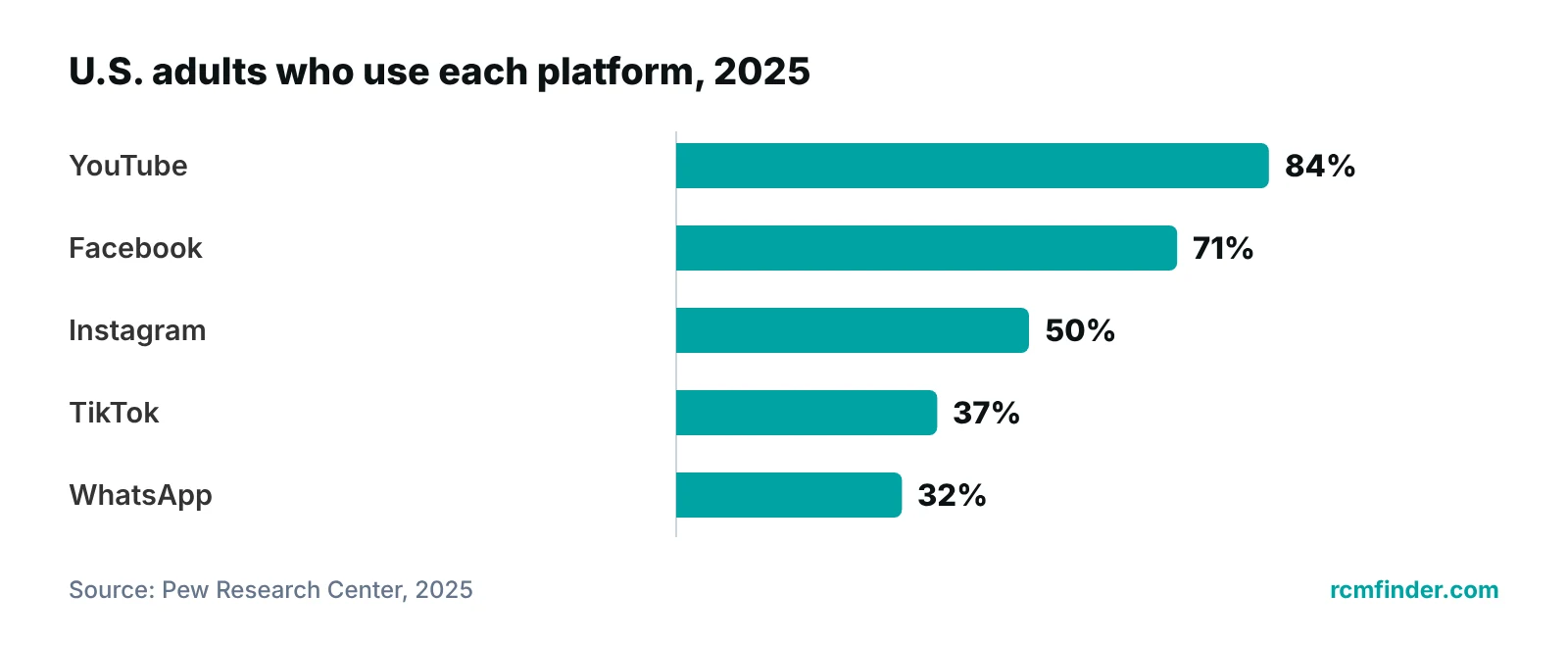
Platform choice follows where your patients already are. In Pew Research Center’s 2025 survey of U.S. adults, YouTube (84%) and Facebook (71%) were the most used platforms, ahead of Instagram (50%) and TikTok (37%) (Pew Research Center). Facebook use peaks among adults 30 to 49, at 80%. One of the two leading platforms plus the Google profile in the chiropractic SEO post is enough to start.
What health claims can a chiropractic post make?
A post can state what chiropractic care involves and what your clinic does. It should not promise a cure, guarantee a result or claim to treat a disease without evidence. Regulators treat social posts as advertising.
In a February 5, 2021 letter, FTC staff told a chiropractic clinic to stop COVID-19 prevention and treatment claims that appeared on its website and in an April 2, 2020 Facebook post, and to review all its other claims for competent and reliable scientific evidence (FTC warning letter). The chiropractic marketing post covers the evidence standard; here the point is that a casual caption counts.
State boards add their own limits. Tennessee’s board told licensees in 2017 not to give clinical advice, communicate a diagnosis or guarantee results on social media, while allowing general health information within chiropractic scope that is clearly not clinical advice (Tennessee Board). Texas rules bar advertising that states or implies results are guaranteed or that chiropractic services cure any condition (22 TAC 77.4, Justia copy), and Florida lists false, deceptive or misleading advertising as grounds for discipline (Fla. Stat. 460.413). Your board’s rules may differ.
A caption check that takes one minute
Ask three questions. Is this true for every reader? Does it name a result, cure or guarantee? Could a reader take it as advice about their own pain? If the answer to the second or third is yes, rewrite it as general information.
Boosting a post adds platform rules. Meta’s personal health and appearance policy lists before-and-after weight-loss images as non-compliant in ads (Meta), so check how it applies to body images; the digital marketing guide covers paid channels.
How do patient photos, videos and testimonials work?
A patient who is identifiable in a clinic post needs a signed authorization first, and the story told must be truthful and representative. The reason is that HHS says the Privacy Rule generally requires written authorization before protected health information is used for marketing, and a photo of someone in your treatment room reveals they are a patient (HHS, content last reviewed July 26, 2013). Applying that page to a social post is a reasoned reading, so have counsel confirm your form.
A valid authorization under 45 CFR 164.508(c) describes the information used, who may disclose it, who may receive it, the purpose, an expiration date or event, and the patient’s signature and date. It must also state the right to revoke in writing, whether treatment can be conditioned on signing, and that shared information may be redisclosed. It must be in plain language, and the patient gets a copy (eCFR). Do not bury a photo release in the intake packet; use a separate, specific form.
Removing a name does not always remove the risk. HIPAA’s de-identification standard also lists dates other than year, full-face photographs and comparable images, and any other unique identifying characteristic (45 CFR 164.514). A first name, a town and an injury date can still point to one person.
The FTC layer sits on top. Under the Endorsement Guides, an endorsement must reflect honest experience and cannot be edited to distort it, and a consumer’s experience on a key point is presumed representative, so the advertiser needs substantiation or a clear statement of generally expected results (16 CFR Part 255). The table applies both layers to common situations.
| Situation | What to have in place | Why |
|---|---|---|
| Clinic photographs or films a patient, even in the lobby | Signed, specific authorization covering social media, with an end date, before the post | Marketing use generally needs written authorization (HHS; 164.508) |
| A patient posts a kind comment and you want to reshare it | Permission and, if the reshare identifies them as a patient, an authorization; keep the words unedited | Endorsements cannot be reworded to distort the view; a reposting clinic may need to disclose its relationship (16 CFR 255.1, 255.5) |
| Anonymous written story | Genuine, typical or paired with what results are generally expected, and free of dates, towns and other identifiers | Experience on a key point is presumed representative (255.2); identifiers can still reveal the person (164.514) |
| Free care, a discount or a prize in return for a post | Clear disclosure in the post itself, and no condition that the post be positive | Material connections must be disclosed; incentives cannot require a particular sentiment (255.5; FTC reviews rule Q&A) |
| Doctor or staff posts about the clinic | Written staff social media policy and a visible disclosure of the relationship | An employee posting about an employer’s service should disclose the connection (255.5(b)(8)) |
| Posture or ‘before and after’ images | Authorization, a caption with no promise of results, and a check of any platform ad policy before boosting | Typical-results and platform-policy risk (255.2; Meta ad policy) |
Source: HHS (2013 page); 45 CFR 164.508 and 164.514; 16 CFR Part 255; FTC Consumer Reviews and Testimonials Rule Q&A (November 2024); Meta Transparency Center.
Disclosure has to be visible. The FTC’s 2019 influencer guide says it belongs with the endorsement, not on a profile page or behind a ‘more’ link, and a platform’s tool may not be enough alone (FTC).
“If a patient would be surprised to see the post, the clinic is not ready to publish it, whatever the form says.”
— Awais Afzal, Healthcare Operations & Data Analyst
How should comments and direct messages be handled?
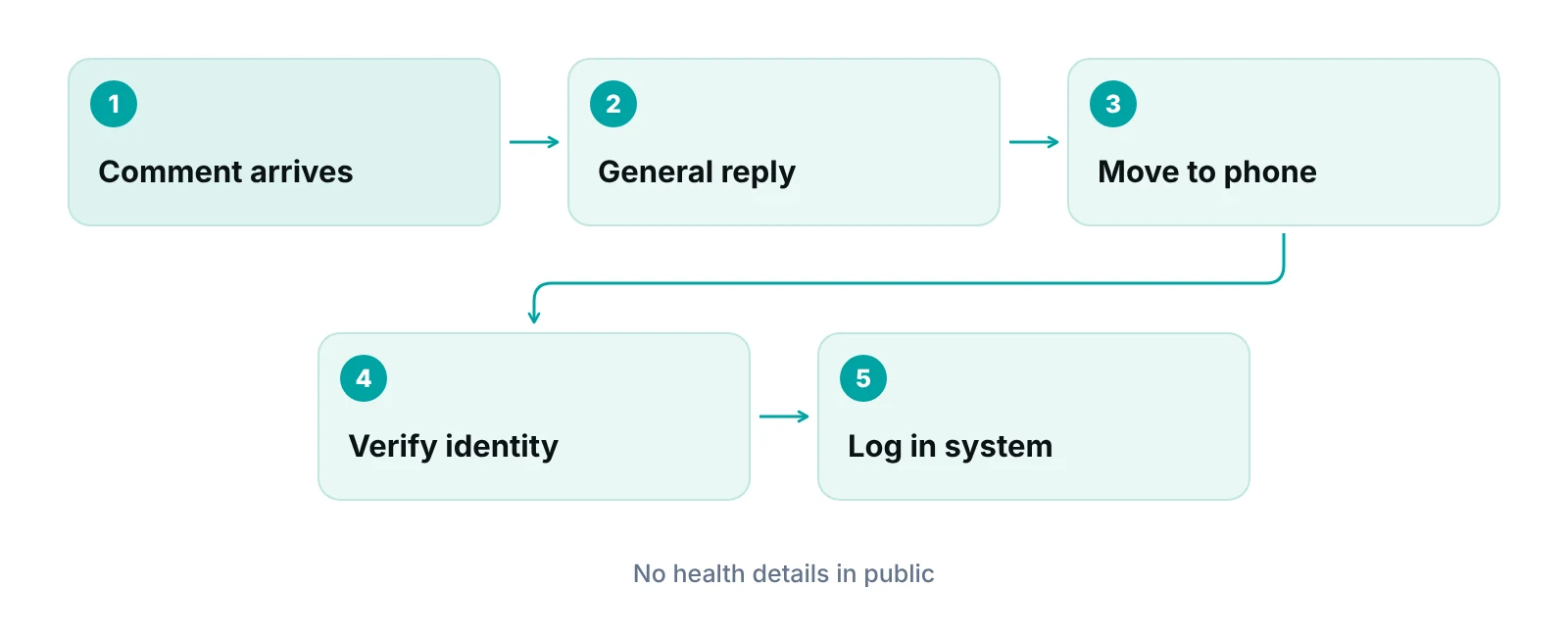
Reply in general terms, keep health details out of public threads, and move the conversation to the phone or portal. In a 2019 settlement, a Dallas dental practice paid $10,000 after responding to patient reviews with a patient’s last name and details of a health condition, and OCR said doctors must think carefully about patient privacy before replying to online reviews (California Dental Association).
Even a friendly reply can confirm a relationship: ‘Great to see you back after your injury’ tells every follower the person is a patient and hints at why.
- Thank the person without naming a visit, a condition or a date.
- Offer the office phone number or a contact form, and say staff will help privately.
- If a message contains health details, move the exchange to the phone or the portal and keep the clinical details out of the platform.
- Verify identity by phone before discussing anything about an appointment, a balance or care.
- Log the contact in the practice system.
Tennessee’s board says patient communication over social media must happen through secure private messaging only (Tennessee Board). HHS says providers may use email with patients if they apply reasonable safeguards, should limit the information in unencrypted messages, and should offer another channel if the patient finds unencrypted email unacceptable (HHS FAQ, content last reviewed July 26, 2013). Ask your security officer whether your platform’s inbox meets that bar.
Who answers matters too. An agency, freelancer or scheduling tool that can read an inbox containing patient information may be a business associate, and HHS says disclosure requires a written business associate agreement first (HHS). The HIPAA compliance checklist covers the wider program, and the reputation management guide covers review replies in detail.
If nobody covers messages after hours, a trained remote front-desk assistant can route questions to the phone line; the virtual medical assistant services page describes how RCM Finder staffs this inside the practice’s own time zone.
Where do social inquiries get stuck?
A free practice audit reviews how messages, calls and forms reach your front desk, and who owns each step. Pricing is quoted after the audit.
How often should a chiropractic clinic post?
Post at a pace the clinic can keep for a year. Dynamic Chiropractic advised at least daily in 2019, while ChiroTouch, a software vendor, says consistency matters more than a fixed schedule and suggests one or two platforms (ChiroTouch, originally published September 2022). Neither is a measured benchmark, and the schedule below is our suggestion.
- Three posts a week on one or two platforms. Two education or common-question posts and one team or clinic post.
- A named owner for scheduling, one for the comment check, and a doctor who approves any health content.
- A 15-minute check each working day for comments and messages, with the reply routine above.
- Reuse the best posts: a strong education post becomes a short article for your website (see the chiropractic website design post) and an item in your recall messages (see the chiropractic email marketing post).
How should social media results be measured?
Measure booked and kept first visits first, and platform numbers second. Likes show interest; only the schedule shows whether a post moved someone toward care.
| Number | Where to read it | Decision it supports |
|---|---|---|
| Reach and engagement by content type | Platform insights | Which topics to repeat or drop |
| Profile actions: calls, direction taps, website clicks | Platform insights | Whether the bio, link and first lines work |
| New-patient inquiries naming social media | Front-desk ‘how did you hear about us’ question, logged at intake | Whether social is worth the staff time |
| Booked and kept first visits from those inquiries | Practice management system | Cost per kept visit, the number that matters |
| Time to first reply on comments and messages | Inbox | Whether coverage is enough |
| Conversations moved to phone or portal | Staff tally | Whether the privacy routine is followed |
Source: RCM Finder suggested monthly review; platform metric names vary by network.
Take care with tracking tags. HHS says tracking on pages where people book appointments can capture protected information, such as an email address or the reason for a visit, and a cookie banner is not a valid HIPAA authorization (HHS). A June 20, 2024 court ruling vacated part of that guidance on unauthenticated public pages, but booking pages remain the safer line to hold. Count bookings from practice records and the intake question rather than tagging a scheduling page.
Do not buy followers to lift the numbers: the FTC’s reviews rule bars fake indicators of influence such as bot followers (FTC Q&A). For the wider return-on-spend view, see the medical marketing ROI guide.
What belongs in a clinic social media policy?
A one-page written policy keeps the doctor, the front desk and any outside helper on the same rules. It should say who may post, what never appears and what happens when something goes wrong.
- Who posts and approves. One calendar owner, and the doctor approves health content.
- What never appears. Patient names, faces, schedules, waiting rooms with patients in view, and screenshots of the practice system.
- Staff accounts. No patient talk on personal accounts, and a disclosed role when staff post about the clinic.
- Incidents. Who removes a post, who tells the privacy officer and how it is logged; the Tennessee board notes that posted information cannot be removed easily.
- Vendors. Any agency or tool with access to patient information has a business associate agreement first.
Our recommendations
- Write the one-page policy before the first post. Decide who posts, who approves health content and what never appears. It takes an hour.
- Use a separate, specific authorization form. We would not hide a photo release in the intake packet. A stand-alone form that names social media, an end date and the right to revoke is clearer for the patient.
- Reply generally and move it offline. Never confirm in public that someone is a patient. Thank them, give the phone number and finish privately.
- Pick one platform and one owner. Three posts a week on one platform beats seven on four. Reread your board’s advertising rules once a year.
- Measure kept visits, not likes. Ask ‘how did you hear about us’ at intake and log it; kept first visits are the number that matters.
Bottom line
Chiropractic social media marketing pays when posts teach, show the team and answer real questions, and when patients appear only with a signed authorization and truthful claims. Keep the inbox private, post at a pace you can hold and count kept visits. For the rest of the front office, billing and software, start with the chiropractic practice management guide, and see how RCM Finder’s healthcare digital marketing supports the work. Pricing is quoted after a free practice audit.
Frequently asked questions
Can a chiropractor post patient photos on social media?
Only with the patient’s signed HIPAA authorization, and only in the way the form describes. HHS says written authorization is generally required before protected health information is used for marketing, and a photo in your treatment room shows the person is a patient. The form needs an expiration, a right-to-revoke statement and a plain-language purpose. Ask counsel to review your form.
Are chiropractic patient testimonials allowed?
Yes, if they are genuine, not edited to distort the patient’s view and not misleading about typical results. Under the FTC Endorsement Guides, a result described by one patient is likely to be read as typical, so you need evidence or a clear statement of what is generally expected. Some state boards add limits, so check yours.
How should I reply to a Facebook comment from a patient?
Reply in general terms, thank them and offer the office phone number or a contact form. Do not confirm they are a patient, mention a visit or discuss a condition. A 2019 settlement involved a practice that replied to reviews with patient details. Move the real conversation to the phone or portal and verify identity there.
Can I give a patient free care for a social media post?
You can offer an incentive, but it must be disclosed clearly in the post, and you cannot require a positive opinion. The FTC says a connection between a poster and a seller, such as free or discounted services, must be disclosed when readers would not expect it. State rules on free or discounted care may also apply.
How often should a chiropractic clinic post?
Pick a pace you can keep for a year. We suggest three posts a week on one or two platforms, with a named owner and a monthly review. Published advice ranges from daily to weekly and none of it is a measured benchmark, so judge by booked and kept first visits.
Should staff post about the clinic on their own accounts?
They can, with a written policy. Staff should not share anything about patients, and they should disclose their role when posting about the clinic. The FTC Endorsement Guides give an example of an employee’s post about an employer needing a disclosure. Train staff on the policy and review it each year.
Get your free practice audit
Tell us about your practice. We will contact you using the details you give.
- A review of your recent claims, denials and A/R aging
- Where your front desk and prior authorizations slow payment
- A prioritized fix list you keep, whether or not you hire us
Pricing is quoted after the audit, based on your volume and the services you choose. Prefer to talk? Call +1 (302) 556-2288.
Sources
- Guides Concerning the Use of Endorsements and Testimonials in Advertising, 16 CFR Part 255 — eCFR (FTC) (2026)
- 45 CFR 164.508, Uses and disclosures for which an authorization is required — eCFR (HHS) (2026)
- 45 CFR 164.514, Other requirements relating to uses and disclosures of PHI — eCFR (HHS) (2026)
- HIPAA Privacy Rule: Marketing — HHS Office for Civil Rights (2013 (content last reviewed July 26, 2013))
- Use of Online Tracking Technologies by HIPAA Covered Entities — HHS Office for Civil Rights (2024 (last content review June 26, 2024))
- Does HIPAA permit health care providers to use email to discuss health issues with patients? — HHS HIPAA FAQ (2013 (content last reviewed July 26, 2013))
- Business Associates — HHS Office for Civil Rights (2026 (last reviewed July 30, 2026))
- Consumer Reviews and Testimonials Rule: Questions and Answers — Federal Trade Commission (2024)
- Disclosures 101 for Social Media Influencers — Federal Trade Commission (2019)
- Warning letter to Freedman Chiropractic Center (COVID-19 claims) — Federal Trade Commission (2021)
- Policy on Social Media — Tennessee Board of Chiropractic Examiners (2017)
- 22 TAC 77.4, Misleading Claims (Texas) — Justia (Texas Board of Chiropractic Examiners rule) (2025)
- Florida Statutes 460.413, Grounds for disciplinary action — Florida Legislature (2026)
- Dental practice pays $10K to settle disclosures of patients' PHI on social media — California Dental Association (2019)
- Americans' Social Media Use 2025 — Pew Research Center (2025)
- Personal health and appearance (ad standards) — Meta Transparency Center (2026)
- 11 Top Social Media Do's & Don'ts for Chiropractors — Dynamic Chiropractic (MPA Media) (2019)
- Chiropractic social media posts — ChiroTouch (software vendor) (2022)
Disclaimer: This article is educational and is not legal, coding, tax or compliance advice. Advertising, privacy and state board rules differ by state and change over time, so confirm current requirements with your state chiropractic board, your attorney and your privacy officer before acting. Social platforms change their policies often; read the current terms before you post or boost.