

Physical therapy SEO is the work of making a PT clinic easy to find for two groups: patients searching for a condition near them, and patients and referrers checking the clinic after a referral. It rests on an accurate Google Business Profile, honest location and condition pages, state-aware access wording, and privacy-safe forms.
Most physical therapy patients do not start with a blank search box. In the American Physical Therapy Association’s 2025 consumer survey, 90% of current patients said a physician referred them, yet 71% of prospective patients said they were exploring PT on their own (APTA). A clinic is therefore found two ways, and search has to serve both.
This guide is for outpatient PT clinic owners and managers. It uses Google’s documentation for platform rules, APTA data for patient and referrer behavior, and federal sources for legal limits. The wider plan is in how to grow a physical therapy practice and the physical therapy marketing plan; general basics are in the healthcare SEO guide.
Key takeaways
- PT clinics are found through referrals and through self-directed search, and the same website has to work for both.
- Google says local ranking rests on relevance, distance and prominence, and that no one can pay for a better local ranking.
- Direct access is not uniform: APTA lists all 50 states as allowing some form, with different limits, and Medicare has its own plan-of-care certification rule.
- Reviews, testimonials and intake forms carry FTC and HIPAA rules that sit outside SEO. Check them before they go live.
- Measure booked and kept first visits by source, not rankings.
How do patients find a physical therapy clinic?
Patients arrive by referral, by their own search, or by word of mouth, and each path leaves a different search trail. A referred patient often searches the clinic’s name to check it out. A self-directed patient searches a problem and a place. APTA’s 2025 survey of 1,199 U.S. adults, run May 1 to 14, 2025, puts numbers on the split (Table 1).
| Path | What APTA's data shows | Likely search | Page that should answer |
|---|---|---|---|
| Physician referral | 90% of patients were referred by a physician | Clinic name, reviews, address, insurance | Google profile, location page, insurance information |
| Own search | 71% of prospective patients were exploring PT on their own | Condition plus place | Condition page, location page, first-visit details |
| Direct access awareness | 41% of the general population and 51% of patients knew PTs can treat without a referral | “Do I need a referral for PT?” | A plain-language access page for the clinic’s state |
| Referring office choosing a PT | 301 primary care physicians named competence, collaboration and patient satisfaction as key drivers | Clinic name, provider names, reviews | Clinician pages, a referral page, reviews |
Source: APTA, Consumer Perceptions of Physical Therapy (2025); APTA, Primary Care Physician Perceptions of Physical Therapy (2024)
The survey is national, so a clinic’s own mix may differ; the only way to know it is to count (see the measurement section). The physician survey shows what a referrer looks for once a name comes up: experience, communication and patient feedback, all things a website and a Google profile can show (APTA, 2024).
How should a PT clinic set up its Google Business Profile?
Set it up exactly as the clinic exists in real life, with the fewest categories that describe it, one profile per location, and complete hours and contact details. For a clinic, the profile is often the first thing both groups in Table 1 see. Google says local results depend on relevance, distance and prominence, that prominence draws on links and on review count and rating, and that “there’s no way to request or pay for a better local ranking” (Google Business Profile Help).
| Setting | What Google's guidelines say | PT clinic application |
|---|---|---|
| Business name | Use the real-world name; no taglines, phone numbers, URLs or service descriptions. | Do not add conditions to the name to chase searches. |
| Categories | Choose as few as possible; they should say what the business is, not what it has. | Conditions and techniques belong on website pages. |
| Address | Use a precise address. Virtual offices and P.O. boxes are not acceptable. | List the staffed clinic. |
| Service area | Businesses that travel to customers hide the address; the area generally stays within about two hours of driving. | A home-visit service sets a service area; a clinic shows its address. |
| One profile per location | One profile per location; duplicates can affect how information displays. | Each site gets its own profile, hours and phone. No duplicates for a service line. |
| Description | Describe services honestly. No links, promotions or prices. | Say who the clinic treats and where. |
Source: Google Business Profile Help, guidelines for representing your business (accessed 2026)
Google also lists steps that help: verify the business, keep information complete and accurate, reply to reviews, and add photos. Recheck the profile whenever hours, a phone line or a provider changes, because a wrong phone number sends referrals nowhere. Clinics that also offer virtual visits should say so plainly; the state and payer side is in the physical therapy telehealth guide.
Which website pages does a PT clinic need first?
Build one page for each location, one for each condition or service the clinic really treats, and one for each clinician. Everything else can wait. Google says its guidance asks who made a page, how, and why, with the “why” being to help people rather than to attract search traffic, and that it has no preferred word count (Google Search Central).
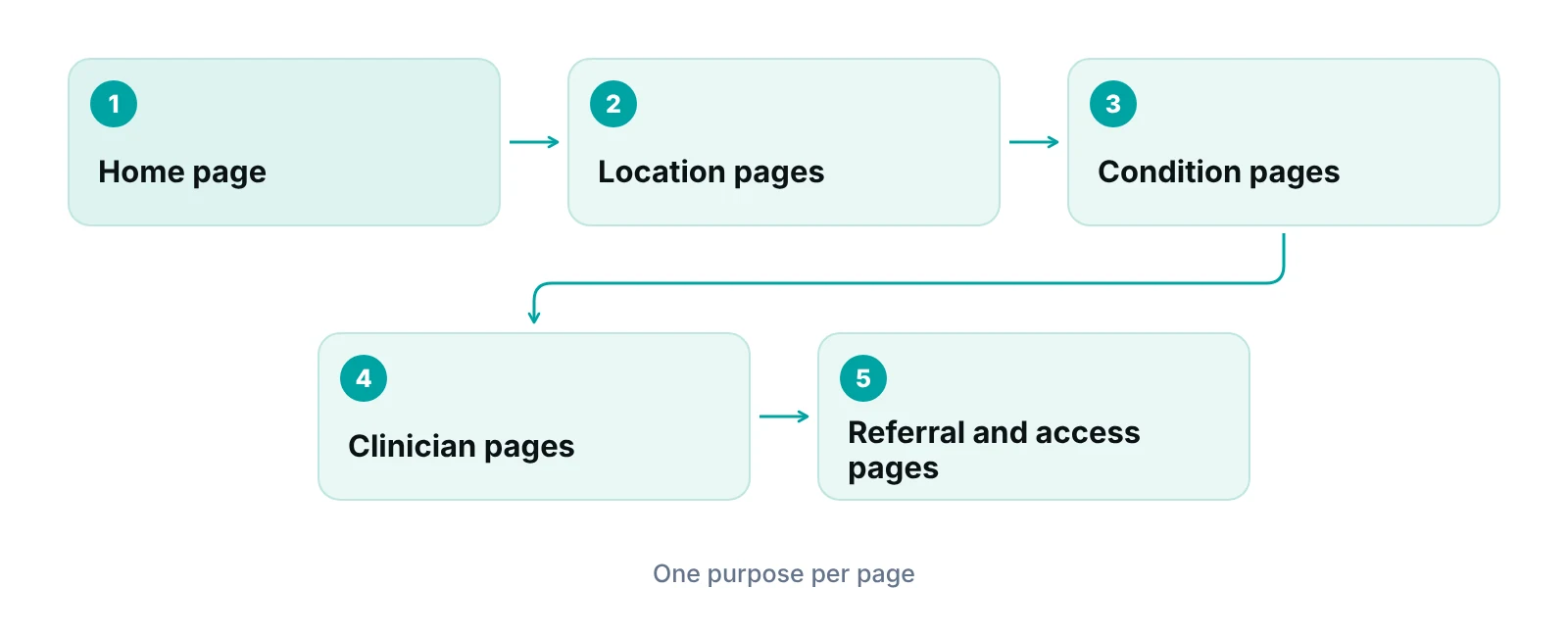
What each page has to do
- Location pages carry the address, phone and hours exactly as the Google profile does, plus the clinicians and plans accepted.
- Condition pages cover a condition the clinic treats well, explain a first visit, say when to seek urgent care, and link to booking.
- Clinician pages state training and focus, and match the state license record.
- Referral page gives a referring office one route and says what happens next.
- Access page says plainly whether a visit needs a referral in the clinic’s state.
Do not clone pages by swapping a town name. Google’s spam policies describe doorway abuse as pages created to rank for specific, similar queries, with multiple pages aimed at specific cities that funnel users to one page as an example, and scaled content abuse as many pages made mainly to manipulate rankings (Google Search Central spam policies). A location page with a real address, real clinicians and real hours is not that. A set of town pages with no clinic in them is.
For markup, Google requires a name and address, recommends telephone, URL, opening hours and coordinates, asks for the most specific business subtype, and wants each location as its own entity. It recommends review and rating markup only for sites that capture reviews of other local businesses, so a clinic should not mark up its own testimonials (Google Search Central). The insurance questions patients ask on these pages are answered on the billing side in the physical therapy billing services post.
How do direct access rules change what a PT website says?
Say only what your state allows, and say it plainly. APTA reports that all 50 states, the District of Columbia and the U.S. Virgin Islands provide some form of direct access to physical therapist services, that the provisions and limits differ, and that its data is current as of July 2025 (APTA). Direct access reached all 50 states in 2015 (APTA timeline).
APTA’s September 2023 chart sorts states into three groups: unrestricted patient access (21 states), patient access with provisions (27 states, D.C. and the U.S. Virgin Islands), and limited patient access (2 states). Table 3 shows a few of the provisions it lists. They show why one national page is wrong; they are not a guide to your state.
| State or group | What APTA's chart lists (September 2023) | What the website and front desk should do |
|---|---|---|
| Unrestricted states | No restriction on treatment without a referral; PT must refer out when care is outside PT scope | Say a referral is not required and explain when the clinic refers out |
| Texas | 10 or 15 days without a referral, depending on the PT’s qualifications; signed insurance disclosure | Explain the window and use the required disclosure |
| California | 45 calendar days or 12 visits, whichever comes first | State the limit and what happens at it |
| Georgia | 21 days or 8 visits; written coverage notice; physician consultation before dry needling | Add the notice and a consult step |
Source: APTA, Direct Access by State chart (current as of September 2023); APTA, Direct Access by State page (data current as of July 2025)
Two more layers sit above state law. Payers set their own rules, and APTA’s chart notes that some states require telling patients a direct access visit might not be covered, so check each payer before a page promises coverage. Medicare has a separate rule. Under 42 CFR 424.24(c), outpatient therapy services must be furnished under a plan of treatment, a physician or certain non-physician practitioners must certify it as soon as possible after the plan is established, and it must be recertified at least every 90 days (eCFR). A state’s direct access law does not remove that. Contractor documentation expectations can differ by Medicare Administrative Contractor, so confirm yours.
A page that says “no referral needed” for every visitor will be wrong for some. Write the access page by state and payer type, and have counsel or your state association check it.
Not sure what your clinic's pages say about access?
Send the website and Google profile. A free practice audit reviews the listing, pages and intake path against the points above.
How does referral-driven search work for a PT clinic?
A referral often ends in a search. The patient or referring office looks the clinic up, so the page that matters confirms the clinic is real, nearby, in network and easy to reach. APTA’s physician survey found that 98% of the 301 primary care physicians had referred a patient to PT within six months, and that 61% thought patient cost made peers hesitant to refer (APTA, 2024). Cost and insurance clarity matter to the referrer as well as the patient.
- Keep the accepted-plans list current and easy to find.
- Show clinicians’ training and focus, since experience and competence led the physician survey’s drivers.
- Make the referral route obvious: one phone number, one secure route, a named contact.
Calls from referred patients and referring offices are where web work meets the front desk. A virtual medical assistant can cover overflow calls, intake and eligibility checks in the practice’s own time zone; see the virtual medical assistant services and the post on front desk staff and revenue. Have a healthcare attorney review any arrangement involving value given for referrals.
What are the rules for reviews and testimonials?
Ask every patient the same way, never reward a review, and never post a patient’s story without written permission. Google lets businesses ask for reviews with a link or QR code, wants replies brief and free of promotions or private details, and prohibits free or discounted services in exchange for reviews (Google Business Profile Help).
Federal law adds to that. The FTC’s rule on consumer reviews and testimonials took effect on October 21, 2024. It prohibits fake or bought reviews, undisclosed insider reviews, certain review suppression and fake social media indicators, and lets the FTC seek civil penalties against knowing violators (Federal Register; FTC). Staff should not post reviews, and no one should offer a gift or discount for a positive one.
HIPAA is the third layer. HHS says communications made for an individual’s treatment are not marketing, while marketing generally needs written authorization (HHS OCR). In a 2016 resolution, a physical therapy practice agreed to pay $25,000 after posting patient testimonials with full names and full-face photos on its website without valid authorizations (HHS OCR). Replies need the same care: do not confirm a reviewer was a patient or describe their care. Ask your privacy officer for a standard reply. The online reputation management guide and the HIPAA compliance checklist for medical practices cover the wider process.
What does HIPAA mean for intake forms and website trackers?
A form where a person types a name, a reason for care and contact details can involve protected health information, so treat the form and every tag around it as a privacy decision. HHS’s bulletin on online tracking technologies says pages where visitors schedule an appointment may collect PHI, such as an email address or the reason for seeking care, in which case the HIPAA rules apply to a disclosure to a tracking vendor (HHS OCR).
Status of the HHS bulletin
A federal court vacated part of the bulletin on June 20, 2024: the part treating an IP address linked to a visit to a public page about specific conditions as PHI. HHS says it is evaluating next steps. The vacatur is not permission to put advertising tags on a booking form. Confirm current status with counsel.
- List every script on booking and intake pages, including analytics, ad and chat tools, and name an owner for each.
- Ask whether a vendor receiving form data is a business associate. The bulletin says that depends on the vendor’s role, and that a cookie banner is not a HIPAA authorization.
- Keep reasons for care out of page addresses and thank-you page URLs that analytics tools can read.
- Use a business associate agreement with any vendor that handles patient data for you. At RCM Finder we put a Business Associate Agreement in place before accessing patient data.
A conversion tag on a booking page is standard marketing practice and may also be a disclosure. Have the privacy officer sign off on the tag list, and repeat the check when the site is rebuilt.
How should a PT clinic measure SEO?
Measure first visits that were booked and kept, by source. Rankings move for reasons that have nothing to do with revenue. Google Search Console reports clicks, impressions, click-through rate and average position, by query, page, country and device, and its table shows the average position for each page or query row while the chart reflects the topmost result from the whole site (Google Search Console Help).
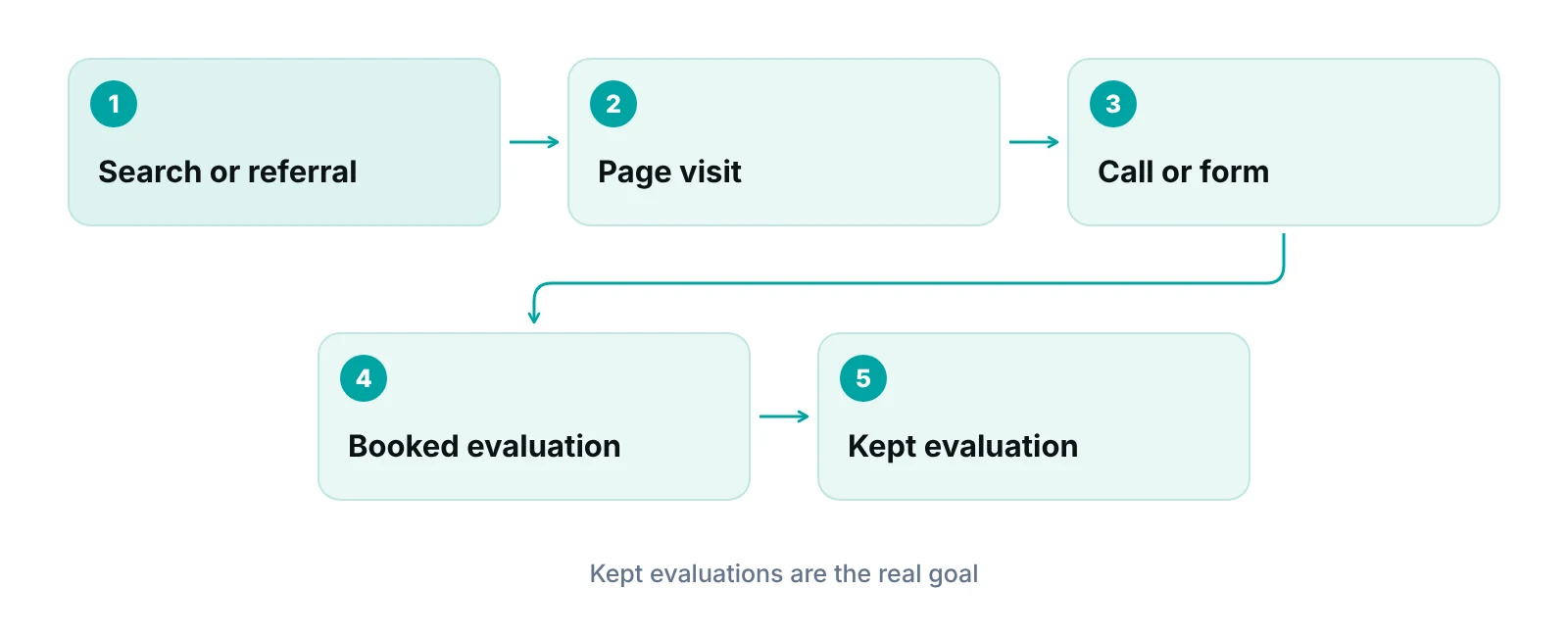
- Use Search Console for queries and pages, and the Google profile for calls and direction requests.
- Record a fixed “how did you find us” answer at scheduling, and name the referring office separately.
- Track days from inquiry to first visit, and the share that never schedule.
- Compare booked against kept evaluations by location, and review monthly with the front desk.
None of the agency pages reviewed for this post backed a results timeline with research, so treat any timeline as an assumption to test. A practice system or a spreadsheet can hold the source field; the physical therapy practice management software guide covers what to look for.
See how search fits your clinic's marketing
Review the healthcare digital marketing service for local search, Google Ads and reputation work.
Our recommendations
- Fix the Google profile before the website. Correct name, categories, address, hours and phone for every location first. A wrong phone number undoes content work.
- Count your two patient groups. Count new evaluations from referrals against the patient’s own search. The answer decides where the work goes.
- Write the access page by state. Have counsel or your state association check the wording on referrals and limits, and revisit it when rules change.
- Build real pages, not town templates. One page per location, per condition you treat well, and per clinician. Skip pages that exist only to hold a keyword.
- Standardize how you ask for reviews. One request process, no rewards, a reply template your privacy officer approved, and no patient stories without written authorization.
- Audit every tag on booking and intake pages. List each script, decide who owns it, and ask whether a vendor receiving form data needs a business associate agreement.
- Report on kept evaluations. Review booked and kept first visits by source and location each month. Treat rankings as a diagnostic, not a goal.
Bottom line
Physical therapy SEO works when the Google profile is accurate, every page has a real purpose, access wording follows state and payer rules, and forms and reviews pass a privacy check. Start there, then measure kept evaluations. For help turning this into a local search plan, see the healthcare digital marketing service and ask for a free practice audit. The revenue cycle management service covers what happens after the patient is on the schedule, and the physical therapy marketing plan puts search next to the other channels.
Frequently asked questions
What is physical therapy SEO?
Physical therapy SEO is the work of making a PT clinic’s website and Google listing easy to find when patients search for a condition near them, and when patients and referrers look the clinic up after a referral. It combines an accurate Google Business Profile, location and condition pages, clinician pages, reviews and measurement of booked and kept first visits.
Do PT clinics need SEO if most patients are referred?
Yes, because referred patients often search the clinic before booking. APTA’s 2025 survey found 90% of patients were referred by a physician, yet 71% of prospective patients were exploring PT on their own. A clinic needs a listing and website that serve both groups, and counting your own mix of sources shows which matters more.
How do I set up a Google Business Profile for multiple clinic locations?
Create one profile per location, each with its own address, phone number and hours, and link each to its own location page. Google says there should be one profile per business location, and that duplicates can affect how information displays. Use the real-world clinic name without taglines or service descriptions.
Can my website say that no referral is needed?
Only where it is true for the visitor. APTA reports every state allows some form of direct access, but the limits differ, including time limits, visit limits and conditions for certain treatments, and payers and Medicare have their own rules. Write the access page by state and payer type, and have counsel check it.
Can I offer patients a discount for leaving a Google review?
No. Google prohibits offering free or discounted goods or services in exchange for reviews, and the FTC’s review rule, effective October 21, 2024, bans buying reviews and certain other practices. Ask every patient in the same way with a link or QR code, and reply to reviews without confirming anyone was a patient.
Is it a HIPAA problem to use analytics or ad tags on my booking page?
It can be. HHS’s bulletin says appointment scheduling pages may collect protected health information, and a vendor receiving it may need a business associate agreement. A court vacated part of the bulletin in 2024 and HHS said it is evaluating next steps. Have your privacy officer review every tag on booking and intake pages.
Get your free practice audit
Tell us about your practice. We will contact you using the details you give.
- A review of your recent claims, denials and A/R aging
- Where your front desk and prior authorizations slow payment
- A prioritized fix list you keep, whether or not you hire us
Pricing is quoted after the audit, based on your volume and the services you choose. Prefer to talk? Call +1 (302) 556-2288.
Sources
- Consumer Perceptions of Physical Therapy 2025 — APTA (2025)
- APTA report on PCP perceptions — APTA (2024)
- Direct access by state — APTA (2026)
- Direct access by state chart (September 2023) — APTA (2023)
- All 50 states achieve some form of direct access — APTA (2015)
- Guidelines for representing your business on Google — Google Business Profile Help (2026)
- How to improve your local ranking on Google — Google Business Profile Help (2026)
- Read and reply to reviews / ask for reviews — Google Business Profile Help (2026)
- Local business structured data — Google Search Central (2026)
- Creating helpful, reliable, people-first content — Google Search Central (2026)
- Spam policies for Google web search — Google Search Central (2026)
- Performance report (Search results) — Google Search Console Help (2026)
- Use of online tracking technologies by HIPAA covered entities and business associates — HHS OCR (2024)
- Complete P.T., Pool and Land Physical Therapy resolution agreement — HHS OCR (2016)
- Marketing (HIPAA Privacy Rule) — HHS OCR (2013)
- 42 CFR 424.24 Requirements for medical and other health services — eCFR (2026)
- FTC announces final rule banning fake reviews and testimonials — FTC (2024)
- Trade regulation rule on the use of consumer reviews and testimonials — Federal Register (2024)
Disclaimer: This article is educational and is not legal, coding, tax or compliance advice. CPT is a registered trademark of the American Medical Association. Advertising, privacy, physical therapy practice acts and payer rules differ by state and change, so confirm current requirements with your attorney, privacy officer, state physical therapy board, payers and Medicare contractor before acting.