
Shoulder pain icd 10 coding uses M25.511 for the right shoulder, M25.512 for the left and M25.519 when the side is not documented. These are symptom codes. When the provider confirms a cause such as a rotator cuff tear, adhesive capsulitis, impingement or osteoarthritis, report that diagnosis instead of the pain code.
Shoulder pain looks like the easiest code in orthopedics, and it still produces denials. The usual causes are the wrong side, a pain code left on the claim after the provider confirmed a diagnosis, and a traumatic injury coded as a degenerative condition.
This guide is for coders, billers and practice managers. It gives the lookup table first, then the rules for side, symptoms versus confirmed diagnoses, Excludes notes and chronic pain codes. It ends with the documentation, denial patterns and a worked example. It covers ICD-10-CM diagnosis codes only, not CPT codes for shoulder procedures.
Key takeaways
- Shoulder pain icd 10 codes are M25.511 (right), M25.512 (left) and M25.519 (unspecified); M25.51 alone is not billable.
- Pain is a symptom code: use it only until the provider confirms a cause, then code the cause.
- Bilateral shoulder pain has no combined code; report M25.511 and M25.512 together.
- A traumatic rotator cuff tear goes to S46.01-, not M75.1-, because of an Excludes1 note.
- Scrub for unspecified side, a pain code left beside a confirmed diagnosis, and G89 codes with no documented acuity.
What is the ICD-10 code for shoulder pain?
The ICD-10-CM code for shoulder pain is M25.511 for the right shoulder, M25.512 for the left and M25.519 for an unspecified shoulder. They sit under M25.51, pain in shoulder, which is a header and not billable on its own. The FY 2027 code set applies to encounters from October 1, 2026 to September 30, 2027, per the CMS ICD-10 page.
These three codes are for pain with no confirmed cause. The same table also shows the shoulder diagnoses that replace them once a provider documents a cause.
| Code | What it describes | Use it when |
|---|---|---|
| M25.511, M25.512 | Pain in the right shoulder; pain in the left shoulder | Pain is documented with a side and no confirmed cause |
| M25.519 | Pain in an unspecified shoulder | The side is not documented and cannot be clarified |
| M75.01, M75.02 (M75.00 unspecified) | Adhesive capsulitis of the right, left or unspecified shoulder | The provider diagnoses adhesive capsulitis |
| M75.101, M75.111, M75.121 (right); M75.102, M75.112, M75.122 (left) | Rotator cuff tear not specified as traumatic: unspecified, incomplete, complete | The provider documents a non-traumatic tear and its extent |
| M75.41, M75.42 | Impingement syndrome of the right or left shoulder | The provider diagnoses impingement |
| M75.51, M75.52 | Bursitis of the right or left shoulder | The provider diagnoses shoulder bursitis |
| M19.011, M19.012 (M19.019 unspecified) | Primary osteoarthritis of the right, left or unspecified shoulder | The provider documents primary osteoarthritis |
| S46.011-, S46.012- | Strain of a rotator cuff muscle or tendon, right or left shoulder, from injury | The tear is traumatic; needs a 7th character |
Source: icd-10codes.com FY 2027 code pages for M25.5, M75, M75.0, M75.1, M75.5, S46.01 (secondary cross-check); allicd10codes.com for M25.51 and M19.011; AAPC (undated) for M19.01-; icd-10codes.com page for M75.4 shows FY 2026.
Not billable on their own
M25.51 is a header with three children. S46.01 and S46.011 are categories that also need a 7th character. Check your encoder against the official FY 2027 tabular list before you load a build table.
How do you choose between right, left and unspecified?
Code the side the provider documents. The guidelines (Section I.B.13) say that when the side is not documented, you assign the code for the unspecified side, and that unspecified-side codes should rarely be used, mainly when the record is insufficient and clarification cannot be obtained.
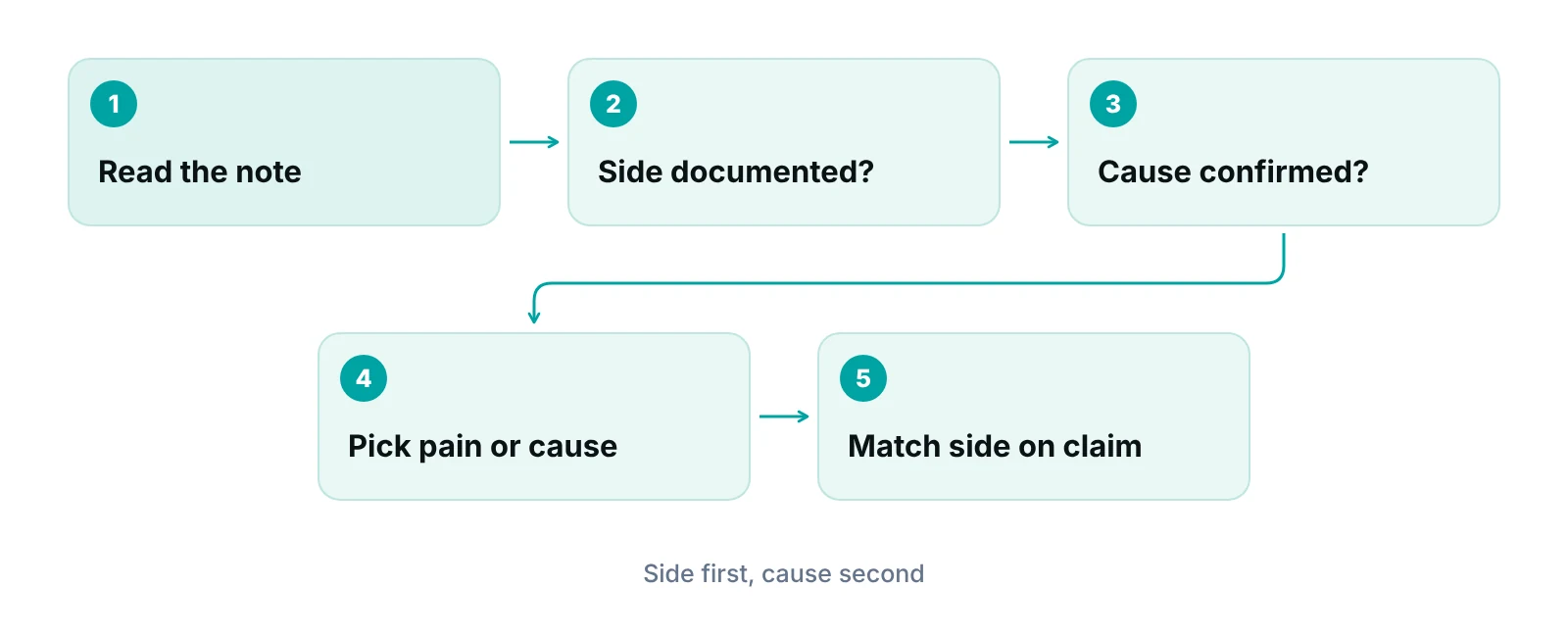
- Side stated: use the right or left code. Do not default to M25.519 for convenience.
- Side missing: query the provider. M25.519 is for records that cannot be clarified.
- Both shoulders: the pain codes have no bilateral option. The guidelines say that when no bilateral code exists, assign separate codes for the left and right side, so report M25.511 and M25.512.
- Separate visits for each side: the same guideline covers this case. The bilateral rule applies unless the condition no longer exists on the treated side.
CMS Q&A guidance tells coders to avoid unspecified codes whenever documentation supports a more detailed code, and also says unspecified codes remain acceptable when the record cannot support more. The point is accuracy, not avoidance.
When does a confirmed diagnosis replace the pain code?
Once the provider confirms a cause, code the cause and drop the pain code. Section I.B.4 allows a symptom code “when a related definitive diagnosis has not been established (confirmed) by the provider,” and Section I.B.5 says signs and symptoms that are routinely part of a disease should not be added unless the classification says otherwise.
| Situation | Report | Rule |
|---|---|---|
| Pain only, side stated, no cause confirmed | M25.511 or M25.512 | Section I.B.4: symptom code is acceptable until a diagnosis is confirmed |
| Pain, side not documented and cannot be clarified | M25.519 | Section I.B.13: unspecified side, rarely |
| Pain in both shoulders | M25.511 and M25.512 | Section I.B.13: separate codes when no bilateral code exists |
| Provider confirms a rotator cuff tear, impingement or osteoarthritis | The cause code, not the pain code | Section I.B.5: integral symptoms are not added |
| A symptom that is not routinely part of the diagnosis | The diagnosis and the symptom | Section I.B.6: non-integral symptoms are coded when present |
| Pain from a documented injury such as a traumatic rotator cuff strain | S46.01- with the 7th character | M75.1 Excludes1 note for traumatic tear |
| Pain in the arm, not the joint | Pain in limb, M79.6- | M25.5 Excludes2 note for pain in limb |
Source: CDC/NCHS FY 2027 ICD-10-CM Official Guidelines (2026), Sections I.B.4, I.B.5, I.B.6, I.B.13; icd-10codes.com M75.1 and M25.5 pages (FY 2027).
A related trap is the working diagnosis. If the provider writes a diagnosis that is not confirmed, the coder should not carry it to the claim as though it were. Section I.B.18 says a sign or symptom is appropriate “in lieu of a definitive diagnosis” when none is established by the end of the encounter. The guidelines also warn against choosing a specific code the record does not support.
Which Excludes notes and traumatic codes affect shoulder pain?
Three notes matter most. They tell you which codes you can pair, which you cannot, and which belong to injury rather than disease.
- M25.5, Excludes2: pain in hand and fingers (M79.64-), foot and toes (M79.67-) and limb (M79.6-). An Excludes2 note means “not included here,” so both codes may be reported when the patient has both conditions.
- M25, Excludes2: calcification of shoulder (joint) (M75.3). Calcific tendinitis of the shoulder is its own diagnosis.
- M75.1, Excludes1: traumatic tear of the rotator cuff (S46.01-). An Excludes1 note means the two are not coded together, so a non-traumatic and a traumatic tear code do not share a claim line unless the conditions are unrelated.
The injury side of the shoulder has its own family. S46.01 is a category for strain of rotator cuff muscles and tendons, with S46.011 for the right shoulder, S46.012 for the left and S46.019 for unspecified. Each needs a 7th character, and the category directs a code also for any associated open wound (S41.-) and the Chapter 20 external cause codes. Our hip fracture ICD-10 guide explains how the 7th character moves from active treatment to routine healing, and the same logic applies here.
Where chronic pain codes fit
Category G89 adds acuity to a site-specific code. Outsource Strategies warns that you should not assign a G89 code if the provider has not specified the pain as acute or chronic. AAPC adds that with a known underlying diagnosis, G89 is not used unless the encounter is for pain control or management. When no related diagnosis is confirmed, the site-specific code comes first and the G89 code second. For a pain-control encounter, the G89 code comes first.
How do the cause codes differ from the pain codes?
The cause codes ask for more from the note than the pain codes do, and their side digits do not follow one pattern. That second point trips up build tables and templates, so check it when you load or map codes.
Rotator cuff tear, non-traumatic
M75.1 has three levels of extent: unspecified (M75.10-), incomplete (M75.11-) and complete (M75.12-). Each has three billable codes for the side. In M75.121 the last digit 1 means right, and in M75.122 the 2 means left. A tear documented only as a tear, with no extent, falls to the unspecified level, so ask the provider whether the tear is incomplete or complete before you finalize.
Adhesive capsulitis, impingement and bursitis
Adhesive capsulitis (M75.0-), impingement syndrome (M75.4-) and bursitis (M75.5-) each end in the side. The titles show the pattern: M75.00, M75.40 and M75.50 are for an unspecified shoulder, 1 for right and 2 for left. These conditions often appear in the same note as pain, which is why the symptom rule matters. The M75 category also has an Excludes2 note for shoulder-hand syndrome (M89.0-), and no Excludes1 note on the page we read.
Osteoarthritis
M19.01- covers primary osteoarthritis of the shoulder: M19.011 right, M19.012 left and M19.019 unspecified. AAPC notes that the shoulder has no bilateral osteoarthritis code, so a patient with both shoulders affected gets M19.011 and M19.012. If the provider documents a type other than primary, query before using M19.01-.
Note the side digits. In M25.51 the unspecified shoulder is 9 (M25.519), while in M75.0, M75.4 and M75.5 it is 0, and in M75.1 it sits in the sixth place with a 0. A mapping table that assumes one pattern will put the wrong side on the claim.
What must the provider document?
Five facts make the difference between M25.511 and a better code, or between a clean claim and a query. The guidelines base code assignment on the patient’s provider, so the note must carry them (Section I.B.14).
- Side: right, left or both, written in the assessment as well as the history.
- Cause or status: unexplained pain, or a named condition such as rotator cuff tear, impingement, bursitis, adhesive capsulitis or osteoarthritis.
- Mechanism: injury or no injury, and when it happened, which separates S46 from M75.
- Acuity and duration: acute or chronic, only if the provider says so, because G89 depends on it.
- Findings and plan: exam, range of motion, imaging results the provider has interpreted, and the treatment plan that links to the services billed.
A general billing-services article makes the same point in plain words: thorough records support medical necessity, and diagnosis codes should be linked to the services billed. That advice is not specific to any payer, so check each payer’s medical policy for covered diagnoses.
Why do shoulder pain claims get denied?
Most shoulder denials trace to side, specificity or a diagnosis that does not match the service. CMS Q&A guidance states that a code not recognized as valid is rejected, and that a valid code can still be denied when it conflicts with a coverage policy. NC Medicaid’s NCTracks adds that claims may deny for insufficient specificity or an outdated code edition.
| Pattern | Why it fails | Fix | Owner |
|---|---|---|---|
| M25.51 or S46.011 submitted without the last characters | A header or category is not a valid code, so the claim is rejected | Scrub for M25.51 and for S46 codes shorter than seven characters | Coder |
| M25.519 when the side is in the note | Unspecified side drops specificity and can fail side-specific edits | Query the provider; reserve M25.519 for records that cannot be clarified | Coder, provider |
| Pain code beside a confirmed diagnosis | The symptom is integral to the diagnosis and is not added | Hold claims that list M25.51- with M75, M19.01 or S46.01 for coder review | Coder |
| M75.1 for a traumatic tear | Excludes1 note sends traumatic tears to S46.01- | Ask whether the tear followed an injury | Provider |
| G89 code with no documented acuity | G89 is assigned only when pain is specified as acute or chronic | Block G89 unless the note says acute or chronic | Coder |
| Left shoulder on the order, right on the claim | The diagnosis side does not match the order or service | Compare the order, note and claim side before release | Biller |
Source: CMS Clarifying Questions and Answers (rev. Aug 2016) via Michigan DHHS copy; NC Medicaid NCTracks (2018); CDC/NCHS FY 2027 guidelines Sections I.B.5, I.B.13; Outsource Strategies (undated); icd-10codes.com M75.1 (FY 2027).
Payer-specific rules sit on top of this. A payer may list the diagnoses it accepts for a given service, and a pain code that is valid in ICD-10-CM can still fall outside that list. We did not review any payer or Medicare coverage policy for this guide, so read the policies your payers publish for the services you bill before you build a scrubber rule from this table.
Run these checks inside your claim scrubber, not at the end of the month. Our clean claims guide explains where each check belongs, and our denial management services page describes how we work denials once they arrive.
Are shoulder claims coming back for diagnosis edits?
Send us a sample of recent orthopedic and pain denials. A free practice audit shows whether the gap is the side, the symptom code or the documentation.
Worked example: from pain to a confirmed diagnosis
Example only. This scenario is invented and de-identified. It shows how the code changes as the diagnosis becomes clear. Confirm every code against your encoder and your payers.
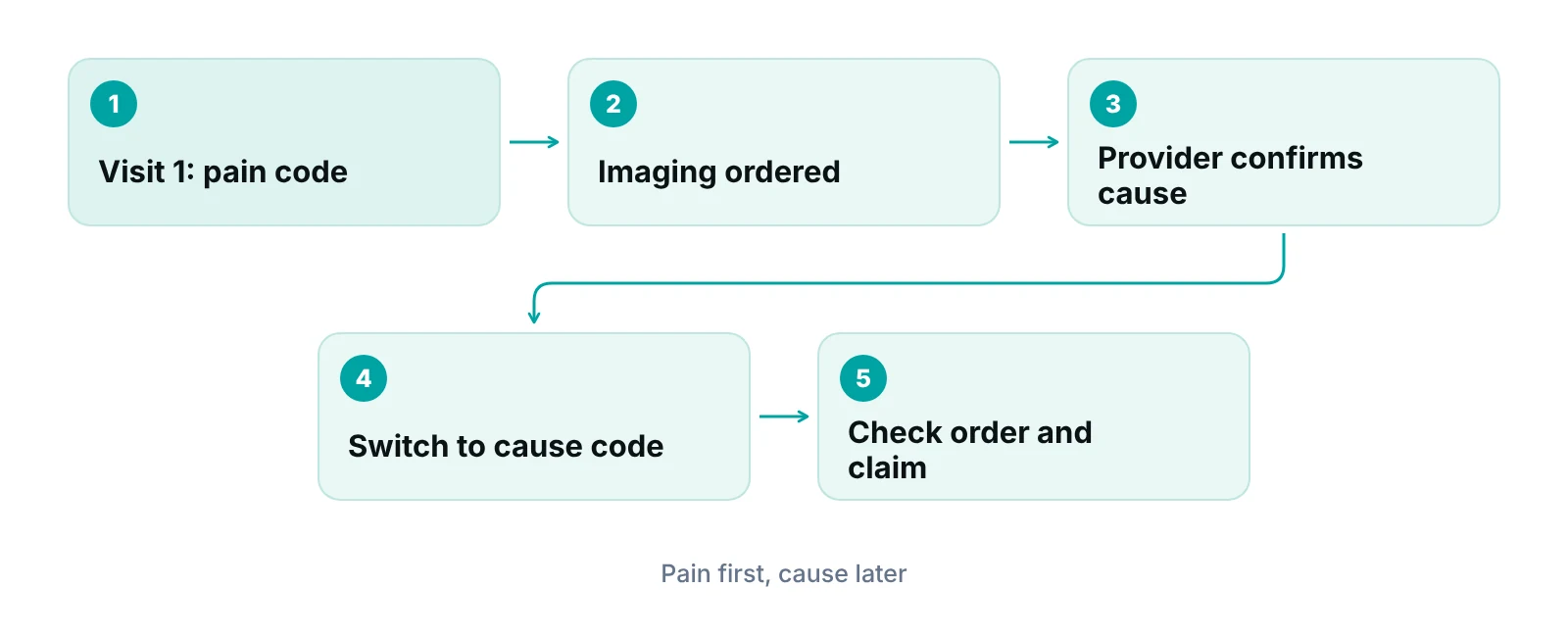
- Visit 1. The provider documents three weeks of right shoulder pain with no injury and no diagnosis yet, and orders imaging. Code M25.511.
- Visit 2. The provider reviews the imaging and documents a complete, non-traumatic rotator cuff tear of the right shoulder. Code M75.121 and drop M25.511, because the pain is part of the confirmed condition.
- Variation. If the provider instead documents the tear after a fall last week, the coder checks the Excludes1 note at M75.1 and uses a code from S46.01- with a 7th character, plus an external cause code.
- Variation. If the patient has pain in both shoulders and no cause is yet confirmed, report M25.511 and M25.512 because no bilateral pain code exists.
At each step the coder worked from what the provider had documented that day, not from what the imaging suggested.
How does this fit with other joint and pain codes?
The shoulder follows the same pattern as other joints: a pain code by side, then a specific condition when one is confirmed. Compare the rules in our knee pain ICD-10 guide, the back pain ICD-10 guide and the neck pain ICD-10 coding guide, then keep a single scrub rule set for symptom codes across all of them.
- Keep a list of symptom codes that need a second look when a diagnosis appears in the same encounter.
- Check the side on the order, the note and the claim line before release.
- Review the codes against the orthopedic coding guide and the orthopedic specialty page when the visit includes a procedure.
- For visits where pain control is the purpose, see how we support pain management billing.
What to check in a quarterly shoulder audit
A short audit finds most shoulder coding problems. Pull a sample of encounters from orthopedics, pain management and primary care, and compare the claim to the note on the same five points each time:
- The code is complete: a billable code, not the M25.51 header, and a 7th character on any S46 code.
- The side on the claim matches the side in the note and on the order.
- No pain code sits beside a diagnosis that already explains it.
- Any tear has its extent and its mechanism documented, so M75.1- and S46.01- are not confused.
- Any G89 code has a documented acuity and the right sequence.
Log each miss by owner, whether coder, provider or front desk, so the fix reaches the person who can change the habit. Repeated misses on one point usually mean a template or charge screen needs a change, not more training. Template wording matters here: a note that defaults to “shoulder pain” in the assessment line will keep producing symptom codes after the plan has moved on.
“A pain code is a placeholder for a diagnosis. The job is to replace it as soon as the provider writes the real one.”
— Awais Afzal, Healthcare Operations & Data Analyst
Our recommendations
- Add a symptom-code review rule. We would hold any claim that lists M25.51- beside a confirmed shoulder diagnosis. A coder should confirm which one the provider meant before release.
- Make the side a required field. We would not let the unspecified-side code be a default. If the side is blank, the order goes back to the provider.
- Teach the traumatic question. We ask providers to state whether a tear followed an injury, because the answer moves the code between M75.1- and S46.01-.
- Block G89 without acuity. We would add an edit that stops G89 codes when the note does not say acute or chronic. The same rule can sit in your claim scrubber as a hard stop.
- Audit a small sample each quarter. We suggest pulling twenty shoulder encounters and comparing side, symptom code and cause code against the note. If a pattern appears, our medical billing services team can review the process.
Bottom line
Shoulder pain icd 10 coding is simple only until a diagnosis is confirmed: M25.511, M25.512 or M25.519 by side, then the cause code once the provider documents it. Fix the side field and the symptom-code rule first. If shoulder claims keep coming back, start with a free audit, or read our hip fracture ICD-10 guide for the injury side of orthopedic coding.
Frequently asked questions
What is the ICD-10 code for right shoulder pain?
The code is M25.511, pain in right shoulder. Use it when the provider documents right shoulder pain and no cause has been confirmed. If the provider confirms a condition such as a rotator cuff tear, report that diagnosis instead of the pain code.
What is the code for left shoulder pain?
M25.512 is pain in left shoulder, under the same M25.51 header. The same rules apply as for the right side: use it when pain is documented without a confirmed cause, and replace it when the provider documents a diagnosis. Check that the side on the claim also matches the side on the order and the note.
When should I use M25.519?
Use M25.519 only when the side is not documented and the provider cannot clarify. The guidelines say unspecified-side codes should rarely be used. If the side is in the note or can be obtained, use M25.511 or M25.512. Using the unspecified code out of habit is a common reason for specificity edits.
Can I report shoulder pain with a rotator cuff tear?
Generally no. When pain is routinely part of a confirmed condition, Section I.B.5 says the symptom code is not added. Report the diagnosis, such as M75.121 for a complete non-traumatic right tear. Add a symptom only if it is not routinely part of the condition.
How do I code pain in both shoulders?
There is no bilateral shoulder pain code. When no bilateral code exists, the guidelines say to assign separate codes for the left and right side. Report M25.511 and M25.512 for the same encounter.
Can I add a chronic pain code to shoulder pain?
Only when the provider documents the pain as acute or chronic. A G89 code adds acuity to the site code. When no related diagnosis is confirmed, the shoulder code comes first and G89 second; a pain-control encounter reverses the order.
Get your free practice audit
Tell us about your practice. We will contact you using the details you give.
- A review of your recent claims, denials and A/R aging
- Where your front desk and prior authorizations slow payment
- A prioritized fix list you keep, whether or not you hire us
Pricing is quoted after the audit, based on your volume and the services you choose. Prefer to talk? Call +1 (302) 556-2288.
Sources
- FY 2027 ICD-10-CM Official Guidelines for Coding and Reporting — CDC/NCHS (2026)
- ICD-10-CM FY 2027 release folder — CDC/NCHS (2026)
- ICD-10 codes (FY 2027 update page) — CMS (2026)
- M25.5 Pain in joint (FY 2027) — icd-10codes.com (secondary) (2026)
- ICD-10-CM Code M25.5 Pain in joint — AAPC Codify (2026)
- M25.51 Pain in shoulder — allicd10codes.com (secondary) (2026)
- M79.6 Pain in limb, hand, foot, fingers and toes (FY 2027) — icd-10codes.com (secondary) (2026)
- M75 Shoulder lesions (FY 2027) — icd-10codes.com (secondary) (2026)
- M75.1 Rotator cuff tear or rupture, not specified as traumatic (FY 2027) — icd-10codes.com (secondary) (2026)
- M75.10, M75.11 and M75.12 pages (FY 2027) — icd-10codes.com (secondary) (2026)
- M75.0 Adhesive capsulitis of shoulder (FY 2027) — icd-10codes.com (secondary) (2026)
- M75.4 Impingement syndrome of shoulder — icd-10codes.com (secondary) (2026)
- M75.5 Bursitis of shoulder (FY 2027) — icd-10codes.com (secondary) (2026)
- S46.01 Strain of rotator cuff of shoulder (FY 2027) — icd-10codes.com (secondary) (2026)
- M19.011 Primary osteoarthritis, right shoulder — allicd10codes.com (secondary) (2026)
- Understand how location of osteoarthritis narrows code choices — AAPC Primary Care Coding Alert (undated)
- Proper Use of Category G89 Codes in ICD-10 — Outsource Strategies International (undated)
- Use these tips to keep pain Dx coding from hurting your bottom line — AAPC Neurology Coding Alert (2022)
- How to document and code right shoulder pain — Billing Care Services (blog) (2026)
- CMS Clarifying Questions and Answers on the CMS/AMA ICD-10 guidance (Michigan DHHS copy) — CMS (2016)
- Use Highly Specific Diagnosis Codes to Prevent Claim Denial — NC Medicaid (NCTracks) (2018)
Disclaimer: This article is educational and is not legal, coding, billing, medical or compliance advice. ICD-10-CM codes and guidelines change each October 1, payer rules vary, and the examples are invented. Verify current requirements with the official code set, your payers and your counsel before you act.
