
The usual hiatal hernia ICD-10 code is K44.9, diaphragmatic hernia without obstruction or gangrene. Use K44.0 when the provider documents obstruction, incarceration or strangulation without gangrene, and K44.1 when gangrene is documented. A congenital hiatus hernia is excluded from K44 and goes to Q40.1 instead.
Many pages for “hiatal hernia icd 10” give K44.9 and stop. That is correct for a straightforward case, but K44 has three billable codes, a congenital exclusion, and frequent companion diagnoses such as reflux. This guide shows how to choose, what the provider must write, which edits to expect, and how a repair claim differs from a diagnosis-only visit.
Key takeaways
- K44 is a category; report K44.0, K44.1 or K44.9. The category itself is not a complete code.
- K44.9 is for hiatal or paraesophageal hernia without obstruction or gangrene, including diaphragmatic hernia NOS.
- When a hernia has both gangrene and obstruction, the Tabular note sends it to the gangrene code, K44.1.
- Congenital hiatus hernia (Q40.1) and congenital diaphragmatic hernia (Q79.0) are Excludes1 for K44.
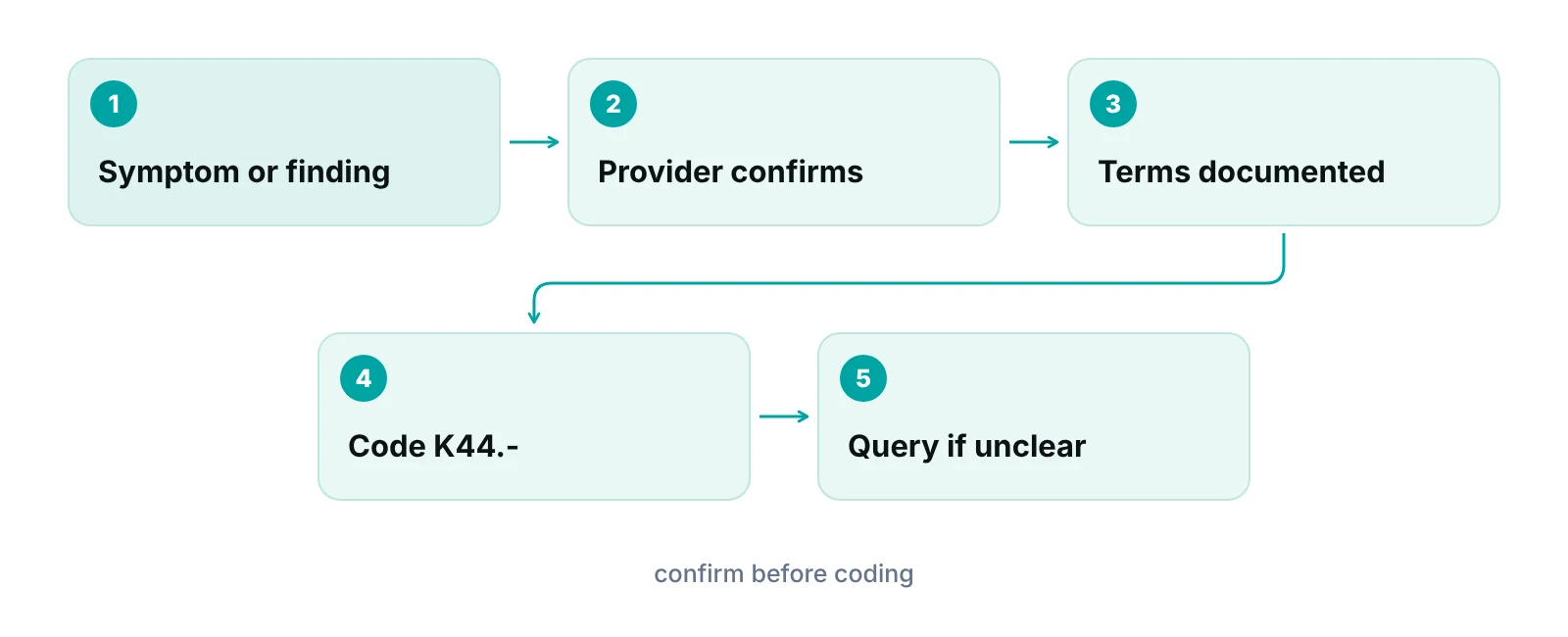
- Symptoms such as heartburn are coded as symptoms until the provider confirms a hernia.
What is the ICD-10 code for hiatal hernia?
Hiatal hernia is classified to K44, diaphragmatic hernia, and the usual billable code is K44.9. The K44 category has an inclusion note for hiatus hernia (esophageal)(sliding) and paraesophageal hernia, and three subcodes split by obstruction and gangrene. The FY 2027 code files apply from October 1, 2026 through September 30, 2027 (CMS ICD-10 page), and a FY 2027 change log lists no change to K44.
| Code | What it describes | Use it when |
|---|---|---|
| K44.9 | Diaphragmatic hernia without obstruction or gangrene (includes hernia NOS) | A hiatal or paraesophageal hernia is documented with no obstruction and no gangrene |
| K44.0 | Diaphragmatic hernia with obstruction, without gangrene (includes incarcerated, irreducible, strangulated) | The provider documents obstruction, incarceration, irreducibility or strangulation, and no gangrene |
| K44.1 | Diaphragmatic hernia with gangrene | The provider documents gangrene, with or without obstruction |
| Q40.1 | Congenital hiatus hernia | Documentation says the hernia is congenital; K44 has an Excludes1 note for it |
| Q79.0 | Congenital diaphragmatic hernia | The hernia is a congenital diaphragmatic hernia; also an Excludes1 note under K44 |
Source: ICD-10-CM Tabular List text (FY 2025 edition, via a third-party reference); AAPC code page for K44.9 (2026). Re-check against the FY 2027 Tabular List.
K44 alone will not process
K44 has three children (K44.0, K44.1, K44.9), so the 3-character category is not billable. Report one of the three, or the claim fails as an invalid diagnosis.
The Tabular text for the whole hernia block adds a rule that is easy to miss: hernia with both gangrene and obstruction is classified to hernia with gangrene. In practice, that means K44.1 covers a gangrenous, obstructed hiatal hernia, and K44.0 is not added on top.
How do you choose between K44.9, K44.0 and K44.1?
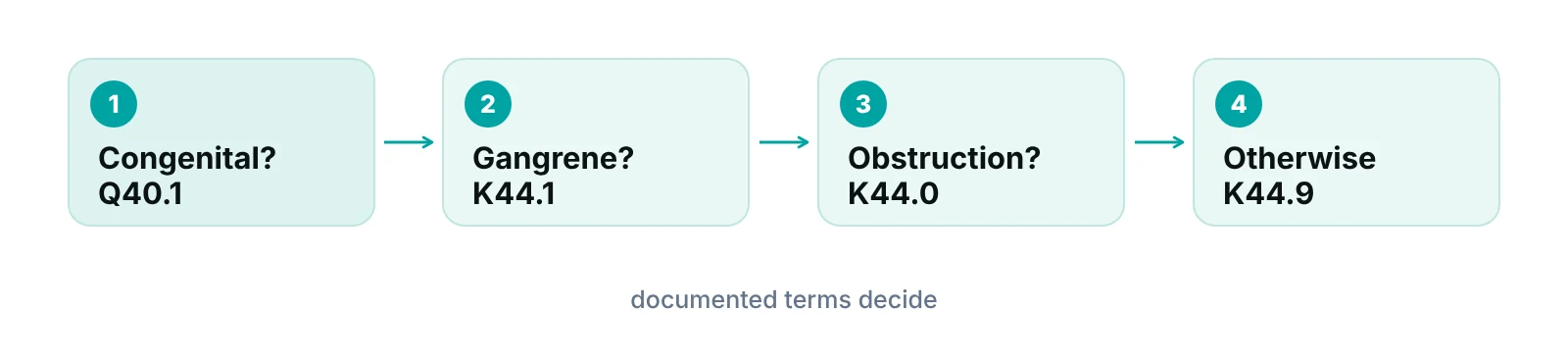
Choose by what the provider documents about obstruction and tissue death, not by how large the hernia looks on imaging. The FY 2027 ICD-10-CM Official Guidelines say that an Excludes1 note means the two codes are not reported together, with a narrow exception for unrelated conditions, which is why congenital hernia and K44 do not combine.
- Is the hernia congenital? If the provider documents a congenital hiatus hernia, the Excludes1 note on K44 points to Q40.1. If the record says only “hiatal hernia,” do not assume congenital; query the provider if the history points that way.
- Is there gangrene? If yes, report K44.1. The gangrene code also absorbs obstruction, per the hernia block note.
- Is there obstruction, incarceration, irreducibility or strangulation, without gangrene? Report K44.0. The inclusion terms under K44.0 are the words that trigger it.
- None of the above? Report K44.9. This includes a sliding hiatal hernia, a paraesophageal hernia without complications and hernia documented only as diaphragmatic hernia.
The ICD-10-CM Tabular text read for this post has no separate codes for hiatal hernia types. A sliding hernia and a paraesophageal hernia both fall under K44, so the type is a documentation and procedure-coding matter, not a diagnosis-code choice.
Which companion diagnoses go with a hiatal hernia?
Hiatal hernia often arrives with reflux, esophageal findings or symptoms, and each has its own code. Report what the provider documents, and use the Tabular notes to avoid conflicts. The K44 and K21 entries read for this post carry no Excludes1 note pointing at each other, so a documented hernia and documented reflux can both be reported when each is supported; confirm that against the FY 2027 Tabular List.
| Code | What it describes | Coding point |
|---|---|---|
| K21.9 | Gastro-esophageal reflux disease without esophagitis (includes esophageal reflux NOS) | Report with K44.9 when both are documented |
| K21.00 / K21.01 | Reflux disease with esophagitis, without or with bleeding | Choose by the documented esophagitis and bleeding status |
| K22.70 | Barrett’s esophagus without dysplasia | Excludes1 at K22.7 for Barrett’s ulcer (K22.1) and esophageal cancer (C15.-) |
| K22.2 | Esophageal obstruction (compression, constriction, stenosis, stricture) | Different from K44.0, which is obstruction of the hernia itself |
| R12 | Heartburn (symptom) | K30 has an Excludes1 note for heartburn; use R12 only when no diagnosis is confirmed |
| R10.13 | Symptom code the K30 Excludes1 note names for dyspepsia NOS | Symptom code when the provider has not confirmed a diagnosis |
Source: ICD-10-CM Tabular List text, K20-K31 (FY 2025 edition, via a third-party reference); CDC FY 2027 Official Guidelines, I.B.4 and I.B.18.
Symptom codes have a place. The FY 2027 guidelines say sign and symptom codes are acceptable when a related definitive diagnosis has not been confirmed by the provider, and may be reported in lieu of a definitive diagnosis if one is not established by the end of the encounter. A patient sent for chest discomfort whose imaging suggests a hernia is a symptom case until the provider confirms the hernia. For the symptom side, see our guide to chest pain ICD-10 codes.
For neighbouring upper-GI diagnoses, our guides to gastritis ICD-10 codes and cholecystectomy ICD-10 codes cover K29 and the diagnosis-versus-procedure split, so this page does not repeat them.
What must the provider document to support the code?
The record needs the words that map to the code, plus the source of the diagnosis. A hernia seen on a study but never adopted by the treating provider is a finding, not a diagnosis.
- The diagnosis in the provider’s own words: hiatal hernia, sliding hiatal hernia or paraesophageal hernia, rather than “abnormal imaging.”
- Obstruction, incarceration, irreducibility, strangulation or gangrene, if present, using those words.
- Whether the hernia is congenital. Silence defaults to the acquired K44 pathway, so ask when the history suggests otherwise.
- Companion conditions as separate diagnoses: reflux with or without esophagitis, Barrett’s esophagus, and symptoms that remain unexplained.
- The reason the diagnosis matters for this visit: the symptoms evaluated, the study that showed the hernia and the plan, so a reviewer can follow the link between diagnosis and service.
- For a repair, the hernia type, since the ASMBS 2024 position statement says the final type is determined intraoperatively and that the operative note should describe every essential step of the standard repair.
How does a hernia repair claim differ from a diagnosis-only visit?
A repair adds a CPT or ICD-10-PCS procedure code, and the procedure rules matter more than the K44 code. Our guide to cholecystectomy ICD-10 codes explains the split between diagnosis and procedure code sets, so this section stays on the hernia-specific points from the ASMBS 2024 position statement.
| Type (clinical) | Description | Coding point |
|---|---|---|
| Type I (sliding) | The esophagogastric junction slides up through the hiatus; the most common type | Falls under K44; the statement says small sliding hernia repairs are considered incidental and not separately reimbursable |
| Type II | Gastric fundus herniates beside a fixed junction; true paraesophageal hernia | Falls under K44; paraesophageal repair CPT codes 43281 (without mesh) and 43282 (with mesh) apply to qualifying repairs |
| Type III | Junction displaced together with the herniated fundus | Falls under K44; the operative note must describe the full standard repair |
| Type IV | Stomach plus other organs, such as bowel or spleen, herniate | Falls under K44; document the other organs, and any obstruction or gangrene for K44.0 or K44.1 |
Source: ASMBS position statement on paraesophageal hernia repair with concurrent bariatric surgery (2024). CPT descriptions are paraphrased; CPT is owned by the AMA.
- Mesh decides the code. The ASMBS statement says whether mesh was used determines 43281 versus 43282, so the note must say.
- Repair with bariatric surgery. The statement describes modifier 259 on the paraesophageal repair when it is a distinct, complex procedure alongside a primary bariatric operation, and notes that an anterior-only dissection with crural repair does not qualify.
- Indication for repair. The statement says the indication should weigh symptoms, anatomy including BMI, hernia size and the bariatric procedure chosen, so a repair claim with a bare K44.9 and no indication in the note is weak.
- Incidental sliding hernia. A small sliding hernia repaired during another operation is incidental, and billing it separately invites denial.
Confirm every CPT code and modifier rule against the current AMA CPT manual and your payers. An older 2013 AAPC article describes different fundoplasty and paraesophageal code pairs and is dated.
What causes hiatal hernia claims to be returned or denied?
Most hernia edits come from an incomplete category code, a diagnosis the note does not support, or a procedure billed against an incidental finding. The list below uses payer-neutral wording; edit names vary by payer and clearinghouse.
- Invalid diagnosis. K44 submitted without the 4th character.
- Excludes1 conflict. A congenital hernia code reported together with K44.-.
- Diagnosis not supported by the note. K44.0 reported without the words obstruction, incarcerated, irreducible or strangulated.
- Symptom code and diagnosis code together for the same problem. Heartburn reported alongside a confirmed hernia and reflux diagnosis.
- Repair of an incidental hernia. A repair line with only K44.9 and no documented symptoms or indication for the repair.
- Mesh not documented. A mesh-based CPT code without a statement of mesh in the note.
Missing or inconsistent information is a common reason for returned claims; our guide to CO-16 denials explains that denial family, and clean claims shows how a pre-bill check catches code conflicts. For operational support, see our denial management services.
Are digestive-system claims coming back for diagnosis edits?
Send a sample of returned claims with the provider notes. A free practice audit can show whether the cause is the diagnosis code, the documentation or a payer edit.
Who reports a hiatal hernia code, and in which setting?
The same K44 code appears on very different claims, and the supporting note changes with the setting. Knowing which claim you are building tells you what the reviewer will look for.
- Gastroenterology office visit. The diagnosis usually comes from an upper endoscopy or imaging, and the provider links it to reflux or swallowing symptoms. See our gastroenterology specialty page for the specialty overview.
- Emergency or urgent visit. The acute picture drives the choice. Obstruction, incarceration or strangulation words move the claim from K44.9 to K44.0, and the note must show that the provider made that call.
- Surgical consultation and repair. The pre-operative diagnosis, the operative findings and the final diagnosis can differ. Our guide to pre-operative ICD-10 codes explains how to code from the most definitive documentation available.
- Hospital stay. The facility adds procedure coding and grouping on top of the K44 diagnosis; see our guide to abdominal surgery ICD-10 codes for the broader surgical context.
How do you confirm the code is valid for FY 2027?
Confirm validity against the files CDC publishes each year, not against a code-list website. The CDC directory for FY 2027 lists the Tabular List PDF, the addenda, the code descriptions file, the table and index file, a conversion table and the official guidelines. A published FY 2027 change log reviewed for this post lists no change to the K44 codes.
- Open the FY 2027 code descriptions file and search for K44.0, K44.1 and K44.9. Confirm each is listed as a valid, billable code.
- Open the FY 2027 addenda and confirm none of the K44 or K21 lines were revised.
- Read the K44 entry in the Tabular List for the Includes and Excludes1 wording, and update your reference card if the wording moved.
- Run the same check each October 1, and update your encoder or claim scrubber rules at the same time.
Our guide to claim scrubbing explains how a pre-bill review can enforce those rules automatically.
Worked example: three hiatal hernia encounters
Example only (made up, de-identified)
The three short cases below show how documentation changes the code. They are teaching examples, not real encounters.
- Case A, reflux visit. The provider documents a sliding hiatal hernia and gastro-esophageal reflux without esophagitis. Report K44.9 and K21.9.
- Case B, emergency visit. The provider documents an incarcerated paraesophageal hernia with obstruction and no gangrene. Report K44.0. If surgery finds gangrene, the final diagnosis becomes K44.1, and K44.0 is not added.
- Case C, chest discomfort. Imaging mentions a possible hernia, but the provider records only heartburn and does not confirm a hernia. Report the symptom, R12, not K44.9.
- Case D, query. The record says “hiatal hernia since infancy.” Query the provider: if the hernia is congenital, Q40.1 applies and K44 does not.
“Coders do not choose between K44.9 and K44.0 from an image report. They choose from the words the treating provider wrote about obstruction and tissue death.”
— Awais Afzal, Healthcare Operations & Data Analyst
Our recommendations
- Put the four questions on the coder desk. We use a short order of questions for K44: congenital, gangrene, obstruction, none of those. It takes seconds and removes most guesses.
- Add obstruction and gangrene prompts to templates. Give hernia templates a line for obstruction, incarceration and gangrene, so K44.0 and K44.1 rest on the provider’s words.
- Query the congenital question when history suggests it. If a note says the hernia has been present since infancy, send one query rather than choosing between Q40.1 and K44.
- Keep symptoms and confirmed diagnoses apart. If the hernia is confirmed, drop the symptom code that it explains. If not, code the symptom.
- Pull payer policies before scheduling repairs. Ask each major payer whether a medical policy applies to hiatal and paraesophageal repair, and capture the required documentation before the case.
- Ask for a free practice audit. If digestive-system claims keep returning, send a sample. We review where the diagnosis, note or payer edit breaks, and we quote pricing only after the audit.
Bottom line
Hiatal hernia coding is a short decision: congenital or not, gangrene or not, obstruction or not, then K44.9. Add reflux and other companion diagnoses only when the provider documents them, and keep symptom codes for unconfirmed cases. If your digestive-system claims keep coming back, our revenue cycle management team can review where they fail, and you can ask for a free practice audit.
Frequently asked questions
What is the ICD-10 code for a hiatal hernia?
The usual code is K44.9, diaphragmatic hernia without obstruction or gangrene. K44.0 applies with obstruction and no gangrene, and K44.1 applies with gangrene. A congenital hiatus hernia is excluded from K44 and uses Q40.1.
Is K44 a billable code on its own?
No. K44 is a category with three subcodes: K44.0, K44.1 and K44.9. Submit one of the three. A claim that carries only K44 is rejected as an invalid diagnosis code, so choose the fourth character from the provider’s documentation.
What is the ICD-10 code for a paraesophageal hernia?
Paraesophageal hernia is an inclusion term under K44, so it uses the same K44 subcodes, with no separate paraesophageal category. Without obstruction or gangrene it is K44.9. The ICD-10-CM text read for this post has no separate code for paraesophageal hernia, so the type is documented in the note for procedure coding.
Can I code hiatal hernia and GERD together?
Yes, when the provider documents both and each is supported. The K44 and K21 entries read for this post have no Excludes1 note pointing at each other. Report K44.9 with K21.9, or the K21.0- esophagitis codes when esophagitis is documented, and confirm against the current Tabular List.
What if the hernia has obstruction and gangrene?
Report K44.1. The Tabular note for the hernia block says hernia with both gangrene and obstruction is classified to hernia with gangrene. K44.0 is not added on top of K44.1 for the same hernia.
Do I code heartburn if the patient has a hiatal hernia?
Not if the hernia is confirmed and explains the heartburn. The FY 2027 guidelines allow symptom codes when a related diagnosis is not confirmed. Once the provider confirms the hernia, report K44.9 and any documented reflux diagnosis instead of R12 for the same complaint.
Get your free practice audit
Tell us about your practice. We will contact you using the details you give.
- A review of your recent claims, denials and A/R aging
- Where your front desk and prior authorizations slow payment
- A prioritized fix list you keep, whether or not you hire us
Pricing is quoted after the audit, based on your volume and the services you choose. Prefer to talk? Call +1 (302) 556-2288.
Sources
- ICD-10-CM Official Guidelines for Coding and Reporting, FY 2027 — CDC / NCHS (2026)
- ICD-10-CM FY 2027 file directory — CDC / NCHS (2026)
- ICD-10 codes page — CMS (2026)
- ICD-10-CM Tabular List text, K40-K46 Hernia (2025 edition) — Skyscape (third-party reference) (2025)
- ICD-10-CM Tabular List text, K20-K31 (2025 edition) — Skyscape (third-party reference) (2025)
- ICD-10-CM Code for Diaphragmatic hernia without obstruction or gangrene K44.9 — AAPC (2026)
- ASMBS position statement on describing and coding paraesophageal hernia repair with concurrent bariatric surgery — American Society for Metabolic and Bariatric Surgery (Surgery for Obesity and Related Diseases) (2024)
- Part B Coding Coach: Eliminate hiatal hernia confusion with 2 quick cases — AAPC Part B Insider (2013)
- ICD-10: Hiatal hernia still hinges on "congenital" — FindACode (General Surgery Coding Alert) (2011)
- FY2027 ICD-10-CM changelog — HCC Buddy (2026)
- ICD-10-CM Official Guidelines for Coding and Reporting, FY 2021 — CDC / NCHS (via stacks.cdc.gov) (2020)
- ICD-10-CM Tabular List FY 2027 (PDF) — CDC / NCHS (2026)
Disclaimer: This article is educational and is not legal, coding, billing, medical or compliance advice. CPT codes are owned by the AMA, and code meanings, Medicare contractor policies and payer rules change and vary by payer, contractor and state. Verify current requirements with the official ICD-10-CM code files, the CPT manual, your payers and your counsel before you act.
