
Gastritis ICD-10 coding uses the K29 series. The fourth character names the type, such as K29.0 acute or K29.5 unspecified chronic, and the fifth character reports bleeding, 0 for without and 1 for with. K29.70 is gastritis, unspecified, without bleeding. Add B96.81 when H. pylori is documented as the cause.
Searches for “gastritis icd 10” usually end at one code. In practice K29 has 18 codes, a fifth character that must be chosen, three Excludes1 notes, and a use-additional-code note for alcohol. This guide shows how to choose, what the provider must write, which edits to expect, and how H. pylori and ulcer diagnoses fit around gastritis.
Key takeaways
- K29 codes need five characters: the fourth names the type and the fifth reports bleeding (0 without, 1 with).
- K29.70 (gastritis unspecified, without bleeding) is the fallback; use a more specific type when the provider documents one.
- K29 has Excludes1 notes for eosinophilic gastritis (K52.81) and Zollinger-Ellison syndrome (E16.4), and K29.0 excludes acute gastric erosion (K25.-).
- Acute and alcoholic gastritis carry a use-additional-code note for alcohol abuse and dependence (F10.-).
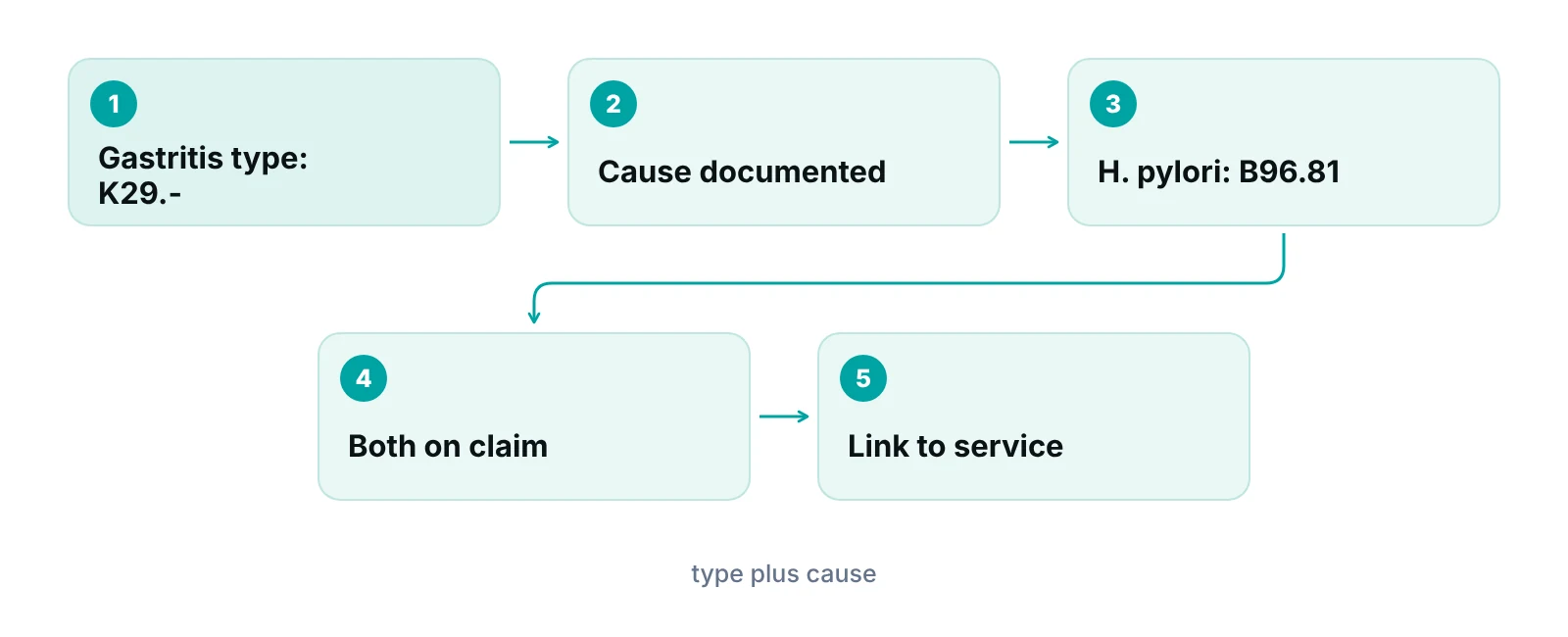
- A 2026 AAPC article reports gastritis with H. pylori as two codes: the K29 type plus B96.81.
What are the ICD-10 codes for gastritis?
Gastritis and duodenitis are classified to K29, and every K29 subcategory has two billable codes split by bleeding. The FY 2027 code files apply from October 1, 2026 through September 30, 2027 (CMS ICD-10 page), and a FY 2027 change log lists no change to K29.
| Type (4th character) | Without bleeding | With bleeding | Use it when |
|---|---|---|---|
| K29.0 Acute gastritis | K29.00 | K29.01 | Acute gastritis is documented; the index also lists acute (erosive) gastritis here |
| K29.2 Alcoholic gastritis | K29.20 | K29.21 | The provider links the gastritis to alcohol |
| K29.3 Chronic superficial gastritis | K29.30 | K29.31 | Chronic superficial gastritis is documented |
| K29.4 Chronic atrophic gastritis | K29.40 | K29.41 | Chronic atrophic gastritis or gastric atrophy is documented |
| K29.5 Unspecified chronic gastritis | K29.50 | K29.51 | Chronic gastritis, including chronic antral or fundal gastritis, with no further type |
| K29.6 Other gastritis | K29.60 | K29.61 | Giant hypertrophic, granulomatous gastritis or Ménétrier’s disease |
| K29.7 Gastritis, unspecified | K29.70 | K29.71 | Gastritis is documented with no type or duration |
| K29.8 Duodenitis | K29.80 | K29.81 | Duodenitis is documented without gastritis |
| K29.9 Gastroduodenitis, unspecified | K29.90 | K29.91 | Inflammation of stomach and duodenum is documented together, unspecified |
Source: ICD-10-CM Tabular List text, K20-K31 (FY 2025 edition, via a third-party reference); FindACode K29 group (printed Oct 2026); RapidClaims code reference (FY 2026). Re-check against the FY 2027 Tabular List.
Four characters are not enough
K29.0, K29.7 and the other four-character entries are not complete codes. Each needs the fifth character, 0 or 1. A claim with K29.7 alone fails as an invalid diagnosis. The list read for this post has no K29.1.
How do you choose the right K29 code?
Work from the most specific documented type down to the unspecified fallback, then add the bleeding character. The FY 2027 ICD-10-CM Official Guidelines say sign and symptom codes are acceptable when a related definitive diagnosis has not been confirmed, so a “possible gastritis” does not earn a K29 code on the strength of the word “possible” alone.
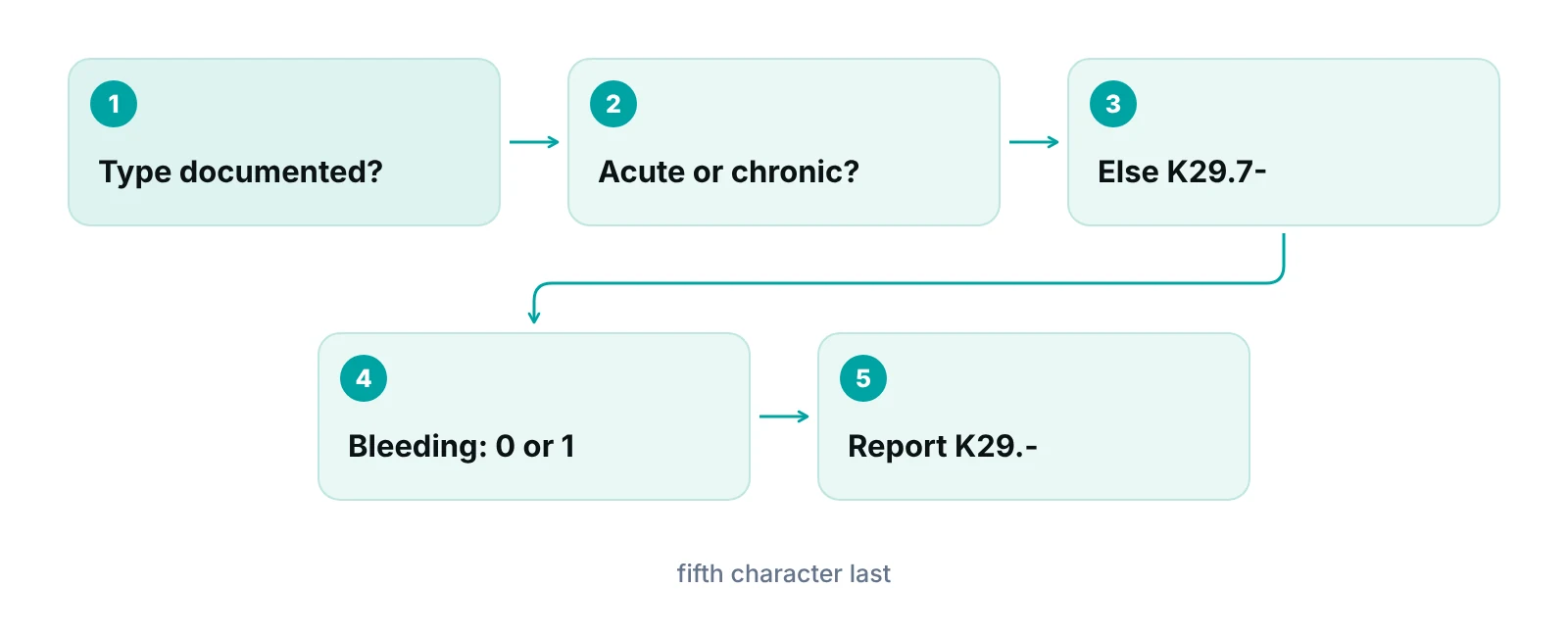
- Is a cause or type documented? Alcoholic gastritis goes to K29.2-. Atrophic, superficial, giant hypertrophic and granulomatous types go to K29.4-, K29.3- and K29.6-.
- Acute or chronic? Acute is K29.0-. Chronic with no further type is K29.5-, which also holds chronic antral and chronic fundal gastritis.
- Neither stated? Use K29.7-, gastritis unspecified. Do not choose acute or chronic from lab or endoscopy language the provider has not adopted.
- Duodenum involved? Duodenitis alone is K29.8-, and combined gastroduodenitis stated without further detail is K29.9-.
- Bleeding? Choose the fifth character last: 0 without bleeding, 1 with bleeding.
The Tabular text for K29.0 also has an Excludes1 note for acute erosion of the stomach (K25.-). The index term for “gastritis (simple), acute (erosive)” leads to K29.00 on the code reference page read, which makes the distinction between erosive gastritis and an erosion a documentation question for the provider.
How does the bleeding fifth character work?
The fifth character reports whether the provider documents bleeding with the gastritis: 0 for without and 1 for with. It applies to every K29 subcategory, so documentation is the only input.
- Use “with bleeding” only on the provider’s word. A positive stool test or a low hemoglobin is a finding, not a diagnosis of gastritis with bleeding, unless the provider links it.
- Words that count. An older AAPC article treats “hemorrhage” and “bleeding” as synonyms for choosing between the 0 and 1 characters, and its example used a positive fecal occult blood result that the provider tied to gastritis. That source is from 2013, so apply the principle and not the example.
- Silence defaults to without bleeding. If the note does not mention bleeding, the default is the 0 character, so send a query when the history points to a bleed.
- Do not stack a second bleeding code unprompted. The K29.x1 codes already include bleeding, so add a separate GI bleed code only if the provider documents a separate condition and the Tabular List supports it. That pairing was not verified for this post.
Which causes and exclusions change a gastritis claim?
Three things change a K29 claim: an Excludes1 note, a use-additional-code note, and a cause code that sits outside chapter 11. Table 2 lists the ones confirmed from the Tabular text and the cited sources.
| Code or note | What it says | What to do |
|---|---|---|
| K52.81 | Eosinophilic gastritis or gastroenteritis; Excludes1 at K29 | Do not report K29 for eosinophilic gastritis; use the K52.81 pathway |
| E16.4 | Zollinger-Ellison syndrome; Excludes1 at K29 | Do not report K29 together with it |
| K25.- | Acute erosion of stomach; Excludes1 at K29.0 | Do not report K29.0- with an acute gastric erosion |
| F10.- | Alcohol abuse and dependence; use additional code at K29.0 and K29.2 | Add the F10 code when the provider documents alcohol abuse or dependence |
| B96.81 | H. pylori as the cause of diseases classified elsewhere | A 2026 AAPC article reports chronic gastritis with H. pylori as K29.50 plus B96.81 |
| K25 / K27 | Gastric ulcer excludes acute gastritis (K29.0-) and peptic ulcer NOS (K27.-) | Code the ulcer when an ulcer is documented; K25 is not coded with K29.0- |
Source: ICD-10-CM Tabular List text, K20-K31 (FY 2025 edition, via a third-party reference); AAPC Gastroenterology Coding Alert (Mar 2026); CDC FY 2027 Official Guidelines (I.A.12, I.B.7).
The guidelines explain the mechanics. Excludes1 means the two codes are not reported together, with a narrow exception for unrelated conditions. “Use additional code” notes mark conditions that need a second code, and “code first” notes put the underlying condition first. For the H. pylori pair, the AAPC article gives the Index path to B96.81 and says to verify it in the Tabular List; it does not address which code is listed first, so confirm sequencing in the Tabular List.
Drug-related gastritis
This post did not verify a specific adverse-effect pairing for gastritis caused by a medication. If a provider documents a drug as the cause, look up the term in the Alphabetic Index and the Tabular List, and query the provider if the note does not state the cause.
If the test that found H. pylori was ordered by a different provider, see our guide to lab review ICD-10 codes for how lab-driven diagnoses are linked to results.
What must the provider document for each code?
The record needs the diagnosis in words that map to a K29 type, a statement about bleeding, and any cause. An endoscopy or pathology report is evidence, but the treating provider’s diagnosis is what the claim needs, so confirm with the provider when a report describes gastritis the visit note does not.
| Provider writes | Likely code family | Watch for |
|---|---|---|
| Acute gastritis, erosive gastritis | K29.0- | Acute gastric erosion is an Excludes1 note; ask what was found |
| Alcoholic gastritis | K29.2- | Add F10.- when alcohol abuse or dependence is documented |
| Chronic gastritis (no type), chronic antral or fundal gastritis | K29.5- | If atrophic or superficial is stated, use K29.4- or K29.3- instead |
| Chronic atrophic gastritis, gastric atrophy | K29.4- | Check for an H. pylori statement |
| Ménétrier’s disease, giant hypertrophic or granulomatous gastritis | K29.6- | Rare; the diagnosis must be stated, not inferred |
| Gastritis (nothing else), “gastritis NOS” | K29.7- | Fallback; pick 0 or 1 for bleeding |
| Duodenitis, gastroduodenitis | K29.8-, K29.9- | Say which structures are involved |
Source: ICD-10-CM Tabular List text, K20-K31 (FY 2025 edition, via a third-party reference).
- State the diagnosis as confirmed, not as “probable” or “rule out,” when the visit is ending with a diagnosis.
- State bleeding as present or absent when it is relevant, and name the cause when known.
- Document the study, test or treatment that the diagnosis supports, so the link from diagnosis to service is visible.
When is an unspecified K29 code the wrong choice?
An unspecified code is correct when the provider has given no more detail, and wrong when the detail is in the record and was missed. Three look-alike codes cause most of the confusion.
- K29.70 versus K29.50. K29.70 is gastritis with no type or duration. K29.50 needs “chronic” in the documentation. Do not upgrade K29.70 to K29.50 because the history is long.
- K29.50 versus K29.40 or K29.30. Once the provider writes “atrophic” or “superficial,” the specific subcategory replaces the unspecified chronic code.
- K29.60 versus K29.70. K29.60 is for named other types such as granulomatous or giant hypertrophic gastritis. “Other” is not a place to park a gastritis that has no type.
A quick monthly report of K29.7- usage by provider shows who needs a documentation reminder. Run the same report after each October 1 update, because the FY 2027 files list no change to K29 but your encoder may still carry old rules.
How do you confirm K29 codes are valid for FY 2027?
Confirm against the files CDC publishes each year, not against a code-list site. The CDC FY 2027 directory lists the Tabular List PDF, the addenda, a code descriptions file, a table and index file, a conversion table and the official guidelines. A published FY 2027 change log reviewed for this post lists no change to K29.
- Search the FY 2027 code descriptions file for all 18 K29 codes and confirm each is listed as billable.
- Check the FY 2027 addenda for any K29, K25 or K52 line.
- Read the K29 entry in the Tabular List and compare the Excludes1 and use-additional-code notes with Table 2 above.
- Update your scrubber rules on October 1 and re-run the check each year.
How does gastritis fit with other digestive-system diagnoses?
Gastritis rarely appears alone on a GI claim, and neighbouring diagnoses sit in different parts of chapter 11. Keeping each in its own lane stops duplicate and conflicting codes.
- Upper GI companions. Hiatal hernia and reflux are coded in K44 and K21, not K29. Our guide to hiatal hernia ICD-10 codes covers those, and the K21 and K44 notes there are separate from the K29 notes here.
- Gallbladder disease. Upper abdominal pain can lead to either a gastric or a gallbladder diagnosis. Gallbladder codes follow different rules; see cholecystectomy ICD-10 codes.
- Lower GI findings. Colon diagnoses follow their own rules; our guides to stercoral colitis ICD-10 coding and positive Cologuard colonoscopy coding cover two common examples.
- Follow-up visits. A return visit after treatment can raise the question of whether to report the gastritis again; our guide to follow-up ICD-10 codes explains that decision.
- Specialty workflow. Gastroenterology practices combine endoscopy, pathology and office visits on the same patient; see our gastroenterology specialty page for the specialty overview.
If your practice needs a broader view of how these claims move from chart to payment, our revenue cycle management page shows the end-to-end process.
What causes gastritis claims to be returned or denied?
Most gastritis edits come from an incomplete code, an Excludes1 conflict, or a diagnosis that does not match the service. The list below uses payer-neutral wording; edit names vary by payer and clearinghouse.
- Four-character code. K29.7 or K29.5 submitted without the fifth character.
- Excludes1 conflict. K29.0- with K25.-, or K29 with K52.81 or E16.4.
- Missing use-additional code. Alcoholic gastritis documented with alcohol dependence but no F10 code.
- Diagnosis does not match the service. A K29 code attached to a service the note does not tie to gastritis. Check payer policy for the service ordered.
- Symptom and diagnosis together. An epigastric pain or heartburn symptom code reported alongside a confirmed gastritis that explains it.
- Unsupported bleeding character. K29.x1 reported when the note never mentions bleeding.
These are the checks a pre-bill review should run. Our guide to claim scrubbing explains that process, and our denial management services can help with the denials that still get through.
Are digestive-system claims returning with diagnosis edits?
Send a sample of returned claims with the provider notes. A free practice audit can show whether the cause is the diagnosis code, the documentation or a payer edit.
Worked example: four gastritis encounters
Example only (made up, de-identified)
These short cases show how documentation changes the code. They are teaching examples, not real encounters.
- Case A. The provider diagnoses chronic gastritis, no bleeding, and documents H. pylori as the cause. Report K29.50 and B96.81.
- Case B. The provider diagnoses acute gastritis with bleeding and documents alcohol dependence. Report K29.01 and add the F10 code for the documented alcohol condition, per the use-additional-code note.
- Case C. The note says “gastritis” with nothing else and no bleeding. Report K29.70. If the provider later adds “atrophic,” the code becomes K29.40.
- Case D. The visit ends with epigastric pain and “possible gastritis,” no confirmed diagnosis. Report the documented symptom, not a K29 code, in line with the guidelines on unconfirmed diagnoses. The Tabular note at K30 names R10.13 for dyspepsia NOS and R12 for heartburn.
“The code for gastritis is rarely the hard part. The hard part is that the fifth character, the cause and the exclusions all depend on one or two sentences in the note.”
— Awais Afzal, Healthcare Operations & Data Analyst
Our recommendations
- Make the fifth character a required field. We recommend a hard stop for any K29 code without the 0 or 1, because a four-character K29 never processes.
- Add a bleeding prompt to GI templates. A one-line prompt for bleeding present or absent removes the most common guess in K29 coding.
- Build the Excludes1 pairs into your scrubber. Flag K29 with K52.81 or E16.4, and K29.0- with K25.-, before a claim leaves the building.
- Pair F10 and B96.81 on purpose. When a note documents alcohol use or H. pylori, check that the companion code is on the claim, and confirm sequencing in the Tabular List.
- Query before assuming a cause. If a pathology or endoscopy report names a cause the visit note does not, send the provider one question before adding a cause code.
- Ask for a free practice audit. If digestive-system claims keep returning, send a sample. We review where the diagnosis, note or payer edit breaks, and we quote pricing only after the audit.
Bottom line
Gastritis coding is a short sequence: confirm the diagnosis, choose the K29 type, choose the bleeding character, then add the cause and check the exclusions. K29.70 is the fallback, not the default. If your digestive-system claims keep coming back, our medical billing services can review where they fail, and you can ask for a free practice audit.
Frequently asked questions
What is the ICD-10 code for gastritis?
Gastritis is in K29. The fourth character names the type, such as K29.0 for acute or K29.5 for unspecified chronic, and the fifth character reports bleeding (0 without, 1 with). K29.70 is gastritis, unspecified, without bleeding, the fallback when no type is documented.
What is the ICD-10 code for chronic gastritis?
Chronic gastritis with no further type is K29.50 without bleeding or K29.51 with bleeding. If the provider documents chronic atrophic gastritis, use K29.40 or K29.41, and for chronic superficial gastritis use K29.30 or K29.31.
How do I code gastritis caused by H. pylori?
A March 2026 AAPC article reports two codes: the K29 code for the gastritis type, such as K29.50 for chronic gastritis, plus B96.81 for H. pylori as the cause. Confirm sequencing and the exact B96.81 wording in the current Tabular List. The article does not say which code is listed first.
Can I code gastritis with a gastric ulcer?
Not in the way the notes allow. K25 gastric ulcer has an Excludes1 note for acute gastritis (K29.0-), so those two are not reported together. Code the ulcer when an ulcer is documented, and keep K29 for gastritis that stands on its own.
Do I need an alcohol code with alcoholic gastritis?
The Tabular List has a use-additional-code note at K29.0 and K29.2 for alcohol abuse and dependence (F10.-). Add the F10 code when the provider documents alcohol abuse or dependence, and do not infer it from a gastritis diagnosis alone.
When do I code a symptom instead of gastritis?
When the provider has not confirmed gastritis by the end of the encounter. The FY 2027 guidelines allow sign and symptom codes in that case. A note that says only “possible gastritis” with epigastric pain is a symptom claim until the provider confirms the diagnosis, and a later visit can then be coded to gastritis.
Get your free practice audit
Tell us about your practice. We will contact you using the details you give.
- A review of your recent claims, denials and A/R aging
- Where your front desk and prior authorizations slow payment
- A prioritized fix list you keep, whether or not you hire us
Pricing is quoted after the audit, based on your volume and the services you choose. Prefer to talk? Call +1 (302) 556-2288.
Sources
- ICD-10-CM Official Guidelines for Coding and Reporting, FY 2027 — CDC / NCHS (2026)
- ICD-10-CM FY 2027 file directory — CDC / NCHS (2026)
- ICD-10 codes page — CMS (2026)
- ICD-10-CM Tabular List text, K20-K31 (2025 edition) — Skyscape (third-party reference) (2025)
- ICD-10-CM Diagnosis Codes in Group K29 — FindACode (2026)
- K29.00 Acute gastritis without bleeding — RapidClaims code reference (2026)
- Gastroenterology Coding: Code gastritis with H. pylori confidently — AAPC Gastroenterology Coding Alert (2026)
- ICD-10 update: straightforward transition eases your acute gastritis reporting — AAPC Gastroenterology Coding Alert (2013)
- ICD-10 codes for gastritis and duodenitis — Coding Ahead (2026)
- FY2027 ICD-10-CM changelog — HCC Buddy (2026)
- ICD-10-CM Official Guidelines for Coding and Reporting, FY 2021 — CDC / NCHS (via stacks.cdc.gov) (2020)
- ICD-10-CM Tabular List FY 2027 (PDF) — CDC / NCHS (2026)
Disclaimer: This article is educational and is not legal, coding, billing, medical or compliance advice. Code meanings, Medicare contractor policies and payer rules change and vary by payer, contractor and state. Verify current requirements with the official ICD-10-CM code files and guidelines, your payers and your counsel before you act.
