
For stercoral colitis icd 10, we found no dedicated code. Published coding data show K52.89 and K52.9 as the closest colitis codes, with K56.41 added when fecal impaction is documented. A stercoral ulcer indexes to K63.3, or K62.6 for anus and rectum. Do not code from a CT report alone; query the provider.
Stercoral colitis is inflammation of the colon wall caused by impacted stool. It is uncommon, but it turns up in older, bedbound and constipated patients, and it can end in perforation. For a coder it is awkward because the classification has no entry named for it in the sources we could read, and because constipation and impaction codes carry an Excludes1 note. This guide shows the codes in play, how to choose between them, what the record must say and what to expect from payers.
Key takeaways
- The sources we read show no code named for stercoral colitis; K52.89 and K52.9 are the closest colitis codes, and a stercoral ulcer indexes to K63.3 or K62.6.
- K56.41 reports fecal impaction. K59.0- constipation has an Excludes1 note for K56.41, so the two should not be reported together unless unrelated.
- Code from the treating provider’s documented diagnosis. A CT report that says “suspected” needs a provider query before it becomes a code.
- A perforation moves the code to K63.1; K63.3 excludes ulcer of intestine with perforation.
- K56.41 was missing in most encounters with imaging that suggested impaction or stercoral colitis in one 2023 study, so documentation gaps are real.
Is there an ICD-10 code for stercoral colitis?
We found no code named for stercoral colitis. A 2023 Cureus study of fecal impaction and nonperforated stercoral colitis says K52.9 and K52.89, the noninfective colitis codes, are the closest approximations, and that no code matches exactly. It names K62.6 as the most appropriate code for stercoral ulcers. One commercial lookup page lists K52.89 for stercoral colitis. Treat that as a pointer, not as a rule, because it gives no index reference.
We could not read the Colitis section of the Alphabetic Index or the FY 2027 Tabular List text for Chapter 11 in this session, so we cannot tell you whether the FY 2027 index has a stercoral colitis entry. Run the term through your encoder before you set a rule. What we could read is below.
| Code | What it reports (our wording) | When it fits | Status we could confirm |
|---|---|---|---|
| K52.89 | Other specified noninfective gastroenteritis and colitis | Closest specific code when the provider documents stercoral colitis | Billable in FY 2027 on a secondary lookup site |
| K52.9 | Noninfective gastroenteritis and colitis, unspecified (includes colitis NOS) | Colitis documented with no further type | Read in the 2025 edition; FY 2027 not confirmed |
| K56.41 | Fecal impaction | Impaction documented as a diagnosis | Billable in FY 2027 on a secondary lookup site |
| K59.00 | Constipation, unspecified | Constipation documented, with no impaction | Billable in FY 2027 on a secondary lookup site; K59.0 alone needs a fifth character |
| K62.6 | Ulcer of anus and rectum; includes stercoral ulcer of anus and rectum | Stercoral ulcer in the anus or rectum | Wording read on AAPC; FY not shown |
| K63.3 | Ulcer of intestine | Stercoral ulcer elsewhere in the intestine (index entry under Ulcer, intestine) | Index read in a 2024 edition; FY not shown |
| K63.1 | Perforation of intestine (nontraumatic) | Documented perforation | Wording read on AAPC; FY not shown |
Source: Cureus (2023); icd-10codes.com FY 2027 display (secondary); AAPC code pages; Skyscape ICD-10-CM 2024 index and 2025 tabular (secondary). Codes need FY 2027 confirmation.
Do not assume a code is valid because a lookup page shows it. The code set changes every 1 October, and FY 2027 took effect on 1 October 2026, as the FY 2027 Official Guidelines confirm. Table 1 says what we could and could not confirm for each code.
How do you choose among colitis, impaction and constipation codes?
Choose by what the provider documents, not by what the CT report shows. If the provider documents stercoral colitis, report the colitis code; if the provider also documents fecal impaction, add K56.41. Constipation is a separate code and has a conflict with impaction, covered next.
K52.89 versus K52.9
K52.9 is the unspecified code. Its inclusion terms include colitis NOS, and its Excludes1 notes cover diarrhea NOS, functional diarrhea, infectious gastroenteritis and colitis NOS (A09), neonatal diarrhea and psychogenic diarrhea. K52.89 is the “other specified” code. When the provider writes “stercoral colitis,” the diagnosis is specified, which points to K52.89. When the provider writes only “colitis,” K52.9 is the faithful choice. A coder should not turn “colitis” into “stercoral colitis” without a query.
The K50 to K52 range also has an Excludes1 note for irritable bowel syndrome (K58.-) and megacolon (K59.3-), per the secondary lookup page we read. If the record also names a megacolon, check that note before you report both.
K56.41 versus K59.0-
K59.0 constipation carries an Excludes1 note for fecal impaction (K56.41). The FY 2027 guidelines say an Excludes1 note means “not coded here,” with one exception: when the two conditions are unrelated to each other. When it is unclear whether they are related, the guidelines tell the coder to query the provider. In stercoral colitis, constipation and impaction are usually the same process, so K56.41 is the better fit when the provider documents impaction.
AHA Coding Clinic took up this exact question in the second quarter of 2024 (“Constipation with Fecal Impaction,” K59.0 and K56.41). The Find-A-Code page shows only the question, so we could not read the answer. Read the Coding Clinic text through your subscription before you write a rule.
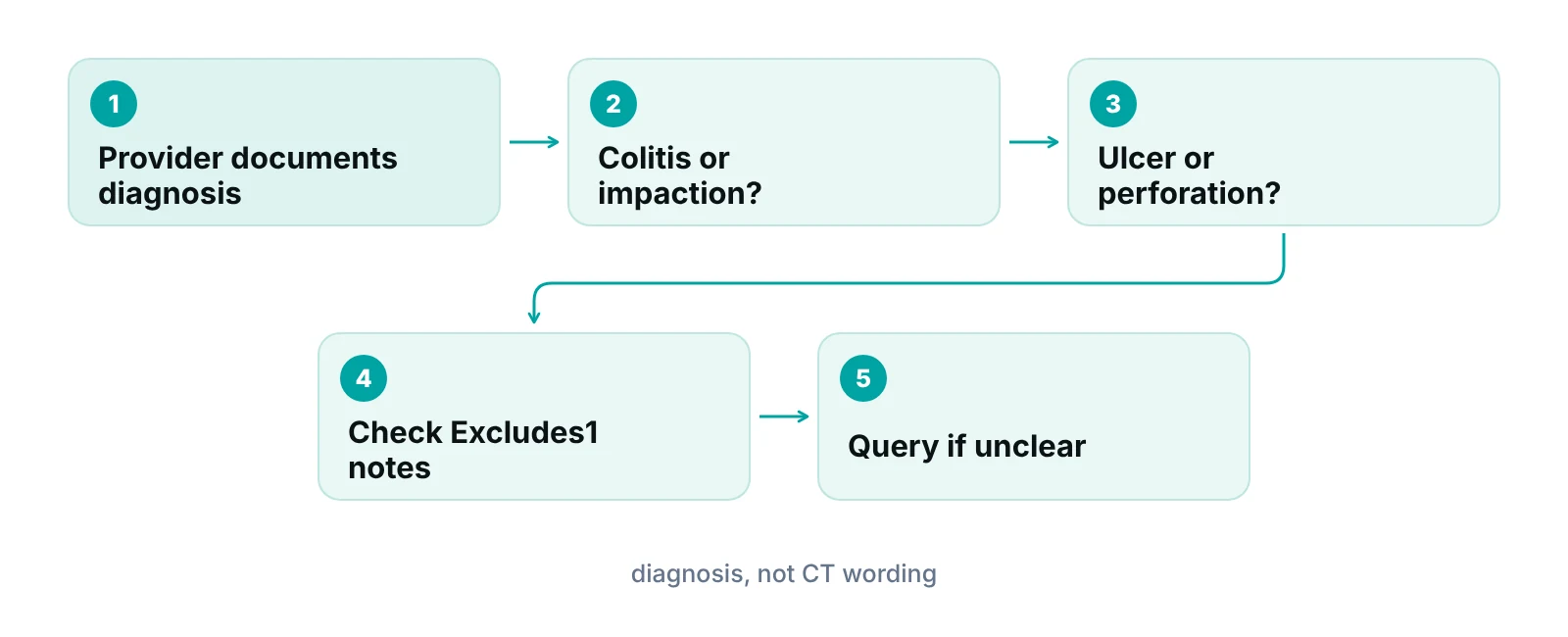
K56.41 also has its own Excludes2 note for incomplete defecation (R15.0), per the lookup page. An Excludes2 note means both codes may be reported when appropriate. The guidelines add that signs and symptoms routinely associated with a disease should not be coded separately. If constipation is just a symptom of the impaction, do not stack extra symptom codes.
What about stercoral ulcer and perforation?
A stercoral ulcer follows the site. K62.6 has an inclusion term for stercoral ulcer of the anus and rectum, per AAPC’s code page. For an ulcer higher in the bowel, the older index we read shows Ulcer, intestine, stercoraceous or stercoral, pointing to K63.3. K63.3 has an Excludes1 note for ulcer of anus or rectum (K62.6), for ulcerative colitis (K51.-) and for ulcer of intestine with perforation (K63.1).
That last note matters in practice. A pressure ulcer that perforates is not coded to K63.3. K63.1 reports the perforation, and it has its own Excludes1 notes for duodenum perforation (K26.-) and for perforation with diverticular disease (K57.-). Stercoral perforation is rare in clinical series but serious. In the Cureus study, 7 of 970 encounters had perforation, and five of the seven patients died or went to hospice.
The clinical background is simple. A 2021 Radiology Case Reports review describes pressure from impacted stool that compromises blood supply and can lead to ulceration, perforation and peritonitis, mostly in the rectosigmoid. A 2011 World Journal of Gastroenterology series found the sigmoid colon was the most common site. You do not need the clinical detail to code, but it explains why the provider’s wording about site matters. “Sigmoid” and “rectal” lead to different codes here.
Sepsis, if documented, has its own guideline section and is outside this post. Code it only on provider documentation, and follow the sequencing rules in the current guidelines.
What documentation does each code need?
The note must name the diagnosis, the site if an ulcer exists and the link between conditions. A radiology impression alone is not enough. In the Cureus study, K56.41 appeared in only 36.6% of encounters in which imaging suggested impaction or stercoral colitis, which shows how often the chart and the claim part ways.
| Code | Provider documentation that supports it | Common gap |
|---|---|---|
| K52.89 | “Stercoral colitis” (or an equally specific colitis term) as a diagnosis | Note says “colitis” or “inflammation” only |
| K52.9 | “Colitis” with no further type | A coder upgrades the term from the CT report |
| K56.41 | “Fecal impaction” or “fecaloma” as a diagnosis, with clinical support | Impaction in the radiology report only |
| K59.00 | Constipation as a diagnosis, with no impaction | Constipation and impaction both listed; Excludes1 applies |
| K62.6 / K63.3 | Stercoral ulcer with the bowel site named | “Ulcer” with no site |
| K63.1 | Perforation, with site and cause if known | Perforation in imaging only |
Source: ICD-10-CM notes as read in Table 1; Cureus (2023). This is coding education, not a clinical standard.
Ask providers for four things: a definitive diagnosis, not “possible” language where the setting requires a confirmed one; the site; the relationship to impaction; and any complication. The rules for uncertain diagnoses differ between inpatient and outpatient coding, and we could not read that part of the guidelines in the fetched PDF, so check the current text. Our coding audit guide explains how to sample charts for this kind of gap.
What denials and edits should you expect?
Most problems come from Excludes1 conflicts, unspecified codes and diagnoses with no support in the note. Payers vary, so write the rule from your own denial data. The table lists the patterns that follow from the code notes above.
| Pattern | Likely cause | First check |
|---|---|---|
| K59.0- and K56.41 on one claim | Excludes1 conflict | Is constipation unrelated? If not, report K56.41 only |
| K63.3 with K62.6 | Excludes1 conflict between ulcer sites | Confirm the site in the note and keep one code |
| K63.3 with a perforation | Perforation belongs under K63.1 | Query the provider about perforation |
| K52.9 on a record that says “stercoral” | Unspecified code where a specified term exists | Review the note and consider K52.89 |
| Colitis code with no supporting note | Diagnosis taken from imaging | Hold the claim and query the provider |
| Code not accepted for the date of service | Code not valid in the fiscal year | Check FY 2027 for dates of service after 1 Oct 2026 |
Source: ICD-10-CM notes as read in Table 1; FY 2027 Official Guidelines (Excludes1 rule).
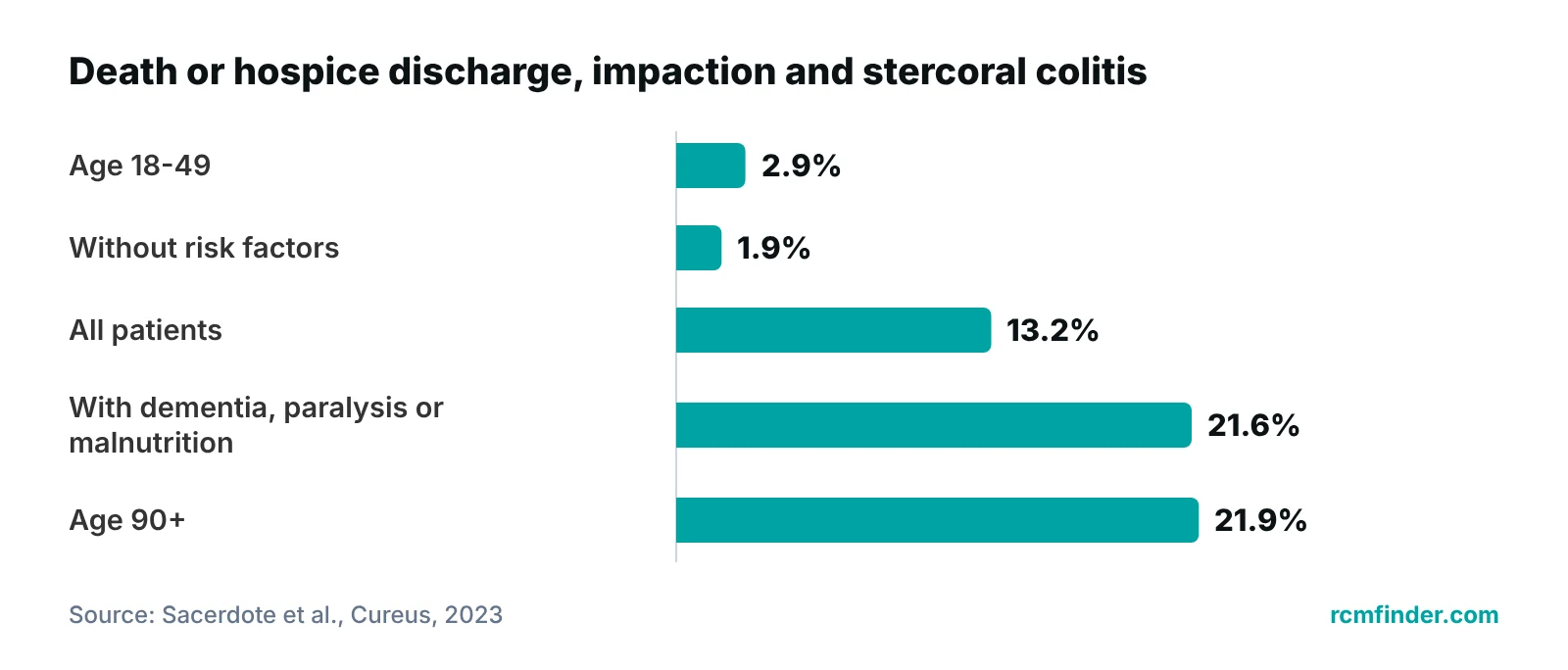
The chart comes from the Cureus study. Dementia, paralysis or neuromuscular disease and malnutrition raised the combined death-or-hospice share to 21.6% against 1.9% without them. For a coder, the lesson is not clinical. When a chart documents those conditions, they belong on the claim, because the patient’s risk is part of the clinical picture.
Worked example and a short coding checklist
Example only (made-up, de-identified)
An 84-year-old patient with dementia and chronic constipation arrives with abdominal pain. CT shows a distended sigmoid colon packed with stool, wall thickening and surrounding stranding. The treating physician writes “stercoral colitis due to fecal impaction; no perforation.” The patient is admitted for disimpaction and monitoring.
The coder takes the diagnosis from the physician: stercoral colitis (K52.89, the closest specified colitis code) and fecal impaction (K56.41). Constipation (K59.00) is not added, because K59.0 carries the Excludes1 note for K56.41, and the physician has linked the conditions. Dementia and any other documented conditions are coded as usual. No ulcer or perforation is documented, so K63.3, K62.6 and K63.1 are not used.
If the physician had written “possible stercoral colitis” after the CT, the coder would check the uncertain-diagnosis rule that applies to the setting before assigning K52.89, and would query the physician if the wording is unclear.
- Read the provider’s final diagnosis, not the imaging report alone.
- Pick the colitis code (K52.89 or K52.9) that matches the specificity written.
- Add K56.41 if impaction is documented, and drop K59.0- if the two are related.
- Assign the ulcer or perforation code by site and by the Excludes1 notes.
- Confirm every code in the FY 2027 encoder before the claim is released.
“A CT report can raise the question, but only the provider's note can answer it. The best coders I know write the query before they write the code.”
— Awais Afzal, Healthcare Operations & Data Analyst
Do your GI and geriatric claims keep returning?
Send a sample of denied colitis, impaction and constipation claims with the notes behind them. A free practice audit shows whether the cause is the code, the Excludes1 conflict or the documentation.
Related digestive-system coding guides
For upper-GI coding, see our gastritis ICD-10 guide and our hiatal hernia coding guide. For surgical encounters in the abdomen, see our abdominal surgery ICD-10 guide. For a colonoscopy ordered after a positive stool test, see our positive Cologuard coding guide. Our gastroenterology page and geriatrics page describe how we support those claims. For a general view of denials, see our guide to medical billing denials.
Our recommendations
- Write a query template for imaging-only diagnoses. A short form that asks the provider to confirm, rule out or clarify a CT finding saves rework and protects the claim.
- Add an Excludes1 check for K59.0- and K56.41. Build a claim edit that flags the pair and sends it to a coder for review.
- Decide your K52.89 versus K52.9 rule. Agree that specified wording gets K52.89 and bare “colitis” gets K52.9, then apply it consistently.
- Teach site wording for ulcers. Ask providers to name the bowel site so the ulcer code can be chosen without a guess.
- Check the code set each October. Re-validate your colitis, impaction and ulcer codes against the new fiscal year every 1 October.
- Read the Coding Clinic answer. Get the second-quarter 2024 answer on constipation with fecal impaction and file it with your coding policies.
Bottom line
Code stercoral colitis from the provider’s documented diagnosis, choose the closest colitis code, add K56.41 for documented impaction and watch the Excludes1 notes. If these claims keep denying, a review of your revenue cycle management process can show where documentation and coding part ways, and you can ask for a free practice audit.
Frequently asked questions
What is the ICD-10 code for stercoral colitis?
We found no code named for stercoral colitis. A 2023 Cureus study calls K52.89 and K52.9 the closest approximations. K52.89 fits when the provider documents stercoral colitis, and K52.9 fits when only colitis is documented. Confirm the index and FY 2027 Tabular List in your encoder.
Can I report K56.41 and K59.00 together?
Usually not. K59.0 has an Excludes1 note for fecal impaction (K56.41), so the two should not be reported together unless they are unrelated. If the relationship is unclear, the guidelines say to query the provider. In stercoral colitis the two are normally one process, so K56.41 alone is the usual choice.
Which code is used for a stercoral ulcer?
K62.6 has an inclusion term for stercoral ulcer of the anus and rectum. For other intestinal sites, an older index shows Ulcer, intestine, stercoral pointing to K63.3. Confirm both in the FY 2027 index, and make sure the provider documented the site, because the site decides which code applies.
Can I code stercoral colitis from a CT report?
Code from the treating provider’s documentation. If imaging suggests stercoral colitis and the provider has not documented a diagnosis, send a query. Uncertain-diagnosis rules also differ between inpatient and outpatient settings, so check the current guidelines.
What code is used if a stercoral ulcer perforates?
K63.3 has an Excludes1 note for ulcer of intestine with perforation, which points to K63.1. K62.6 covers the anus and rectum. Use the provider’s documentation of site and perforation, check both Excludes1 lists and confirm the codes in the FY 2027 encoder before release.
Is K52.89 valid in FY 2027?
A secondary lookup site shows K52.89 as billable in FY 2027. Because that is not an official file, and we could not read the FY 2027 Tabular PDF for this chapter, check the FY 2027 Tabular List in your encoder before using the code on claims for dates of service after 1 October 2026.
Get your free practice audit
Tell us about your practice. We will contact you using the details you give.
- A review of your recent claims, denials and A/R aging
- Where your front desk and prior authorizations slow payment
- A prioritized fix list you keep, whether or not you hire us
Pricing is quoted after the audit, based on your volume and the services you choose. Prefer to talk? Call +1 (302) 556-2288.
Sources
- Fecal Impaction and Nonperforated Stercoral Colitis: Red Flags for Poor Outcomes — Cureus (Sacerdote et al.) (2023)
- Stercoral colitis due to massive fecal impaction: a case report and literature review — Radiology Case Reports (PMC) (2021)
- Necrotic stercoral colitis: Importance of computed tomography findings — World Journal of Gastroenterology (2011)
- K52.89 Other specified noninfective gastroenteritis and colitis (FY 2027 display) — icd-10codes.com (secondary) (2026)
- K56.41 Fecal impaction (FY 2027 display) — icd-10codes.com (secondary) (2026)
- K59.0 Constipation (FY 2027 display) — icd-10codes.com (secondary) (2026)
- K59.0 Constipation — AAPC (2026)
- ICD-10-CM Code K63.3 Ulcer of intestine — AAPC (2026)
- ICD-10-CM Code K62.6 Ulcer of anus and rectum — AAPC (2026)
- ICD-10-CM Code K63.1 Perforation of intestine (nontraumatic) — AAPC (2026)
- ICD-10-CM 2025 Tabular (K52 section) — Skyscape ICD-10-CM 2025 edition (secondary) (2025)
- ICD-10-CM 2024 Alphabetic Index (Ulcer section) — Skyscape ICD-10-CM 2024 edition (secondary) (2024)
- ICD-10-CM Official Guidelines for Coding and Reporting FY 2027 — CDC/NCHS (2026)
- AHA Coding Clinic 2024 Q2: Constipation with Fecal Impaction (question only) — Find-A-Code (2024)
- Stercoral Colitis ICD-10-CM Codes — Carepatron (secondary) (2026)
Disclaimer: This article is educational and is not legal, coding, billing, medical or compliance advice. Code meanings, Medicare contractor policies and payer rules change and vary by payer, contractor and state. Verify current requirements with the ICD-10-CM Tabular List and Index, your payers and your counsel before you act.
