
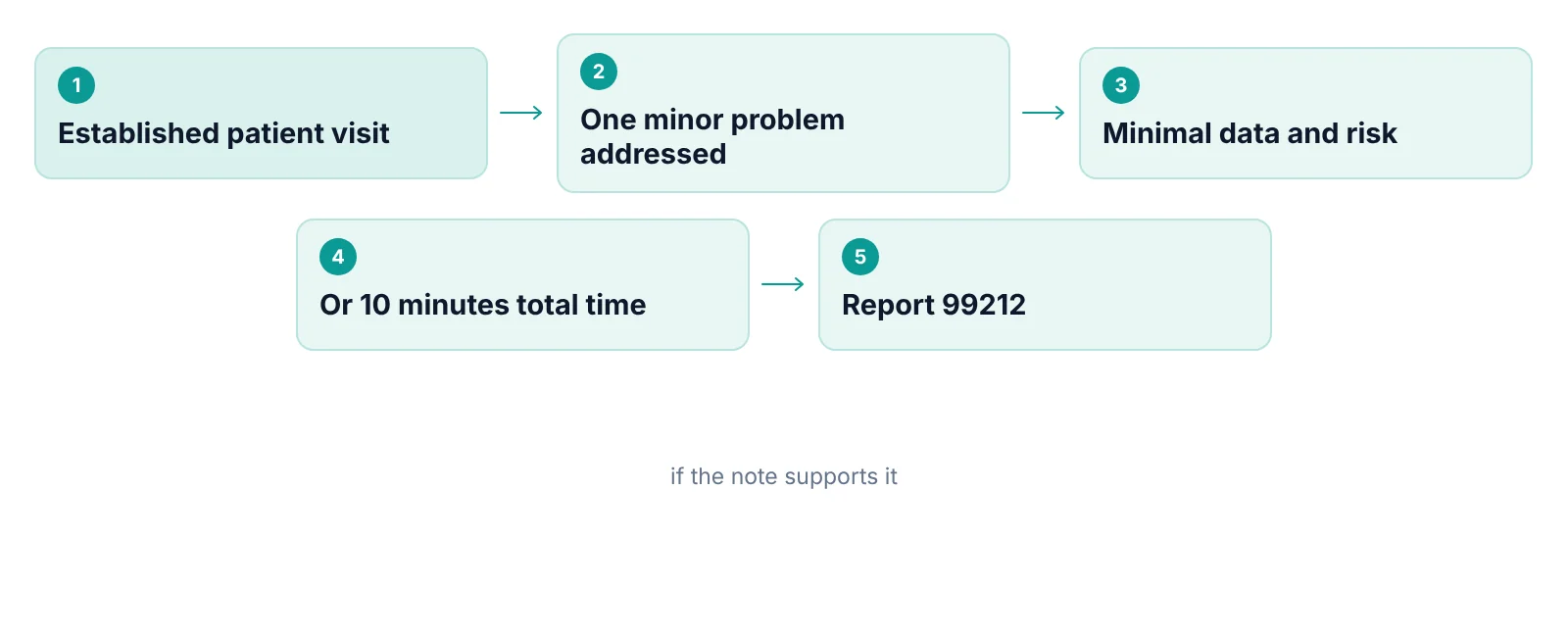
CPT 99212 is an office or other outpatient visit for an established patient that meets straightforward medical decision making, or that takes at least 10 minutes of total practitioner time on the date of the encounter. It fits a short visit for a minor problem with minimal data and risk.
The lowest level is the easiest to overlook. Many practices code 99212 out of habit for short visits, and just as many code 99213 for visits that never needed it. Both create problems, one through lost revenue and the other through audit risk.
This guide explains the thresholds, what straightforward MDM looks like, and how to tell 99212 from 99213. Thresholds follow the current CPT office visit guidelines as summarized by CMS and the AAFP.
Key takeaways
- 99212 needs straightforward MDM or 10 minutes of total practitioner time on the date of the visit.
- Straightforward MDM means a minimal problem, minimal or no data, and minimal risk. Two of three must be met.
- Length of the visit alone does not set the level unless time is documented.
- Do not undercode out of habit. Code what the note supports.
What is CPT 99212?
99212 describes an office or other outpatient visit for an established patient with a medically appropriate history and exam and straightforward medical decision making. By time, the threshold is 10 minutes. It is the lowest of the four established patient visit levels that include a practitioner service.
| Code | MDM level | Time threshold |
|---|---|---|
| 99212 | Straightforward | 10 minutes must be met or exceeded |
| 99213 | Low | 20 minutes. See 99213 |
| 99214 | Moderate | 30 minutes. See 99214 |
| 99215 | High | 40 minutes. See 99215 |
Thresholds from the current CPT office visit guidelines, as summarized by the AAFP.
What does straightforward MDM look like?
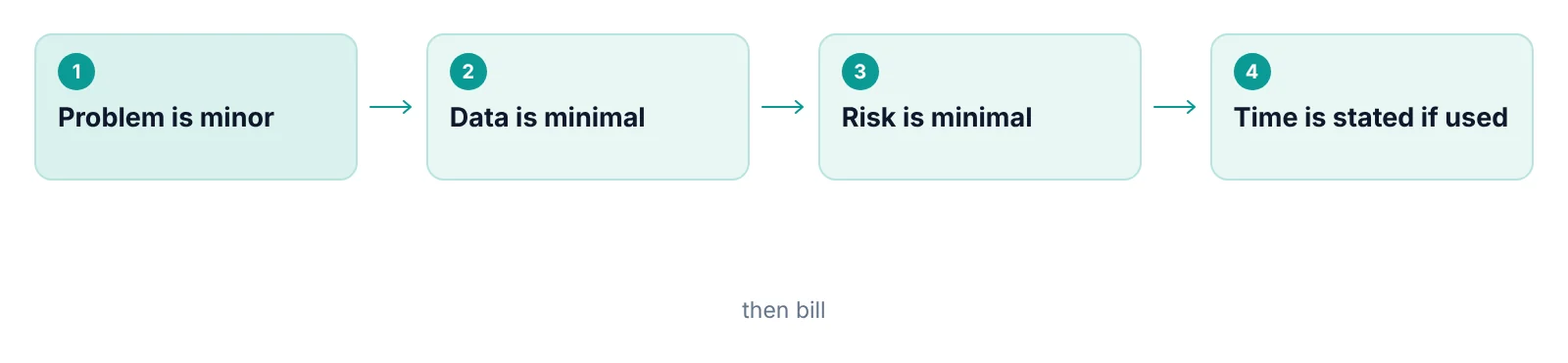
Straightforward MDM means two of three elements are at the lowest level. The problem is minimal, such as a self-limited or minor issue. Data is minimal or none. Risk is minimal.
| Element | What meets straightforward | Example |
|---|---|---|
| Problems | One self-limited or minor problem | A minor rash that is resolving |
| Data | Minimal or none | No tests ordered or reviewed |
| Risk | Minimal risk of morbidity | No treatment beyond advice |
Summarized from the AMA CPT MDM table as reproduced in AAFP guidance.
If the visit involves a stable chronic illness or an acute uncomplicated problem, the problem element reaches low, and 99213 may fit if a second element also reaches low.
How do you tell 99212 from 99213?
Ask what the practitioner did. If the work was a minor problem with little or no data and minimal risk, 99212 fits. If it was a stable chronic condition or an acute uncomplicated problem with some data or a low-risk decision, 99213 fits.
| Question | If yes | If no |
|---|---|---|
| Was a stable chronic illness addressed? | Look at 99213 or above | 99212 may fit |
| Were tests reviewed or ordered? | Data may reach low | Data is minimal |
| Was a prescription decision made? | Risk may reach moderate | Risk is minimal or low |
Use the AMA table for edge cases. Our 99213 guide covers the next level.
Want a second pair of eyes on your claims?
Send us your recent denials and we will show where the same issue repeats. The audit is free and the fix list is yours to keep.
How does the 10-minute rule work?
If you choose the level by time, total practitioner time on the date of the encounter must be 10 minutes or more. Count the practitioner’s own work, including record review, exam, counseling and documentation. Do not count clinical staff time.
Most 99212 visits are short, so time is often a weaker basis than MDM. A visit that lasts 12 minutes but includes only minimal MDM can still be coded by time if the time is documented.
What documentation supports 99212?
Record the reason for the visit, the problem addressed, any data reviewed and the plan. Even a short visit needs a note that shows what was done. A one-line entry with no problem named is not enough.
| Element | What to record | Why |
|---|---|---|
| Reason | What the patient came for | Establishes the problem |
| Assessment | What the practitioner found | Shows the work |
| Plan | Advice or treatment | Shows the decision |
| Time | Total minutes if using time | Supports time-based level |
See timely documentation for why same-day notes help.
Why undercoding matters as much as overcoding
Coding 99212 when the note supports 99213 loses revenue visit after visit. Over a year, a small gap per visit becomes a large total. Our guide to down-coding explains how habit and fear of audits drive it, and upcoding covers the other side.
A regular coding audit should check both directions.
Related E/M guides
99212 is the first rung. See 99213, 99214 and 99215 for higher levels, and 99204 for new patients.
Our recommendations
- Review short-visit templates. Make sure they capture problems and data.
- Audit both directions. Check for undercoding and overcoding.
- Teach the MDM table. A one-page version at each desk helps.
- Document time when used. Total and activities.
- Track level mix. Compare practitioners.
- Revisit habits yearly. Level mix drifts.
Bottom line
99212 fits a short visit for a minor problem, and the note should show that. Teach the thresholds, audit in both directions and code what the note supports. For denial help, see our denial management services.
Frequently asked questions
How many minutes for 99212?
Ten minutes of total practitioner time on the date of the encounter must be met or exceeded when you choose the level by time. Only the billing practitioner’s work counts, not clinical staff time. If you choose by MDM instead, straightforward decision making supports the level regardless of time.
What is straightforward MDM?
Straightforward MDM means two of three elements are at the lowest level: a minimal problem such as a self-limited or minor issue, minimal or no data, and minimal risk. The note should show what was addressed and decided so a reviewer can see why the level was chosen.
What is the difference between 99212 and 99213?
99212 is straightforward, with a 10-minute threshold, and 99213 is low, with a 20-minute threshold. In practice, 99213 usually involves a stable chronic illness or an acute uncomplicated problem with some data or a low-risk decision. Choose the level the note supports, not the length of the appointment slot.
Can I bill 99212 for a nurse visit?
A visit performed only by clinical staff does not meet 99212, which requires a practitioner service. Some payers have a separate code or rule for nurse visits. Check the policy for the payer, and do not bill an office visit code for work the practitioner did not personally provide.
Can G2211 be added to 99212?
It can be added to an eligible office or outpatient visit when the practitioner is the continuing focal point for care or provides ongoing care for a serious or complex condition. A short visit does not rule it out, but the record has to show the relationship. Medicare generally does not pay it with modifier 25.
Is it wrong to bill 99212 often?
No. If the notes support straightforward MDM or 10 minutes for a high share of visits, 99212 is correct. The risk is habit. If the level is chosen by routine and not by the note, you may be undercoding. An audit that checks both directions will show whether your mix is accurate.
Get your free practice audit
Tell us about your practice. We will contact you using the details you give.
- A review of your recent claims, denials and A/R aging
- Where your front desk and prior authorizations slow payment
- A prioritized fix list you keep, whether or not you hire us
Pricing is quoted after the audit, based on your volume and the services you choose. Prefer to talk? Call +1 (302) 556-2288.
Sources
- Evaluation and Management Services Guide (MLN006764) — Centers for Medicare & Medicaid Services (2025)
- Time and medical decision making levels for evaluation and management — American Academy of Family Physicians (2025)
- Complexity Add-on Code G2211 — Noridian Healthcare Solutions, JF Part B (2026)
- Medicare Claims Processing Manual, Chapter 12 — Centers for Medicare & Medicaid Services (2026)
- Medicare Physician Fee Schedule — Centers for Medicare & Medicaid Services (2026)
- Evaluation and management services — American Medical Association (2025)
Disclaimer: This article is educational and is not legal, coding, billing, medical or compliance advice. CPT codes and modifier descriptions are owned by the AMA, and code meanings, Medicare contractor policies and payer rules change and vary by payer, contractor and state. Verify current requirements with the official CPT manual, your payers and your counsel before you act.
