
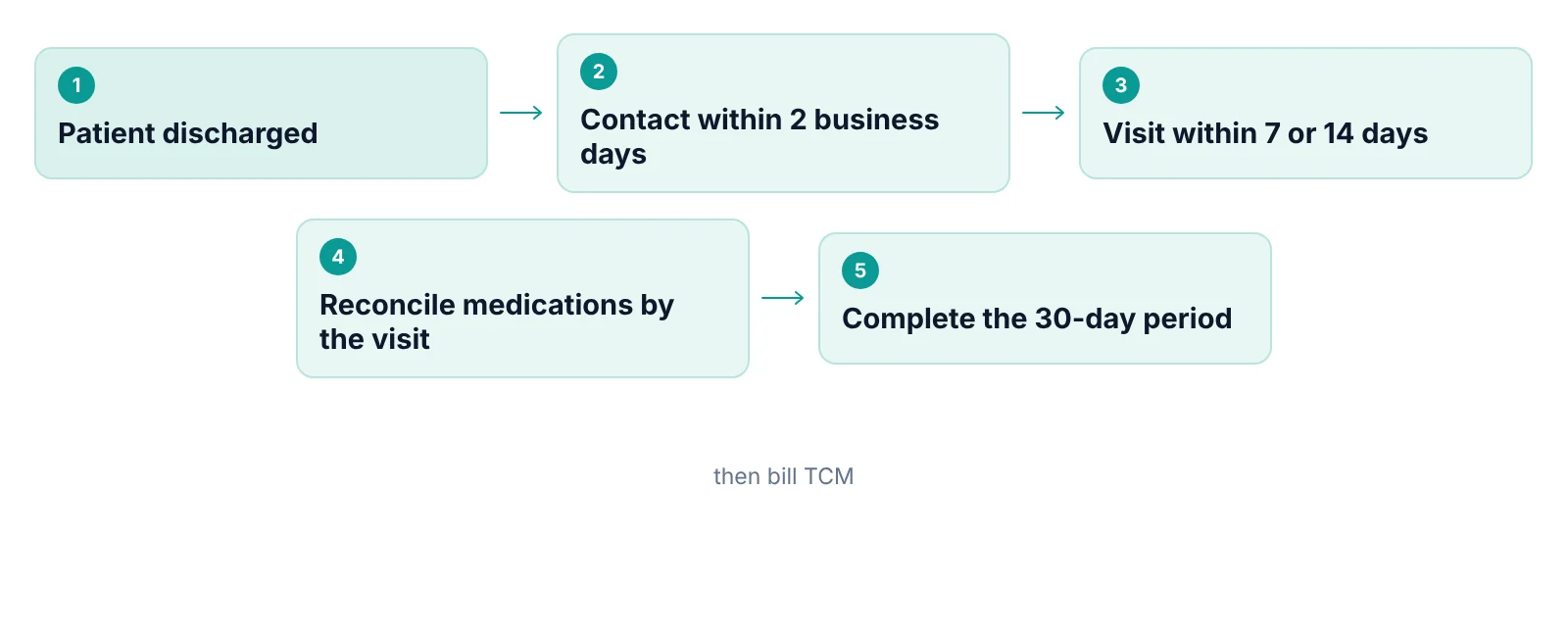
Transitional care management, CPT 99495 and 99496, pays for care coordination during the 30 days after discharge from a qualifying facility stay. Both need an interactive contact within 2 business days. 99495 needs at least moderate MDM and a visit within 14 days. 99496 needs high MDM and a visit within 7 days.
Patients are at their most vulnerable in the weeks after a hospital stay, and TCM is the code that pays for the work of bringing them back to the community safely. It is also a code with strict deadlines. A contact made on day three or a visit on day fifteen can lose the whole claim.
This guide explains the requirements, who can bill, what can and cannot be billed at the same time, and the documentation to keep. The rules follow the CMS Medicare Learning Network booklet on TCM. Check your payer for variations.
Key takeaways
- 99495: contact within 2 business days, at least moderate MDM, face-to-face visit within 14 days.
- 99496: contact within 2 business days, high MDM, face-to-face visit within 7 days.
- The service period is 30 days, starting on the day of discharge.
- Only one practitioner can bill TCM for a patient in the period.
What do 99495 and 99496 cover?
TCM covers the first 30 days after a discharge from an inpatient hospital, a partial hospitalization, or a skilled nursing, psychiatric or rehabilitation facility stay, to the patient’s home or community setting. The 30 days start on the day of discharge and run for 29 more days.
| Element | 99495 | 99496 |
|---|---|---|
| Contact | Within 2 business days of discharge | Within 2 business days of discharge |
| MDM | At least moderate | High |
| Face-to-face visit | Within 14 calendar days | Within 7 calendar days |
From the CMS MLN booklet on transitional care management services.
What counts as the 2-business-day contact?
The contact can be by phone, email or face to face. Clinical staff may make it, if they can address the patient’s status and needs beyond scheduling. Business days are Monday through Friday, excluding holidays. If two or more separate, timely attempts fail and are documented, the requirement can still be met, but attempts must continue until contact is made.
- Record the date and time of each attempt and the outcome.
- Record who made the contact and what was discussed.
- Keep trying after two unsuccessful attempts. Without a timely visit, TCM cannot be billed.
Want a second pair of eyes on your claims?
Send us your recent denials and we will show where the same issue repeats. The audit is free and the fix list is yours to keep.
What are the visit and medication rules?
One face-to-face visit is required within the code-specific window, and it can be done by telehealth. It is not reported separately. It cannot happen on the same day as discharge day management. Medication reconciliation and management must be done on or before the date of the visit.
| Item | Rule | Note |
|---|---|---|
| Timing | 14 days for 99495, 7 days for 99496 | Counted from discharge |
| Setting | Office, home or residence, or telehealth | All allowed per the MLN booklet |
| Separate billing | Do not report the visit separately | It is part of TCM |
| Medication reconciliation | On or before the visit date | Record the date |
Requirements from the CMS MLN booklet.
MDM is scored by the same rules as office visits. See our guides to 99214 and 99215 for how moderate and high MDM look in practice.
Who can bill TCM and what else can be billed?
Physicians of any specialty can bill TCM. So can nurse practitioners, physician assistants, clinical nurse specialists and certified nurse-midwives where state law allows. Only one practitioner can report TCM per patient per period, and Medicare pays the first valid claim.
| Service | Billable in the same period? | Note |
|---|---|---|
| Chronic care management | Yes, if time is not counted twice | See CCM billing |
| Remote monitoring | Yes, if time is not counted twice | See RTM codes |
| Global surgery period of the same practitioner | No | TCM cannot be billed if the period falls in the global period |
| Another practitioner’s TCM | No | Only one TCM per period |
From the CMS MLN booklet, which lists examples of codes that can be billed with TCM when time is not double counted.
How and when do you bill TCM?
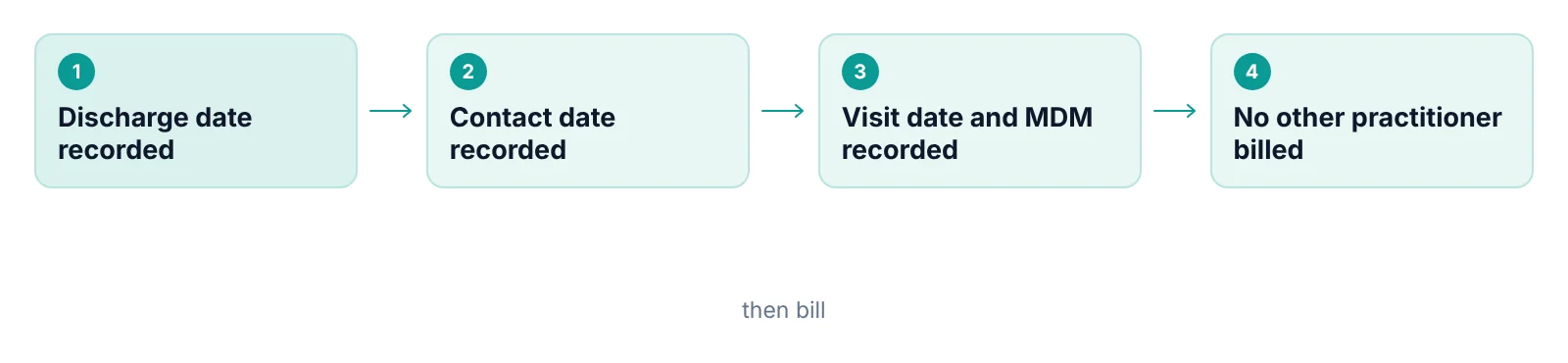
Commonly, the claim is submitted with the 30th day as the date of service, and AAFP guidance says so. The CMS booklet does not state a date of service rule on the page we reviewed, so confirm with your Medicare contractor. If the patient is readmitted, the visit is billed as an E/M, and a new period begins at the next discharge.
| Item | Why |
|---|---|
| Discharge date | Starts the 30-day period |
| Date of first interactive contact | Shows the 2-business-day rule was met |
| Date of face-to-face visit | Shows the 7 or 14-day rule was met |
| MDM level | Supports 99495 or 99496 |
Items listed in the AAFP TCM guidance.
See clear documentation for note habits that hold up in review.
What are the common TCM mistakes?
| Mistake | Why it fails | Fix |
|---|---|---|
| Contact after day two with no documented attempts | Requirement not met | Track discharge lists daily |
| Visit outside the window | Wrong code or not billable | Schedule the visit at the contact |
| No medication reconciliation date | Required element missing | Add it to the template |
| Two practitioners bill TCM | Only the first claim is paid | Confirm who owns the patient |
Prevent these with a daily discharge list and a scheduling rule.
A periodic coding audit of TCM claims will show whether the dates hold up.
Related care management guides
TCM sits among several care management services. See chronic care management, 99484 and telehealth billing for related codes. For observation and admission rules, see the two-midnight rule.
Our recommendations
- Review discharge lists every day. The 2-business-day clock starts at discharge.
- Schedule the visit during the contact. Book a slot inside the 7 or 14-day window.
- Use a TCM template. Include discharge, contact, visit and medication reconciliation dates.
- Check for other TCM billers. Confirm the patient does not have another practitioner billing it.
- Check global periods. TCM cannot be billed in your own global period.
- Audit a sample. Check that dates meet the rules.
Bottom line
TCM pays for a coordinated 30 days, and the deadlines are strict. Track discharges, book visits early and record the dates. For billing support, see our medical billing services.
Frequently asked questions
What is the difference between 99495 and 99496?
Both require an interactive contact within 2 business days of discharge. 99495 requires at least moderate MDM and a face-to-face visit within 14 calendar days. 99496 requires high MDM and a visit within 7 calendar days. Choose the code the record supports, based on the MDM level and the date of the visit.
Who can make the 2-business-day contact?
The practitioner or clinical staff working under the practitioner’s direction can make it, if they can address the patient’s status and needs beyond scheduling. The contact can be by phone, email or face to face. If attempts fail, document at least two timely attempts and keep trying until contact is made.
Can TCM be billed with chronic care management?
Yes. The CMS MLN booklet lists chronic care management among services that can be billed with TCM when medically necessary and time is not counted twice. The AAFP notes that time spent on TCM cannot count toward CCM time. Check your payer for any limits.
Can the TCM visit be done by telehealth?
Yes. The CMS booklet says the one required face-to-face visit can be provided via telehealth. It must occur within the code-specific window, it is not reported separately, and it cannot take place on the same day as discharge day management services.
Can two practitioners bill TCM for the same patient?
No. Only one practitioner can report TCM for a patient in the 30-day period, and Medicare pays the first valid claim received. Before you invest effort in TCM, confirm that no other practitioner, such as a specialist, has taken on the service for that patient.
When do I submit the TCM claim?
The AAFP says the claim is submitted with the 30th day as the date of service, though the CMS booklet page we reviewed does not state a date rule. Confirm with your Medicare contractor and your payers, and keep the discharge, contact, visit and MDM records ready for review.
Get your free practice audit
Tell us about your practice. We will contact you using the details you give.
- A review of your recent claims, denials and A/R aging
- Where your front desk and prior authorizations slow payment
- A prioritized fix list you keep, whether or not you hire us
Pricing is quoted after the audit, based on your volume and the services you choose. Prefer to talk? Call +1 (302) 556-2288.
Sources
- Transitional care management services (MLN908628) — Centers for Medicare & Medicaid Services (2025)
- Transitional care management (TCM): Medicare codes and toolkit — American Academy of Family Physicians (2025)
- TCM fact sheet — American College of Physicians (2024)
- Medicare Claims Processing Manual, Chapter 12 — Centers for Medicare & Medicaid Services (2026)
- Medicare Physician Fee Schedule — Centers for Medicare & Medicaid Services (2026)
- Evaluation and Management Services Guide (MLN006764) — Centers for Medicare & Medicaid Services (2025)
Disclaimer: This article is educational and is not legal, coding, billing, medical or compliance advice. CPT codes and modifier descriptions are owned by the AMA, and code meanings, Medicare contractor policies and payer rules change and vary by payer, contractor and state. Verify current requirements with the official CPT manual, your payers and your counsel before you act.
