
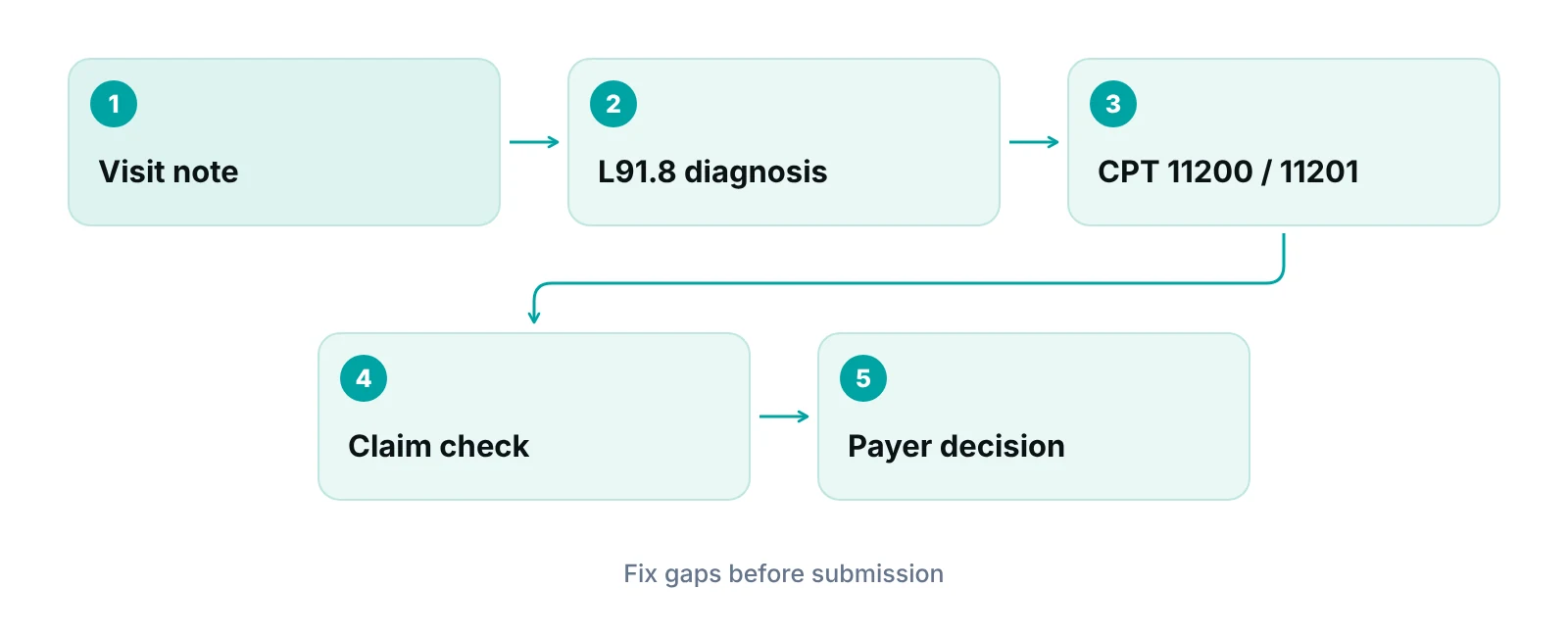
The ICD-10 code for skin tags is L91.8, Other hypertrophic disorders of the skin. Removal is reported with CPT 11200 for up to 15 tags and 11201 for each added 10. Whether it is paid depends on the note: cosmetic removal is excluded by Medicare, and payers cover it when symptoms are documented.
Older guides list four or five ICD-10 codes for skin tags and skip the question that decides payment: is the removal cosmetic? This guide gives the code, the CPT codes, and the published payer rules, with the sources linked. It is written for coders, billers and practice managers, and it is not coding advice for a specific claim.
Key takeaways
- L91.8 is the index default for a skin tag; anal and hemorrhoidal tags index to K64.4.
- CPT 11200 covers up to 15 tags; CPT 11201 is added for each extra 10 or part of 10.
- D23 codes are for benign neoplasms, not plain skin tags.
- Medicare excludes cosmetic surgery; commercial payers set their own symptom criteria.
- The note, not the code, carries the medical-necessity case.
Which ICD-10 code is used for skin tags?
Use L91.8, Other hypertrophic disorders of the skin, for a skin tag on the skin. The ICD-10-CM index entry for a hypertrophied skin tag points to L91.8, and the code is billable in the FY 2027 code set that began on October 1, 2026 (ICD-10 code listing; index entry).
A skin tag is also called an acrochordon. The index does not send you to a different code because of the body site. A tag on the neck, in the armpit or in the groin is still L91.8 when it is a plain skin tag. Location belongs in the note and, if the payer asks for it, in the claim narrative. It does not change the diagnosis code.
The index has separate entries for tags that are not ordinary skin tags. A tag at the anus or a hemorrhoidal tag indexes to K64.4, and an adenoid or tonsil tag indexes elsewhere. That is why a code search for the word “tag” alone can land on the wrong chapter.
| Clinical situation | Code to consider | What to check before you use it |
|---|---|---|
| Skin tag on the skin (neck, axilla, groin, trunk) | L91.8 | This is the index default for a hypertrophied skin tag. Record the site in the note. |
| Skin tag at the anus, or residual hemorrhoidal tag | K64.4 | The index sends anal and hemorrhoidal tags here, not to L91.8. |
| Hypertrophic disorder of the skin with no further detail | L91.9 | Use only when the note really gives no more detail. It is a weaker support for medical necessity. |
| Raised scar, not a tag | L91.0 | Hypertrophic scar is a different condition. Do not use it as a stand-in. |
| Lesion the clinician diagnoses as a benign neoplasm | D23.- | This is a neoplasm code. It belongs on the claim only if the diagnosis is a benign neoplasm, not because the lesion looks like a tag. |
| Removal done only for appearance, when the payer asks for it | Z41.1 | One Medicare contractor article tells providers to submit cosmetic-only removals with this code. |
Source: ICD-10-CM FY 2027 listings and index entry (icd-10codes.com, icdlist.com); National Government Services billing article A54602 (rev. effective January 1, 2024). Confirm every code in the official FY 2027 tabular list and index.
Coding teams that want worked examples for other lesions and conditions can see our medical coding examples guide.
When is a code other than L91.8 correct?
A different code is correct only when the clinical diagnosis is different. The code follows the diagnosis in the note, not the procedure on the schedule.
K64.4 for anal and hemorrhoidal tags
If the tag is at the anus or is a residual hemorrhoidal tag, the index entry is K64.4. Do not use L91.8 for it just because the word “skin” appears in the name of the lesion.
D23.- only for a benign neoplasm
Older web guides list D23.9 for faces, eyelids and backs. That mixes two different ideas. D23 sits in the neoplasm block of the code set. If the clinician diagnoses a skin tag, the index points to L91.8. Use a D23 code when the diagnosis is a benign neoplasm of skin, for example after pathology says so. The ICD-10-CM listing for L91.8 also carries an Excludes2 note for neoplasms, which means the two conditions are separate and can be reported together when both are present and documented.
Codes that older posts list by mistake
Two codes appear in older skin tag guides and do not describe a tag. L91.0 is a hypertrophic scar. L91.9 is the unspecified hypertrophic disorder code. Viral warts have their own category, B07.-, and the L91.8 listing carries an Excludes2 note for them. Also treat any guide that gives L98.8 as a “bleeding skin tag” code with caution. We could not confirm that mapping in the index and have left it out.
Do not use the symptom to pick the diagnosis code
Irritation, bleeding or inflammation is the reason a payer may call the removal medically necessary. It does not move the skin tag to a new code. Put the symptom in the note, and ask your coder whether an additional sign or symptom code applies under the guidelines in effect on the date of service.
Which CPT codes report skin tag removal?
Skin tag removal is reported with CPT 11200 for up to and including 15 tags, plus CPT 11201 for each additional 10 tags or part thereof. Medicare contractors and commercial payers describe both codes in this way (National Government Services billing article A54602; Network Health policy). The AMA owns the official CPT descriptors, so check the current CPT manual for exact wording.
The 11201 rule is easy to misread. 11200 covers the first block of up to 15. 11201 is then reported once for every extra 10 lesions or part of 10. By that rule, 16 to 25 tags is 11200 plus one unit of 11201, and 26 to 35 is 11200 plus two units. The NGS article says 11201 is reported with units for each additional group of 10.
| CPT code | What it reports (our wording) | Reporting notes |
|---|---|---|
| 11200 | Removal of skin tags, any area, up to and including 15 lesions | Reported for the first block of up to 15 tags. |
| 11201 | Each additional 10 lesions, or part of 10 | Add-on code. Report units for each extra group of 10. Do not report it without 11200. |
| 11200 with a diagnosis code that shows a symptom or site-specific irritation | Medically indicated removal | The diagnosis and note must carry the indication, since payers read the note for it. |
| 11200 with Z41.1 where the payer or contractor instructs it | Cosmetic-only removal | Some Medicare contractors and plans ask for this pairing so the claim denies as not covered. |
Source: National Government Services billing article A54602 (rev. effective January 1, 2024); Network Health benign skin lesion policy (approved February 19, 2026); OHSU HealthServices policy (effective April 9, 2024). CPT is a registered trademark of the AMA.
Other destruction codes exist for benign lesions that are not skin tags. OHSU HealthServices, for example, lists 17110 and 17111 for benign lesions other than skin tags. Do not switch to those codes to get around a skin tag denial. The code should match what was done and the lesion that was treated.
When a skin tag is removed during a visit for another problem, the visit and the procedure may both be billed only if the note supports a separately identifiable visit. See our guide to modifier 25 and modifier 59 before you append either one.
When is skin tag removal cosmetic, and when is it medically necessary?
Removal is treated as cosmetic when it is done for appearance at the patient’s request, and as medically necessary when the note shows a clinical reason such as bleeding, inflammation, pain, itching or repeated irritation. Medicare does not cover cosmetic surgery, and commercial payers write their own criteria.
For Medicare, the exclusion is in the statute and the regulation. Section 1862(a)(10) of the Social Security Act excludes cosmetic surgery, except to repair accidental injury or improve the function of a malformed body member (42 U.S.C. 1395y), and 42 CFR 411.15(h) repeats it (eCFR). The NGS article states the same principle for skin lesions: “Medicare does not cover cosmetic surgery or expenses incurred in connection with such surgery.”
Commercial and Medicaid plans do not share one standard. The table shows how five published policies handle it. Read it as a sample of how criteria differ, not as a rule for every payer.
| Policy | Cosmetic when | Medically necessary when |
|---|---|---|
| National Government Services (Medicare contractor), article A54602, rev. effective Jan. 1, 2024 | Medicare does not cover cosmetic surgery. Cosmetic-only removal is to be submitted with Z41.1. | The article does not list supporting diagnosis codes. Coverage depends on the lesion not being cosmetic. |
| Aetna CPB 0633, last reviewed Sept. 9, 2026 | None of the listed indications is met. | Biopsy suggests pre-malignancy or malignancy, recurrent trauma or irritation from the anatomic location, symptoms such as bleeding, burning, intense itching or irritation, or inflammation, infection or restriction of vision or a body orifice. |
| Network Health benign skin lesion policy, approved Feb. 19, 2026 | Done at the member’s request without a physician verifying medical necessity. | Lesion bleeds or ulcerates, is significantly inflamed, infected, itchy or painful, or sits in a chronically irritated area such as skin folds, groin, scalp, breasts or neckline. |
| OHSU HealthServices, effective Apr. 9, 2024 | Any removal outside the listed criteria. | At least one objective sign or symptom, such as bleeding, intense itching, pain, recent enlargement or inflammation. Records must give the location, physical features and a specific diagnosis. |
| Blue Cross & Blue Shield of Rhode Island, updated Apr. 6, 2022 (effective Sept. 1, 2019) | Commercial products: skin tag removal is considered cosmetic and not covered. | Medicare Advantage: covered when signs or symptoms warrant intervention. |
Sources: the five policies named in the table, fetched October 2026. Policies are revised often, so confirm the version in force on the date of service.
Notice what the criteria have in common. Each one asks for an objective, documented reason. “The patient wanted it off” is never enough. “Catches on a bra strap, bleeds, and has become red and tender” is the kind of detail these policies look for, as long as the clinician really observed it.
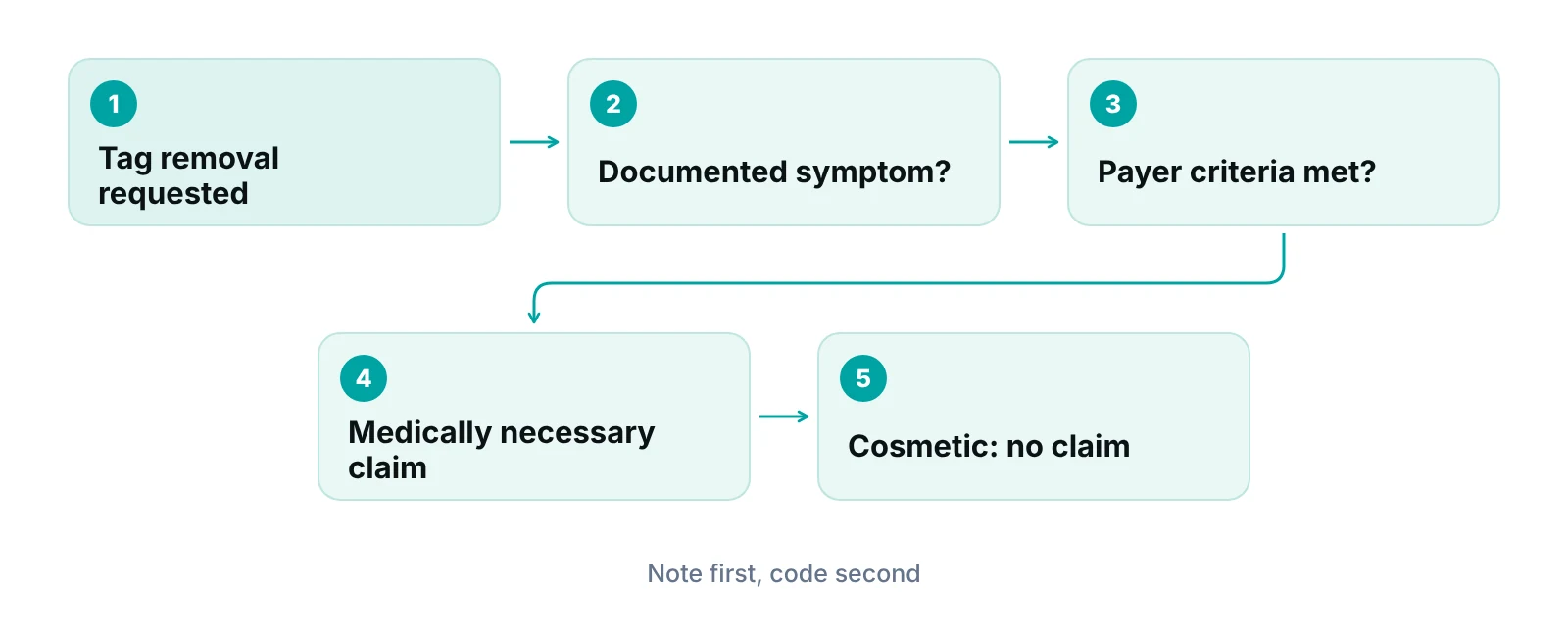
“A payer cannot read intent. It reads the note, so the reason for removal has to be written down on the day of service.”
What should the note show to support a medically necessary claim?
The note should show what the clinician saw and why removal was needed. The OHSU policy asks for the location and physical characteristics of the lesion and a specific diagnosis. Aetna, Network Health and OHSU all use objective signs or symptoms as the test.
- Site and number. Name each area (for example, left axilla and posterior neck) and count the tags, since the count drives 11200 versus 11201 units.
- Size and appearance. Give size, color and whether the lesion is pedunculated, in the clinician’s own words.
- The reason for removal. Record bleeding, ulceration, inflammation, pain, itching, repeated trauma from clothing or jewelry, or a concern about the diagnosis.
- What was done. OHSU’s policy lists cryotherapy, electrosurgery, excision and shave excision as accepted methods. The note should say which was used.
- Pathology, if sent. If the clinician is unsure of the diagnosis, a biopsy result is a stronger basis than a guess.
- Consent and cosmetic discussion. If some tags are cosmetic and some are symptomatic, document which is which so the claim and the patient notice match.
A practice management system that tracks claims by stage and checks data completeness before submission can hold a claim when the diagnosis, units or note flag is missing. It does not replace the clinician’s documentation, but it can stop an incomplete claim from leaving the office.
How dermatology practices handle skin tag billing
Skin tags are common minor procedures in dermatology, and the same tag can be cosmetic for one patient and medically necessary for another. Practices that bill them well keep a short decision rule at the front desk and in the exam room. Our dermatology billing and revenue cycle page covers how specialty-specific billing rules are handled across the claim, and our guide to dermatology insurance coverage explains the wider cosmetic and medical line for the specialty.
Three habits help. First, tell the patient before the procedure whether the plan is likely to treat it as cosmetic, and collect the cosmetic fee under your own policy if so. Second, do not add a symptom to the note because the plan requires one. Third, send both cosmetic and medical removals through the same claim review so nothing slips through with a mismatched code.
Why skin tag claims are denied, and what to do
Most denials come from one of three places: the payer treated the service as cosmetic, the diagnosis did not support the CPT code, or the note lacked a symptom. Fix the cause before you resubmit.
- Denied as cosmetic. Compare the note to the payer’s own criteria. If the criteria were met and documented, appeal with the note. If they were not, the denial may be correct.
- Diagnosis does not match the procedure. A wrong code from an older guide, such as a neoplasm code on a plain skin tag, can trigger a review. Correct it only if the original coding was an error.
- Unit errors on 11201. Count tags against the 15 and the groups of 10. Units that do not match the note get adjusted or denied.
- Patient-responsibility errors. If a plan denies a service as cosmetic, whether you may bill the patient depends on the contract and the notice given. Check the contract before you send a statement.
Our guides to medical billing denial management, the clean claims checklist and the CMS-1500 claim form explain the general steps. If denials on minor procedures are a pattern in your practice, our denial management services team can review them.
Find out where minor-procedure claims are getting stuck
A free practice audit looks at your coding, documentation and denial patterns and shows where claims for minor procedures leak. Pricing for any service is quoted after the audit.
Our recommendations
- Code the diagnosis, not the symptom. We recommend L91.8 for a plain skin tag and K64.4 only for anal or hemorrhoidal tags, then recording the reason for removal in the note.
- Retire the old code lists. Search templates and cheat sheets for D23.9 on skin tags, L98.8 as a bleeding-tag code, and any list of codes that does not match the FY 2027 index.
- Build a one-page payer grid. List each major payer, whether skin tag removal is covered, the symptom criteria, and the code pairing it wants for cosmetic removals. Review it each time a policy changes.
- Give clinicians a documentation prompt. A short template with site, count, size, symptom, method and pathology keeps the note ready for the payer reviewer.
- Count units before the claim leaves. Check 11200 and 11201 units against the number of tags in the note. A second reviewer on minor procedures is cheap compared with an appeal.
- Handle cosmetic removals openly. Where the plan will not cover it, give the patient the choice and the fee in writing before the visit, and follow the payer contract.
A practice management system can hold incomplete minor-procedure claims before they go out.
The RCM Finder portal tracks each claim by stage with an owner and runs data-completeness checks before submission, so a missing diagnosis, unit count or note flag can be caught while the visit is fresh.
See how the RCM Finder portal works · Create a portal account
Disclosure: RCM Finder builds and sells this portal. It is a practice management system, not an EHR.
Bottom line
Skin tags are simple to code and easy to get wrong. Use L91.8 for a plain skin tag, 11200 and 11201 for removal, and let the note, not the code, carry the medical-necessity case. Payer policies differ, so keep a current grid for your plan mix. If your practice wants help with coding and claims for minor procedures, see our medical billing services and our end-to-end revenue cycle management service, or estimate where revenue slips with the revenue calculator.
Frequently asked questions
What is the ICD-10 code for skin tags?
L91.8, Other hypertrophic disorders of the skin, is the index default for a skin tag. Anal and hemorrhoidal tags index to K64.4. Check the code in the official FY 2027 tabular list and index before you bill, and keep the site and the reason for removal in the note.
What is the CPT code for skin tag removal?
CPT 11200 reports removal of up to and including 15 skin tags. CPT 11201 is added for each additional 10 tags or part of 10. Use the current CPT manual for the official descriptors, and count the tags in the note before you set units.
Does insurance cover skin tag removal?
It depends on the payer and the reason for removal. Medicare does not cover cosmetic surgery. Several published policies cover removal when the note documents bleeding, inflammation, pain, itching or repeated irritation, and some commercial products treat it as cosmetic and not covered.
Can I use D23.9 for a skin tag?
Not as a general rule. D23 is a benign neoplasm code. A skin tag indexes to L91.8. Use a D23 code only when the clinician’s diagnosis is a benign neoplasm of skin, for example after pathology confirms it.
How do I bill when more than 15 skin tags are removed?
Bill 11200 for the first block and 11201 for each additional group of 10 or part of 10. For example, 16 to 25 tags is 11200 plus one unit of 11201. Check the payer policy and the tag count in the note first, since units must match the documentation.
What if the payer says the removal is cosmetic?
Compare the note to the payer’s own criteria. If a criterion was met and documented, appeal with the note. If not, the denial may stand, so tell patients before the visit when a plan is likely to treat removal as cosmetic.
Get your free practice audit
Tell us about your practice. We will contact you using the details you give.
- A review of your recent claims, denials and A/R aging
- Where your front desk and prior authorizations slow payment
- A prioritized fix list you keep, whether or not you hire us
Pricing is quoted after the audit, based on your volume and the services you choose. Prefer to talk? Call +1 (302) 556-2288.
Sources
- ICD-10-CM L91.8 code listing, FY 2027 — icd-10codes.com (2026)
- Tag (hypertrophied skin) index entry — icdlist.com (2026)
- L91 Hypertrophic disorders of skin, FY 2027 — icd-10codes.com (2026)
- ICD-10-CM FY 2027 files directory — CDC/NCHS (2026)
- Billing and Coding: Removal of Benign Skin Lesions (A54602) — National Government Services (Medicare contractor) (2024)
- Benign Skin Lesion Removal, CPB 0633 — Aetna (2026)
- Benign skin lesion UM policy — Network Health (2026)
- Treatment or Removal of Benign Skin Lesions — OHSU HealthServices (2024)
- Benign Skin Lesions and Viral Infectious Lesion Removal — Blue Cross & Blue Shield of Rhode Island (2022)
- 42 CFR 411.15 — eCFR (2026)
- 42 U.S.C. 1395y — Cornell LII / U.S. Code (2026)
Disclaimer: This article is educational and is not legal, coding, billing, medical or compliance advice. CPT codes are owned by the AMA. Code sets, payer policies and Medicare contractor articles change and vary by payer, plan and state. Verify current requirements in the official ICD-10-CM and CPT manuals and with each payer before you bill.
