
The CO-45 denial code means the billed charge exceeded the payer's fee schedule, maximum allowable or contracted amount, and the difference is the provider's responsibility (CO is the group code, 45 the reason). Usually it is a routine write-off, not a rejected claim. Check it against your contract.
Many guides online still define CO-45 wrongly, as an experimental-service denial or as a code used to send replacement claims. Neither matches the code’s published definition. This post reads CO-45 the way the X12 code lists and CMS remittance guidance describe it, so a biller can decide what to do with the line on the screen.
If you want the bigger picture first, start with our guide to medical billing denials. If your remittance shows a different code, the sections below point to the matching explainers.
Key takeaways
- CARC 45 reads: charge exceeds fee schedule, maximum allowable or contracted/legislated fee arrangement.
- It is used only with group code CO (provider liable) or PR (patient liable); CO-45 is the provider-liable version.
- X12 treats CARC 45 as a reduction to an allowed amount, not a rejection of the whole charge.
- The key check is whether the allowed amount matches your contract. If it does, post the write-off. If not, dispute it.
- You never type CO-45 on a claim. It appears on the payer’s remittance advice.
What does the CO-45 denial code mean?
CO-45 combines two pieces of a remittance adjustment. CO is the claim adjustment group code for contractual obligation. 45 is the claim adjustment reason code (CARC). The X12 code list gives CARC 45 as “Charge exceeds fee schedule/maximum allowable or contracted/legislated fee arrangement,” and says to use it only with group codes PR or CO, depending on liability (X12 Request for Interpretation, Massachusetts CARC code memo, February 2025).
In plain words, the payer is saying: you billed more than we pay for this service under the fee schedule or your contract, so the difference is adjusted off. With group code CO, that difference is the practice’s to absorb. It is not billed to the patient.
| Part | What it is | What it tells you |
|---|---|---|
| CO | Claim adjustment group code | Who is financially responsible for the adjusted amount: here, the provider |
| 45 | Claim adjustment reason code (CARC) | Why the amount was adjusted: the charge was above the fee schedule, maximum allowable or contracted amount |
| Remark code (RARC), if present | Remittance advice remark code | Optional extra detail that supplements the reason code |
Source: CMS MLN remittance advice material; X12 CARC list as reproduced in the Massachusetts CARC code memo (February 2025).
CMS describes the same structure: group codes assign financial responsibility for the unpaid portion, CARCs give the overall reason, and RARCs add a more specific explanation (CMS Medicare Learning Network).
What CO-45 is not
CO-45 is not an experimental-or-investigational denial, and it does not belong to HCPCS. Those descriptions appear in some older articles but do not match the code list. CO is a group code and 45 is a reason code, and both are set by the payer on the remittance.
It is also not an instruction a practice enters on a claim. Providers do not type CO-45 to submit a corrected or replacement claim. The adjustment shows up on the payer’s remittance advice, which, according to CMS, is the companion to a payment or the explanation of why there was no payment, and shows why an amount differs from the submitted charge (CMS).
Why this matters
If a biller believes CO-45 means the service was experimental, the team may start an appeal or a documentation request that the payer never asked for. Read the code’s real meaning first, then decide whether anything needs action.
CO versus PR: who pays the difference?
The group code decides who carries the amount, so it matters as much as the reason code. For Medicare, the CO group “includes any amounts for which the supplier is financially liable,” and the beneficiary may not be billed for them. PR signifies the amount that may be billed to the beneficiary or to another payer on the beneficiary’s behalf (Noridian Medicare).
| Group code | Meaning | Who is liable |
|---|---|---|
| CO | Contractual obligation | The provider or supplier; the patient may not be billed for it |
| PR | Patient responsibility | The patient, or another payer on the patient’s behalf (deductible and coinsurance are examples) |
| OA | Other adjustment | Used only if neither PR nor CO applies; neither the patient nor the provider is responsible |
| CR | Correction or reversal of a prior decision | Applies when a previously adjudicated claim changes; shown together with PR, CO or OA |
Source: Noridian Medicare, Claim Adjustment Group Codes; CMS MLN remittance advice material.
CMS also notes that providers may bill Medicare beneficiaries for an unpaid portion only when an adjustment shows group code PR (CMS). CARC 45 can appear with PR on some plans where a patient-liable fee arrangement applies, so always read the group code, not just the number. Billing the patient for a CO amount is the costly mistake to avoid.
“A group code is a liability label. Read it before posting a write-off or a patient balance.”
A worked example of a CO-45 line
Take a hypothetical visit. The practice bills $200 and the contracted allowed amount is $120. The remittance shows an $80 adjustment with group code CO and reason 45. The remaining $120 is then split between the payer’s payment and any patient share shown with PR codes, such as a deductible or coinsurance. The figures here are illustrative only.
Two points follow from X12’s guidance. First, the CO-45 amount is the difference between the charge and the allowed amount, so it should equal the gap between your billed charge and the contracted rate for that line. Second, the code list notes that the CARC 45 adjustment amount cannot equal the total service or claim charge amount (CARC code memo). X12 reads CARC 45 as presuming a non-zero allowed amount, with the reduction applied to that allowed amount (X12 RFI).
That second point is useful in practice. If a remittance shows CO-45 against the entire charge with nothing allowed, the line does not fit the code’s intent, and it is reasonable to ask the payer which adjustment reason actually applies.
When is CO-45 routine, and when should you question it?
CO-45 is routine when the allowed amount matches the fee schedule or contract for that code, plan and date of service. It deserves a closer look when the allowed amount does not match, when the line shows no allowed amount, or when the remark codes point to a different problem.
| What you see | What it usually means | What to do |
|---|---|---|
| Allowed amount matches your contract or fee schedule | Normal contractual adjustment | Post the write-off to the contractual adjustment account; do not bill the patient the CO amount |
| Allowed amount is lower than your contract | Possible underpayment or wrong fee schedule applied | Compare the line to your loaded contract rate and send the payer a dispute with the contract page |
| CO-45 applied to the full charge with nothing allowed | Does not fit the code’s definition under X12 guidance | Call or message the payer and ask for the correct adjustment reason |
| CO-45 appears with a remark code about missing information | Mismatched combination; X12 has described such remarks as used with CARC 16 | Review the claim for the missing data and read our CO-16 guide |
| CO-45 on a secondary claim | Adjustment should not repeat what the primary payer already adjusted | Compare it with the primary remittance for duplicated reductions |
Source: X12 Request for Interpretation (CARC 45 and RARC usage); CARC code memo, February 2025. Action column is operational advice, not payer policy.
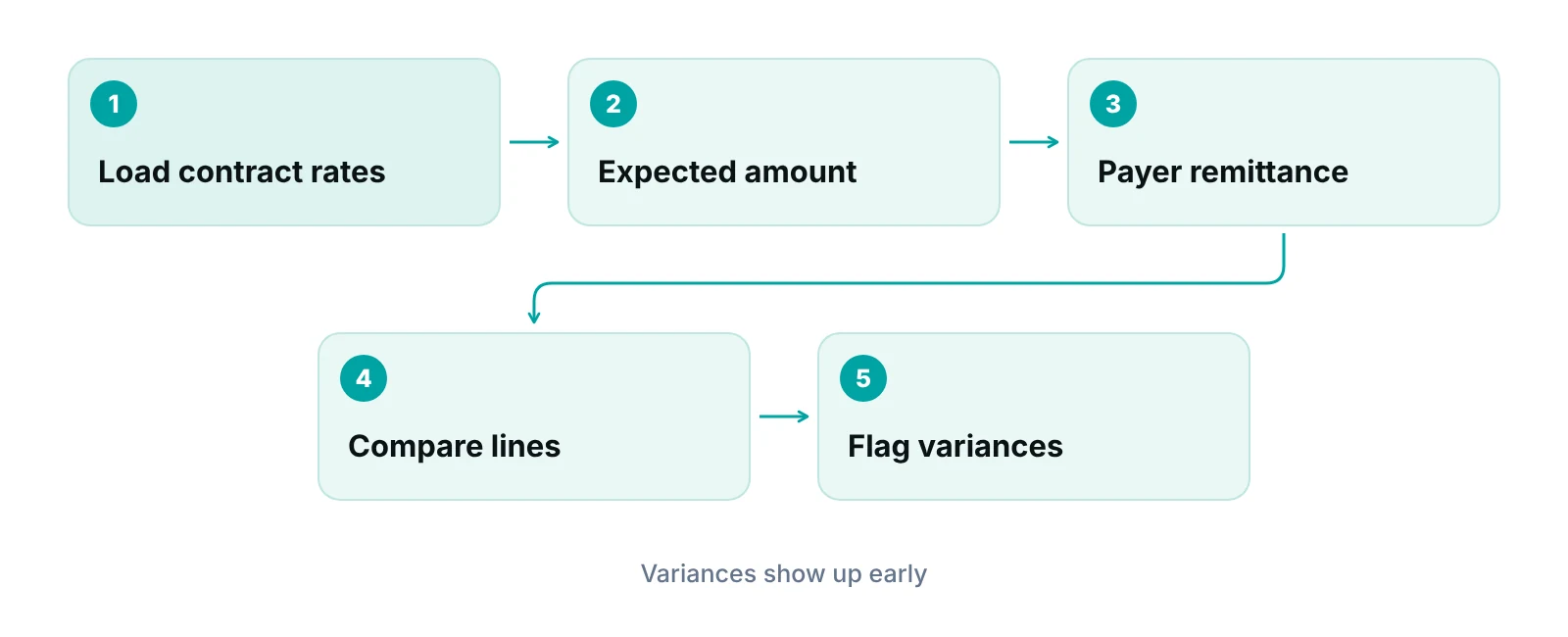
The second row is where money is lost. A contract rate is only useful if someone compares it with what was paid. Loading fee schedules into the billing system makes these variances easier to flag early.
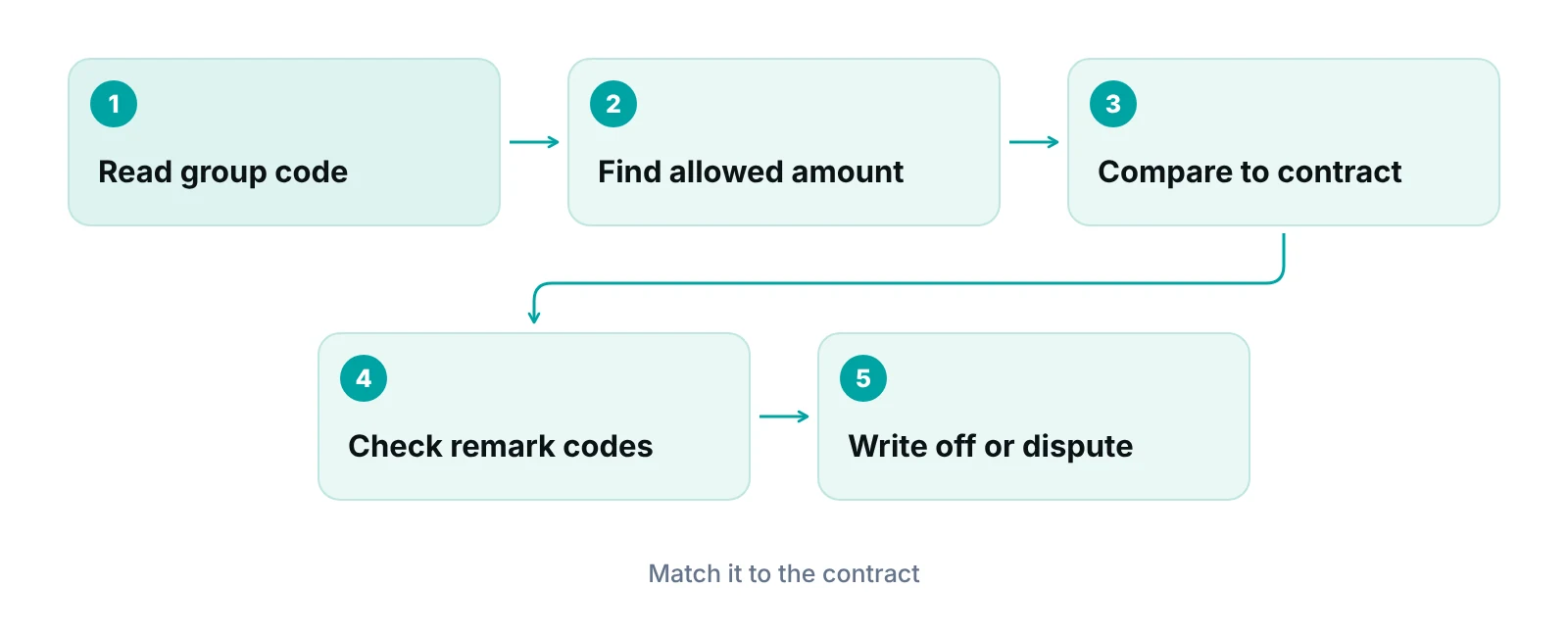
How to check a CO-45 line step by step
A short, repeatable check keeps the team from either writing off errors or chasing normal adjustments. We recommend doing it on the remittance itself, line by line.
- Confirm the group code. CO means the provider absorbs it; PR means the patient may owe it.
- Find the allowed amount for the line and compare it with the contract or fee schedule for that code, plan and service date.
- Check the remark codes. A remark about missing data or coverage points to a different denial type, not a pure fee-schedule reduction.
- Look at the claim’s other adjustments. Confirm no reduction is repeated, especially on secondary claims.
- If the amount matches, post the write-off. If it does not, open a dispute with the contract page, claim number and remittance attached.
Should you appeal a CO-45 adjustment?
Usually not, because a correct CO-45 is a contractual reduction rather than a rejected claim, so there is nothing to appeal. A dispute makes sense only when the allowed amount is wrong, such as when the payer used the wrong fee schedule, the wrong plan or an old contract rate.
Appeal and dispute deadlines differ by payer, plan and program,. Do not assume a fixed number of days from an article. Find the deadline in the payer’s provider manual or contract and the date on the remittance, and note it on the work item the day the line is flagged.
If you want help sorting payer disputes from normal write-offs, our denial management services cover denial follow-up and appeals, and the denial management process guide explains the workflow.
Related codes that get confused with CO-45
A remittance can show several adjustments on the same claim. Each has its own meaning, and the CARC list gives the following descriptions (CARC code memo):
- CARC 16: claim or service lacks information or has submission or billing errors. See our CO-16 guide.
- CARC 22: care may be covered by another payer per coordination of benefits. See our CO-22 guide.
- CARC 24: charges are covered under a capitation agreement or managed care plan. See our CO-24 guide.
- CARC 197: precertification, authorization or notification absent. See our CO-197 guide.
Those four point to a problem with the claim, the coverage or the authorization. CO-45 is different: it reflects the agreed rate applied to the service. Code lists are also revised several times a year, typically around March 1, July 1 and November 1 according to CMS, so check the current list when a code looks unfamiliar (CMS MLN).
How to reduce surprises from CO-45
You cannot stop a payer from applying its fee schedule, but you can stop being surprised by it. The goal is to know the expected allowed amount before the claim is sent and to compare it with what is paid.
- Load each payer’s contracted rates into your billing system and update them when contracts renew.
- Keep the contract and fee schedule effective dates on file so the right rate is checked for each service date.
- Verify the patient’s plan before the visit. See our insurance verification guide for the front-end steps.
- Send complete, accurate claims. Our clean claims guide covers what to check first.
- Review variances in A/R follow-up, not only denials. See accounts receivable in medical billing.
Specialty also changes the mix of codes and payers, so the contract review is worth doing per service line. Our specialty billing pages show the code patterns by specialty.
Not sure whether your CO-45 lines match your contracts?
Request a free practice audit. We review a sample of your recent remittances and denials and show where adjustments look off. Pricing is quoted after the audit.
Our recommendations
- Read the group code before anything else. CO and PR decide who pays. Train posters to check it before they write off a balance or bill a patient.
- Keep a current rate sheet per payer. A CO-45 amount is only checkable if the contracted rate is on file. Update it at every contract renewal.
- Flag low allowed amounts, not just denials. Add a variance report that compares expected and paid amounts by line so underpayments surface in days, not months.
- Question CO-45 on a zero allowed amount. A reduction with nothing allowed does not fit the code’s definition. Ask the payer for the correct reason before posting.
- Document each dispute with the contract page. Attach the rate page, remittance and claim number so the payer can resolve it in one pass.
- Note payer deadlines when a line is flagged. Deadlines vary by payer. Record the date on the work item as soon as the line enters the queue.
Bottom line
The CO-45 denial code is a contractual adjustment: the charge was above the payer’s fee schedule or contracted amount, and the provider absorbs the difference. Most of the time it is correct. The skill is checking the allowed amount against the contract so real underpayments are caught. If you want help with that review, see our medical billing services and our denial management services, or estimate your own revenue gap with the revenue calculator.
Frequently asked questions
What does CO-45 mean on a remittance?
CO-45 means the billed charge exceeded the payer’s fee schedule, maximum allowable or contracted amount, and the provider is responsible for the difference. CO is the group code for contractual obligation and 45 is the reason code. In most cases it is a routine write-off after you confirm the allowed amount.
Is CO-45 a denial?
Not in the usual sense. A correct CO-45 reduces the charge to the allowed amount, and the claim is still paid at that amount. X12 describes CARC 45 as a reduction to an allowed amount, so the code is not meant to reject the entire charge. Billers often call every adjustment a denial, which is where the confusion starts.
Can I bill the patient for a CO-45 amount?
No. CO assigns liability to the provider, and CMS states that providers may bill Medicare beneficiaries for an unpaid portion only when an adjustment shows group code PR. For commercial plans, follow your contract and the payer’s remittance instructions, and ask the payer if a line is unclear.
Should I appeal a CO-45 adjustment?
Only if the allowed amount is wrong. If it matches your contract or fee schedule, post the write-off. If it is lower than contracted, send a dispute with the contract rate page, the claim number and the remittance. Check the payer’s manual for the deadline, since it varies.
What is the difference between CO-45 and PR-45?
The reason is the same (charge exceeds the fee arrangement), but the group code changes who is liable. CO-45 is the provider’s responsibility. PR-45 means the amount may be billed to the patient, which depends on the plan and the payer’s remittance. Always read the group code, not only the number.
What if CO-45 shows up on the whole charge?
Ask the payer. X12 guidance treats CARC 45 as a reduction to a non-zero allowed amount, so applying it to the full charge with nothing paid does not fit its intent. Request the correct adjustment reason from the payer before you post a write-off.
Get your free practice audit
Tell us about your practice. We will contact you using the details you give.
- A review of your recent claims, denials and A/R aging
- Where your front desk and prior authorizations slow payment
- A prioritized fix list you keep, whether or not you hire us
Pricing is quoted after the audit, based on your volume and the services you choose. Prefer to talk? Call +1 (302) 556-2288.
Sources
- RFI 2052: CARC 45 being used as a denial — X12 (2026 (accessed 2026-10-17))
- Companion Guide CARC Memo (February 2025) — Massachusetts Executive Office of Health and Human Services (2025)
- Claim Adjustment Group Codes — Noridian Healthcare Solutions (CMS contractor) (2026 (accessed 2026-10-17))
- Medicare Learning Network: Remittance Advice guide — CMS (2026 (accessed 2026-10-17))
Disclaimer: This article is educational and is not legal, coding, billing or compliance advice. Payer rules, contracts and code lists change, and the examples here are illustrative. Check current X12, CMS and payer sources before you post adjustments or bill patients.