
<strong>Lean medical billing</strong> is a method for removing work that does not help a claim get paid: errors, waits, repeated checks and unowned follow-up. Map one claim from visit to payment, find where it waits or comes back, and fix one recurring defect at a time.
Most billing teams are busy, but a share of that work is rework: claims fixed, resubmitted and checked again. Lean gives you a plain way to see it. This post explains the idea in billing terms and shows a small first step. For the whole cycle, see our healthcare revenue cycle management guide.
Key takeaways
- Lean removes work that does not help a claim get paid; it is not about working faster.
- Defects (claim errors) create most downstream work, so start there.
- Rejections and denials need different fixes; count them separately.
- Map one claim type with real dates before changing anything.
- Improve one recurring defect at a time, with one owner and a weekly count.
What lean means in a billing office
Lean is a method for removing work that does not help a claim get paid. In a billing office that means fewer touches per claim, fewer claims that come back, and fewer places where work sits and waits. It starts from the idea of "value": a step has value only if the payer, the patient or the practice would pay for it if they saw it.
The method came from manufacturing and has been taught to hospitals for years. The American Hospital Association’s lean course outline lists five lean principles: value, value stream, flow, pull and perfection, and teaches value stream mapping as the technique for finding and measuring waste (AHA lean management course outline). None of that needs a consultant or special software. It needs a whiteboard, a few weeks of claim data and the people who touch the claims.
This post is the awareness-level view. It shows where waste hides in a billing workflow and how to start small. For the full revenue cycle from scheduling to final payment, read our healthcare revenue cycle management guide.
Lean is not about working faster
Speeding up a broken step produces more broken claims sooner. Lean first asks whether the step should exist, then whether it can be done right the first time.
Why waste is worth hunting for
Health care carries a lot of avoidable cost, and administration is part of it. The 2012 Institute of Medicine report Best Care at Lower Cost estimated that about 30 percent of 2009 health spending, roughly $750 billion, was wasted. The American Hospital Association’s summary of the report lists unnecessary services and excessive administrative costs among the causes (AHA summary of the 2012 report). That is a national figure from 2009 data, not a measure of your practice. Treat it as context, not a target.
Inside one practice, the same idea shows up in small ways: a claim returned for a missing field, a biller who rechecks the same status page three times, a charge that waits two days for a provider to sign. Each one is small. Together they decide how many people you need to keep billing current.
The eight wastes, translated into billing
Lean teaches eight kinds of waste, often remembered as DOWNTIME. TechSolve, a nonprofit manufacturing-improvement organization, lists them as defects, overproduction, waiting, non-utilized talent, transportation, inventory, motion and extra-processing (TechSolve). The names sound like factory language, but each has a plain billing equivalent.
| Lean waste | Billing example | First question to ask |
|---|---|---|
| Defects | A claim with a wrong subscriber ID, a missing modifier or a charge on the wrong date | Which error types repeat most often? |
| Overproduction | Appeal letters written for denials that were never worth appealing | Is this work needed by the payer or the patient? |
| Waiting | Charges held until a provider signs the note; claims waiting for a biller to pick them up | Where does work sit longest between steps? |
| Non-utilized talent | An experienced coder spending the day on data entry that a rule could check | Who knows why claims fail, and are we asking them? |
| Transportation | Paper superbills, faxed records or files passed between systems by hand | How many times is the same data handled or moved? |
| Inventory | A backlog of unworked rejections or old balances sitting in a queue | How large is the pile, and how old is its oldest item? |
| Motion | Switching between five payer portals and a spreadsheet to answer one question | How many screens does one status check take? |
| Extra-processing | Re-keying data already in the EHR; checking the same claim twice with no new information | What would happen if this step were removed? |
Source: waste names from TechSolve, The 8 Wastes of Lean Manufacturing. Billing examples are RCM Finder’s illustrations, not measured data.
Notice that the first item, defects, is the one that creates the most downstream work. A defective claim does not only cost the time to fix it. It costs the time to find it, the delay in payment and often a second pass through the payer’s queue.
Map one claim from visit to payment
A value stream map is a simple picture of every step a claim passes through, who does each step and how long the claim waits between steps. Draw it for one common claim type, such as a standard office visit billed to your largest payer. Use sticky notes on a wall if you like. The goal is to see the steps, not to make a polished chart.
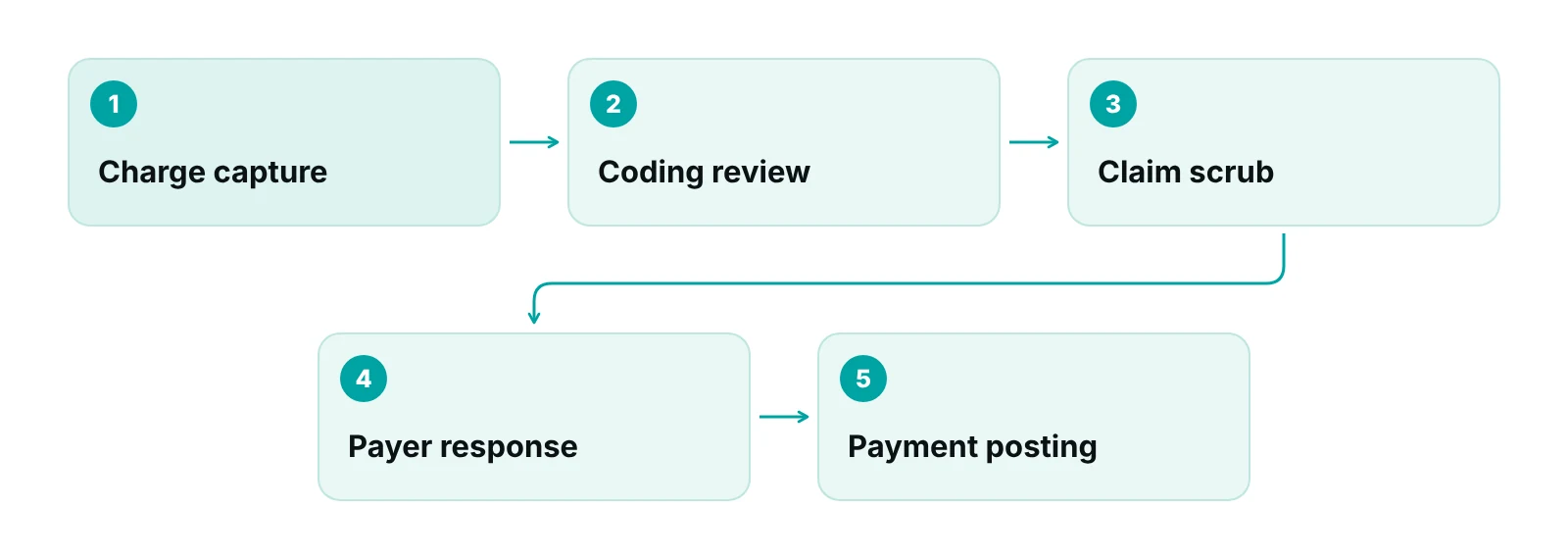
| Step | What adds value | Common waste | Measure to track |
|---|---|---|---|
| Charge capture | Complete, accurate charge from the visit | Late charges; missing documentation | Days from visit to charge entry |
| Coding review | Codes that match the documentation | Rework after a coder query goes unanswered | Share of charges sent back to a provider |
| Claim scrub and submit | Required data present before the claim leaves | Rejections for missing or invalid fields | Share of claims accepted on first submission |
| Payer response | A decision on the claim | Repeated manual status checks | Days from submission to adjudication |
| Payment posting and follow-up | Correct posting; owner assigned to every unpaid claim | Unowned balances; duplicate follow-up | Age of the oldest unworked item |
Source: RCM Finder template for discussion. Steps and measures are suggestions to adapt to your own workflow.
Fill in the "wait" time between each pair of steps with real dates from ten recent claims. Most teams find that a claim spends more time waiting than being worked. That is the finding lean is built to surface, and it points to fixes that are cheaper than adding staff.
Separate rejections, denials and rework
A rejected claim is one the payer never accepted for processing. A denied claim was processed and not paid. They need different fixes, and mixing them up hides where the waste starts.
Medicare offers a clear example. Noridian, a Medicare contractor, explains that unprocessable claims are most easily spotted by claim adjustment reason code CO-16, "claim/service lacks information which is needed for adjudication." Appeal rights do not apply to them. The supplier corrects the claim and submits it as new (Noridian Medicare). If your team writes appeals for what is really a missing-information problem, that is extra-processing waste. Our guide to the CO-16 denial code explains what the code usually means in practice.
| Problem | What happened | Usual fix | Lean question |
|---|---|---|---|
| Rejection / unprocessable claim | Payer or clearinghouse stopped the claim at intake | Correct the data and resubmit; no appeal | Can we catch this before submission? |
| Denial | Claim processed and not paid | Check the reason code; appeal or correct, depending on cause | Why is the same reason code recurring? |
| Underpayment | Paid, but less than the contract expects | Compare to the expected amount; dispute | Do we know the expected amount? |
| Internal rework | Claim held or sent back inside the practice | Fix the handoff that caused it | Who owns this step, and what do they need? |
Source: Noridian Medicare (unprocessable claims and CO-16). Remaining rows are general billing practice and vary by payer.
Count each category separately for a month. You will usually find that a short list of causes produces most of the rework. Our guides to clean claims and claim scrubbing cover the checks that catch these defects early, and denial management covers what to do with the ones that get through.
“Fix the step that creates the error. Fixing the error every time it appears only makes the same work permanent.”
Start with one defect, not a program
The most common reason lean efforts fade is scope. A practice announces a transformation, trains everyone and loses momentum in a month. A better start is a single defect type, owned by one person, reviewed weekly.
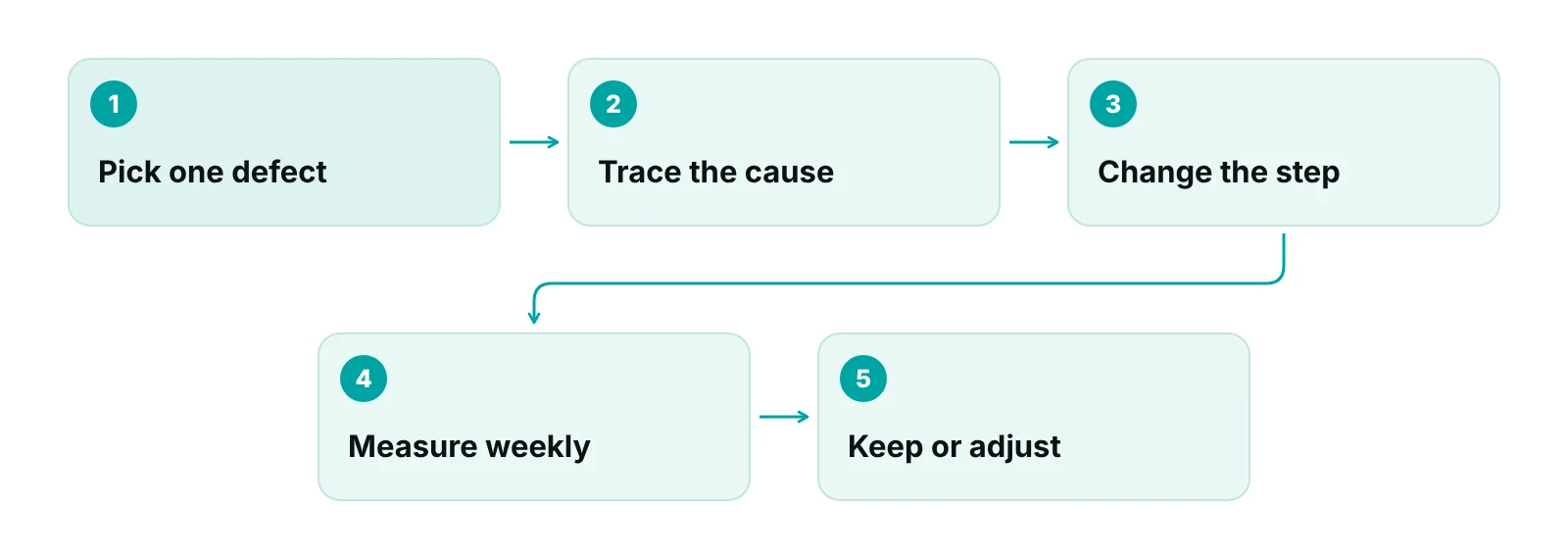
- Pick one recurring defect. Choose the rejection or denial reason that appears most often in your last 60 to 90 days of claims.
- Trace it to the step that created it. Ask the person who made the entry, not only the person who found the error. The cause is usually a handoff or a missing field, not carelessness.
- Change the step. Add a required field, a checklist item or a rule that holds the claim until the data is present.
- Measure weekly. Track the count of that defect and the share of claims accepted on first submission.
- Keep or drop the change, then pick the next defect. This plan, do, check, act loop is the continuous improvement part of lean.
Measures need clear definitions or the team will argue about the numbers instead of the work. Our guide to revenue cycle KPIs defines the common ones. Agree on the definition first, then watch the trend.
Cut motion and waiting in status checks and follow-up
Status checks are a common source of motion and waiting waste, and they are measurable. The CAQH Index, an industry benchmark of administrative transactions, estimated the savings from moving a medical claim status inquiry from fully manual to fully electronic at $16.65 per transaction, and an eligibility and benefit inquiry at $15.09, using calendar-year 2020 data (2021 CAQH Index slides). Those are industry-wide averages from 2020, so use them to see the order of magnitude, not to forecast your own savings.
A simple illustration shows why small times add up. Suppose a billing team checks the status of 400 claims a month and 40 of them need a second look because the first answer was incomplete. At 15 minutes each, that is 10 hours of repeat work, before any fix is made. The numbers are invented to show the arithmetic. Count your own.
The fix is rarely more effort. It is a rule: every unpaid claim has an owner and a next-check date, and the claim does not need to be looked at before then. A practice management system that tracks claims by stage with owners, workflow rules and underpayment flags makes that rule easy to follow. It is a claims system, not an EHR, so it works alongside the EHR you already use.
Balances that are old enough to need dedicated attention are a separate job. Our accounts receivable guide covers aging and follow-up in detail.
Where lean efforts go wrong in billing
- Borrowing results from other settings. Hospital case studies often describe clinical flow, such as wait times or discharge. They do not predict billing results. Measure your own claims.
- Blaming people instead of steps. If staff expect blame, they hide errors, and you lose the data lean depends on.
- Cutting checks that prevent defects. A pre-submission check can look like extra-processing, yet it often costs far less than the rework it prevents. Judge a check by the defects it catches.
- Measuring too many things. Three measures that the team reviews every week beat fifteen that nobody opens.
- No owner. A change that belongs to everyone belongs to no one.
Specialty also matters. Rules, modifiers and documentation needs differ across fields, so the most frequent defect in a cardiology practice may not be the one in a behavioral health practice. See how this plays out in our specialty billing pages.
When to bring in outside help
A small team can run the steps above alone. Outside help makes sense when billing staff have no time to look at the process because they are busy working the backlog. A review of your claim data can find the repeating defects quickly, and a medical billing service can take over steps that keep generating rework. If you want to see what a month of unpaid claims could be worth, the revenue calculator is a starting point.
Want a second look at your claim workflow?
Our free practice audit reviews where claims stall, which rejection and denial reasons repeat, and who owns each step. Pricing for any service is quoted after the audit.
Our recommendations
- Map one claim type first. We recommend drawing the path of a single common claim, with real dates for each wait, before changing anything.
- Count rejections and denials separately. They have different causes and different fixes. A combined number hides where the problem begins.
- Choose one defect and one owner. Name the person responsible and review the count weekly for at least a month before moving on.
- Fix the creating step. Add a required field, checklist item or hold rule where the error starts, not where it is found.
- Give every unpaid claim an owner and a next-check date. This removes repeated status checks and shows which items are overdue.
- Keep checks that catch defects. Review each check by what it catches. Remove only those that find nothing.
A practice management system built around claims, not charts.
RCM Finder's portal tracks every claim by stage with an owner, applies workflow rules to hold or advance claims, and flags underpayments against expected amounts. It is a claims system, not an EHR.
See how the RCM Finder portal works · Create a portal account
Disclosure: RCM Finder builds and sells this portal. It is a practice management system, not an EHR.
Bottom line
Lean medical billing starts with seeing your own claims clearly: where they wait, where they bounce and who owns the next step. Fix one defect, measure it, then pick the next. If rejections and denials keep returning, our denial management services and a free practice audit can show which steps cause them.
Frequently asked questions
What is lean in medical billing?
Lean in medical billing is a way of removing steps and handoffs that do not help a claim get paid. It focuses on getting claims right the first time, shortening the waits between steps and giving each open claim an owner. It is a working method, not a software product.
What are the eight wastes of lean in a billing office?
They are defects, overproduction, waiting, non-utilized talent, transportation, inventory, motion and extra-processing. In billing, defects are claim errors, waiting is work sitting between steps, inventory is unworked backlog, and extra-processing is repeated or unneeded steps such as re-keying data.
What is a value stream map for a claim?
It is a simple diagram of each step a claim passes through, who does it and how long the claim waits between steps. Build it from real dates on ten or so recent claims for one claim type. The longest gaps point to the first things to fix.
Is a rejected claim the same as a denied claim?
No. A rejected claim never entered the payer’s processing because of a data problem, so it is corrected and resubmitted. A denied claim was processed and not paid, and may be appealed or corrected depending on the reason. Track them separately because the causes differ.
Do I need Six Sigma or lean certification to start?
No. The first steps need only a map of one claim, a list of the repeating defects and a weekly review. Training can help later, but a small team can begin with the steps in this post and its own claim data.
Will lean reduce my denials?
It can, when you trace recurring denial reasons to the step that causes them and change that step. No result is guaranteed, and it depends on your payers, specialty and starting point. Measure your own first-pass acceptance and denial reasons before and after.
Get your free practice audit
Tell us about your practice. We will contact you using the details you give.
- A review of your recent claims, denials and A/R aging
- Where your front desk and prior authorizations slow payment
- A prioritized fix list you keep, whether or not you hire us
Pricing is quoted after the audit, based on your volume and the services you choose. Prefer to talk? Call +1 (302) 556-2288.
Sources
- Best Care at Lower Cost: The Path to Continuously Learning Health Care in America (summary) — American Hospital Association (2012)
- The 8 Wastes of Lean Manufacturing — TechSolve (n.d.)
- Lean Management course outline — American Hospital Association (2019)
- Reminder – Unprocessable (Return/Reject) Claims Must Be Resubmitted — Noridian Healthcare Solutions (Medicare) (2017)
- 2021 CAQH Index webinar slides — CAQH (2021)
Disclaimer: This article is educational and is not legal, coding or compliance advice. Payer rules and reason codes vary by payer and change over time; confirm current requirements with each payer or your compliance advisor.
