
The obstructive sleep apnea ICD-10 code is G47.33, a billable code in the FY 2027 ICD-10-CM that covers adults and children. Other sleep apnea types use the rest of G47.3: G47.30 for unspecified, G47.31 for primary central and G47.39 for other. Excludes1 notes bar pairing G47.33 with apnea NOS (R06.81) or Cheyne-Stokes breathing (R06.3).
Sleep apnea claims look simple: one common code, one study, one device. The trouble is the nine-code family around it, the Excludes1 notes that block certain pairs, and the sleep testing codes that have to agree with the diagnosis. This guide covers which G47.3 code to report, the exclusion rules, and the revenue cycle checks around sleep testing. Code details follow the CMS FY 2027 ICD-10 page and the FY 2027 ICD-10-CM Official Guidelines, which apply to encounters from October 1, 2026 through September 30, 2027.
Key takeaways
- G47.33 is the FY 2027 ICD-10-CM code for obstructive sleep apnea, adult or pediatric.
- G47.3 is a category. Nine billable codes sit under it, and G47.30 is for a type that is not documented.
- G47.3 has Excludes1 notes for apnea NOS (R06.81), Cheyne-Stokes breathing (R06.3), pickwickian syndrome (E66.2) and newborn sleep apnea (P28.3-).
- Sleep study codes and payer policy need to agree with the diagnosis on the claim.
- The FY 2027 set applies to encounters from October 1, 2026 through September 30, 2027.
G47.33 is the code for obstructive sleep apnea, adult or pediatric
G47.33 is the ICD-10-CM code for obstructive sleep apnea. Its descriptor reads obstructive sleep apnea (adult) (pediatric), so one code covers both age groups. The FY 2027 tabular entry on ICD10Codes marks it billable, and the AAPC code reference shows the same descriptor.
The clinical phrase obstructive sleep apnea hypopnea is listed at G47.33, so a note that uses it still points to the same code. CMS lists the FY 2027 code files for encounters from October 1, 2026 through September 30, 2027 (CMS ICD-10 codes page). In the FY 2027 change list we reviewed, no G47.3 code was added, deleted or revised, so the family reads the same as the year before.
Three notes to check before you report G47.33
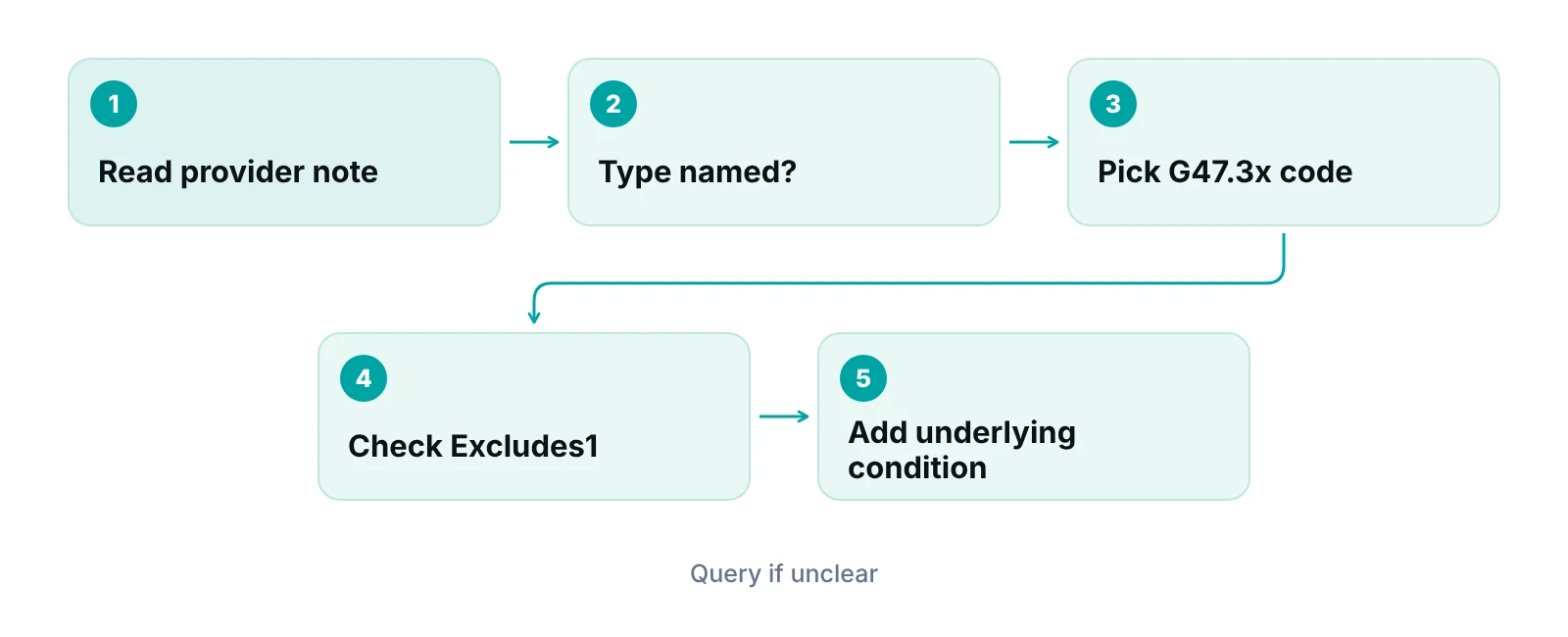
First, G47.33 has an Excludes1 note for obstructive sleep apnea of newborn (P28.3-). Second, the parent G47.3 has Excludes1 notes for apnea NOS (R06.81), Cheyne-Stokes breathing (R06.3), pickwickian syndrome (E66.2) and sleep apnea of newborn (P28.3-) (tabular entry for G47.3). Third, G47.3 says to code any associated underlying condition. Under Section I.A.12.a of the FY 2027 Official Guidelines, an Excludes1 note means the two codes are not reported together unless the conditions are unrelated. If it is unclear whether they are related, query the provider.
The code also note is not a sequencing rule. Section I.A.17 of the guidelines states that a code also note does not provide sequencing direction, so it does not tell you which diagnosis goes first on the claim.
The G47.3 family has nine billable codes, and only one is obstructive
G47.3 itself is a non-billable category. The nine codes under it are billable in the FY 2027 set, and G47.33 is the only one whose descriptor names obstructive sleep apnea. The rest describe an unspecified type, central apnea, altitude-related breathing, hypoventilation or another type.
| Code | Descriptor | What to remember on the claim |
|---|---|---|
| G47.30 | Sleep apnea, unspecified | For sleep apnea with no type documented. Ask whether the type is known. |
| G47.31 | Primary central sleep apnea | A central type. It is not a substitute for G47.33. |
| G47.32 | High altitude periodic breathing | Altitude-related breathing pattern, not obstructive. |
| G47.33 | Obstructive sleep apnea (adult) (pediatric) | Covers adults and children. Excludes1 for obstructive sleep apnea of newborn (P28.3-). |
| G47.34 | Idiopathic sleep related nonobstructive alveolar hypoventilation | A hypoventilation code, not an obstructive apnea code. |
| G47.35 | Congenital central alveolar hypoventilation syndrome | A hypoventilation syndrome, not an obstructive apnea code. |
| G47.36 | Sleep related hypoventilation in conditions classified elsewhere | The descriptor points to an underlying condition. G47.3 says to code any associated underlying condition. |
| G47.37 | Central sleep apnea in conditions classified elsewhere | A central type tied to an underlying condition, not obstructive. |
| G47.39 | Other sleep apnea | For a documented type that has no code of its own. |
Source: ICD10Codes, ICD-10-CM FY 2027 tabular entry for G47.3 (reviewed October 2026); descriptors cross-checked on AAPC and HCC Buddy.
Two points catch teams out. First, G47.30 is for sleep apnea with no type documented. Section I.A.9 of the guidelines says to use unspecified codes when the record does not hold enough detail for a more specific one. So G47.30 is correct when the note is silent, but it is also a prompt to ask the provider whether the type is known.
Second, G47.34, G47.35 and G47.36 describe hypoventilation, and G47.31 and G47.37 describe central sleep apnea. None of them is a synonym for obstructive sleep apnea. They should not be picked because they sit near G47.33 in a pick list.
The wording in the provider note decides which code you report
The provider’s diagnostic statement decides the code, not the sleep study alone. The table below maps common wording to the code and shows the exclusion note that applies.
| Provider documents | Report | Why |
|---|---|---|
| Obstructive sleep apnea or OSA | G47.33 | The descriptor names obstructive sleep apnea for adults and children. |
| Obstructive sleep apnea hypopnea | G47.33 | Listed as a clinical term at G47.33. |
| Sleep apnea, no type stated | G47.30 | Unspecified code. Query the provider if the type may be known. |
| Primary central sleep apnea | G47.31 | A different type. G47.33 does not apply. |
| Apnea only, with no sleep apnea stated | R06.81 | G47.3 has an Excludes1 note for apnea NOS (R06.81). |
| Cheyne-Stokes breathing | R06.3 | G47.3 has an Excludes1 note for Cheyne-Stokes breathing (R06.3). |
| Pickwickian syndrome | E66.2 | G47.3 has an Excludes1 note for pickwickian syndrome (E66.2). |
| Obstructive sleep apnea of newborn | P28.3- | Excludes1 at both G47.33 and G47.3 for newborn sleep apnea. |
Source: ICD10Codes, ICD-10-CM FY 2027 tabular entries for G47.3 and G47.33; CMS FY 2027 ICD-10-CM Official Guidelines, Section I.A.12.a.
Combined cases need care. When the provider documents OSA together with another condition, G47.3 tells you to code any associated underlying condition, and the Excludes1 list tells you which pairs cannot appear together unless they are unrelated. If the note leaves the relationship unclear, query the provider rather than choosing for them. Section I.A.12.a supports that step.
Children and newborns
The descriptor at G47.33 includes pediatric, so a child with documented obstructive sleep apnea does not need a different code. A newborn is the exception. The P28.3- Excludes1 note moves obstructive sleep apnea of newborn out of G47.33.
“A sleep apnea claim is only as strong as the sentence in the note that names the type. I would rather send the provider one question than guess between G47.30 and G47.33. – Awais Afzal”
— Awais Afzal, Healthcare Operations & Data Analyst
Sleep study and CPAP codes must agree with the diagnosis on the claim
A G47.33 claim rarely travels alone. The diagnosis is usually reported alongside a sleep study and then CPAP start-up or management. The American Academy of Sleep Medicine (AASM) publishes a sleep medicine codes page that lists the common ones, and it notes that some insurers accept the HCPCS G-codes for home testing while others accept certain CPT codes. Confirm each payer’s policy.
| Code | In plain words | Where it fits |
|---|---|---|
| 95810 | Attended polysomnography for age 6 and older, with sleep staging and four or more additional parameters | In-lab diagnostic study |
| 95811 | Same as 95810, plus CPAP or bilevel therapy started during the study | In-lab study with device titration |
| 95806 | Unattended study recording heart rate, oxygen level, airflow and breathing effort | Home testing, where the payer accepts it |
| G0398 | Home sleep test with a type II portable monitor, at least 7 channels | Home testing, where the payer accepts G-codes |
| G0399 | Home sleep test with a type III portable monitor, at least 4 channels | Home testing, where the payer accepts G-codes |
| G0400 | Home sleep test with a type IV portable monitor, at least 3 channels | Home testing, where the payer accepts G-codes |
| 94660 | CPAP ventilation, initiation and management | Starting and managing CPAP |
Source: American Academy of Sleep Medicine, Sleep Medicine Codes page (last modified September 20, 2024). Descriptions paraphrased; CPT descriptors belong to the AMA.
Use your licensed CPT book for the official wording, and check these codes against the current year’s code set. The AASM page was last modified in September 2024 and carries no note about 2026 or 2027 changes.
What the Medicare CPAP coverage rule asks for
For Medicare beneficiaries, National Coverage Determination 240.4 sets the conditions for CPAP coverage in adults with OSA. These points come from the Medicare Coverage Database entry, version effective March 13, 2008.
- Coverage starts with a 12-week trial, and continues only for patients who benefit from CPAP.
- Diagnosis needs a clinical evaluation plus a positive attended polysomnography in a sleep lab, or an unattended home sleep test with a type II, III or IV monitor. A type IV monitor must measure at least 3 channels.
- The treating physician must order the sleep test, and it must be done under appropriate physician supervision.
- The event index (AHI or RDI) must be 15 or more events per hour, or 5 to 14 events per hour with documented excessive daytime sleepiness, impaired cognition, mood disorders or insomnia, or documented hypertension, ischemic heart disease or a history of stroke.
- The CPAP provider must educate the patient on correct use before use begins.
Treat this as a documentation checklist
The Medicare Coverage Database page marks this as an older version and tells readers to check the latest one. Medicare contractors and commercial payers may add their own rules, so read the payer’s current policy before you bill.
Where sleep apnea claims go wrong in the revenue cycle
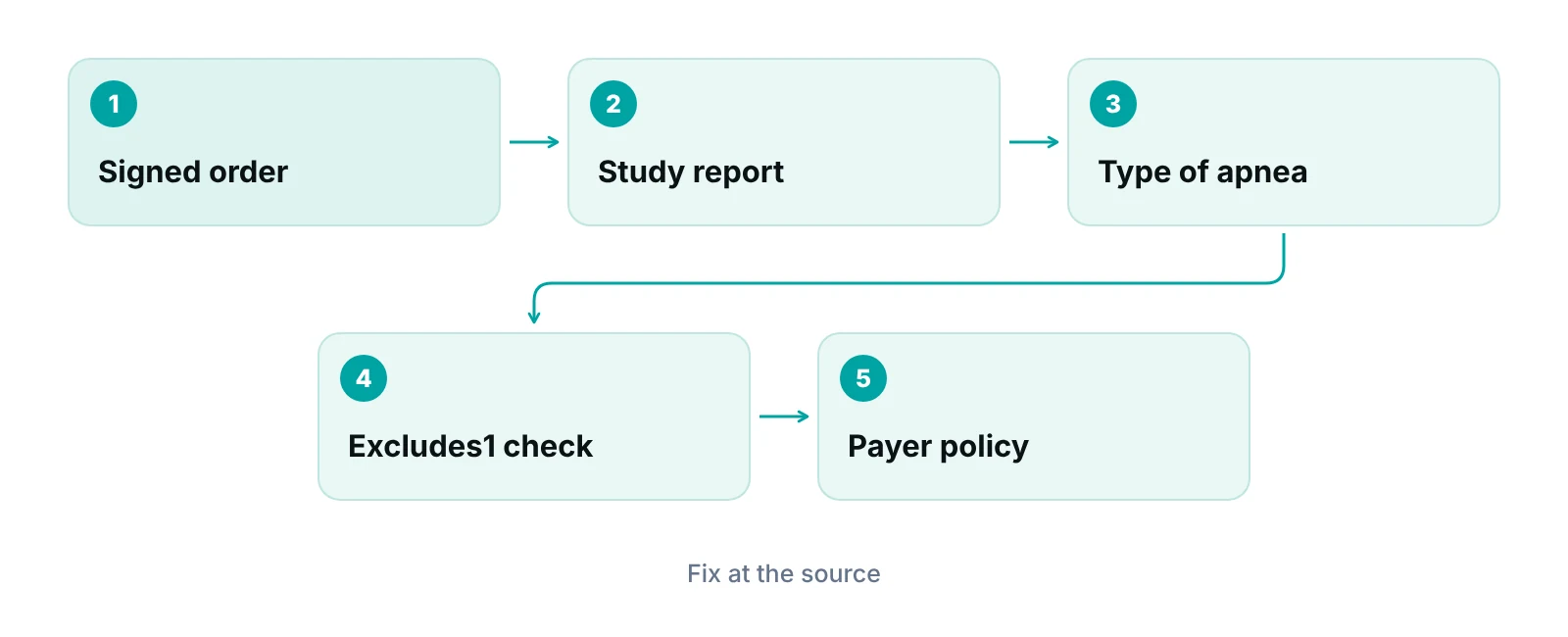
The risk is rarely G47.33 itself. It is a mismatch between the order, the study, the report and the claim. A short check at each point keeps the diagnosis and the procedure telling the same story.
- Order. The test order is signed by the treating provider and names the suspected condition. Medicare requires the treating physician to order the sleep test.
- Study. The report shows which kind of study was done, so the CPT or G-code billed matches what was performed.
- Diagnosis. The note names the type of sleep apnea, so you can report G47.33 and not default to G47.30.
- Exclusion check. No pair on the claim is blocked by an Excludes1 note, such as R06.81 with G47.33.
- Payer policy. Check the payer’s sleep testing and CPAP rules, including whether it accepts home test G-codes or certain CPT codes, and whether it asks for authorization first. Our prior authorization guide covers that step.
If your practice runs a sleep program inside a pulmonary practice, our pulmonology billing specialty page explains how specialty billing patterns are handled. For the coding and claim side, our medical billing and coding support team works from the provider’s documentation and queries when it is unclear.
A check like this fits into claim review before submission. Our guide to claim scrubbing explains how those edits work. If your practice or supplier also bills the CPAP device, the guide to DME coding, HCPCS modifiers and ICD-10 covers that side.
Want a second set of eyes on your sleep claims?
Send us a sample of recent sleep study claims. We will review how the order, study and diagnosis line up and show you where the gaps are. The audit is free, and pricing is quoted afterward.
The code set changes each October, so name the fiscal year
ICD-10-CM is released by fiscal year. The FY 2027 set applies to encounters from October 1, 2026 through September 30, 2027, so a new set will apply after that date. The NCHS FY 2027 file listing includes the code descriptions, tabular and index files, and an addenda file that shows what changed.
Re-check the G47.3 family each October. In the change list we reviewed, FY 2027 left the family unchanged, but that can differ in a future year.
Related sleep and respiratory codes sit elsewhere. The G47 category has an Excludes2 note for nonorganic sleep disorders (F51.-), nightmares, sleep terrors and sleepwalking, which means those conditions can be reported with a G47 code when appropriate (Section I.A.12.b). Our insomnia ICD-10 coding guide covers the other common sleep diagnosis, and the COPD ICD-10 guide covers a frequent respiratory neighbor. For the basics of how code sets differ, see CPT, ICD-10 and HCPCS codes explained and HCPCS vs CPT in medical billing.
Our recommendations
- Make the type of sleep apnea a required field. We ask providers to name the type in the note, such as obstructive or central. One word is the difference between G47.33 and G47.30.
- Use G47.30 only when the note is silent. Unspecified is a correct code for an incomplete note, but we treat it as a query trigger, not a default.
- Keep the G47.3 exclusions on a short card. R06.81, R06.3, E66.2 and P28.3- are the four Excludes1 targets at G47.3. A coder who sees them in the claim review catches blocked pairs before submission.
- Match the test code to the study that was done. Compare the report to the code billed. Then check whether the payer wants CPT codes or G-codes for home sleep tests.
- Keep a Medicare CPAP documentation checklist. Use the NCD 240.4 points as a prompt: ordering physician, test type, event index and the 12-week trial. Confirm the current version before relying on it.
- Re-check the family every October. Open the new addenda, search for G47.3 and note the fiscal year in your coding reference.
Bottom line
G47.33 is the right code when the provider documents obstructive sleep apnea. Use G47.30 when the type is missing and query before you settle on it, respect the Excludes1 notes at G47.3, and keep the sleep study code and payer policy in step with the diagnosis. If you want help building those checks into your workflow, our denial management services team can trace recurring diagnosis denials back to their source. You can contact us or use the revenue calculator to see what rework costs your practice.
Frequently asked questions
What is the ICD-10 code for obstructive sleep apnea?
The ICD-10-CM code for obstructive sleep apnea is G47.33. Its descriptor reads obstructive sleep apnea (adult) (pediatric), so it applies to adults and children. It is listed as billable in the FY 2027 code set, which applies to encounters from October 1, 2026 through September 30, 2027.
Is G47.3 a billable code?
No. G47.3 is a category. You report one of the nine codes under it: G47.30, G47.31, G47.32, G47.33, G47.34, G47.35, G47.36, G47.37 or G47.39. For obstructive sleep apnea, the specific billable code is G47.33. Claims that list only G47.3 are reporting a category, not a valid billable diagnosis code.
Which code do I use if the type of sleep apnea is not documented?
G47.30, sleep apnea, unspecified, is the code for sleep apnea with no type documented. The guidelines say to use unspecified codes when the record lacks detail. Before you settle on it, check whether the provider can state the type, because G47.33 describes a different condition.
Can I report G47.33 with R06.81 or Cheyne-Stokes breathing?
Not normally. G47.3 has Excludes1 notes for apnea NOS (R06.81) and Cheyne-Stokes breathing (R06.3). An Excludes1 note means the codes are not reported together unless the conditions are unrelated. If the relationship is unclear, query the provider.
Does G47.33 apply to children?
Yes. The descriptor includes both adult and pediatric patients. The exception is a newborn: G47.33 and G47.3 both have Excludes1 notes for obstructive sleep apnea of newborn, which is coded in category P28.3-.
Which sleep study codes go with a G47.33 claim?
It depends on the study. Common ones are 95810 and 95811 for in-lab polysomnography, 95806 and G0398, G0399 or G0400 for home testing, and 94660 for starting CPAP. Payers differ on which home test codes they accept, so confirm each payer’s policy.
Get your free practice audit
Tell us about your practice. We will contact you using the details you give.
- A review of your recent claims, denials and A/R aging
- Where your front desk and prior authorizations slow payment
- A prioritized fix list you keep, whether or not you hire us
Pricing is quoted after the audit, based on your volume and the services you choose. Prefer to talk? Call +1 (302) 556-2288.
Sources
- ICD-10 Codes (FY 2027 files and effective dates) — CMS (2026)
- FY 2027 ICD-10-CM Official Guidelines for Coding and Reporting — CMS / NCHS (2026)
- G47.3 Sleep apnea (FY 2027 tabular entry) — ICD10Codes (2026)
- G47.33 Obstructive sleep apnea (adult) (pediatric) — ICD10Codes (2026)
- ICD-10-CM Code G47.33 — AAPC (2026)
- G47.33 FY 2027 code page — HCC Buddy (2026)
- ICD-10-CM changelog FY 2027 — HCC Buddy (2026)
- ICD10CM FY 2027 file listing — CDC / NCHS (2026)
- National Coverage Determination 240.4: CPAP Therapy for Obstructive Sleep Apnea — CMS Medicare Coverage Database (2008)
- Sleep Medicine Codes — American Academy of Sleep Medicine (2024)
Disclaimer: This article is general educational information for practice owners and managers. It is not legal, coding, compliance or medical advice. Code sets, guidelines and payer policies change; verify codes against the current ICD-10-CM release, the current CPT and HCPCS code sets, and your payers' rules before billing.
