
The jaundice ICD-10 code for an unspecified case is R17, Unspecified jaundice. It does not apply to newborns, which use the perinatal codes P55 and P57-P59. If a cause such as a liver disease is documented, code that diagnosis instead. Hyperbilirubinemia has no single code.
The jaundice codes are spread across four chapters, and a few of the widely shared lists contain wrong titles. This guide is for coders, billers and practice managers. It shows which code family to open first, how Excludes1 notes stop bad pairings, and what the provider’s note must say. It is general education, not coding advice for a specific claim.
Key takeaways
- R17 is the code for unspecified jaundice, and it is not used for newborns.
- Newborn jaundice is coded in the perinatal chapter (P55, P57-P59), by documented cause.
- Hyperbilirubinemia is an index lookup; inherited bilirubin disorders sit in E80, such as E80.4 for Gilbert syndrome.
- When a liver diagnosis explains the jaundice, code the liver condition from K70-K77, not R17.
- K71.90 is not a valid code; the unspecified toxic liver disease code is K71.9.
What is the jaundice ICD-10 code, and when does R17 apply?
The general jaundice code is R17, Unspecified jaundice. It sits in the symptoms and signs chapter of ICD-10-CM, in the block for digestive system and abdomen symptoms (R10-R19). R17 is a complete code with no extra characters, and it is the right choice only when the provider documents jaundice and has not named a cause or a more specific condition.
R17 has a hard stop built in. Its Excludes1 note says neonatal jaundice is not reported with R17 and is classified to P55 and P57-P59 instead. So the first question on any jaundice claim is the patient’s age: is this a newborn, or is it a child or adult? The code set that applies today is the FY 2027 release, which the CDC lists with an October 1, 2026 effective date (CDC/NCHS ICD-10-CM files).
Jaundice is a sign, not a disease. It is the yellow colour of skin and eyes that appears when bilirubin builds up. A coder cannot pick a cause from that colour, and must not guess one. Everything below is about reading the note, finding what the provider actually documented, and matching it to the right part of the code book.
Keep the clinical and the coding questions apart
This post explains how the codes are organised. It does not say what causes jaundice in any patient or how to treat it. The diagnosis always comes from the provider’s documentation; coders and billers work from that.
Which code family fits the documentation?
Four families cover most jaundice-related claims: the symptom code (R17), newborn codes (P55-P59), inherited bilirubin metabolism codes (E80) and liver disease codes (K70-K77). The table matches what the note says to the family you should open in the Tabular List.
| What the provider documents | Code family to check | Key rule from the code book |
|---|---|---|
| Jaundice with no cause or related diagnosis stated, patient is not a newborn | R17 Unspecified jaundice | R17 Excludes1: neonatal jaundice (P55, P57-P59) |
| Jaundice in a newborn | P55-P59, by documented cause | Newborn jaundice is classified to the perinatal chapter, not R17 |
| Gilbert syndrome, Crigler-Najjar syndrome or another bilirubin metabolism disorder | E80.- (for example E80.4, E80.5, E80.6, E80.7) | E80 is titled disorders of porphyrin and bilirubin metabolism |
| Jaundice with a named liver condition such as toxic liver disease or cirrhosis | K70-K77, the specific liver diagnosis | K70-K77 Excludes1: jaundice NOS (R17) |
| Jaundice and a lab value only, with no diagnosis | Ask the provider before coding | Do not infer a diagnosis from a result |
Source: ICD-10-CM code descriptors and notes as published on AAPC Codify, Veroscribe (FY 2027), icd-10codes.com and the ICD-10-CM edition 23 tabular list; confirm against the CDC FY 2027 Tabular List.
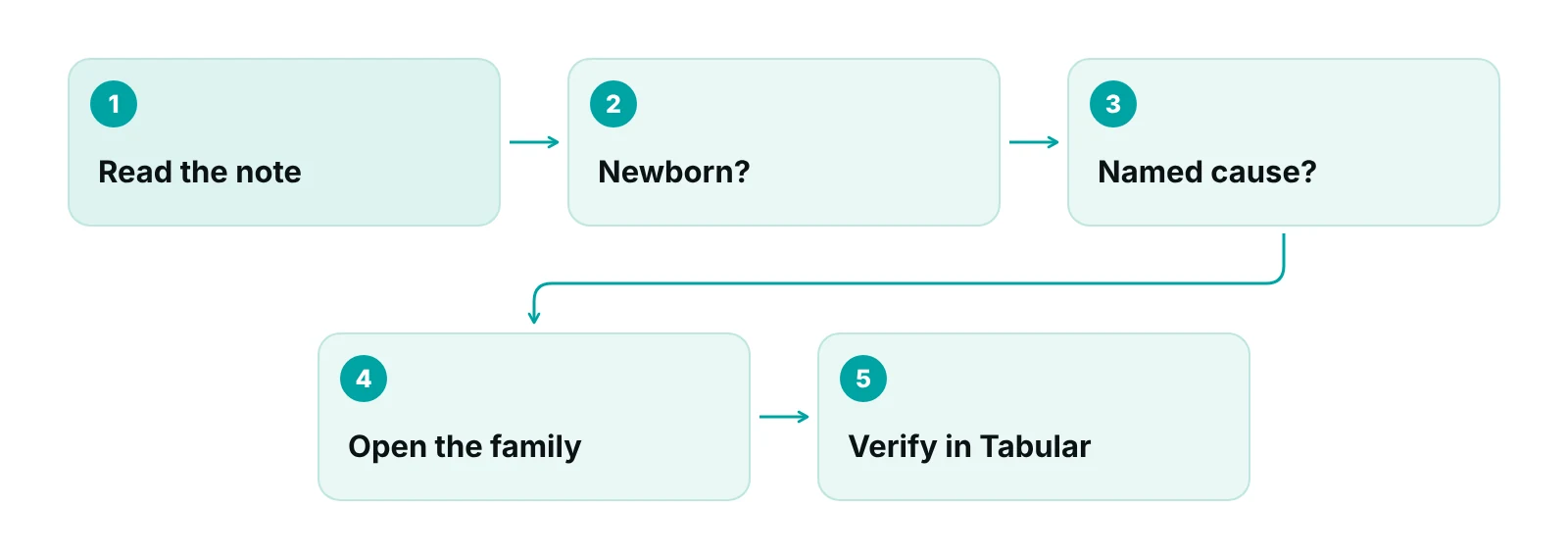
The last row of the table matters most for front-end teams. A bilirubin result in the chart is not a diagnosis. If the note says only “jaundice” or “icterus” and nothing else, R17 may be right. If it says something broader or narrower, send a documentation query before the claim goes out.
What codes apply to newborn jaundice?
Newborn jaundice is coded in the perinatal chapter, mainly P55, P57, P58 and P59, not with R17. Which one depends on the documented cause. This is the area where many generic code lists fall short, and it is the one a pediatric or newborn-care practice needs to get right. See our pediatric billing support page if your practice sees newborns.
| Code | Short meaning | Codes within it | Note from the code book |
|---|---|---|---|
| P55 | Hemolytic disease of newborn | P55.0 Rh isoimmunization, P55.1 ABO isoimmunization, P55.8 other, P55.9 unspecified | Header code; choose the full code |
| P57 | Kernicterus | P57.0 due to isoimmunization, P57.8 other specified, P57.9 unspecified | Header code; kernicterus is excluded from P59 |
| P58 | Neonatal jaundice due to other excessive hemolysis | P58.0 bruising, P58.1 bleeding, P58.2 infection, P58.3 polycythemia, P58.4 drugs or toxins, P58.5 swallowed maternal blood, P58.8 other specified, P58.9 unspecified | Excludes1: jaundice due to isoimmunization (P55-P57) |
| P59 | Neonatal jaundice from other and unspecified causes | P59.0 preterm delivery, P59.1 inspissated bile syndrome, P59.3 breast milk inhibitor, P59.8 other specified, P59.9 unspecified | Excludes1: kernicterus (P57.-) and jaundice due to inborn errors of metabolism (E70-E88) |
Source: ICD-10-CM P55, P57, P58 and P59 as listed by Rapidclaims, AAPC Codify and icd-10codes.com (FY 2026-2027 listings). P59.2 has more specific child codes and is left out of this table; look it up in the Tabular List.
Two practical points follow. First, P59.9, Neonatal jaundice, unspecified is the catch-all when no cause is documented, so a good note moves the claim up to P58 or P59.0-P59.8 where it applies. Second, the Excludes1 notes stop contradictory pairs. Kernicterus is not reported with P59, and jaundice from isoimmunization (P55-P57) is not reported with P58, unless the provider documents the conditions as unrelated.
Gilbert syndrome (E80.4), Crigler-Najjar syndrome (E80.5) and Dubin-Johnson syndrome (E80.6) are listed in an Excludes1 note for the whole P50-P61 block. They are inherited bilirubin disorders and are coded from the endocrine and metabolic chapter, not as newborn jaundice.
“Age on the date of service decides the first fork in a jaundice claim. Check it before choosing any code.”
How is hyperbilirubinemia coded?
There is no single hyperbilirubinemia code. The word on its own is an index lookup, not an instruction. The Alphabetic Index sends you to a code based on any modifier the provider documents, such as neonatal or inherited. Then you confirm the code in the Tabular List.
For inherited or metabolic bilirubin disorders, the category is E80, Disorders of porphyrin and bilirubin metabolism. The bilirubin-related codes in that category are:
- E80.4 Gilbert syndrome
- E80.5 Crigler-Najjar syndrome
- E80.6 Other disorders of bilirubin metabolism
- E80.7 Disorder of bilirubin metabolism, unspecified
E80.0-E80.3 cover porphyria and enzyme defects and are not jaundice codes. If a provider documents Gilbert syndrome, E80.4 describes the diagnosis itself, so you would not add R17 to repeat the same finding. If the note describes hyperbilirubinemia without any cause and the index offers no better fit, query the provider rather than choosing E80.7 by default.
A related lab-coding question is how to link a bilirubin or liver panel to a diagnosis. Our guides on ICD-10 codes for lab review and the CBC ICD-10 code show how to match a test to a documented reason for ordering it.
What changes when jaundice comes with liver disease?
When the provider documents a liver diagnosis that explains the jaundice, you code that diagnosis from K70-K77, not R17. The whole K70-K77 range carries an Excludes1 note for jaundice NOS (R17), and the same principle appears in the Official Guidelines: symptoms that routinely accompany a disease are not coded separately unless the classification says so (Section I.B.5, FY 2027 guidelines).
Some liver codes are often mixed up with jaundice codes. The table lists the ones that cause the most trouble, with the titles as published.
| Code | Title as published | Common mistake |
|---|---|---|
| K70.30 | Alcoholic cirrhosis of liver without ascites | Read as a jaundice code; the title has no jaundice wording |
| K71.0 | Toxic liver disease with cholestasis | Missed as the drug-related cholestasis code |
| K71.9 | Toxic liver disease, unspecified | Written as K71.90, which is not a valid code |
| K74.60 | Unspecified cirrhosis of liver | Described as “cirrhosis with jaundice” |
| K76.7 | Hepatorenal syndrome | Confused with drug-induced cholestasis |
| K76.9 | Liver disease, unspecified | Used when a more specific diagnosis is documented |
Source: ICD-10-CM K71 (icd-10codes.com, FY 2027 listing); K70.30, K74.60, K76.7 and K76.9 titles from the ICD-10-CM edition 23 tabular list; K74.60 billable status per Pabau. Confirm in the current Tabular List.
The K71 category also has two instructions worth knowing. It includes drug-induced liver disease, and it says to use an additional code for the adverse effect of the drug (T36-T50, with 5 as the fifth or sixth character) where applicable. The same category also carries a code first note for poisoning. Both need the provider to document the drug and whether the event was an adverse effect or a poisoning.
Do not carry old code lists forward without checking. A list with the wrong title next to a valid-looking code will pass a quick scan and still produce a denial or a diagnosis that does not match the chart. The coding audit guide covers how to sample your own claims for that kind of error.
When should a practice use R17 and when should it not?
Use R17 when jaundice is the only thing documented and no cause has been confirmed. Do not add it when a definitive diagnosis that accounts for the jaundice is on the claim. The FY 2027 Official Guidelines (Section I.B.4) accept symptom codes when a related definitive diagnosis has not been established by the provider.
- First visit, cause not yet known: R17 can be the reason for the encounter.
- Follow-up after a diagnosis is made: code the diagnosis the provider documents, not the symptom.
- Two codes that seem to disagree: look for an Excludes1 note before you submit. If the provider documents unrelated conditions, the note allows both.
The Official Guidelines also have a section on symptom codes together with a confirmed diagnosis (I.C.18.b), which this post did not review in full. Read it in the current guidelines if your practice treats jaundice often.
What documentation and claim checks prevent jaundice denials?
Most jaundice coding errors start in the note, not the code book. The provider needs to record the patient’s age group, the cause if it is known, and whether the jaundice is a sign, a diagnosis or a lab finding. A coder can do the rest. Our guide to clear documentation in medical billing goes into how to set that up.
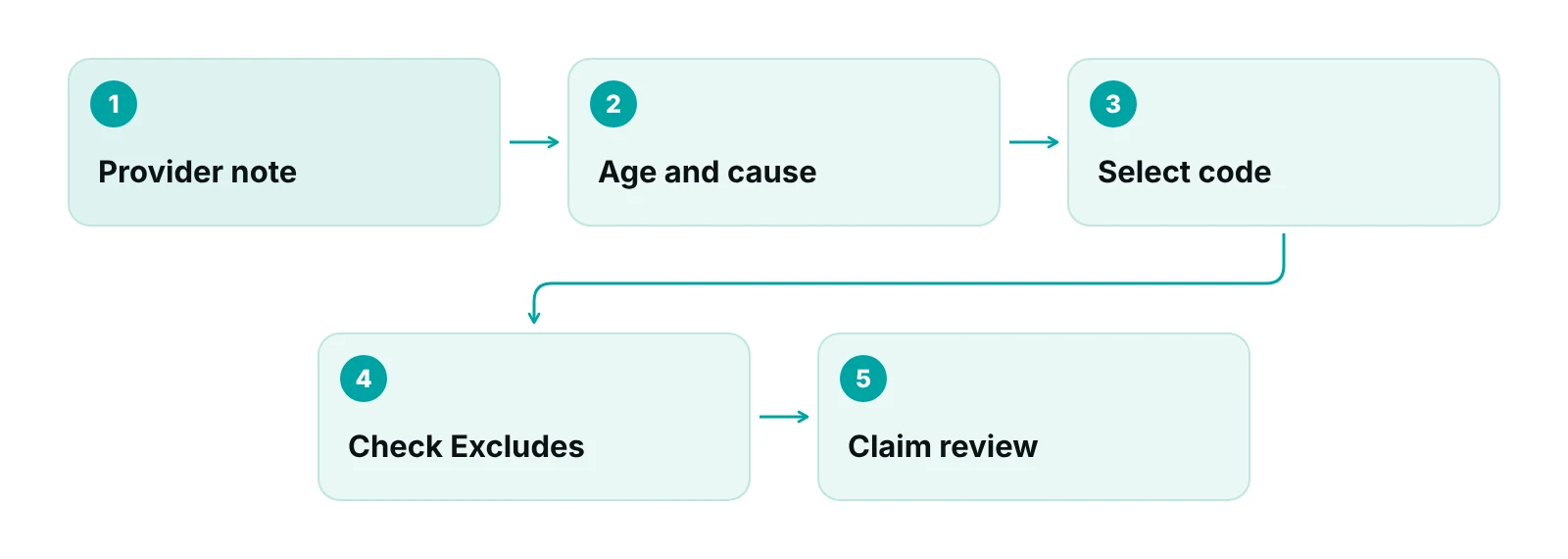
- Confirm the age group before coding. A newborn does not use R17.
- Find the documented cause. If none, use the unspecified code and consider a query.
- Read the Excludes1 notes for each code before you pair them.
- Check the full code length against the Tabular List, so a header code does not go out as if it were complete.
- Match the diagnosis to the service. A lab, imaging or visit code should have a diagnosis that supports why it was done.
A claim that fails these checks may be rejected before the payer sees it, or denied after. A scrub step catches the structural problems; a person has to resolve the clinical ones. See how clean claims are built for the scrubbing side.
Want a second look at your coding workflow?
Our free practice audit reviews how your diagnosis codes move from the note to the claim, including query steps and denial patterns. Pricing for any service is quoted after the audit.
How often do the codes change?
The ICD-10-CM code set is updated every year with an October 1 effective date, and a smaller update can follow in April. The CDC publishes a release folder for FY 2027 (effective October 1, 2026) and, for FY 2026, an October 2025 release plus an April 1, 2026 update. Tabular List titles and notes can change, so a code list copied from an old blog post or a printed cheat sheet is a risk.
Build one habit: after each October release, check the codes you use most against the new Tabular List, update your superbill or EHR pick lists, and tell your billers and front-desk staff what changed. Our general explainer on CPT, ICD-10 and HCPCS codes shows how the three code sets fit together on a claim. For payer-side denials from a diagnosis mismatch, read the denial management guide.
If you want hands-on help with coding review, claim submission or denials, see our medical billing services. For practices that serve children, our post on pediatric billing challenges covers the collections side.
Our recommendations
- Make age the first question. Add a check so any jaundice diagnosis on a patient in the newborn period routes to a perinatal code review rather than R17.
- Retire old code lists. Replace any printed or saved list of jaundice codes with one built from the current Tabular List, and note the fiscal year on it.
- Query instead of guessing. Write a short query template for notes that say only jaundice, hyperbilirubinemia or elevated bilirubin so coders ask the provider for the cause.
- Check Excludes1 notes before pairing codes. Train coders to read the notes at the category and block level, since the R17 and K70-K77 rule sits at the range level.
- Review one month of jaundice claims each October. After each code set update, pull a sample of claims with these codes and check the titles, code length and denial reasons.
Bottom line
Pick the code family from the patient’s age and the documented cause, check the Excludes1 notes, and confirm the full code in the current Tabular List. If coding errors and denials are eating staff time, a denial management service can review the claims and the root causes, or start with a free practice audit or talk to us.
Frequently asked questions
What is the ICD-10 code for jaundice?
The general code is R17, Unspecified jaundice. It applies when jaundice is documented without a cause or a related diagnosis and the patient is not a newborn. If a cause such as a liver condition is documented, code that diagnosis from the proper chapter instead. Always confirm the code in the current Tabular List.
What ICD-10 code is used for newborn jaundice?
Newborn jaundice is not coded with R17. R17 has an Excludes1 note for neonatal jaundice (P55, P57-P59). The right code depends on the documented cause. P59.9 is the unspecified option when no cause is recorded, while P55, P57 and P58 cover hemolytic disease, kernicterus and excessive hemolysis.
Is there one ICD-10 code for hyperbilirubinemia?
No. Hyperbilirubinemia is a lookup in the Alphabetic Index, and the answer depends on the modifier the provider documents. For inherited or metabolic disorders of bilirubin the category is E80, for example E80.4 for Gilbert syndrome. Newborn cases go to the perinatal codes. If the cause is not documented, ask the provider.
Can I report R17 with a liver disease code?
Usually not. The K70-K77 range has an Excludes1 note for jaundice NOS (R17), so the two are generally not reported together unless the provider documents them as unrelated. The Official Guidelines also say that symptoms that routinely accompany a disease are not coded separately.
Does K71.90 exist as an ICD-10 code?
No. The code for toxic liver disease, unspecified is K71.9, with no fifth character. The category also has more specific codes, such as K71.0 for toxic liver disease with cholestasis. Check the full list before choosing, and add a drug adverse-effect code where the note supports it.
How often should I check my jaundice codes?
At least once a year. ICD-10-CM updates take effect on October 1, and a smaller update can follow in April. Review the codes your practice uses most after each release, and replace any saved lists with ones built from the current Tabular List.
Get your free practice audit
Tell us about your practice. We will contact you using the details you give.
- A review of your recent claims, denials and A/R aging
- Where your front desk and prior authorizations slow payment
- A prioritized fix list you keep, whether or not you hire us
Pricing is quoted after the audit, based on your volume and the services you choose. Prefer to talk? Call +1 (302) 556-2288.
Sources
- ICD-10-CM files (FY 2027 and FY 2026 release folders) — CDC / NCHS (2026)
- ICD-10-CM Official Guidelines for Coding and Reporting, FY 2027 — CDC / NCHS (2026)
- ICD-10-CM R17 Unspecified jaundice — AAPC Codify (n/d)
- R17 (FY 2027 ICD-10-CM) — Veroscribe (2026)
- P59 Neonatal jaundice from other and unspecified causes — icd-10codes.com (2026)
- P58 Neonatal jaundice due to other excessive hemolysis — AAPC Codify (n/d)
- P57 Kernicterus — Rapidclaims ICD-10-CM codebook (n/d)
- P55 Hemolytic disease of newborn — Rapidclaims ICD-10-CM codebook (n/d)
- E80 Disorders of porphyrin and bilirubin metabolism — icd-10codes.com (2026)
- K71 Toxic liver disease — icd-10codes.com (2026)
- ICD-10-CM tabular list K70-K77 (edition 23) — Skyscape / ICD-10-CM (n/d)
- ICD-10 code K74.60 — Pabau (n/d)
Disclaimer: This post is general educational information about ICD-10-CM code families. It is not coding, clinical, legal or compliance advice. Code titles and rules change each fiscal year and payers apply their own policies. Always confirm codes against the current official Tabular List and Alphabetic Index, and rely on the provider's documentation.
