
The CO-24 denial code means the payer says the charges are covered under a capitation agreement or managed care plan. It is a wrong-payer problem, not a medical necessity denial. To fix it, confirm who covered the patient on the date of service, then bill that plan.
Many guides online define reason code 24 as a medical necessity denial. That is wrong, and following that advice sends staff to write appeals that cannot work. This guide explains what CO-24 means, how to tell it from look-alike codes, and a practical order of steps for fixing and preventing it.
Key takeaways
- CO-24 means charges are covered under a capitation agreement or managed care plan.
- Medical necessity is reason code 50, not 24.
- On Medicare claims, the usual cause is a Medicare Advantage patient billed to Original Medicare.
- Check eligibility for the date of service, then rebill the responsible plan.
- Most CO-24 denials start at registration, so ask about new plans at every visit.
What the CO-24 denial code means
Reason code 24 reads “Charges are covered under a capitation agreement/managed care plan.” That is the wording in the MassHealth CARC memo (February 2025). The payer is telling you that someone else, a managed care plan or a capitated arrangement, is responsible for these charges, so it will not pay them on this claim.
On a remittance, the code has two parts. CO is the group code, which marks a contractual obligation. 24 is the reason code. Read both, then read any remark codes on the same line. They often help you work out which plan or arrangement the payer has on file.
Capitation, in plain terms, is an arrangement where a plan or provider group is paid in advance to cover a patient’s care, instead of paying claim by claim. When a patient sits inside one of those arrangements, a claim sent to the wrong place has no one to pay it.
CO-24 is not a medical necessity denial
A common mix-up is to read CO-24 as “the payer says the service was not needed.” It is not. Medical necessity is reason code 50, worded “these are non-covered services because this is not deemed a ‘medical necessity’ by the payer” in the same MassHealth memo. An appeal that argues medical necessity will not fix a CO-24 denial, because the problem is where the claim was sent.
CO-24 versus the codes it gets confused with
Several codes look alike on a busy remittance. Sorting them first keeps staff from chasing the wrong fix. The wording below is the standard text for each code.
| Code | Standard meaning | What it points to | First thing to check |
|---|---|---|---|
| 24 | Charges are covered under a capitation agreement/managed care plan | Wrong payer or capitated arrangement | Which plan covered the patient on the date of service |
| 50 | Non-covered services because not deemed a medical necessity by the payer | Clinical coverage criteria | Documentation and the payer’s coverage policy |
| 22 | This care may be covered by another payer per coordination of benefits | Payer order | Which plan is primary |
| 16 | Claim/service lacks information or has submission/billing error(s) | Missing or wrong claim data | The remark code on the line |
| 197 | Precertification/authorization/notification/pre-treatment absent | Missing authorization | Whether authorization was required and obtained |
| 31 | Patient cannot be identified as our insured | Identity or member ID | Name, date of birth and member ID on the claim |
Source: MassHealth, CARC Code Memo (February 2025). The right-hand columns are our plain-language reading, not payer text.
If your remittance shows CO-22 instead, the issue is payer order, covered in our CO-22 denial code guide. If it shows CO-16, start with the CO-16 denial code guide. For a missing authorization, see the CO-197 denial code guide. For the wider picture of how denials are grouped and worked, read the guide to understanding medical billing denials.
Why payers send CO-24
The most common cause on Medicare claims is simple: the patient is in a Medicare Advantage (MA) plan, and the claim went to Original Medicare. First Coast Service Options, a Medicare Administrative Contractor, describes it this way on its CO 24 prevention page (June 2026). The beneficiary enrolled in an MA plan, which replaces Original Medicare for that patient, and the claim was sent to Medicare instead of the plan. Medicare returns it as unprocessable with CO-24.
The same page names a second cause. For end-stage renal disease (ESRD) dialysis, a patient may be covered under a capitation agreement, so the charges belong to the capitation arrangement and not to a standard fee-for-service claim.
- New or changed plan. The patient switched to an MA plan, often at a plan-year change, and the practice still has the old Medicare record.
- Card on file is out of date. Staff scanned a red, white and blue Medicare card and did not ask about a plan card.
- Retroactive enrollment. Enrollment records can change after the visit, so a claim that was correct on the day it was sent can later land in the wrong place.
- Capitated arrangement. The service falls under a capitation agreement, so it must be handled through that arrangement.
- Payer-specific rules. Other payers, including Medicaid and commercial plans, use the same code. The code text is general, so read that payer’s own guidance.
| Situation | What the remittance suggests | First move |
|---|---|---|
| Patient moved to a Medicare Advantage plan | Claim went to Original Medicare and came back unprocessable | Confirm the plan for the date of service, then bill the plan |
| Patient was not in a plan on that date | Medicare records may have been updated since | Resubmit to Medicare if its records now show no plan |
| Dialysis patient under a capitation agreement | Charges belong to the capitated arrangement | Contact the capitation provider and follow its process |
| Other payer sends CO-24 | Code text is general | Read that payer’s own guidance and remark codes |
Source: First Coast Service Options, CO 24 prevention page (June 2026); table layout is RCM Finder’s reading.
Retroactive enrollment is not a new problem. A CMS transmittal from 2006 explains that Original Medicare payments for periods when a beneficiary was actually enrolled in a managed care plan are identified and recovered, and providers are directed to the plan for payment. It also notes that the remittance carries adjustment reason code 24 in this case.
How to fix a CO-24 denial, step by step
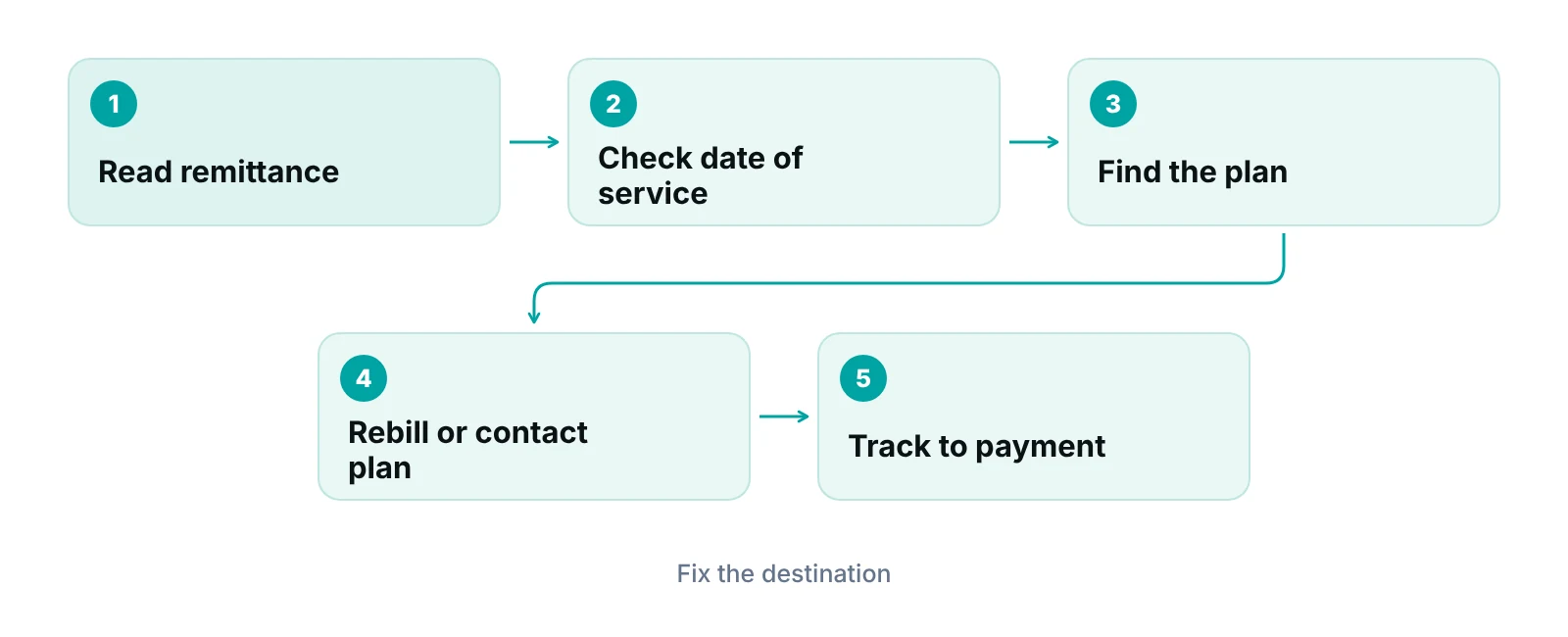
Start with the facts, not the appeal. A CO-24 denial is a routing problem, so the repair is almost always to find the right payer and bill it.
- Read the full line. Confirm the group code, reason code 24 and any remark codes. Note the date of service.
- Check coverage for the date of service. Run an eligibility check for the exact date the service was provided, not today’s date. Coverage can change between visits.
- Identify who is responsible. If the patient was in an MA plan, the plan is the payer. If the service is under a capitation agreement, find the capitated entity and what it requires.
- Look at the card and the record. Compare what the patient showed with what the practice management system holds. Update the record and keep a copy of the eligibility response.
- Rebill the correct payer. Send the claim to the plan, following that plan’s claim rules, forms and filing limits. Do not simply resend the same claim to the same payer.
- If Medicare records now show no MA plan on that date, resubmit to Medicare. First Coast says that is the case in which a claim returned with CO-24 can be sent again.
- Track it. Log the denial, the cause and the new payer, and watch the rebilled claim until it pays.
Be careful with the word “appeal.” First Coast states that claims returned as unprocessable cannot be appealed. Medicare’s own process for unprocessable claims is to correct and resubmit, not to ask for a review. Other payers have their own rules and deadlines, so check the plan’s provider manual and your contract before assuming an appeal route exists. The Noridian Medicare Part B contractor publishes a similar notice titled Claims Denying Contractual Obligation (CO)-24: Charges covered under a Capitation Agreement/Managed Care Plan.
Do not bill the patient yet
Until you know which plan owes the charge, hold patient statements for the denied amount. A balance billed too early on a CO line can create a patient complaint and a refund task. Payer and contract rules differ, so confirm with the payer before moving any amount to patient responsibility.
Seeing the same denial codes month after month?
A free practice audit reviews your denial reports and shows which causes repeat and where in the process they start. There is no obligation.
Where CO-24 denials really begin: the front end
Most CO-24 denials are created at registration, days or weeks before a claim is sent. The billing team sees the denial, but the front desk can usually prevent it. Verifying insurance at the right moments is the cheapest control you have.
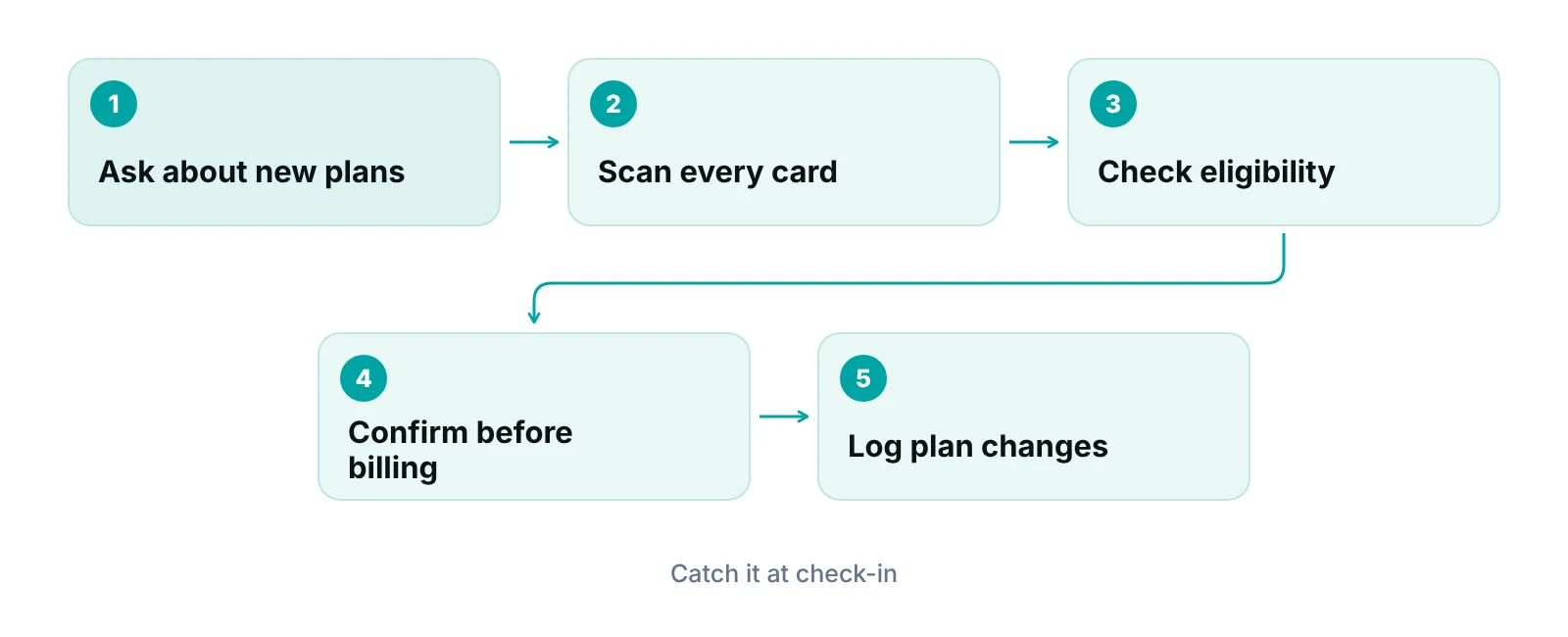
First Coast’s prevention advice is plain and practical. It tells providers to verify eligibility and benefits before rendering services, ask patients whether they have recently enrolled in any new health insurance plans, request copies of all of the patient’s insurance cards, and check eligibility again before submitting claims to Medicare. For ESRD patients, it advises verifying eligibility before dialysis and contacting the capitation provider before the service if a capitation agreement applies. The full list is on its prevention page.
We cover the mechanics of these checks in our patient insurance verification guide. Because a patient can carry more than one policy, the explanation of coordination of benefits in medical billing is also worth sharing with registration staff. Practices that struggle to staff these checks sometimes use a virtual medical assistant for the front desk to handle eligibility work, which is a staffing choice, not a requirement.
Who should own each part of the fix
A denial that belongs to no one stays open. Naming an owner for each step is the simplest way to stop the same wrong-payer claim from returning.
| Role | Prevention task | When |
|---|---|---|
| Front desk | Ask about new plans, scan all cards, run eligibility for the visit date | Every visit, not only the first |
| Biller | Check eligibility again before submitting, work CO-24 lines, rebill the right payer | Before claim release and on each remittance |
| Practice manager | Review CO-24 volume by payer and by registration point, give feedback | Monthly |
| Owner or administrator | Decide on tools and staffing for eligibility checks | Quarterly or at plan-year change |
Source: RCM Finder recommended practice. This is operational advice, not a payer requirement.
If a pattern shows up, such as one location or one staff member sending the most wrong-payer claims, fix the process there. Retraining the whole team rarely helps as much as repairing one weak handoff.
Where CO-24 shows up in specialty practices
The code can appear in any specialty, but it is especially relevant for dialysis and kidney care because of the capitation point in First Coast’s guidance. Practices in nephrology billing should check eligibility before each dialysis session and confirm whether a capitation agreement applies. Practices serving older adults, where MA enrollment is common, also see more plan switches at the start of a plan year.
A short rule that works in any specialty: if the patient is on Medicare, ask for every card they carry, and ask whether they enrolled in anything new this year.
“The cheapest denial to fix is the one that never leaves the front desk. A thirty-second question about new insurance can save a rebilling cycle.”
Track CO-24 denials so they do not repeat
Fixing one claim helps once. Tracking the cause helps every month. Log each CO-24 denial with its payer, the registration point, and the root cause, then review the list. Our guide to medical billing denial management explains how to build that routine, and the post on clean claims in medical billing shows how front-end checks fit into a clean-claim process.
A practice management system that tracks claims by stage gives each returned claim a status and an owner, so a rebill does not sit unnoticed. If your denial queue is large and your team is stretched, our denial management services cover denial follow-up, and you can use the revenue calculator to see how denied claims affect cash flow before you decide on anything.
Our recommendations
- Ask about new insurance at every visit. We recommend one standing question at check-in: have you enrolled in any new health plan this year? It takes seconds and catches most plan switches.
- Scan every card, front and back. For Medicare patients, ask for any plan card as well as the Medicare card, and keep the images in the record.
- Check eligibility for the date of service. Run the check for the visit date and again before the claim is released. Save the response in the patient file.
- Rebill, do not just appeal. For a wrong-payer denial, find the responsible plan and send it a correct claim. Use appeals only when the payer’s rules offer them.
- Hold patient statements until the payer is known. Confirm who owes the charge before moving any amount to the patient.
- Review CO-24 denials monthly by payer. A repeating pattern points to one weak step. Fix the step, not only the claim.
Returned claims need a stage and an owner.
RCM Finder’s portal tracks each claim by stage with a named owner, so a claim being rebilled to a managed care plan stays visible until it pays.
See how the RCM Finder portal works · Create a portal account
Disclosure: RCM Finder builds and sells this portal. It is a practice management system, not an EHR.
Bottom line
A CO-24 denial is a routing signal: the claim went to a payer that is not responsible, and the fix is to find the right one and bill it. If wrong-payer denials keep returning, look at where your front end lets them through. Our denial management services and medical billing services cover that work, and we start with a free practice audit.
Frequently asked questions
What does the CO-24 denial code mean?
It means the charges are covered under a capitation agreement or managed care plan. The standard wording is “Charges are covered under a capitation agreement/managed care plan.” In practice, the claim went to the wrong payer, and the responsible plan or capitated entity must be billed instead.
Is CO-24 a medical necessity denial?
No. Medical necessity is reason code 50. CO-24 is a payer-routing issue. Arguing medical necessity will not fix it. Confirm who covered the patient on the date of service, then bill that plan. Compare the reason code, the remark codes and the group code before choosing a fix.
Why does Medicare send CO-24 for a Medicare patient?
Usually because the patient is enrolled in a Medicare Advantage plan, which replaces Original Medicare for that patient, and the claim was sent to Medicare. First Coast Service Options describes this cause and also names capitated ESRD dialysis. The fix is to confirm the patient’s plan for the date of service and send the claim to that plan.
Can I appeal a CO-24 denial?
First Coast states that claims returned as unprocessable cannot be appealed. Correct and resubmit instead. Other payers set their own rules, so check the plan’s provider manual and your contract. An appeal is rarely the right first move for a wrong-payer problem, so look at the cause first.
How do I prevent CO-24 denials?
Ask patients about new health plans at every visit, copy every insurance card, and verify eligibility for the date of service before billing. For dialysis patients, check whether a capitation agreement applies before the service. Review denials monthly to find the weak step. Small habits at check-in, repeated every visit, prevent most wrong-payer claims before a biller ever sees them.
Should I bill the patient after a CO-24 denial?
Not until you know who owes the charge. A CO-24 line usually means another plan or arrangement is responsible. Hold the statement, confirm coverage, rebill the right payer, and check payer and contract rules before shifting any balance to the patient. A premature patient bill creates extra work if the plan later pays.
Get your free practice audit
Tell us about your practice. We will contact you using the details you give.
- A review of your recent claims, denials and A/R aging
- Where your front desk and prior authorizations slow payment
- A prioritized fix list you keep, whether or not you hire us
Pricing is quoted after the audit, based on your volume and the services you choose. Prefer to talk? Call +1 (302) 556-2288.
Sources
- Tips to prevent RUC CO 24 — First Coast Service Options (Medicare Administrative Contractor) (2026)
- CARC Code Memo (Denied & Adjusted CARCs) — MassHealth SENDPro (2025)
- Collection of Fee-for-Service Payments Made During Periods of Managed Care Enrollment (Transmittal 106) — CMS (2006)
- Claims Denying Contractual Obligation (CO)-24: Charges covered under a Capitation Agreement/Managed Care Plan — Noridian Healthcare Solutions (Medicare Administrative Contractor) (2026)
Disclaimer: This article is general education for practice owners and billing staff. It is not legal, coding or compliance advice. Payer rules, contracts and plan terms vary, so confirm the details with the payer or your own advisers before acting.