Dental billing and coding is the work of reporting each dental service with the right CDT procedure code, checking the patient's plan rules first, and sending a complete claim the plan can pay on the first pass. Most denials start at the front desk, not in the coding: missing eligibility checks, plan limits and incomplete records.
If your dental claims keep coming back unpaid, the cause is rarely one bad code. It is usually a plan rule nobody checked, a missing record or a claim nobody followed up. Below we explain the basics in plain words, then show where denials start.
Key takeaways
- CDT is owned and updated yearly by the ADA; code from the current manual, not from a copied table.
- Most dental denials start at the front desk: eligibility, plan limits, waiting periods and missing records.
- Alternate-benefit clauses can leave patients owing a gap; explain before treatment.
- Send complete claims on the right form or 837D, with the primary EOB on secondary claims.
- Whoever bills, sign a Business Associate Agreement first and track every claim by stage.
What is dental billing and coding?
Dental billing and coding is two jobs that depend on each other. Coding describes what was done, using the ADA’s procedure code set. Billing turns that description into a claim, sends it to the right payer, posts the payment and follows up on anything unpaid. A practice usually has two payers on one visit: the dental plan and the patient.
Dental claims use their own code set and their own claim form. This guide covers the basics, then the plan rules behind most denials, then who should run the work. For the specialty overview, see our page on billing support for dental practices.
How does CDT coding work?
CDT, short for Current Dental Terminology, is the code set used to report dental procedures. The American Dental Association (ADA) owns and maintains it, and federal HIPAA rules name it as the code set for dental services (45 CFR 162.1002). Every CDT procedure code on a claim starts with the letter D, followed by four digits (ADA claim form instructions).
The ADA updates CDT every year. Its Code Maintenance Committee agreed changes for CDT 2027 at a March 13, 2026 meeting, and its next meeting is set for March 4 to 5, 2027 (ADA). The 2026 edition applies to services provided from January 1 through December 31, 2026 (UnitedHealthcare Dental summary of CDT 2026 changes). A code that paid last year may be revised or retired this year.
Do not copy code lists from the web
The ADA holds the copyright on CDT and sells the code manual each year. The ADA says its free coding help is for members and for non-members who bought the current manual (ADA). Build your fee schedule and charge sheet from the current manual, not from an old blog table or a screenshot.
Codes are grouped into series by type of care, which tells you what documentation and plan rules to expect.
| Series | Type of care | What to check before you bill |
|---|---|---|
| D0xxx | Diagnostic (exams, imaging) | Plan limits on how often exams and images are covered; keep the images with the chart |
| D1xxx | Preventive | Age and frequency rules; whether the plan treats the visit as preventive or basic |
| D2xxx | Restorative (fillings, crowns) | Material, tooth number and surface; the plan may pay for a cheaper option |
| D3xxx | Endodontics | Tooth number, diagnosis and radiographs to support the need |
| D4xxx | Periodontics | Records that support the treatment; plan-specific coverage rules |
| D5xxx to D6xxx | Prosthodontics, implants, maxillofacial prosthetics | Replacement-history questions, waiting periods, predetermination before treatment |
| D7xxx | Oral and maxillofacial surgery | Whether the plan or a medical plan is primary for the service; narrative or report if required |
| D8xxx | Orthodontics | Orthodontic benefit rules and payment schedule; the claim form has its own orthodontic fields |
| D9xxx | Adjunctive general services | Wide mix of services; read the exact code rules before billing |
Source: series structure as printed in the AAPD reproduction of the ADA code set (2017 edition); descriptions and billing watch-points are our own wording. Confirm against the current CDT manual.
If a code’s rules call for a written description, the ADA glossary says that report must be kept in the patient record and sent with the claim (ADA glossary).
What are the steps of a dental claim?
A dental claim moves through five stages: verify benefits, plan the treatment, code it, send the claim with the right records, and post and follow up. Skipping the first stage is the most common cause of avoidable denials.
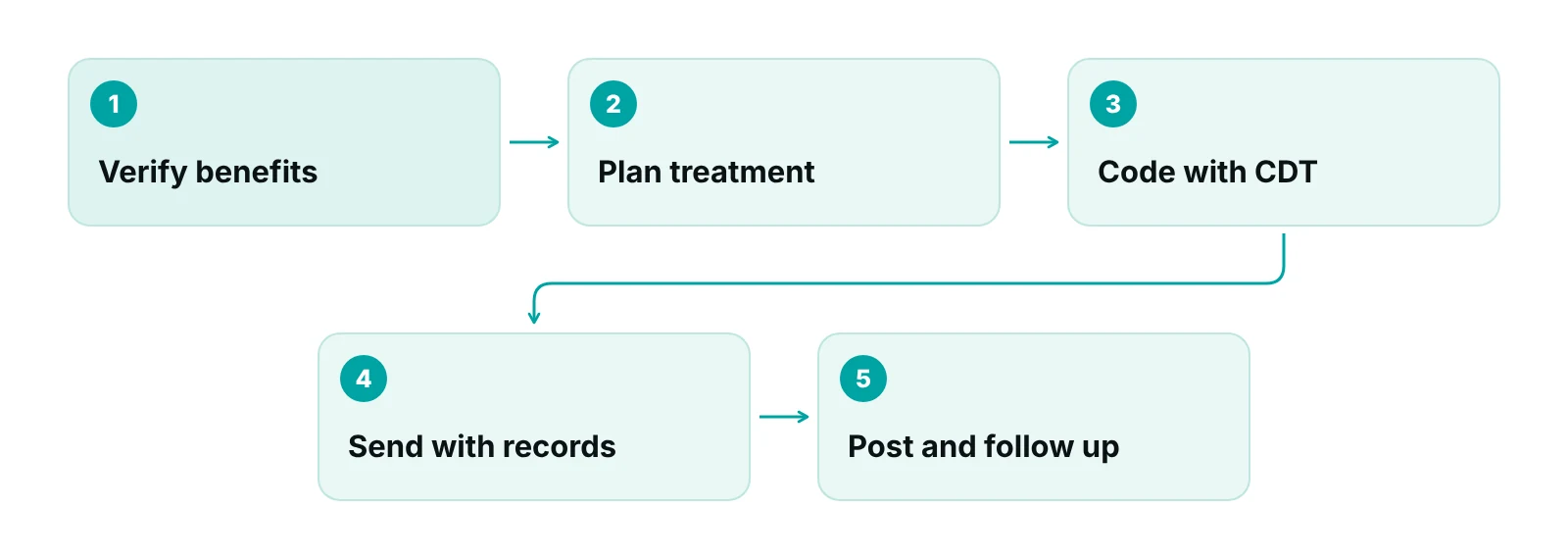
1. Verify benefits before the visit
Collect plan, subscriber and ID details at scheduling, then confirm coverage is active. Our insurance verification guide lists what to confirm on every call.
2. Plan the treatment and ask for a pre-estimate when it is large
A predetermination, also called a pretreatment estimate, is a treatment plan you send to the payer before treatment. The payer replies with eligibility, covered services, expected payment, copayments, deductibles and maximums. A preauthorization is different: it is the payer’s statement that the proposed treatment will be covered under the contract (ADA glossary). For the wider process, see our prior authorization guide.
3. Code each procedure with CDT
Assign the code from the clinical note, add the tooth number and surface where needed, and check the note supports the code.
4. Send the claim with the records the plan may ask for
Use the current ADA claim form format or its electronic equivalent, and attach what the payer’s rules require, such as images or a written report. Run a final check for blanks and mismatches before submission. Our guides to claim scrubbing and clean claims show what a pre-submission check should catch.
5. Post the payment and follow up on what is unpaid
Post what the plan paid, bill the patient only after the plan has finished processing, and work every unpaid or short-paid claim on a schedule. Our accounts receivable guide explains how to keep a follow-up routine going.
Which dental plan rules cause denials and short payments?
The rules that cause most surprises are the ones attached to the plan, not the code: how much the plan will pay in a year, what it will pay for when there is a cheaper option, and how it handles a second plan. The ADA’s own plain-language definitions are a good place to learn the terms.
| Term | What it means in plain words | What to do at the front desk |
|---|---|---|
| Maximum plan benefit and contract term | The most the plan will pay, and the period over which that limit applies. The ADA notes the term is usually 12 months. | Ask what the patient has already used before you quote a plan share |
| Deductible | What the patient pays before the plan begins paying benefits | Tell the patient at the visit, not after the EOB |
| Waiting period | The gap between enrollment and when a benefit becomes available | Ask about waiting periods for new members before booking major work |
| Alternate benefit or least expensive alternative treatment | The plan pays based on a cheaper substitute procedure | Explain options and likely patient cost before treatment |
| Downcoding and bundling | The plan processes a different, lower-paying code, or combines separate procedures | Compare the EOB with what you billed; appeal when the record supports your code |
| Coordination of benefits | How two plans share payment so total payments do not exceed 100% of charges | Bill the primary plan first, then send the secondary claim with the primary EOB |
Source: ADA glossary of dental administrative terms and ADA News, ‘dental benefit terms’ (2026); ADA claim form instructions for the secondary-claim EOB step. Practice tips are our own.
A worked example: the cheaper-option rule
The ADA gives a simple example of an alternative-treatment clause. A dentist places a composite filling with a $90 allowed fee. The plan processes it as an amalgam filling with a $60 allowed fee and pays 80% of $60, which is $48. The patient pays the $12 copay plus the $30 difference between the two fees, so $42 in total. The dentist still collects the full $90 (ADA, least expensive alternative treatment clause).
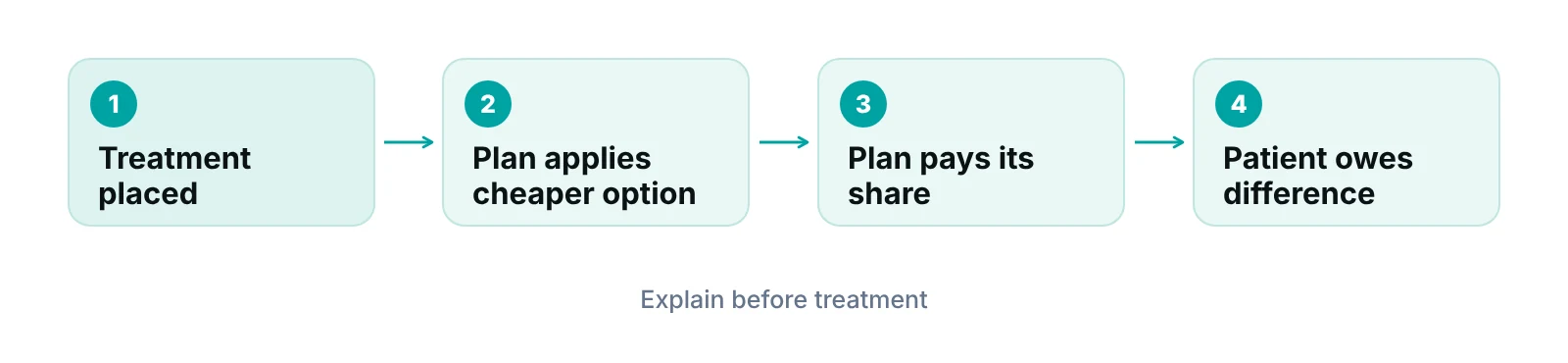
The ADA advises dentists to explain the treatment options and to tell the patient when this kind of clause may raise their cost, and to consider a pre-estimate and a written informed consent that lists costs (ADA).
Plans differ on how often they cover the same service. Ask the plan for the rule, or find it in the provider manual, and note it in the patient’s chart.
What does a dental claim need to carry?
A dental claim needs the patient and subscriber details, one line per procedure with the date, tooth information and CDT code, the fee, and the billing and treating provider details. The ADA publishes a standard claim form, and its 2024 version is the current version it lists, along with completion instructions (ADA Dental Claim Form page).
Electronic dental claims follow a different standard from medical ones. Federal rules adopt the ASC X12 837 Dental transaction (version 5010) for dental health care claims (45 CFR 162.1102). Your software handles that file, but you still decide what goes into each field. The ADA’s instructions cover these points on the paper form, and the same information is needed electronically (ADA form instructions):
- Choose whether the form is a statement of actual services or a request for predetermination or preauthorization.
- Check the box for other dental or medical coverage, and fill in the other-coverage fields when it applies.
- Report one tooth number per claim line, with the surface where relevant.
- Start each procedure code with D, and enter the fee as the usual charge to the general public multiplied by the units billed.
- Add diagnosis codes only when the diagnosis may affect how the claim is adjudicated.
- For a secondary claim, attach the primary payer’s EOB showing what it paid.
- Give the billing dentist and treating dentist their own National Provider Identifier (NPI), and the tax ID that matches the billing NPI.
- If there are more procedures than lines, send a separate, complete claim.
Use the current ADA instructions and your payer’s own claim rules as the final authority.
How do you cut dental claim denials?
Cut denials by fixing the cause that repeats. Pull the last 90 days of denied and short-paid claims, group them by reason, and fix the biggest group first. The groups usually fall into four buckets: eligibility and plan limits, coding and claim data, missing records, and follow-up gaps.
Under many state prompt-payment laws, a clean claim is one sent on the carrier’s standard form with current codes and all fields complete enough to process, and interest on late payment applies to clean claims (ADA glossary). So send complete claims, keep proof of when you sent them, and work them on a schedule.
- Before the visit: confirm active coverage, the plan’s maximum benefit used so far, and any waiting period.
- At treatment planning: send a pre-estimate for larger work, and explain any cheaper-option clause to the patient.
- Before submission: check the CDT code against the current year’s manual, the tooth and surface, the dates and the provider IDs.
- With the claim: include the records or written report the code and the plan require.
- After submission: track every claim by stage, and set a date to call when a claim goes quiet. Our denial management guide covers appeals.
“In our experience, a missed eligibility check costs far more time than a coding mistake, because it shows up weeks later as a surprise bill. We would fix the front end first.”
— Awais Afzal, Healthcare Operations & Data Analyst
See where your claims are leaking
Send us a sample of recent dental denials and short payments, and we will point out the patterns. Pricing is quoted after the audit.
Who should run dental billing: your team, a partner, or both?
The right choice depends on where the work breaks down, not on practice size alone. A practice with a steady biller and few plans can stay in house; one with growing volume, many plans or turnover may do better with a partner or a split.
| Option | Fits when | Watch out for |
|---|---|---|
| In house | One or two experienced staff, stable systems, few plans, low turnover | One absence stops claims; training and CDT updates depend on one person |
| Outsourced billing | Backlog in claims or A/R, many plans, no time to follow up | Needs clear reporting, a signed Business Associate Agreement and a named contact; you still own patient communication |
| Hybrid | Front desk handles benefits and patient talk; a partner handles claims, denials and A/R | Hand-offs must be written down: who verifies, who codes, who calls the plan |
If your front desk is the bottleneck, a dental virtual assistant can take over scheduling calls, intake and benefit checks. If the claims themselves are the problem, our medical billing services cover charge entry, claims and follow-up. Dental surgery done in a surgery center brings its own rules, and our guide to ASC billing services, including dental cases explains that setting.
Whoever does the work, you need to see where every claim sits. A practice management system that tracks claims by stage gives each claim an owner and shows what is waiting on the plan. It is a claim-centred system, not an electronic health record.
What to ask any billing partner about patient data
A billing company that handles patient information is a business associate under HIPAA, so you need a written Business Associate Agreement before any data moves. HHS says that agreement should set out how the associate may use the information, require safeguards, require it to report unauthorized use or breaches, bind any subcontractors to the same limits, and cover return or destruction of the data when the contract ends (HHS sample business associate provisions). Ask who can see your patient data and how access is logged.
Our recommendations
- Verify benefits before every new treatment plan. Check active coverage, the maximum used so far and any waiting period before booking major work.
- Keep this year's CDT manual at the desk. Codes change every year. Whoever codes should work from the current edition, and the team should review the yearly change list before January.
- Script the cheaper-option conversation. Give the front desk two sentences that explain how an alternate benefit can raise a patient’s share, and a pre-estimate habit for larger work.
- Group your denials by cause every month. Count them by reason: eligibility, coding, missing records, follow-up. Fix the biggest group first rather than appealing each claim by hand.
- Write down who owns each hand-off. Whether billing is in house or outsourced, name the person who verifies, who codes, who sends and who calls the plan. Our revenue calculator can help you estimate what unpaid claims cost your practice.
Track every dental claim by stage, with an owner.
RCM Finder's practice management portal shows where each claim sits, who owns it, which claims are missing data before submission and which payments look low against the expected amount. It is a claim-centred system, not an EHR.
See how the RCM Finder portal works · Create a portal account
Disclosure: RCM Finder builds and sells this portal. It is a practice management system, not an EHR.
Bottom line
Good dental billing and coding is mostly preparation: check the plan first, code from the current CDT manual, send complete claims and chase what goes quiet. If the front desk is where you lose time, a virtual medical assistant for your practice can take on benefit checks and scheduling. If you want a second pair of eyes on your claims, ask for a free practice audit.
Frequently asked questions
What is the difference between dental billing and dental coding?
Coding is choosing the CDT procedure code that describes each service, and supporting it with the clinical note. Billing is everything that follows: building the claim, sending it, posting the plan’s payment, billing the patient and following up on unpaid claims. Both must be right for a claim to pay.
Who owns CDT codes, and can I copy them from the internet?
The American Dental Association owns and maintains CDT. Federal rules name it as the dental code set. Because the ADA holds the copyright and updates it every year, build your charge sheet from the current manual, not from an old web table. Free ADA coding help is for members and for non-members who bought the current manual.
Why do dental claims get denied?
Common causes are inactive or mismatched coverage, a plan limit already used, a waiting period, missing tooth or surface data, missing records, and an outdated code. Another cause is a secondary claim sent without the primary plan’s EOB. Group your denials by reason and fix the largest group first.
What is the difference between a predetermination and a preauthorization?
A predetermination, also called a pretreatment estimate, is a treatment plan you send before treatment so the payer can report expected coverage, payment, copayments, deductibles and maximums. A preauthorization is the payer’s statement that the proposed treatment will be covered under the contract. Read each payer’s wording for what it promises.
What is an alternate benefit or downgrade on a dental claim?
It is a plan provision that lets the payer base payment on a cheaper substitute procedure. The patient may owe the gap between the two fees, plus their normal copay. Explain it before treatment, and consider a pre-estimate so the patient is not surprised by the explanation of benefits.
Should I outsource dental billing?
It can help when claims or A/R are backing up, you have many plans, or staff turnover is high. It works only with clear reporting, named contacts and a signed Business Associate Agreement before any patient data is shared. Many practices keep benefits and patient talk in house and outsource claims and follow-up.
Get your free practice audit
Tell us about your practice. We will contact you using the details you give.
- A review of your recent claims, denials and A/R aging
- Where your front desk and prior authorizations slow payment
- A prioritized fix list you keep, whether or not you hire us
Pricing is quoted after the audit, based on your volume and the services you choose. Prefer to talk? Call +1 (302) 556-2288.
Sources
- The CDT Code — American Dental Association (2026)
- 45 CFR 162.1002 Medical data code sets — Cornell LII (eCFR text) (2026)
- 45 CFR 162.1102 Standard: Health care claims or equivalent encounter information transaction — eCFR (2026)
- ADA Dental Claim Form — American Dental Association (2026)
- ADA Dental Claim Form completion instructions (state-hosted copy) — Oklahoma State and Education Employees Group Insurance Board (hosting ADA instructions) (undated)
- Glossary of Dental Administrative Terms — American Dental Association (2026)
- Least Expensive Alternative Treatment Clause — American Dental Association (2026)
- 12 dental benefit terms new dentists should know — ADA News (2026)
- ADA CDT code changes 2026 — UnitedHealthcare Dental (2026)
- Code on Dental Procedures and Nomenclature for Pediatric Services, Chapter 1 — American Academy of Pediatric Dentistry (2017 Codes on Dental Procedures Coding and Insurance Manual) (2017)
- Sample Business Associate Agreement Provisions — U.S. Department of Health and Human Services (2026)
Disclaimer: This article is educational. It is not legal, coding, compliance or financial advice. CDT codes, plan rules and payer policies change and vary by plan and state. Check the current ADA CDT manual and each payer's own rules before you bill.