
Hospital vs professional billing is the split between the facility's bill and the clinician's bill for the same care. The hospital bills its facility costs on an institutional claim (UB-04 or CMS-1450 on paper, 837I electronically). The physician bills professional services on a CMS-1500 or 837P claim. Medicare pays the two under different systems.
Many practice managers learn this the hard way: a patient has surgery at a hospital, the surgeon’s office sends a claim, the hospital sends a separate claim, and the payer treats them as unrelated. They are unrelated in one sense. Each one bills for a different thing, on a different form, under a different payment method. This guide explains the difference in plain terms. For claim-level detail, see our guides to institutional vs professional claims, the UB-04 claim form and the CMS-1500 claim form.
Key takeaways
- Facility billing and professional billing are two claims for two different costs, not two locations.
- A physician who treats a patient in a hospital still bills a professional claim (837P or CMS-1500).
- Medicare pays hospitals by MS-DRG (inpatient) or APC (outpatient) and pays physicians from the physician fee schedule.
- Most mix-ups come from putting a charge on the wrong claim type or leaving off the right place of service.
- Do not rely on old rules of thumb such as a fixed facility-fee share. Read the payer contract and the current CMS rules.
The short version: two claims for one episode of care
A facility claim bills for the hospital’s resources: the building, nursing staff, equipment and supplies. A professional claim bills for the clinician’s own work: the exam, the procedure, the interpretation. One visit can produce both, and each goes to the payer on its own claim.
Older explainers describe professional billing as billing “outside the hospital.” That is the wrong test. Where the care happens does not decide the claim type. What is being billed for does. A surgeon operating in a hospital operating room bills the surgeon’s work on a professional claim, while the hospital bills its own costs on an institutional claim.
| Feature | Hospital (facility) billing | Professional billing |
|---|---|---|
| What is billed | The facility’s services and resources | The clinician’s own services |
| Claim type | Institutional | Professional |
| Paper form | CMS-1450 (commonly called the UB-04) | CMS-1500 |
| Electronic format | 837I | 837P |
| Who files it | Institutional providers such as hospitals, critical access hospitals, skilled nursing facilities, home health agencies, hospice and rural health clinics | Physicians and specialists, nurse practitioners, physician assistants, therapists, chiropractors, clinical psychologists, social workers and others |
| Procedure coding | HCPCS (CPT is Level I) for most services; ICD-10-PCS for inpatient facility Part A claims | HCPCS (CPT is Level I) with modifiers |
| Claim-level codes | Bill type and revenue codes (National Uniform Billing Committee) | Two-digit place of service code; ICD-10-CM for diagnoses |
Source: CMS, Medicare Billing: CMS-1450 & 837I (MLN006926) and Medicare Billing: CMS-1500 & 837P (MLN006976), December 2025.
The last row deserves a second look. Institutional claims carry bill type and revenue codes, while a professional claim carries a place of service code, a two-digit code that tells the payer where the service was provided. Our guide to place of service 11 shows how that code works for office visits.
Why one visit becomes two bills
The split exists because Medicare, and most payers that follow its lead, pay for the facility and for the clinician separately. In the CMS description of the inpatient payment system, the hospital payment does not include physician professional fees, and physicians are paid separately under the Physician Fee Schedule for their services during the stay.
The same logic shows up in the office. For the Physician Fee Schedule, CMS explains that in an office (a non-facility setting) Medicare pays one rate that covers the full range of resources needed for the service. In a facility setting such as a hospital outpatient department or an ambulatory surgical center, the physician rate reflects only the resources the practitioner typically provides, and the facility covers the remaining costs through its own claim.
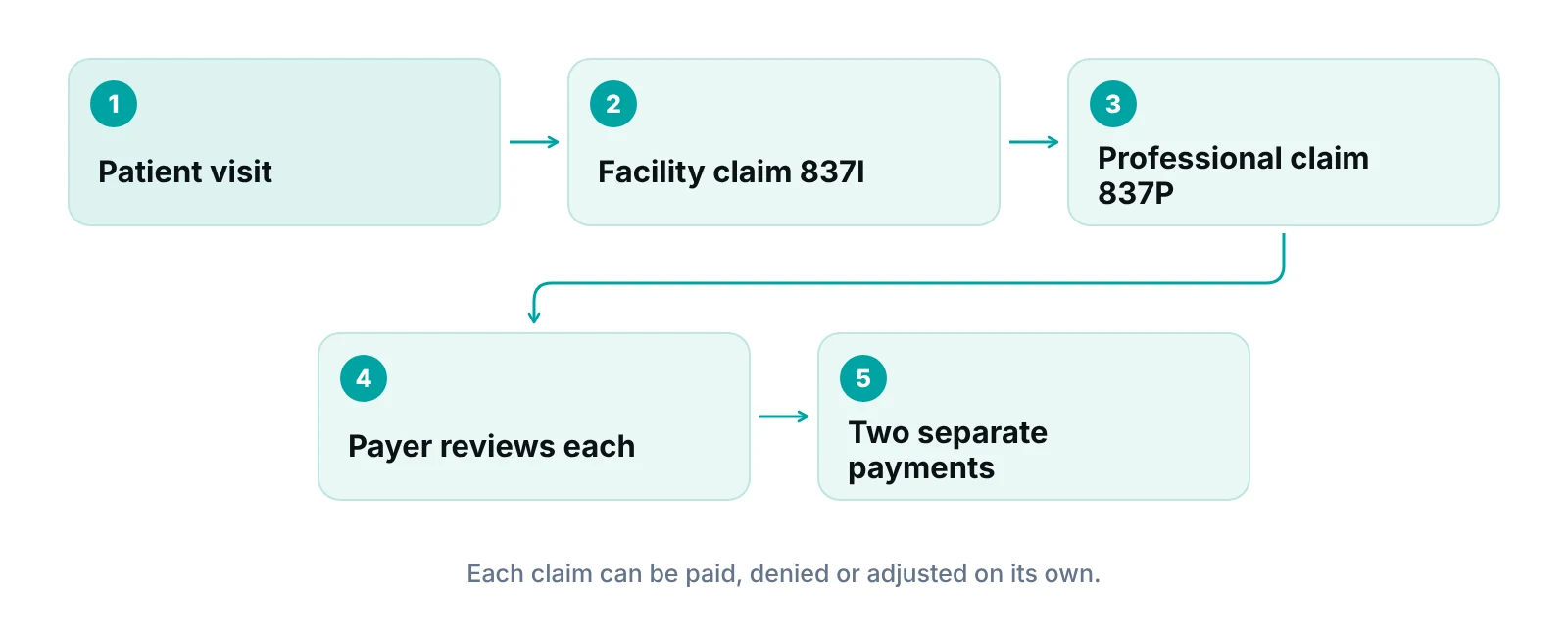
For a practice, the practical point is that the two claims do not rise or fall together. A hospital claim can be paid while the physician claim is denied for a missing referral or authorization. The reverse also happens. Each needs its own eligibility check, coding review and follow-up.
Why this matters for your A/R
If your practice bills only the professional side, the facility claim is not in your A/R and not in your control. When a patient calls about a “duplicate” bill, the first question is which entity sent each one.
Estimate what slow claims cost
Use the revenue calculator to see how days in A/R and denial rates affect your collections.
How Medicare pays each side
Medicare uses a different payment method for each claim type, and the unit of payment is different too. The hospital is paid per discharge or per grouped service. The physician is paid per service from a fee schedule. Mixing these up is where older articles go wrong, including the claim that hospitals are paid by diagnosis-related group across the board.
Inpatient: MS-DRGs
Under the inpatient prospective payment system, CMS pays acute care hospitals a fixed amount per inpatient discharge. Each case is assigned to a Medicare Severity Diagnosis Related Group (MS-DRG) using the principal diagnosis, secondary diagnoses, procedures, sex, age and discharge status. CMS lists 768 MS-DRGs for fiscal year 2027, and the count can change from year to year, so a figure in an old article should not be reused. Certain hospital types, such as cancer hospitals, children’s hospitals, inpatient psychiatric and rehabilitation facilities and long-term care hospitals, are excluded from this system (CMS, Medicare payment systems).
Outpatient: APCs
Hospital outpatient services are paid under a separate system. CMS groups the items and services paid under the hospital outpatient prospective payment system into payment groups called Ambulatory Payment Classifications (APCs), organized by clinical similarity and resource use. For certain costly primary services, CMS applies a comprehensive APC policy that covers the other items and services reported on the same hospital outpatient claim. So an outpatient hospital claim is not a DRG claim, and its line items do not all pay separately.
Professional services: the fee schedule
Physicians and other practitioners are paid under the Physician Fee Schedule. CMS sets relative value units (RVUs) for each service and converts them to a payment rate with a fixed conversion factor, with geographic adjustments for local costs (CMS, Physician Fee Schedule).
| Claim | Payment system | Unit of payment | Who is paid |
|---|---|---|---|
| Hospital inpatient stay | Inpatient prospective payment system | MS-DRG, one payment per discharge | The acute care hospital |
| Hospital outpatient service | Outpatient prospective payment system | Ambulatory Payment Classification (APC) | The hospital outpatient department |
| Physician or practitioner service | Physician Fee Schedule | Relative value units times a conversion factor | The physician, practitioner or supplier |
Source: CMS, Medicare payment systems (IPPS section, updated for FY 2027); CMS OPPS and Physician Fee Schedule pages.
Commercial payers can differ
Everything above describes Medicare. Commercial and Medicaid plans set their own methods in contracts and may pay hospitals by case rate, percent of charges or fee schedule. Always read the contract or the payer’s billing manual before assuming Medicare rules apply.
Who bills what: common scenarios
The easiest way to settle a claim question is to ask who furnished the service and who owns the resources behind it. The table below applies that test to common situations.
| Scenario | Facility (institutional) claim | Professional claim |
|---|---|---|
| Inpatient surgery | Hospital bills the stay on an 837I | Surgeon bills the surgeon’s services on an 837P |
| Hospital outpatient clinic visit | Hospital outpatient department bills its facility services | Physician bills the visit on an 837P with the matching place of service |
| Radiologist reads a hospital X-ray | Hospital bills the technical side of the exam | Radiologist bills the interpretation on an 837P |
| Office visit in a private practice | No facility claim | Practice bills the visit on an 837P |
| Imaging done in a physician-owned office | No facility claim | Practice can bill the technical and professional work together on an 837P, because the office rate covers the full resources |
| Hospital-employed physician | Hospital claim for facility services | Professional services are still professional services. Confirm with each payer how it wants them submitted |
Source: CMS, Physician Fee Schedule and Medicare Billing MLN booklets (2025). Last row is general billing practice: payer rules vary.
The last row is where many practices stumble. Employment status does not turn a professional service into a facility service. What changes is who submits the claim and whom the payer pays. Check how each payer wants employed physicians’ services submitted and keep that rule in the billing manual.
A specialty example: radiology's technical and professional components
Radiology shows the split more clearly than any other specialty. For many diagnostic tests, CMS says separate payment may be made under the Physician Fee Schedule for the professional and technical components when different suppliers furnish them. The technical side covers the equipment, supplies and staff who perform the test. The professional side covers the physician’s interpretation and report.
A hospital that owns the scanner bills its technical side on its institutional claim. The radiologist who reads the study bills the interpretation on a professional claim. A freestanding imaging group that owns the equipment and employs the radiologists may bill both parts on a single professional claim. Radiology groups therefore need to know, for every study, which side they own. Our radiology billing and RCM page covers how groups manage this.
Where hospital and professional billing go wrong
Most errors come from a few repeat patterns. Each one is avoidable with a front-end check, and each one shows up later as a denial or a rejection at the clearinghouse.
- Wrong claim type. A professional charge sent on an institutional claim, or the reverse, will usually be rejected or paid incorrectly. Decide the claim type before coding.
- Wrong coding set for the setting. Procedure coding differs: inpatient facility claims use ICD-10-PCS, while HCPCS (including CPT) is used for other procedures. Mixing the sets triggers edits.
- Missing or wrong place of service. A professional claim must carry the correct two-digit place of service code. The code tells the payer which rate (facility or non-facility) to apply.
- Treating the two claims as one. Separate claims need separate eligibility, authorization and follow-up. Verify coverage and prior authorization for both.
- Using an old rule of thumb. A fixed facility-fee percentage, a DRG count from a past year or an assumed E/M share of claims may not match current CMS rules or your contracts.
A claim scrubber that checks claim type, place of service and code sets before submission catches most of these. When a claim does come back, a structured denial management process starts with confirming the claim type was right. For site-of-service differences between surgery centers and hospitals, see our guide to ASC vs hospital billing.
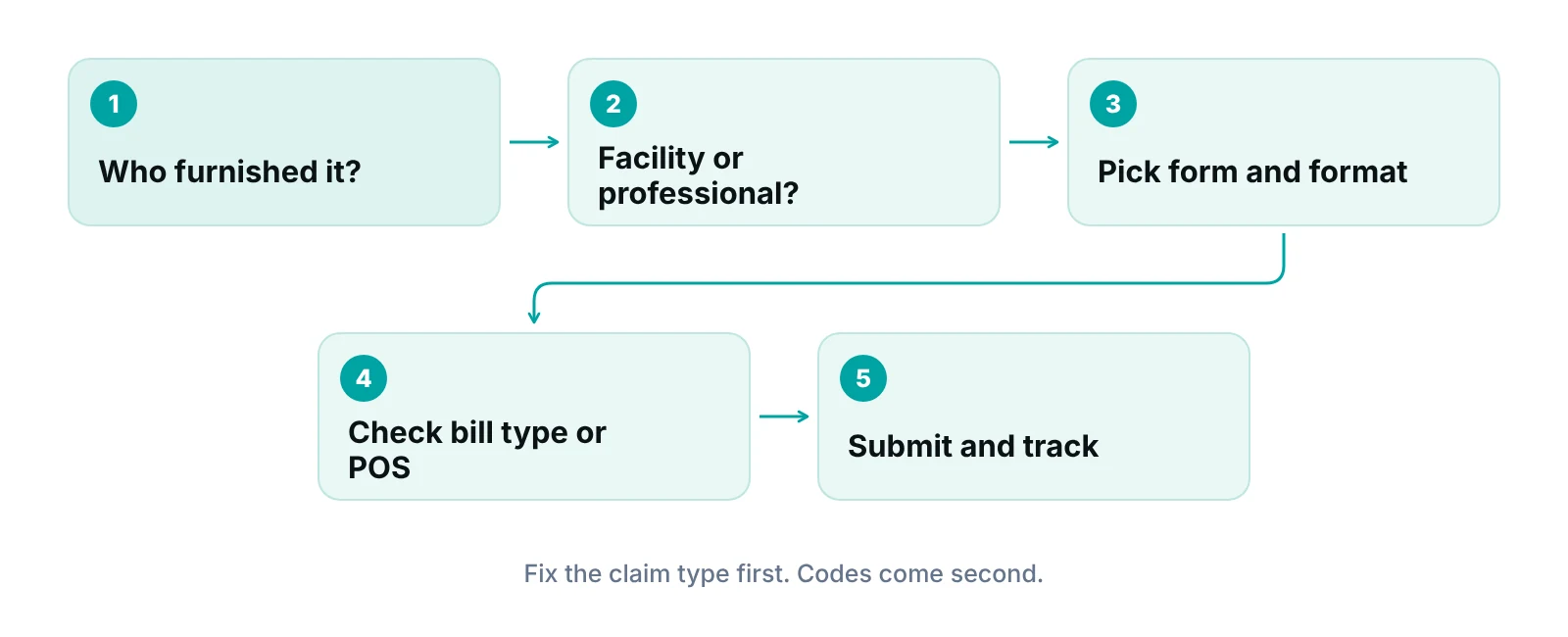
“Decide who is billing, and for what, before anyone picks a code.”
Electronic submission rules for both claim types
For Medicare, both claim types are expected to be sent electronically. CMS states that initial Medicare claims should be submitted electronically unless the provider qualifies for a waiver or exception under the Administrative Simplification Compliance Act (ASCA). The size thresholds differ by claim type.
- Institutional claims (CMS-1450 / 837I): paper is allowed for providers with fewer than 25 full-time equivalent employees that bill their MAC.
- Professional claims (CMS-1500 / 837P): paper is allowed for practices with fewer than 10 full-time equivalent employees that bill their MAC.
- Both: roster billing for mass immunizations such as COVID-19, flu and pneumonia shots, paper claims under a Medicare demonstration project, and certain Medicare Secondary Payer claims with more than one primary payer.
Most practices submit electronically regardless, because clearinghouse edits catch errors before the payer sees them. If your group is small enough to qualify for the paper exception, that is a choice, not a requirement, and it does not change which form applies.
Keeping two claims per patient organized
When a practice bills professional claims for hospital patients, it has to match its own charges to hospital encounters it does not control. That means capturing the admission date, the facility and the encounter details, then tracking the claim until it is paid. A practice management system that tracks claims by stage gives each claim an owner and a status, so a professional claim stuck waiting on a hospital record does not sit unnoticed.
Practices that outsource can ask any vendor the same question: how does it keep facility-linked professional claims from falling out of the queue? Our medical billing services cover claim creation, charge entry and coding support for practices that want a second pair of eyes on the front end.
See where your claims leak
A free practice audit reviews how your claims are routed, coded and followed up, including facility-linked professional claims.
Our recommendations
- Decide the claim type before coding. Write down, for each service line, whether the practice or the facility owns the resources behind it. Then pick the form and format. Coding questions come second.
- Build place of service into your charge entry. Make place of service a required field in charge entry, and review it on the first pass of every claim scrub. A wrong code changes which rate the payer applies.
- Verify coverage and authorization for each claim. A hospital authorization does not automatically cover the surgeon or the radiologist. Check each payer’s rule for each claim.
- Keep a payer-by-payer note on employed physicians. Record how each payer wants hospital-employed physicians’ services submitted, and update it after contract changes.
- Replace rules of thumb with current sources. Re-check code counts, payment-system names and thresholds against CMS each year. Fiscal-year figures, such as the MS-DRG count, change.
- Review denials by claim type. Split denial reports into institutional and professional so the root causes (authorization, coding set, place of service) stay visible.
Track facility-linked professional claims by stage.
RCM Finder's practice management portal gives each claim a stage and an owner, applies specialty-aware billing logic and runs data-completeness checks before submission, so claims tied to hospital encounters do not stall unseen.
See how the RCM Finder portal works · Create a portal account
Disclosure: RCM Finder builds and sells this portal. It is a practice management system, not an EHR.
Bottom line
Hospital vs professional billing comes down to one question: whose resources and whose work is on this claim? Get that right and the form, the coding set and the payment method follow. If your practice wants help sorting facility-linked professional claims, our revenue cycle management services cover the front end through A/R follow-up, and you can start with a free practice audit.
Frequently asked questions
What is the difference between hospital billing and professional billing?
Hospital billing is the facility’s bill for its own resources, sent on an institutional claim (UB-04/CMS-1450 or 837I). Professional billing is the clinician’s bill for their own services, sent on a CMS-1500 or 837P. A single visit can generate both.
Does a doctor who works in a hospital bill on the UB-04?
Generally no. The physician’s services are professional services and go on a professional claim (CMS-1500 or 837P). The hospital bills its facility services on the UB-04 or 837I. How employed physicians are submitted can vary by payer, so check the payer’s rules.
Are all hospital claims paid by DRG?
No. Medicare pays acute care hospitals by MS-DRG for inpatient stays. Hospital outpatient services are paid under a separate system using Ambulatory Payment Classifications. Some hospital types are excluded from the inpatient system. Commercial payers set their own methods in contracts.
What is a facility fee?
A facility fee is the charge for the hospital’s or other facility’s resources, such as space, staff, equipment and supplies. It is billed on the institutional claim, separately from the physician’s professional fee. Its size depends on the payer contract and payment system, not on a fixed share of the bill.
What is place of service on a claim?
Place of service is a two-digit code on the professional claim that shows where the service was provided. Payers use it to decide whether to apply a facility or non-facility rate, so a wrong code can mean a wrong payment or a denial.
Can a small practice still send paper claims to Medicare?
Medicare expects electronic claims unless a waiver or exception applies. For professional claims, one exception covers practices with fewer than 10 full-time equivalent employees billing their MAC. Institutional claims use a threshold of fewer than 25. Other payers set their own rules.
Get your free practice audit
Tell us about your practice. We will contact you using the details you give.
- A review of your recent claims, denials and A/R aging
- Where your front desk and prior authorizations slow payment
- A prioritized fix list you keep, whether or not you hire us
Pricing is quoted after the audit, based on your volume and the services you choose. Prefer to talk? Call +1 (302) 556-2288.
Sources
- Medicare Billing: CMS-1450 & 837I (MLN006926) — CMS (2025)
- Medicare Billing: CMS-1500 & 837P (MLN006976) — CMS (2025)
- Physician Fee Schedule — CMS (2026)
- Medicare payment systems (IPPS, updated for FY 2027) — CMS (2026)
- Hospital Outpatient Prospective Payment System (OPPS) — CMS (2026)
- Inpatient Prospective Payment System (IPPS) — CMS (2026)
Disclaimer: This article is general education about medical billing, not legal, coding or compliance advice. Medicare rules are described as published by CMS at the time of the last update, and payers apply their own contracts and policies. Confirm current requirements with the payer, the CMS website and a qualified coding or compliance professional.
