
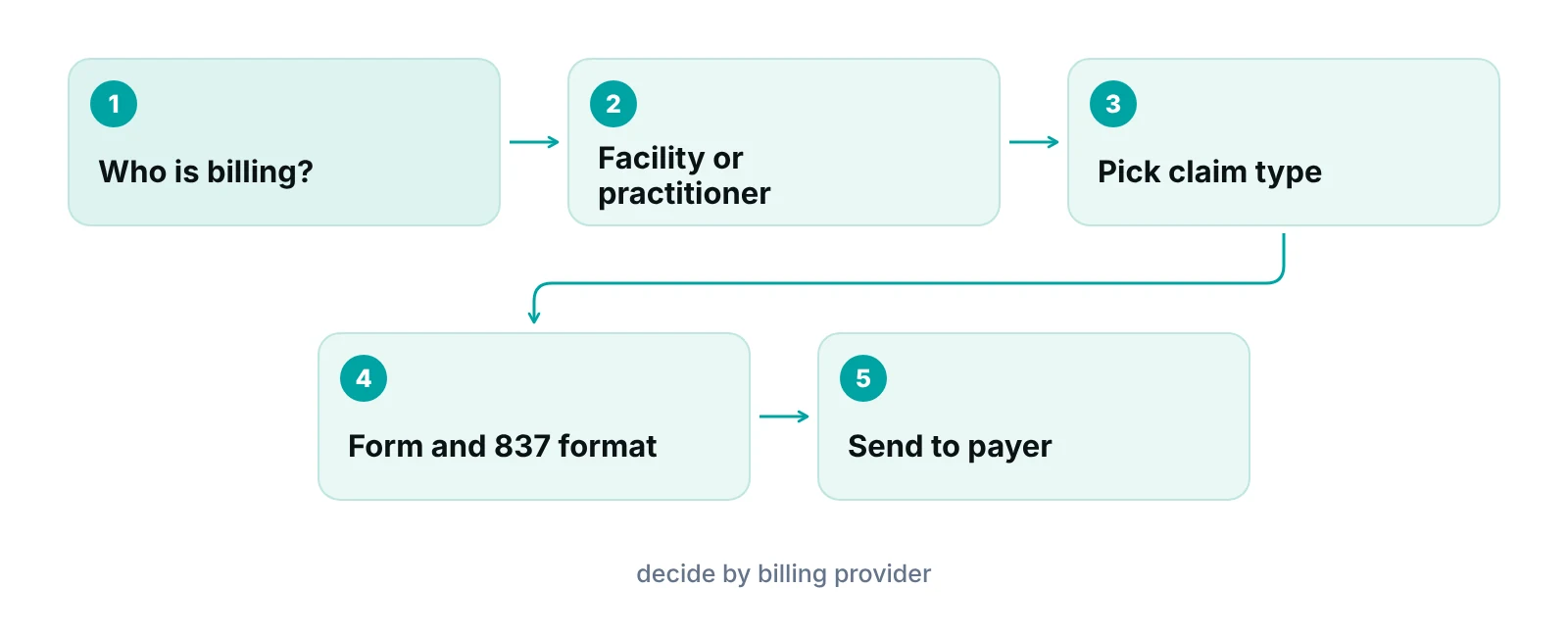
Institutional vs professional claims come down to who is billing. Facilities such as hospitals and skilled nursing facilities send institutional claims (UB-04 on paper, 837I electronically). Physicians, therapists and other practitioners send professional claims (CMS-1500 on paper, 837P electronically). One hospital visit can produce both.
If you have ever seen a hospital bill and a separate doctor bill for the same visit, you have seen both claim types at work. This guide is for practice managers, new billers and owners who need the distinction straight before they pick a billing workflow. Where we cite a rule, it comes from CMS or the federal regulations, and we say which year.
Key takeaways
- Institutional claims (UB-04 / 837I) come from facilities. Professional claims (CMS-1500 / 837P) come from practitioners and suppliers.
- The UB-04 and CMS-1450 are the same form. The paper CMS-1500 is the professional form.
- Both claim types use ICD-10-CM diagnosis codes and HCPCS procedure codes. Revenue codes and type of bill are institutional only.
- A single hospital visit can generate a facility claim and a separate physician claim, each to the same payer.
- Check which claim type your billing provider is enrolled to send before you submit. The wrong form is a common avoidable rejection.
Institutional vs professional claims at a glance
An institutional claim bills for a facility’s services and charges. A professional claim bills for a practitioner’s own services. That is the whole split. The rest is forms, code sets and who is allowed to send which.
CMS’s December 2025 MLN booklet on the 837I and Form CMS-1450 describes the 837I as “the standard electronic format that institutional providers use to submit health care claims.” The paper version is the CMS-1450, which CMS says is also known as the UB-04. On the professional side, CMS’s December 2025 MLN booklet on the 837P and Form CMS-1500 describes the CMS-1500 as the paper form non-institutional providers or suppliers use to bill Medicare Administrative Contractors (MACs), with the 837P as the electronic format.
| Institutional claim | Professional claim | |
|---|---|---|
| Paper form | UB-04 (CMS-1450) | CMS-1500 |
| Electronic format | 837I | 837P |
| Who sends it | Facilities: hospitals, skilled nursing facilities, home health agencies, hospices, critical access hospitals, rural health clinics and similar | Practitioners and suppliers: physicians, nurse practitioners, physician assistants, therapists, chiropractors, ambulance services and similar |
| Bills for | The facility’s charges, each explained by a revenue code | The practitioner’s own services, reported with procedure codes |
| Where the service happened | Shown through the type of bill (a four-digit code for facility type, care classification and frequency) | Shown through a two-digit place of service (POS) code |
| Unique to this claim type | Revenue codes, type of bill, ICD-10-PCS on inpatient facility Part A claims | Place of service code on each service line |
Source: CMS MLN booklets on the 837I / CMS-1450 and 837P / CMS-1500 (December 2025); CMS Medicare Claims Processing Manual, Chapter 25 (2019).
What is an institutional claim (UB-04 / 837I)?
An institutional claim is the facility’s bill. CMS lists the institutional provider types that use the 837I and CMS-1450, including hospitals, critical access hospitals, skilled nursing facilities, home health agencies, hospice organizations, ESRD facilities, rural health clinics and federally qualified health centers (FQHCs), in the CMS’s December 2025 MLN booklet on the 837I and Form CMS-1450.
Three details make it different from a professional claim. First, every charge line needs a revenue code in Form Locator 42 to explain the charge in Form Locator 47, per the CMS Medicare Claims Processing Manual, Chapter 25. If you want the full code structure, our guide to revenue codes in medical billing walks through it. Second, Form Locator 4 carries the type of bill, a four-digit code that, after a leading zero, identifies the facility type, the care classification and the frequency of the bill. Third, the facility reports the principal diagnosis, and inpatient claims also carry procedure codes.
For form completion, field by field, see our UB-04 claim form guide.
UB-04 and CMS-1450 are the same form
CMS describes the CMS-1450 as “also known as the UB-04.” If a payer manual says CMS-1450 and your team says UB-04, they mean one form. The National Uniform Billing Committee (NUBC) maintains the approved code lists the form uses, such as revenue codes and type of bill.
What is a professional claim (CMS-1500 / 837P)?
A professional claim is the practitioner’s bill for their own work. The CMS’s December 2025 MLN booklet on the 837P and Form CMS-1500 lists the provider types that use it: physicians (general practitioners and specialists), nurse practitioners, physician assistants, physical and occupational therapists, speech-language pathologists, chiropractors, clinical psychologists, clinical social workers, ambulance services and others.
Each service line on a professional claim carries a procedure code and a two-digit place of service code that tells the payer where the service was provided. Modifiers sit on the line with the code. Our CMS-1500 claim form guide covers the form box by box.
The place of service code matters beyond data entry. CMS says the code determines whether a facility or non-facility rate applies to a physician service, and that for hospital inpatients (POS 21) and hospital outpatients (POS 19 or 22) the facility rate applies, per the CMS Recovery Audit Program topic on facility vs non-facility reimbursement. A wrong POS code can change the payment, not just the paperwork.
Therapy shows up on both lists
CMS lists physical therapists, occupational therapists and speech-language pathologists among professional billers. It also lists outpatient physical therapy, occupational therapy and speech-language pathology services among institutional provider types. Which claim a therapy provider sends depends on how that provider is enrolled with the payer. Confirm this with your MAC or payer before you build a workflow.
Which code sets appear on which claim?
The common shortcut is “institutional uses revenue codes and DRGs, professional uses CPT and ICD-10.” It is wrong in two ways. Both claim types use ICD-10-CM for diagnoses, and both use HCPCS for procedures with one exception. CMS’s own booklets say so.
| Code set | Institutional (837I) | Professional (837P) |
|---|---|---|
| ICD-10-CM diagnosis codes | Yes | Yes |
| HCPCS Level I (CPT) and Level II procedure codes | Yes, to code all procedures except those performed in inpatient hospitals | Yes, to code all procedures except those performed in inpatient hospitals |
| ICD-10-PCS procedure codes | Yes, on inpatient facility Medicare Part A claims | Not listed for professional claims in CMS’s booklet |
| Revenue codes | Yes, on each charge line | No |
| Type of bill | Yes | No |
| Place of service (POS) code | Not listed in CMS’s institutional booklet; setting is shown through the type of bill | Yes, on each service line |
Source: CMS MLN booklets on the 837I / CMS-1450 and 837P / CMS-1500 (December 2025); CMS Medicare Claims Processing Manual, Chapter 25 (2019).
Two points from the table are worth keeping. HCPCS Level I is CPT, which the AMA maintains, and Level II covers items and services CPT does not, such as ambulance services and DMEPOS. And the inpatient exception means a hospital stay’s procedures are coded in ICD-10-PCS, not CPT. We have limited this table to what CMS states; payer-specific rules, including Medicaid and commercial plans, may add requirements. Check payer manuals for the exact fields.
One visit, two claims: who files what
A single encounter can need an institutional claim and a professional claim. The facility bills for its resources and charges. Each practitioner who personally treats the patient bills for their own professional service. This is why a patient can get a hospital statement and a separate statement from the physician.
| Setting | Facility sends | Practitioner sends | Notes |
|---|---|---|---|
| Office visit in a physician practice | Not applicable | Professional claim (837P) | The practice bills as a non-institutional provider. |
| Hospital outpatient visit or procedure | Institutional claim (837I) | Professional claim (837P) with POS 19 or 22 | CMS applies the facility rate to the physician service for hospital outpatients. |
| Inpatient hospital stay | Institutional claim (837I), with ICD-10-PCS procedure codes | Professional claim (837P) with POS 21 | CMS applies the facility rate to the physician service for inpatients. |
| Skilled nursing facility stay | Institutional claim (837I) | Professional claim (837P) for visiting practitioners | SNFs are on CMS’s institutional provider list. |
| Emergency department visit in a hospital | Institutional claim (837I) for the hospital’s charges | Professional claim (837P) for the treating physician’s services | Two claims: the hospital’s charges and the physician’s service are billed separately. |
Source: CMS MLN booklets on the 837I / CMS-1450 and 837P / CMS-1500 (December 2025); CMS Medicare Claims Processing Manual, Chapter 25 (2019); CMS Recovery Audit Program topic 0108. The emergency department and SNF rows apply these sources to the setting; they are not stated for those settings verbatim.
Hospital-based specialties feel this split most. A group that reads studies or sees patients in a hospital still sends its own professional claim, with a hospital place of service code. If that describes your group, see how we handle radiology billing and revenue cycle support, where the facility-and-professional split comes up every day.
For a business-model view of the same split, see our hospital billing vs professional billing guide. For the forms themselves, our guide to medical claim forms compares them all.
Submission rules: electronic formats and exceptions
Federal rules name a separate electronic standard for each claim type. 45 CFR 162.1102 lists ASC X12 837 Professional (005010X222) and ASC X12 837 Institutional (005010X223, with its Type 1 Errata 005010X223A1) as the standards for health care claims, per the eCFR. Practically, that means a clearinghouse or billing system has to build the right 837 for the right claim type, not one generic claim.
For Medicare, CMS tells providers to submit initial claims electronically unless they qualify for a waiver or exception under the Administrative Simplification Compliance Act (ASCA). One exception is size: the professional booklet lists providers with fewer than 10 full-time equivalent employees who bill their MAC, and the institutional booklet lists those with fewer than 25. Those are Medicare rules; other payers set their own submission requirements. If you use a clearinghouse, our clearinghouse guide explains what it does between your system and the payer.
Know your enrollment before you pick the form
The claim type follows the billing provider’s enrollment and the payer’s rules, not the department the patient visited. Ask the payer or MAC which claim type your billing provider should send for each service before you configure the billing system.
Common mix-ups and how to catch them early
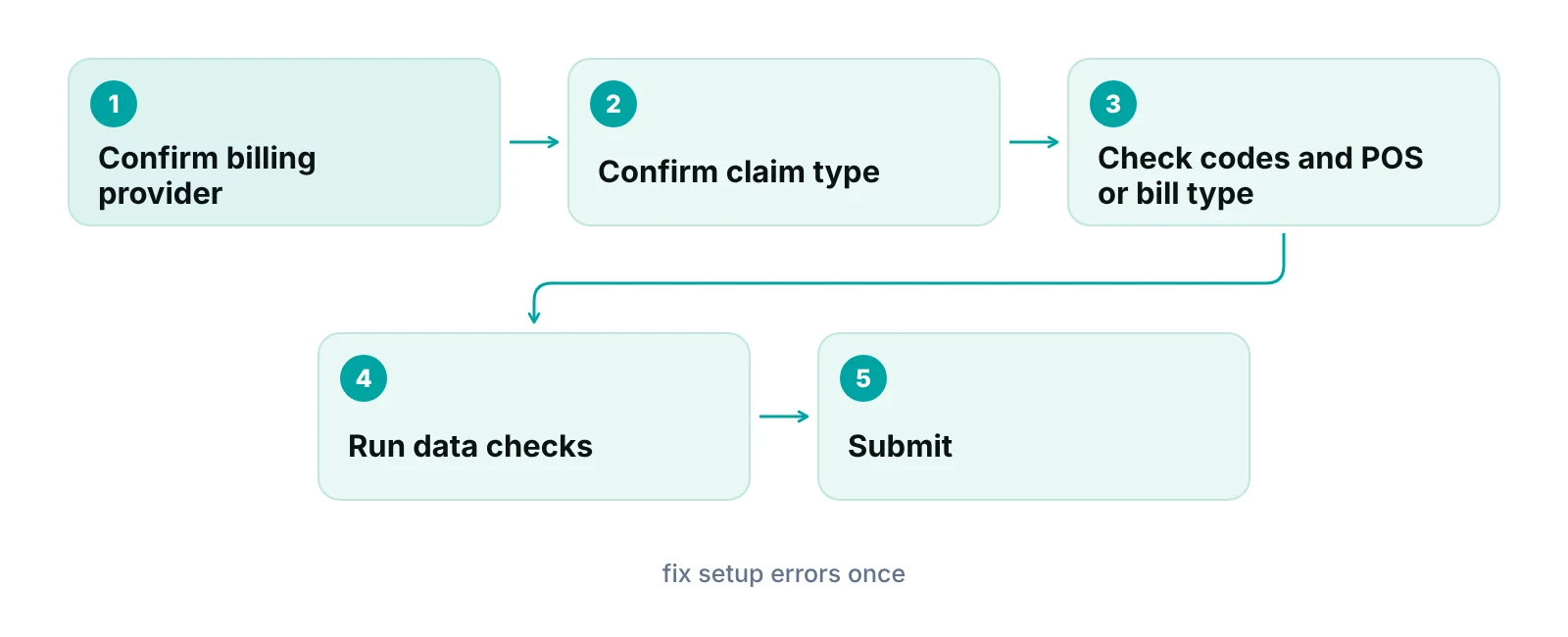
Most institutional-versus-professional errors are setup errors that repeat on every claim. A short check before submission catches them. The items below are practical checks, not CMS requirements.
- Wrong form for the billing provider. Confirm the claim type for each billing provider and service line of business before you submit.
- Missing revenue code on an institutional charge line. CMS requires a revenue code for each charge, so a blank here is a claim error.
- Wrong place of service on a professional line. The POS code can change which rate applies, as shown above.
- Treating the code sets as separate worlds. Diagnosis coding is ICD-10-CM on both. Staff who learn only one claim type often assume the other differs.
- Sending one claim when two are needed. A hospital-based practitioner’s service needs its own professional claim, even when the facility bills the stay.
Claim scrubbing and front-end checks help here. Our guide to clean claims explains how edits catch missing fields before the payer does, and our medical billing services team can set up those checks for either claim type.
Keeping both claim types visible
If your group sends only professional claims, the basics above are most of what you need. If you also work with a facility, you need to see both claims for an encounter side by side. A practice management system that tracks claims by stage lets staff see where each claim sits, who owns it and what data is missing before it goes out. Ours is claim-centred, not an EHR.
Not sure which claims your setup should be sending?
Our free practice audit reviews how your claims are built and routed and flags setup errors. Pricing, if any service fits, is quoted after the audit.
Our recommendations
- List every billing provider and the claim type each uses. We recommend a one-page sheet: billing provider, claim type, form or 837 format, payer. Update it whenever you add a location or payer.
- Write down the facility rule for each hospital you work in. If your physicians work in a hospital, record the POS code for each setting and who bills the facility side. That prevents missing or duplicate claims.
- Teach one code-set chart, not two separate ones. Diagnosis codes are shared. Revenue codes and type of bill are institutional. POS is professional. One chart avoids the ‘two worlds’ error.
- Review rejections by claim type. Group rejection reasons by 837I and 837P. If one type rejects more, the cause is usually in setup, not in individual claims.
- Confirm payer-specific rules in writing. Medicare booklets are a starting point. Ask each commercial and Medicaid payer for its claim submission guide and keep it with your sheet.
See where every claim stands before it goes out.
Our practice management system tracks claims by stage with an owner and runs data-completeness checks before submission. It is claim-centred, not an EHR.
See how the RCM Finder portal works · Create a portal account
Disclosure: RCM Finder builds and sells this portal. It is a practice management system, not an EHR.
Bottom line
Institutional claims bill the facility; professional claims bill the practitioner; and one visit can need both. Get the billing provider’s claim type right once, and most of the downstream errors go away. If you want help setting claims up or cleaning up rejections, our end-to-end revenue cycle management team starts with a free practice audit.
Frequently asked questions
What is the main difference between institutional and professional claims?
Who is billing. Institutional claims come from facilities such as hospitals and skilled nursing facilities and use the UB-04 or 837I. Professional claims come from practitioners and suppliers and use the CMS-1500 or 837P. Facilities bill for their charges, practitioners bill for their own services. Many encounters involve both, so the same visit can produce one of each.
Is the UB-04 the same as the CMS-1450?
Yes. CMS describes the CMS-1450 as the standard paper claim form for institutional providers, also known as the UB-04. Payer manuals may use either name, so treat them as one form. The professional paper form is the CMS-1500, and the electronic equivalents are the 837I and 837P.
Do institutional and professional claims use different diagnosis codes?
No. CMS says both use ICD-10-CM for diagnoses. The difference is in what else the claim carries: revenue codes and type of bill on institutional claims, and place of service on professional claims. Inpatient facility Part A claims also use ICD-10-PCS for procedures.
Can one patient visit generate both claim types?
Yes. A hospital bills its charges on an institutional claim, and the treating practitioner bills their own service on a professional claim. For hospital inpatients and outpatients, CMS applies the facility rate to the physician service based on the place of service code.
Which claim type do therapists and rural health clinics use?
It depends on how the provider is enrolled. CMS lists therapists among professional billers, and also lists outpatient therapy services and rural health clinics among institutional provider types. Confirm the claim type with the MAC or payer before you set up billing, and keep the answer in writing.
Are paper claims still allowed?
For Medicare, CMS tells providers to submit initial claims electronically unless they qualify for an ASCA waiver or exception, such as a small-provider exception. Other payers set their own rules. Check each payer’s submission guide, because a commercial or Medicaid plan can differ from Medicare on paper claims and formats.
Get your free practice audit
Tell us about your practice. We will contact you using the details you give.
- A review of your recent claims, denials and A/R aging
- Where your front desk and prior authorizations slow payment
- A prioritized fix list you keep, whether or not you hire us
Pricing is quoted after the audit, based on your volume and the services you choose. Prefer to talk? Call +1 (302) 556-2288.
Sources
- Medicare Billing: 837I and Form CMS-1450 (MLN006926) — CMS (2025)
- Medicare Billing: CMS-1500 and 837P (MLN006976) — CMS (2025)
- 45 CFR 162.1102 Standards for health care claims — eCFR / HHS (2026)
- Medicare Claims Processing Manual, Chapter 25 (Form CMS-1450 data set) — CMS / HHS (2019)
- RAC topic 0108: Facility vs Non-Facility Reimbursement — CMS (n.d.)
Disclaimer: This post is general educational information about claim types and is not legal, coding or compliance advice. Payer rules vary and change over time, and the CMS references here describe Medicare. Confirm what applies to your practice with your payers and qualified advisors.
