
Revenue codes in medical billing are four-digit numbers, entered in Form Locator 42 of the UB-04, that tell a payer where a patient was treated or what type of item or service a charge covers. They belong to institutional claims from hospitals and other facilities, and they sit beside the procedure code on each billed line.
If you have seen four-digit numbers like 0450 or 0360 on a hospital bill and wondered what they mean, this guide explains them in plain terms. It also corrects older versions of this article, which mixed three-digit and four-digit codes and carried statistics that could not be sourced. For the full form, see our UB-04 claim form guide.
Key takeaways
- A revenue code is a four-digit category label for a charge, entered in FL 42 of the UB-04.
- The procedure code names the service. The revenue code names where or what category it belongs to.
- Read 0450 as family 045X, general emergency room, and keep the leading zero.
- Institutional providers such as hospitals use revenue codes. Professional claims follow a different form.
- Use your payer’s current list, because the NUBC owns the definitions and unlisted codes may not be accepted.
What are revenue codes in medical billing?
A revenue code is a four-digit number that tells the payer where a patient was treated or what kind of item or service a charge is for. A Medicare contractor describes them as four-digit numbers on hospital bills that tell insurers where the patient was treated or what type of item or service the patient received (Noridian Healthcare Solutions). Think of it as the department or category label on a charge.
Two examples show the idea. Code 0450 sits in the emergency room category. Code 0360 sits in the operating room category. Neither one says which procedure was performed. That job belongs to the procedure code (HCPCS) on the same line. CMS puts it this way: revenue codes explain in what capacity the reported charges and the HCPCS code apply on that line (CMS MLN web-based training on the CMS-1450).
The National Uniform Billing Committee (NUBC) maintains the revenue code set, and the CMS-1450 and its electronic version, the 837I, require it (CMS MLN, 837I and Form CMS-1450 (December 2025)). This guide uses the Medicare contractor code list for its examples. For the official definitions, go to the NUBC, because the NUBC owns the descriptors.
Who this guide is for
Revenue codes matter most to hospitals, hospital-owned clinics and other facilities that bill on the institutional claim. If your practice bills only professional claims, this is background that helps you read hospital paperwork. For the form-level differences, read our guide to institutional vs professional billing claims.
Where do revenue codes appear on the UB-04?
Revenue codes go in Form Locator 42 (FL 42), one per line, and each one explains a charge reported in FL 47. CMS instructs billers to enter the correct numeric revenue code on the adjacent line in FL 42, and says these numeric codes explain each charge reported in FL 47 (CMS MLN web-based training on the CMS-1450). So every service line on a UB-04 starts with a revenue code and ends with a charge.
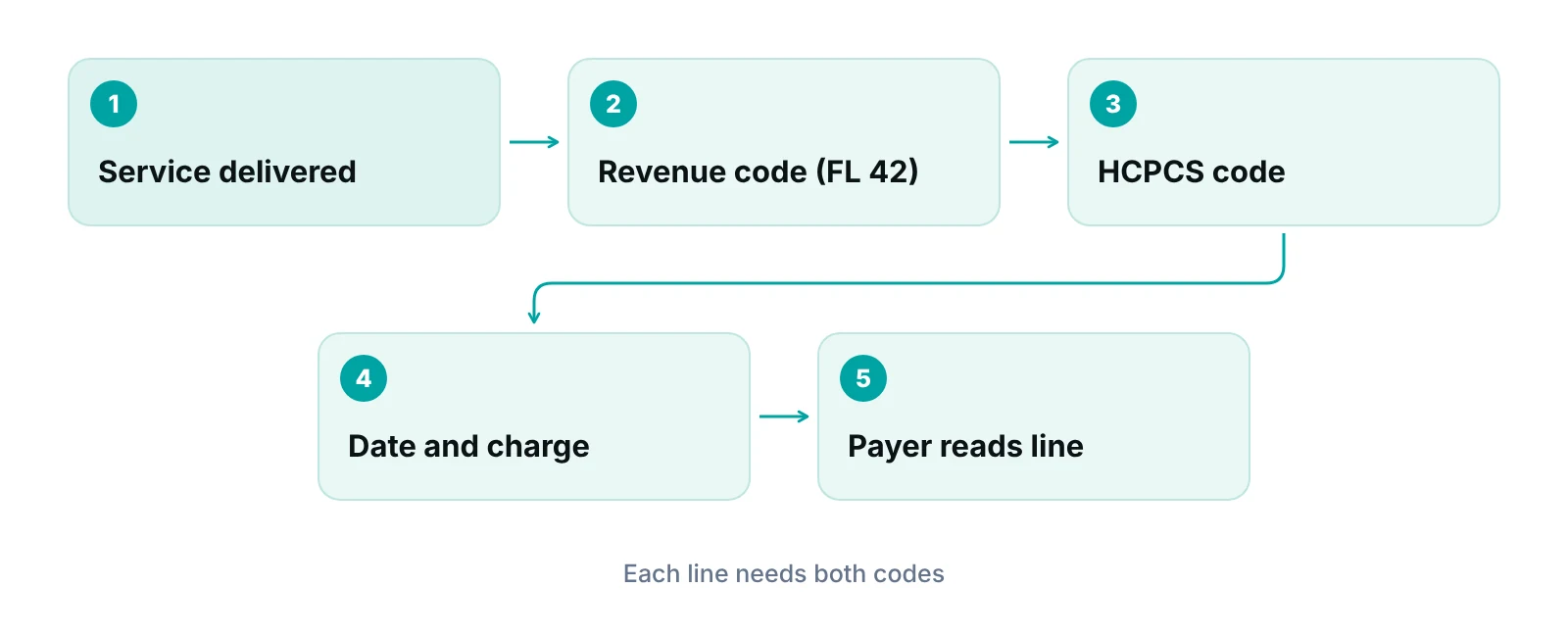
| Field | What it tells the payer | What CMS says |
|---|---|---|
| Revenue code (FL 42) | The category of the charge, such as emergency room or pharmacy | Entered in FL 42 and explains each charge reported in FL 47 |
| HCPCS code | The specific service or procedure on that line | Providers often pair revenue codes with HCPCS codes, and each revenue code has its own HCPCS requirements |
| Line item date of service (FL 45) | When the service happened | Required wherever a HCPCS code is required on a hospital outpatient claim |
| Charges (FL 47) | The amount billed for that line | Each revenue code explains the charge reported here |
| Revenue code 0001 | The total of the charges | Paper claims only, as the last revenue code listed in FL 42 |
Source: CMS MLN web-based training on the CMS-1450; Medicare Claims Processing Manual, Chapter 4 (hospital outpatient services).
The same revenue code logic carries into the electronic claim. Institutional providers use the CMS-1450 and the 837I to bill certain government and private insurers, and CMS lists hospitals, skilled nursing facilities, home health agencies, hospices, critical access hospitals, federally qualified health centers and rural health clinics among them (CMS MLN, 837I and Form CMS-1450 (December 2025)). For a field-by-field walk through the paper form, see our UB-04 claim form guide.
How do you read a four-digit revenue code?
Read the first three digits as the category and the last digit as the specific item within it. The Medicare contractor list shows this pattern. Category 045X is Emergency Room. Its subcodes run from 0450 (general) to 0459 (other) (Noridian Healthcare Solutions). The X is shorthand for the family, and the code you bill is the full four digits.
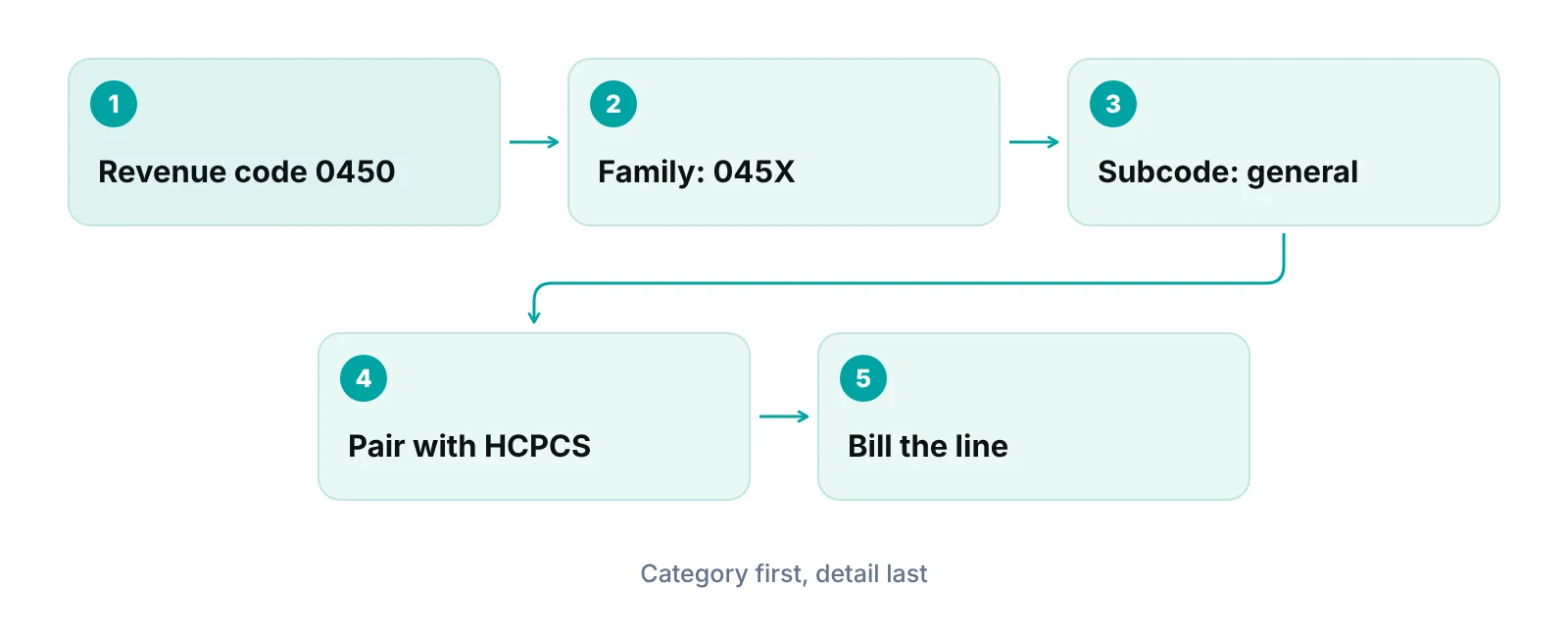
Older guides, including earlier versions of this one, mix three-digit and four-digit forms, for example writing 250 for pharmacy. The reported code is four digits, with the leading zero. Keep the zero in your billing system, spreadsheets and training sheets, because a code stored as a plain number can lose it.
One more rule saves time. Do not assume a code exists because it fits a pattern. The Medicare contractor states that any code not listed in its table is not currently in use by CMS, including code ranges reserved for national assignment (Noridian Healthcare Solutions). If a code is missing from the payer’s list, ask the payer before you bill it.
What are the most common revenue codes?
The general code in each family is the one most readers meet first. The table below lists eleven of them, with the Medicare contractor’s category and a plain-words example. The examples are ours, written to help you picture the line. Your payer’s list governs what you may bill.
| Revenue code | Category | Plain-words example |
|---|---|---|
| 0100 | All-inclusive rate: room and board plus ancillary | A stay billed under one inclusive rate |
| 0120 | Room and board, semi-private, two beds | A semi-private inpatient room |
| 0200 | Intensive care unit, general | Time in the ICU |
| 0250 | Pharmacy, general | Drugs supplied by the hospital pharmacy |
| 0300 | Laboratory, general | Blood work done in the hospital lab |
| 0320 | Radiology, diagnostic, general | Diagnostic imaging |
| 0360 | Operating room services, general | A surgical procedure in the OR |
| 0420 | Physical therapy, general | An outpatient therapy visit |
| 0430 | Occupational therapy, general | An outpatient therapy visit |
| 0450 | Emergency room, general | An ER visit |
| 0510 | Clinic, general | A hospital clinic visit |
Source: Noridian Healthcare Solutions, Revenue Codes (Medicare Part A contractor), category names and general codes.
Therapy is a good example of how the same family appears outside hospital walls. Rehabilitation departments report physical therapy under 042X and occupational therapy under 043X. If you run or bill for rehab services, our rehabilitation billing and revenue cycle page covers how those claims move from visit to payment.
Subcodes for ICU, pharmacy, emergency room and clinic
The general code is rarely the only option. Four families carry subcodes that many billers need. The Medicare contractor list shows them as follows.
| Family | Subcodes on the Medicare contractor list |
|---|---|
| 020X Intensive care unit | 0200 general; 0201 surgical; 0202 medical; 0203 pediatric; 0204 psychiatric; 0206 intermediate ICU; 0207 burn care; 0208 trauma; 0209 other |
| 025X Pharmacy | 0250 general; 0251 generic drugs; 0252 non-generic drugs; 0253 take-home drugs; 0254 drugs incident to other diagnostic services; 0255 drugs incident to radiology; 0256 experimental drugs; 0257 nonprescription; 0258 IV solutions; 0259 other |
| 045X Emergency room | 0450 general; 0451 EMTALA emergency medical screening services; 0452 ER beyond EMTALA screening; 0456 urgent care; 0459 other |
| 051X Clinic | 0510 general; 0511 chronic pain center; 0512 dental clinic; 0513 psychiatric clinic; 0514 OB/GYN clinic; 0515 pediatric clinic; 0516 urgent care clinic; 0517 family practice clinic; 0519 other |
Source: Noridian Healthcare Solutions, Revenue Codes (Medicare Part A contractor). Official definitions are maintained by the NUBC.
Notice what changed from the older version of this guide. There is no 205 in the ICU list, 206 is intermediate ICU rather than a general intermediate-care code, 0253 is take-home drugs rather than drugs for home use, and 0511 is a chronic pain center. Small wording drift like that is how a billing sheet slowly stops matching the payer list.
How do revenue codes work with procedure codes?
On a hospital outpatient claim, a revenue code usually travels with a HCPCS code, and the two must make sense together. CMS tells billers to follow the HCPCS coding requirements for each revenue code (CMS MLN web-based training on the CMS-1450). The Medicare outpatient manual goes further: other revenue codes that are billable on a hospital outpatient claim must contain a HCPCS code, and hospitals report a HCPCS code under the revenue center where the service was performed (Medicare Claims Processing Manual, Chapter 4).
The manual’s chart shows the pairing. Emergency department visit codes are reported under the 045X family, and clinic visit codes under the 051X family. That is why an ER evaluation reported under a clinic revenue code, or the reverse, is a data error even if every individual code is real. The charge lands in the wrong category for the setting in which care was given.
“A revenue code answers where the charge came from. The procedure code answers what was done. A clean line needs both answers to agree.”
Revenue codes are also separate from diagnosis codes. The revenue code describes the capacity of the charge, as CMS puts it, not the patient’s condition. A claim can carry a correct diagnosis and procedure and still be returned or denied because the revenue code and procedure code do not belong together. Our medical coding examples guide explains how the other code sets are used, and our charge entry guide covers how charges are keyed in the first place.
Why do revenue code mistakes cost money?
A wrong or missing revenue code can send the claim back for correction before anyone reads the clinical content. The Medicare outpatient manual states that claims containing revenue codes that require a HCPCS code, but lack one, are to be returned to the provider (Medicare Claims Processing Manual, Chapter 4). A returned claim is a delay, and a delay in submission is time that does not count toward getting paid.
Older versions of this article quoted denial percentages, revenue lifts and a hospital case study. None of those could be traced to a primary source, so they have been removed. What can be said safely is simpler: every manual correction takes staff time, and codes keyed from memory are where most corrections begin.
Where mismatches usually come from
- Stale code lists. A billing sheet built from an old guide keeps codes that the payer no longer lists.
- Lost leading zeros. A spreadsheet that stores 0450 as 450 can feed the wrong field.
- Department mapping drift. A service moves to a new cost center, but the charge still carries the old revenue code.
- Missing procedure code. The revenue code is present, but the line has no HCPCS code where one is required.
- Setting mismatch. A visit billed under a clinic code when the care was delivered in the emergency department, or the reverse.
Catching these before submission is the job of a claim edit step. Our claim scrubbing guide explains how pre-submission checks work, and our clean claims guide shows what a claim needs to pass on the first try. If the claim is already denied, start with denial management in medical billing.
How can a billing team keep revenue codes accurate?
Treat the revenue code list as a controlled document with one owner, a version date and a review each year. The list changes, and the Medicare contractor itself points readers to the NUBC for expanded definitions (Noridian Healthcare Solutions). A weekly spot check of a handful of claims is cheap compared with reworking a month of them.
- Pull the current list from your payer or Medicare contractor and date it.
- Map each department or cost center to its revenue code, and have billing and finance both sign off.
- Store codes as four-character text so leading zeros survive exports.
- Confirm that every line that needs a procedure code has one before the claim leaves.
- Sample a few claims per payer each week and compare the revenue code, the procedure code and the setting of care.
If you are weighing whether to hand claim preparation to a specialist team, see our overview of medical billing services for how coding support, charge entry and submission are covered.
Want a second set of eyes on how your claims are built?
A free practice audit looks at how charges move from the visit to the claim to payment, and where mismatches and returned claims start. Pricing, if you decide to go further, is quoted after the audit.
Do independent practices need revenue codes?
Only if they bill the institutional claim. CMS names the groups that use the CMS-1450 and 837I: hospitals, skilled nursing facilities, home health agencies, hospices, critical access hospitals, federally qualified health centers and rural health clinics, among others (CMS MLN, 837I and Form CMS-1450 (December 2025)). A physician office billing on the professional claim follows a different form. See our CMS-1500 claim form guide for that side.
The difference is practical. A hospital-owned clinic may bill the facility charge on the UB-04 with revenue code 0510 while the physician’s own service is billed separately. Which claim carries which charge depends on the setting and the payer. Our guide to ASC vs HOPD billing shows how setting changes the claim, and the institutional vs professional claims guide sets the two side by side.
Not sure which claim form your setting uses? Ask your payer representative or contracted billing team before building any code sheet. A short call avoids a lot of rework.
Our recommendations
- Keep a dated, owned revenue code list. We recommend one named owner, a version date and an annual review. Pull the list from your payer or Medicare contractor, not from an old article.
- Store codes as text. Leading zeros disappear when a code is stored as a number. Format the column as text in every spreadsheet and export.
- Check the pairing, not just the code. For each outpatient line, confirm that a procedure code is present where one is required and that it belongs under that revenue code.
- Match the code to the setting of care. An ER visit belongs under the emergency room family and a clinic visit under the clinic family. Review any exceptions with your compliance lead.
- Sample claims every week. Compare the revenue code, procedure code and department on a few claims per payer. Patterns show up in a sample before they show up in returns.
- Ask before you bill an unlisted code. If a code is not on your payer’s list, do not assume it is accepted. Ask the payer first.
Bottom line
Revenue codes are the category label on every institutional charge, and they only work when they agree with the procedure code, the setting and the payer’s current list. If returned claims or denials are piling up at your facility, our denial management services can trace them back to their cause, and the revenue calculator gives a rough view of what unpaid claims may be costing you. Start with the free practice audit.
Frequently asked questions
What is a revenue code in medical billing?
A revenue code is a four-digit number on an institutional claim that tells the payer where a patient was treated or what kind of item or service a charge covers. It is entered in Form Locator 42 of the UB-04. The procedure code on the same line says what was done, and the NUBC maintains the code set. Facilities such as hospitals report them; most office-based professional claims follow a different form.
Where do you enter the revenue code on a UB-04?
Revenue codes go in Form Locator 42, one per line, next to the charge they explain in Form Locator 47. On paper claims only, revenue code 0001 is entered as the last code in FL 42 to total the charges. Electronic 837I claims carry the same codes, so check your system’s field mapping.
How are revenue codes different from CPT or HCPCS codes?
A revenue code gives the category or capacity of a charge, such as emergency room or pharmacy. A HCPCS code names the specific service or procedure on the line. On hospital outpatient claims the two are reported together, and each revenue code has its own HCPCS requirements, so they must agree.
Are revenue codes three or four digits?
They are reported as four digits, with a leading zero, for example 0450 or 0360. Some guides write three-digit forms such as 450, which is shorthand and can cause errors if a system drops the zero. Keep the full four characters, stored as text, in your billing sheets.
Do physician practices use revenue codes?
Revenue codes belong to the institutional claim used by hospitals, skilled nursing facilities, home health agencies, hospices, critical access hospitals and similar facilities. A practice that bills only on the professional claim does not report them, though a hospital-owned clinic bills the facility side with them.
Where can I find the official list of revenue codes?
The NUBC maintains the revenue code set and owns the official descriptors. Medicare contractors publish the codes they accept, and any code not on their list is not in use by CMS. Check your own payer’s list before you bill, because acceptance varies by payer and changes over time.
Get your free practice audit
Tell us about your practice. We will contact you using the details you give.
- A review of your recent claims, denials and A/R aging
- Where your front desk and prior authorizations slow payment
- A prioritized fix list you keep, whether or not you hire us
Pricing is quoted after the audit, based on your volume and the services you choose. Prefer to talk? Call +1 (302) 556-2288.
Sources
- Revenue Codes — Noridian Healthcare Solutions (Medicare Part A contractor, Jurisdiction F) (2026 (accessed))
- CMS-1450 web-based training, Revenue Codes lesson — CMS Medicare Learning Network (2026 (accessed))
- 837I and Form CMS-1450 (MLN006926) — CMS Medicare Learning Network (2025)
- Medicare Claims Processing Manual, Chapter 4: Part B Hospital (Including Inpatient Hospital Part B and OPPS) — CMS (manual chapter (version dated August in file name))
Disclaimer: This article is educational and is not legal, coding, billing or compliance advice. Revenue code descriptors are maintained by the NUBC, and payer policies, code lists and federal rules change and vary by payer and state. Verify current requirements with the NUBC, your payers and your counsel before you act.
