
Bill IOP by payer, not by diagnosis. Medicare uses revenue code 0905 and condition code 92, while Medicaid and private plans often use H0015 (substance use) or S9480 (psychiatric per diem). Medicare also needs a physician certification of at least nine IOP hours a week. Confirm each payer's code, hours and authorization rules first.
Co-occurring IOP billing breaks at the same few points: the wrong code set for the payer, hours that do not meet the payer’s definition, and an authorization that lapses mid-treatment. This guide replaces our earlier version, which mixed Medicare and Medicaid rules and contradicted itself on one-session-per-day. It uses CMS, Medicare contractor and state Medicaid documents, and it says plainly where the answer is your payer’s own policy.
Key takeaways
- H0015 and S9480 are Medicaid and private-plan codes. Medicare does not pay S codes.
- Medicare IOP claims use revenue code 0905 and condition code 92, with a 9-hours-a-week physician certification.
- Bill one IOP day once and report both diagnoses on it, unless a payer tells you otherwise in writing.
- Hours, units, authorization and eligible provider types are set by each payer, so build rules per payer.
- Time every service and keep the certification and plan of care in the chart.
Which codes do you use to bill a co-occurring IOP?
It depends on the payer. Medicare bills IOP on facility claims with revenue code 0905, condition code 92 and CPT or HCPCS service lines. H0015 and S9480 are different animals: they are HCPCS Level II codes that Medicaid programs and private plans use, and Medicare does not pay S codes.
CMS’s Level II coding procedures say certain H codes are used by state Medicaid agencies to identify services such as alcohol and drug treatment. They also say S codes are used mainly by private insurers, may be used by Medicaid programs, and are not payable by Medicare (CMS). That one rule explains most of the confusion in IOP billing. Two programs can treat the same patient and bill in two completely different code sets.
| Code | What it identifies | Where it applies |
|---|---|---|
| H0015 | Alcohol and/or drug services, intensive outpatient. The descriptor describes a program that runs at least 3 hours a day and at least 3 days a week from an individualized treatment plan. | Medicaid programs (H codes are used by state Medicaid agencies). Louisiana Medicaid limits it to one unit per day. |
| S9480 | Intensive outpatient psychiatric services, per diem. | Private insurers and some Medicaid programs. Not payable by Medicare. South Carolina Medicaid uses it for hospital IOP with revenue code 905. |
| Revenue code 0905 | Psychiatric intensive outpatient services on a facility claim. | Medicare IOP claims. Also used by South Carolina Medicaid for S9480. |
| Revenue code 0906 | Listed by one Medicare contractor for chemical dependency IOP in opioid treatment programs, with no HCPCS code defined. | Do not assume it is the general substance use IOP code. Confirm with each payer. |
| Condition code 92 | Flags a Medicare claim as intensive outpatient. | Medicare IOP institutional claims. |
| Revenue code 0900 | General mental health services. CMS says not to report IOP services under it. | Medicare. |
Sources: CMS, HCPCS Level II Coding Procedures (revised 2015); AHCCCS H0015 public notice (2023); Louisiana Department of Health IB 22-36 (2022); SCDHHS Medicaid Bulletin 24-054 (2024); CMS Change Request 13264 (2024); First Coast Service Options IOP billing page.
What we corrected from the earlier version of this post
The earlier version presented revenue code 0906 as the substance use IOP code and 0905 as the mental health IOP code, as if the pairing applied everywhere. The Medicare documents we checked list 0905 for IOP and show 0906 only for chemical dependency in opioid treatment programs. Treat any 0905/0906 split as a payer-specific rule, and get it in writing.
How do you bill a patient with both a mental health and a substance use diagnosis?
Bill the program day once and report both conditions as diagnoses. Do not create two IOP charges for the same patient on the same day to represent two conditions. The earlier version of this post told you both to submit claims separately and to never bill two sessions in one day. Those two instructions cannot both be right, and the evidence points to one billable IOP day.
Medicare makes one IOP payment per day on rural health clinic claims, and one IOP service line is paid per day for FQHCs (CMS Change Request 13264). Louisiana Medicaid limits H0015 to one unit per day, and says that aligns the code with its CMS descriptor (Louisiana Department of Health). On the diagnosis side, the FY 2026 ICD-10-CM guidelines include a section for outpatient services with a rule to code all documented conditions that coexist (CDC/NCHS). Your documentation should support both diagnoses; your claim should carry one IOP day.
Choosing between H0015 and S9480
The choice follows how the payer classifies your program, not the patient’s diagnosis list. Louisiana describes H0015 as substance use disorder IOP at ASAM level 2.1. South Carolina Medicaid pays S9480 for hospital-based IOP and H0015 for county substance use disorder authorities. A program that treats both populations may be expected to bill under its license type, its contract or its level-of-care designation.
Ask each payer in writing which code it wants for a mixed program, and record the answer as a billing rule for that payer. If you are building those rules for the first time, our behavioral health billing and RCM guide covers the wider behavioral health workflow.
Do not split one day into two IOP claims to capture both diagnoses
A second IOP line for the same patient and date can hit a one-per-day edit or look like duplicate billing. If a payer tells you it wants two lines, get that instruction in writing and keep it on file.
How does Medicare bill IOP, and does it cover co-occurring disorders?
Medicare has covered and paid for IOP since January 1, 2024, and CMS describes the benefit as psychiatric services for people with an acute mental illness, with substance use disorders named as an included condition (CMS). The earlier version of this post left Medicare out entirely. If you serve Medicare patients, this is your rulebook, and our guide to Medicare reimbursement for mental health therapy covers the neighboring outpatient benefit.
| Item | What CMS or the Medicare contractor says | Applies to |
|---|---|---|
| Start date | Coverage applies to dates of service on or after January 1, 2024. | All IOP settings |
| Who can furnish IOP | Hospital outpatient departments, community mental health centers, rural health clinics and FQHCs. Opioid treatment programs may also furnish IOP for opioid use disorder treatment. | Provider setting |
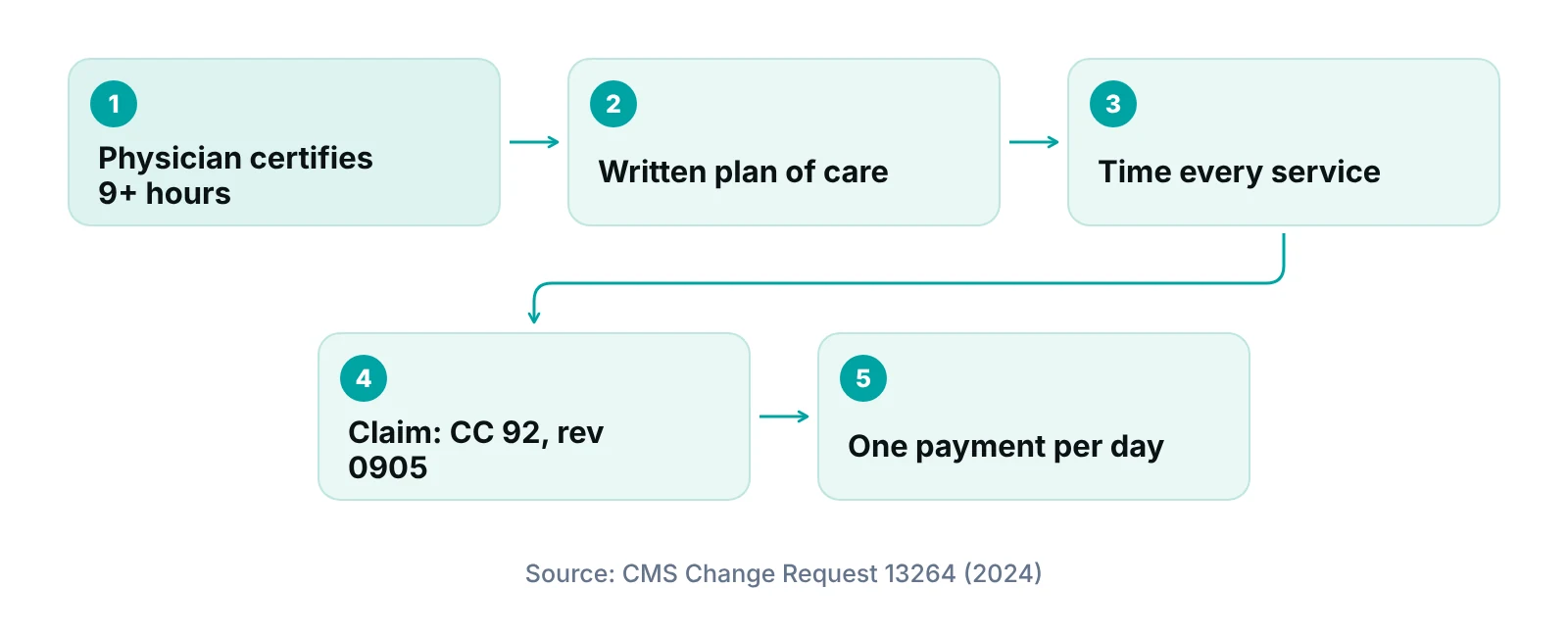
| Physician certification | A physician certifies the patient needs at least 9 hours per week of IOP services, shown in an individualized written plan of treatment. | Admission and plan of care |
| Re-certification | At least every other month. Noridian describes this as at least every 60 days. | Ongoing treatment |
| Claim identifiers | Condition code 92 and revenue code 0905. Rural health clinics and FQHCs use bill types 71X or 77X. | Institutional claims |
| Service lines | At least one primary service, such as 90832, 90834, 90837, 90853 or G0410. Certain add-on services are bundled into that day. | IOP claims |
| One payment per day | Only one IOP payment is made per day on RHC claims, and one service is paid per day on FQHC IOP lines. | RHC and FQHC |
| Short sessions | Hospital outpatient departments should not bill sessions under 45 minutes for codes with no time reference. | Hospital outpatient |
Sources: CMS Change Request 13264, Transmittal R12460OTN (2024); CMS CY 2024 OPPS final rule fact sheet (2023); Noridian JE Part A IOP page; First Coast Service Options IOP billing page.
Two cautions. First, hospital-based IOP and community mental health center IOP are paid per diem, with different payment levels for days with one to three services and days with four or more, according to Noridian’s page. Second, the rules above reflect CMS documents from the benefit’s launch. The OPPS rate and policy updates each year, so check the current-year OPPS rule before you build billing logic around any of this.
How do Medicaid and commercial IOP rules differ?
They differ by state and by plan, and the differences are in hours, units and authorization. The old post’s “minimum of three hours of active treatment per day” is the H0015 descriptor language, not a universal payer rule. We could not verify its “at least two group therapy sessions” claim in any source, so we dropped it.
| Program | Code and hours | Limits and authorization |
|---|---|---|
| Louisiana Medicaid, SUD IOP (August 2022) | H0015. Adults: at least 3 hours a day on at least 3 days a week, up to 5 days. Weekly maximum of 19 hours. | One unit per day. Group services paid at a per diem rate. The bulletin does not discuss authorization. |
| South Carolina Medicaid, hospital IOP (October 2024) | S9480 per diem with revenue code 905. Adults: 9 to 19 hours a week. Youth: 6 to 19. | Prior authorization required. Stays beyond 30 calendar days need a medical necessity review. IOP cannot be the first episode of care for a behavioral health condition. A physician order is required for admission. |
| South Carolina Medicaid, county SUD authorities (October 2024) | H0015, paid on an all-inclusive hourly rate. The bulletin lists no hour requirement for this code. | Billing basis is hourly here, not per diem. |
| Kentucky Medicaid managed care plan, H0015 policy (2024) | H0015 describes a program operating 3 hours a day and at least 3 days a week. | Claims above 32 units per member per year need clinical records to confirm medical necessity. |
Sources: Louisiana Department of Health IB 22-36 (2022); SCDHHS Medicaid Bulletin 24-054 (2024); Molina Healthcare H0015 payment policy (2024). Examples only. Your payer’s current policy controls.
The pattern across these documents is useful even if your payers are elsewhere. Hours, per-day limits, who can furnish the service and whether prior authorization applies are all set by the payer. Build your front-end checklist around those four questions rather than around a code list.
What should you verify before the first IOP session?
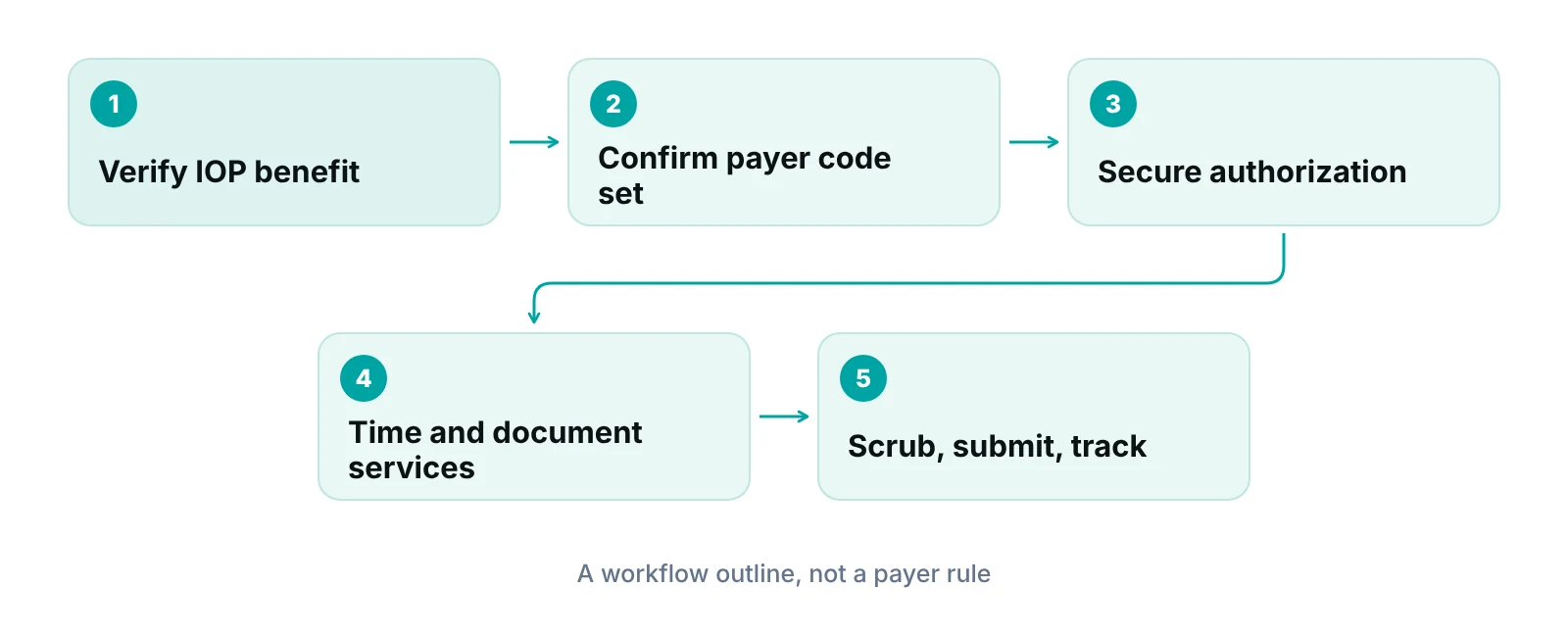
Verify the IOP benefit and its authorization status before the patient’s first session, not when the first claim denies. IOP is a stretch of several weeks, so one missed authorization end date can leave many days of care unbillable. Our guides to behavioral health eligibility verification and prior authorization cover the process in detail.
- Benefit and carve-out: confirm IOP is covered and which plan or vendor manages behavioral health for this member.
- Code set: confirm whether the payer wants H0015, S9480 or CPT/HCPCS lines with a revenue code, and for which facility type.
- Authorization: record the approved start and end dates, the level of care and the units or days approved.
- Hours rule: record the weekly or daily hours the payer expects, so scheduling and billing work from the same number.
- Continued-stay review: note the date by which you must request more days. South Carolina, for example, reviews stays beyond 30 calendar days.
Put the continued-stay request date on a work queue, not in someone’s memory. We do not have a source for a universal lead time, so set your own based on how long each payer takes to respond.
What documentation supports an IOP claim?
The note has to show medical necessity for each service, with beginning and ending times, and the chart has to show the certification and plan of care behind it. That is Noridian’s documentation list for Medicare IOP (Noridian JE Part A), and it is a sound baseline for commercial and Medicaid payers too.
- The physician’s certification of the weekly hours needed, and each re-certification.
- An individualized, physician-signed plan of care with measurable goals and a multidisciplinary approach.
- Start and end times for each service, because hospitals must retain them.
- Notes tied to the patient’s response, symptoms and discharge-focused goals.
Keep non-covered activity off the IOP claim. Noridian lists meals, transportation, recreational or diversional activities, psychosocial programs and vocational training as not covered. For a co-occurring program, that line matters because many programs include life-skills and recovery-support content that payers may not count toward billable hours.
When does it make sense to bring in billing and credentialing help?
Bring in help when your payer mix spans Medicare, Medicaid and commercial plans, because each uses a different code set and each fails in a different way. Payers also decide which provider types they will pay for IOP. South Carolina, for instance, requires hospitals to be enrolled as outpatient hospitals to be reimbursed for IOP. Confirm enrollment and contract scope early; our credentialing services cover payer enrollment for programs and clinicians.
For the claims side, our medical billing services include charge entry, coding support, claim scrubbing and denial follow-up, and our team works inside your existing EHR (for example PrognoCIS, eClinicalWorks or athenahealth). In our portal, claim data-completeness checks run before submission and workflow rules can hold a claim for review, which suits an IOP where the payer-specific code set has to be right before the claim leaves. Behavioral health is one of the areas we cover on our behavioral and mental health RCM page.
What to ask any IOP billing partner
Ask how they separate Medicare, Medicaid and commercial code sets, how they track authorization end dates, who reviews a claim before it is sent, and how they handle denials. Ask for a Business Associate Agreement before any patient data is shared.
Want a second set of eyes on your IOP billing setup?
We review your payer code rules, authorization tracking and denial reasons in a free practice audit.
How do you keep IOP claims from denying?
Most IOP denials we would expect start before the claim: a wrong code set, an expired authorization, or hours the note cannot support. We have not found a reliable published denial rate for IOP claims, so the earlier version’s 20 to 30 percent figure has been removed. Track your own denial reasons instead; our guide to medical billing denial management shows how to sort them by cause.
If you want to size what a recurring denial pattern costs your program, the revenue calculator gives you a starting estimate from your own volume and rates.
Our recommendations
- Write a one-page code rule for every payer. List the code, revenue code, unit rule and hours rule for each payer you bill. Get answers in writing, and date them.
- Bill one IOP day once. Report both diagnoses, but keep one IOP charge for the patient and date unless a payer instructs otherwise in writing.
- Treat Medicare as its own workflow. Certification, plan of care, condition code 92 and revenue code 0905 belong to a separate checklist from your Medicaid H0015 or S9480 workflow.
- Put authorization end dates on a queue. Assign an owner and a due date for each continued-stay request. Do not rely on memory for a multi-week course of care.
- Time every service. Make start and end times a required field in the note template. Billing cannot add them later.
- Re-check the rules every year. Medicare, state Medicaid and plan policies change. Review your payer code rules each January and when a bulletin arrives.
Bottom line
Co-occurring IOP billing is a payer-rules problem more than a coding problem. Get each payer’s code set, hours and authorization rules in writing, bill one IOP day once with both diagnoses, and keep the chart ready to support the hours. If you want help with the claim side, see our medical billing services or talk to our team.
Frequently asked questions
Can I bill H0015 and S9480 for the same patient on the same day?
Do not assume so. Medicare pays one IOP payment per day on rural health clinic claims, and Louisiana Medicaid limits H0015 to one unit per day. Some payers may handle mixed programs differently, so ask the payer which single code it wants, and keep the answer in writing.
Does Medicare use H0015 or S9480?
No. CMS says S codes are not payable by Medicare, and H codes are used by state Medicaid agencies. Medicare IOP institutional claims use revenue code 0905 and condition code 92 with CPT or HCPCS service lines.
How many hours does an IOP need to run?
It depends on the payer. Medicare requires a physician certification of at least 9 hours per week. The H0015 descriptor describes at least 3 hours a day on at least 3 days a week. South Carolina Medicaid lists 9 to 19 hours a week for adults in hospital IOP.
Which revenue code goes on an IOP claim?
For Medicare psychiatric IOP, revenue code 0905, with condition code 92. South Carolina Medicaid also uses 905 with S9480. One Medicare contractor lists 0906 only for chemical dependency IOP in opioid treatment programs. For commercial plans, follow the contract and provider manual.
Is prior authorization required for IOP?
Often, but it is payer-specific. South Carolina Medicaid requires it for IOP and PHP and reviews stays beyond 30 calendar days. We did not find a Medicare authorization rule in the documents we reviewed, so check each Medicare Advantage plan separately.
How do I report both diagnoses on one IOP claim?
List both conditions as diagnoses and keep the documentation consistent with each. The FY 2026 ICD-10-CM guidelines include a rule to code all documented conditions that coexist in outpatient settings. First-listed diagnosis order can matter to a payer, so confirm its preference.
Get your free practice audit
Tell us about your practice. We will contact you using the details you give.
- A review of your recent claims, denials and A/R aging
- Where your front desk and prior authorizations slow payment
- A prioritized fix list you keep, whether or not you hire us
Pricing is quoted after the audit, based on your volume and the services you choose. Prefer to talk? Call +1 (302) 556-2288.
Sources
- CMS Change Request 13264 (Transmittal R12460OTN): Intensive Outpatient Program — CMS (2024)
- MLN Matters MM13264: Intensive Outpatient Program for FQHCs and RHCs — HHS / CMS (2024)
- Intensive Outpatient Program (IOP) – JE Part A — Noridian Healthcare Solutions (2026)
- Intensive outpatient program (IOP) billing requirements for institutional services — First Coast Service Options (2026)
- CY 2024 Medicare Hospital OPPS and ASC Payment System Final Rule fact sheet — CMS (2023)
- HCPCS Level II Coding Procedures (revised Nov. 13, 2015) — CMS (2015)
- H0015 public notice — Arizona Health Care Cost Containment System (AHCCCS) (2023)
- Informational Bulletin 22-36: SUD Intensive Outpatient H0015 — Louisiana Department of Health (2022)
- Medicaid Bulletin MB# 24-054: IOP and PHP — South Carolina Department of Health and Human Services (2024)
- H0015 Payment Policy — Molina Healthcare (Kentucky Medicaid) (2024)
- ICD-10-CM Official Guidelines for Coding and Reporting FY 2026 — CDC / NCHS (2025)
Disclaimer: This article is educational and is not legal, coding, billing or compliance advice. Payer rules, codes and rates vary by plan and state and change over time. Confirm current requirements with each payer and the official code sets before you bill.
