
Outsourcing urgent care billing makes sense when walk-in volume, payer mix and staff turnover outpace what one or two in-house billers can handle accurately. Decide from your own denial and A/R numbers, then pick a partner that knows urgent care contracts, signs a business associate agreement and deposits payments to your account.
Most urgent care owners ask this question after a specific pain: a biller leaves and claims pile up, denials climb after a payer contract change, or a growing center outgrows a one-person billing desk. This guide gives you a decision test instead, the parts of urgent care billing that a generalist can get wrong, the measures to track before and after you switch, and the questions to ask a partner. For the general vendor checklist that applies to any specialty, see our guide to questions to ask before hiring a medical billing company.
Key takeaways
- Decide from your own denial, A/R and volume data, not from a vendor’s promise.
- Urgent care adds place of service 20, visit-level coding, S-code contracts, CLIA/QW and workers’ compensation.
- Hybrid works if every billing step has one named owner.
- Insist on payments to your account, a signed business associate agreement and written reporting.
Should an urgent care center outsource its billing?
Usually yes when billing depends on one or two people, claims are aging faster than they are worked, or you cannot say why claims are denied. Usually not yet when you have a stable, experienced team, clean reporting and a clear view of every payer. The honest answer comes from your own data, not from a vendor’s brochure.
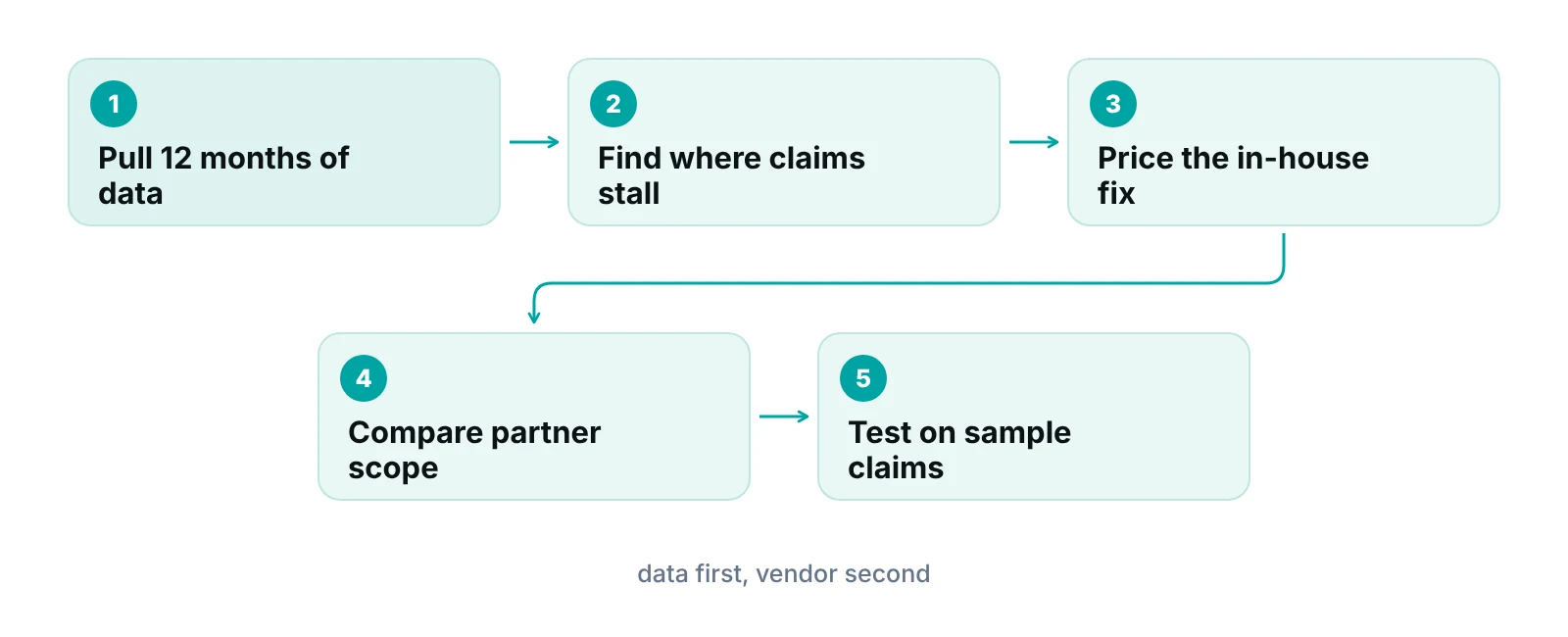
Run this test before you take a single sales call:
- Single point of failure. If your lead biller left tomorrow, who could work denials and A/R next week? If nobody, you carry a continuity risk.
- Visibility. Can you see denials by payer and reason, and A/R by aging bucket, without asking someone to build a report? If not, you cannot manage the problem you may be paying to fix.
- Payer complexity. Do you bill commercial plans, Medicare, Medicaid, workers’ compensation and employer contracts, plus self-pay? Each has its own rules and filing limits.
- Capacity at peak. When visit volume spikes, does charge entry fall behind? Unbilled charges are the quietest form of lost revenue.
- Cost of the alternative. Price the real in-house cost: salaries, benefits, training, software, clearinghouse fees and the cost of a vacancy. Then compare it with a written quote.
“I would never recommend outsourcing as a reflex. If you cannot describe your own denial reasons, a new billing company will inherit the confusion rather than clear it.”
— Awais Afzal, Healthcare Operations & Data Analyst
What makes urgent care billing different from a regular office?
Urgent care mixes unscheduled visits, many payer types and same-day procedures, and each of those creates its own billing errors. CMS defines place of service 20 as a location, distinct from a hospital emergency room, an office or a clinic, that diagnoses and treats illness or injury for unscheduled, ambulatory patients seeking immediate attention (CMS place of service code set). That unscheduled flow is the root of most of the difference.
Volume is part of it. The Urgent Care Association’s spring 2021 benchmarking report put average volume at about 30 visits per clinic per day in 2018 and 2019, and 45 to 50 per day in early 2021 (Urgent Care Association). Those figures are several years old, so use them only as a sense of scale. More walk-ins mean more registrations captured at a front desk under time pressure, which is where wrong insurance details and missing subscriber data start. Our guide to common urgent care billing mistakes covers those errors in detail.
| Topic | What to know | Ask a billing partner |
|---|---|---|
| Place of service | Urgent care has its own place of service code, 20, defined by CMS for unscheduled walk-in care. | How do you set place of service per payer, and how do you check it on claims? |
| Visit level | Since 2021, office and outpatient visit codes 99202 to 99215 are chosen by medical decision making or total time on the date of the encounter. Code 99201 was deleted. | Who reviews visit levels against documentation, and do providers get feedback? |
| S codes | S codes are temporary national codes used mainly by private insurers. Medicare does not pay claims that use them. Some commercial urgent care contracts use S9083 (a per-visit global code) or S9088 (added to a visit code), so check each contract. | Which of our payers require S codes, and how do you load that into the rules? |
| Waived lab tests | CMS ties payment for waived-complexity tests to a valid CLIA certificate of waiver, and the QW modifier is required on the codes for certain waived tests. | How do you check that test codes and modifiers match our CLIA certificate? |
| Workers’ compensation | Workers’ compensation fee schedules are set state by state. WCRI’s 2025 study covers 44 states with fee schedules plus the District of Columbia. | How do you bill employer and occupational visits, and which state schedules do you work with? |
| Medicare filing deadline | Medicare claims must generally be filed within one calendar year after the date of service, with limited exceptions. Commercial deadlines come from each payer contract. | How do you track filing limits by payer, and what happens to claims close to the limit? |
Sources: CMS (place of service code set; HCPCS Level II coding procedures; transmittal R13465CP, 2025); MGMA (2021 E/M changes); JUCM (2014, for S9083 and S9088); WCRI (2025); 42 CFR 424.44.
These rules stack. A partner who bills mostly scheduled office visits may not know to check the S-code language in your commercial contracts, or how workers’ compensation claims differ from health plan claims. Our walkthrough of urgent care billing and coding and our note on workers’ compensation in the revenue cycle go deeper on the coding and payer sides.
Verify your own contracts
S-code use, bundling and workers’ compensation rules vary by payer and state. The JUCM article we used for S9083 and S9088 dates from 2014, so treat it as background and confirm current payer policy in your contracts. Our page on urgent care billing shows how we approach the specialty.
How do in-house, outsourced and hybrid billing compare?
Each model trades control against capacity and expertise, and hybrid is often the practical middle. The table compares them on the points that matter most to a busy urgent care. It reflects our experience and is not survey data.
| Factor | In-house | Outsourced | Hybrid |
|---|---|---|---|
| Day-to-day control | Highest. Staff sit with your providers and front desk. | Lower. You depend on reports and on how fast the partner responds. | Shared. You keep tasks that need to be on site. |
| Coverage when someone leaves | Weak if one or two people hold all the knowledge. | Stronger if the partner has a team behind your account. | Depends on which tasks sit with each side. |
| Payer and contract knowledge | Only what your team has learned and kept current. | Can be broad, but only useful if it includes urgent care. | Can fill gaps such as denials or A/R follow-up. |
| Cost shape | Fixed salaries, benefits, training, software and vacancies. | Fee based on a written model. Ask what is included and what costs extra. | Fewer hires than full in-house, but two parties to manage. |
| Main risk | Backlog and burnout when volume rises. | Weak reporting, unclear money flow, hard exit. | Gaps between who does what. |
| Often a fit when | You have an experienced team, reporting and stable payers. | You are scaling, adding sites or losing billers. | You want help on denials and A/R but keep charge entry in-house. |
Editorial comparison by RCM Finder. Not survey data.
Hybrid needs a written owner for every step, because a denial that sits between the front desk and the partner often stays unworked. Write down who owns eligibility, charge entry, claim submission, payment posting, denials and patient balances.
What should you measure before and after outsourcing?
Measure with fixed definitions before you sign, then use the same formulas after the switch. We do not quote benchmark numbers here, because published figures rarely match an urgent care’s payer mix and any unsourced “before and after” table is a sales claim, not evidence. The Healthcare Financial Management Association’s MAP Keys give standard formulas (HFMA MAP Keys, 2023 edition).
| Measure (HFMA key) | Formula as published | What it tells an urgent care |
|---|---|---|
| Net days in A/R (FM-1) | Net accounts receivable divided by average daily net patient service revenue | Whether payments are keeping pace with visits. |
| Remittance denial rate (AR-5) | Claims denied divided by claims remitted, counting actionable denials | Whether front-desk data and coding are producing payable claims. |
| Denial write-offs (AR-6) | Net dollars written off as denials divided by average monthly net patient service revenue | How much denied revenue you are giving up. |
| Cost to collect (FM-6) | Total revenue cycle cost divided by total patient service cash collected | Whether in-house or outsourced billing costs less for what it collects. |
Source: HFMA, MAP Keys, Indicators of Revenue Cycle Excellence, 2023 edition. Check HFMA’s definition notes for exclusions.
HFMA’s own scope rules for some keys separate hospital and ambulatory data, so read the notes before comparing your numbers to anyone else’s. Pull twelve months, break results out by payer, and add patient point-of-service collections if you take payments at check-in. Our guide to revenue cycle KPIs explains how to calculate and read these.
Then agree on reporting in writing. A partner should send the same measures on a set schedule, so a bad month is visible in weeks rather than a quarter.
What should an urgent care ask a billing partner?
Ask the urgent care questions first, then the vendor-vetting questions that apply to every billing company. The general list lives in our ten-question billing company checklist. These are the ones specific to a walk-in center.
Urgent care fit
- Which urgent care clients do you bill for today, and which payer types and states do they involve?
- How do you handle S-code and per-visit contract terms, and who loads them into the claim rules?
- Who reviews visit levels and same-day procedure coding against documentation, and how do you feed that back to providers?
- How are occupational medicine and workers’ compensation claims billed and tracked, separately from health plan claims?
- How do you handle payer enrollment, credentialing and contract changes, and who owns each?
Money flow and fees
Payments should land in an account in your practice’s name. For Medicare, the rule is explicit: Medicare may pay a billing agent only if conditions are met, including that payment is made in the provider’s name and that the agent’s compensation is not related to the dollar amounts billed or collected (42 CFR 424.73(b)(3)). Whatever fee model you choose, ask for the bank-account arrangement in writing and review the contract with counsel.
On percentage-based fees, the HHS Office of Inspector General’s 1998 guidance for billing companies voiced a longstanding concern that percentage arrangements can increase upcoding, and said pay for coders and consultants should not reward improper upcoding (OIG compliance guidance, 63 FR 70138). That is a reason to ask how coding is independently reviewed under any fee model. It is not a ruling on any particular arrangement.
Privacy and exit
HHS lists billing among business associate functions, so a billing vendor that handles patient information needs a written business associate agreement with you before it sees that data (HHS business associate guidance). A business associate must also notify you of a breach of unsecured protected health information without unreasonable delay and no later than 60 calendar days after discovery (45 CFR 164.410). Ask for shorter notice in the contract if you want it. Also ask how you get your data and claim history back if you leave.
Want a baseline before you compare quotes?
Our free practice audit reviews a sample of your claims, denials and A/R aging, so you have numbers to hold any billing partner to, including us.
What moves to a billing partner and what stays at the clinic?
Claim work moves; patient-facing capture stays. The front desk still collects insurance cards, identification and consent, and providers still write the documentation that supports the codes. A billing partner can only code and bill what the chart and registration data support.
- Usually moves: charge entry, coding review, claim scrubbing and submission, payment posting, denial and appeal work, and A/R follow-up.
- Usually stays: registration, insurance card capture, patient point-of-service payments, clinical documentation and provider questions.
- Needs a named owner: eligibility checks, patient statements and payer contract changes.
At RCM Finder, our team works inside your existing EHR (for example PrognoCIS, eClinicalWorks or athenahealth) in your practice’s time zone, and we agree on weekly reporting at the start. Our medical billing services cover claims, charge entry and coding support. We quote pricing after a free audit, not before, because a fair quote depends on your claim data. We put a Business Associate Agreement in place before accessing patient data.
Who this is not for
If your claims are clean, your A/R is current and you can explain every denial, switching adds disruption for little gain. Outsourcing is also a poor fit if you want to hand off billing without any internal oversight. Someone at the clinic still has to own the relationship, review reports and fix front-desk capture.
Curious what stalled A/R could be costing you?
Use our revenue calculator to put a rough figure on open claims before you decide.
Our recommendations
- Start from your own numbers. We would not take a vendor call before pulling twelve months of denial reasons, A/R aging by payer and visit volume by month. Every answer you hear is then testable.
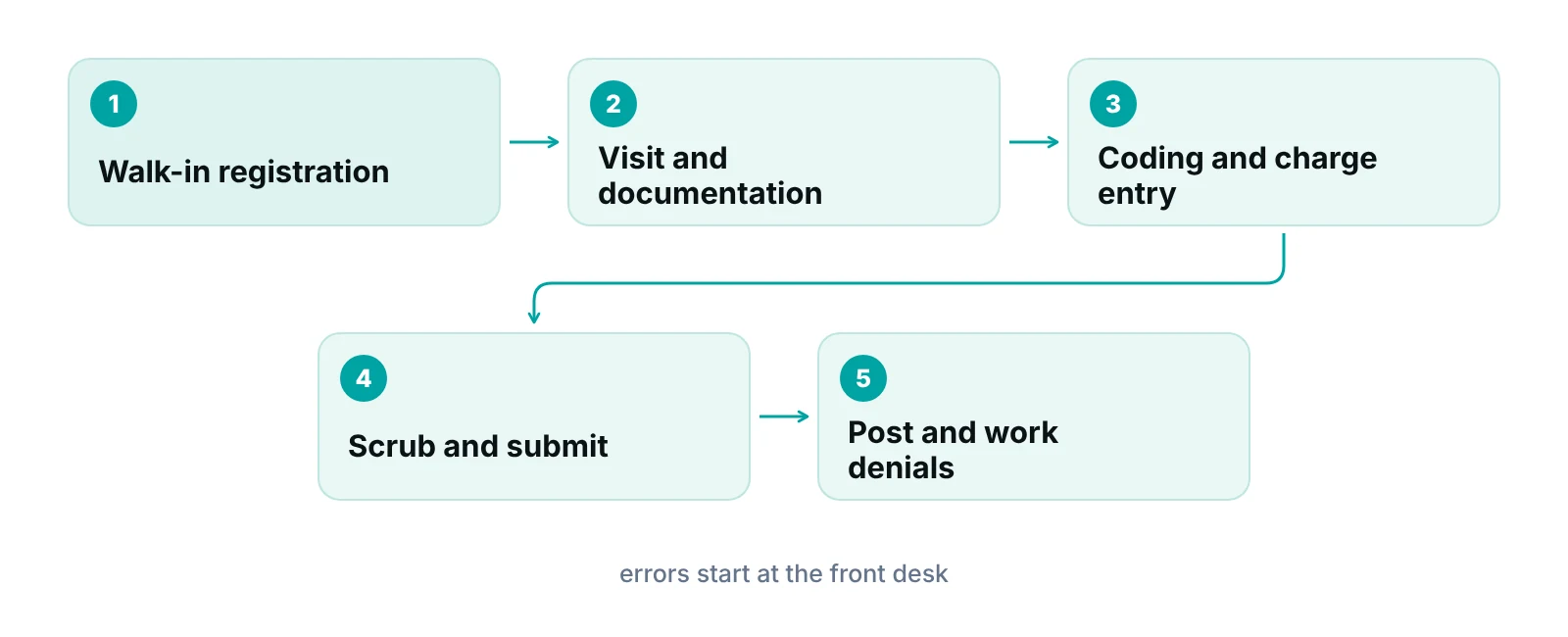
- Fix registration before you blame billing. Wrong insurance details at check-in cause denials that no billing team can fully undo. Tighten card capture and eligibility checks at the front desk first, whichever model you pick.
- Read your commercial contracts line by line. Check for S-code or per-visit terms, filing limits and bundling rules. Give any partner a clean summary, so they are not guessing.
- Test on a sample of real claims. Ask a partner to review a sample of your claims, denials and aged A/R before you sign. Judge them on what they find and how they explain it.
- Keep money and data in your name. Payments should go to your account, the business associate agreement should be signed first, and you should get your data back when you leave.
- Fix the reporting schedule in writing. Agree on the measures, the formulas and the dates before go-live, then compare against your baseline after a full cycle.
Outsourcing works better when you can see the work.
The portal gives an urgent care practice a client view of claim status by stage and owner, with reporting dashboards.
See how the RCM Finder portal works · Create a portal account
Disclosure: RCM Finder builds and sells this portal. It is a practice management system, not an EHR.
Bottom line
Outsourcing urgent care billing is worth it when it fixes a continuity, visibility or capacity problem you can measure, and not before. Start with your own data, ask the urgent care questions, and put money flow and privacy in writing. If you want an outside view of where claims stall, read how our end-to-end revenue cycle management service works, or talk to us through our contact page.
Frequently asked questions
When does it make sense to outsource urgent care billing?
It makes sense when billing relies on one or two people, claims age faster than they are worked, or you cannot explain your denials. If your team is stable, your reports are clear and your payers are well understood, in-house billing can work. Start by measuring your own denial and A/R numbers.
Does outsourcing urgent care billing guarantee higher collections?
No. Results depend on your documentation, front-desk data, payer contracts and starting point. Be wary of any quote promising a fixed percentage gain. Agree on measures such as net days in A/R and remittance denial rate, and compare them after a full billing cycle.
What is place of service 20 and why does it matter?
Place of service 20 is the CMS code for an urgent care facility, defined as a location distinct from an emergency room, office or clinic that treats unscheduled ambulatory patients seeking immediate attention. Payers use it to price and edit claims, so billing teams must set it correctly.
Can a billing company be paid a percentage of collections?
Percentage fees are common, but the OIG has long raised upcoding concerns about them, and Medicare sets conditions on paying billing agents, including payment in the provider’s name. Ask how coding is reviewed independently, and have counsel review the fee terms in the contract.
Do I need a business associate agreement with a billing company?
Yes, if the company will handle patient information for you. HHS lists billing as a business associate function, so you need a written agreement before the vendor accesses that data. Ask what it says about safeguards, breach notice and returning your data.
Can an urgent care use a hybrid billing model?
Yes. Many centers keep registration and charge entry in-house and hand denials and A/R follow-up to a partner. It works when every step has one named owner. Without that, denials fall between the front desk and the partner and stay unworked.
Get your free practice audit
Tell us about your practice. We will contact you using the details you give.
- A review of your recent claims, denials and A/R aging
- Where your front desk and prior authorizations slow payment
- A prioritized fix list you keep, whether or not you hire us
Pricing is quoted after the audit, based on your volume and the services you choose. Prefer to talk? Call +1 (302) 556-2288.
Sources
- Place of Service Code Set — CMS (current)
- 42 CFR 424.44 Time limits for filing claims — eCFR / CMS (current)
- Business Associates (HHS guidance) — HHS OCR (current)
- UCA Benchmarking Report, Spring 2021 — Urgent Care Association (2021)
- Preparing your practice for 2021 E/M changes — MGMA (2020)
- HCPCS Level II Coding Procedures — CMS (2015)
- Workers' Compensation, Medicare and S Codes — Journal of Urgent Care Medicine (2014)
- Transmittal 13465, CR 14273 (CLIA waived tests) — CMS (2025)
- Designing Workers' Compensation Medical Fee Schedules 2025 — WCRI (2025)
- MAP Keys, Indicators of Revenue Cycle Excellence, 2023 Edition — HFMA (2023)
- OIG Compliance Program Guidance for Third-Party Medical Billing Companies, 63 FR 70138 — HHS OIG / Federal Register (1998)
- 42 CFR 424.73 Prohibition of assignment; exceptions — Cornell LII (eCFR text) (current)
- 45 CFR 164.410 Notification by a business associate — Cornell LII (eCFR text) (current)
Disclaimer: This article is general educational information for medical practices. It is not legal, HIPAA-compliance, coding or billing advice. Payer rules, contract terms and state workers' compensation rules vary and can change. Confirm requirements with qualified counsel and your payers before acting.
