
Medical marketing ROI is the net gain from your marketing divided by what you spent on it. Count only new patients you can trace to a campaign, use collected revenue or contribution rather than billed charges, and include every cost. The worked example below uses clearly labelled illustrative numbers, not benchmarks, so you can substitute your own.
Clicks and calls are inputs. The return is what the practice collects from new patients, after the cost of treating them, compared with what it spent. This guide gives you the formula, one complete example, the metrics behind it and the privacy and advertising rules that shape how you measure. It is written for owners and managers, and it is educational, not legal advice.
Key takeaways
- ROI = (return – cost) / cost. An ROI of 4 means $4 net gain per $1, which is $5 returned in total.
- Count collected revenue from traceable new patients, not billed charges or existing patients.
- Prefer contribution ROI for decisions, and check a 12-month and a longer view against your own retention data.
- Track each step from source to payment: the weakest step often sits at the front desk, not in the ads.
- Report by source and counts, keep tracking tools off pages where patients share health details, and make only claims you can support.
What is medical marketing ROI?
Medical marketing ROI is the profit a marketing effort produced, expressed as a share of what the practice spent on it. If you spend $1 and get back $1.50 of profit on top, your ROI is 150%. It answers one question: did this money earn more than it cost?
The arithmetic often goes wrong. The old version of this article, for example, said an ROI of 4 meant “$4 back for every dollar.” It does not. An ROI of 4 (400%) means $4 of net gain per $1 spent, so you received $5 in total: your $1 back plus $4 more.
Which patients you count, which dollars you count and how long you wait change the answer more than the formula does. If you want the wider picture of which channels a small practice should run first, start with our guide to marketing strategies for small medical practices and come back here to measure them.
What is the formula for medical marketing ROI?
The formula is ROI = (return − marketing cost) ÷ marketing cost, multiplied by 100 if you want a percentage. “Return” should be money the practice actually collected, or better, the profit left after the direct cost of delivering care. Billed charges are not a return.
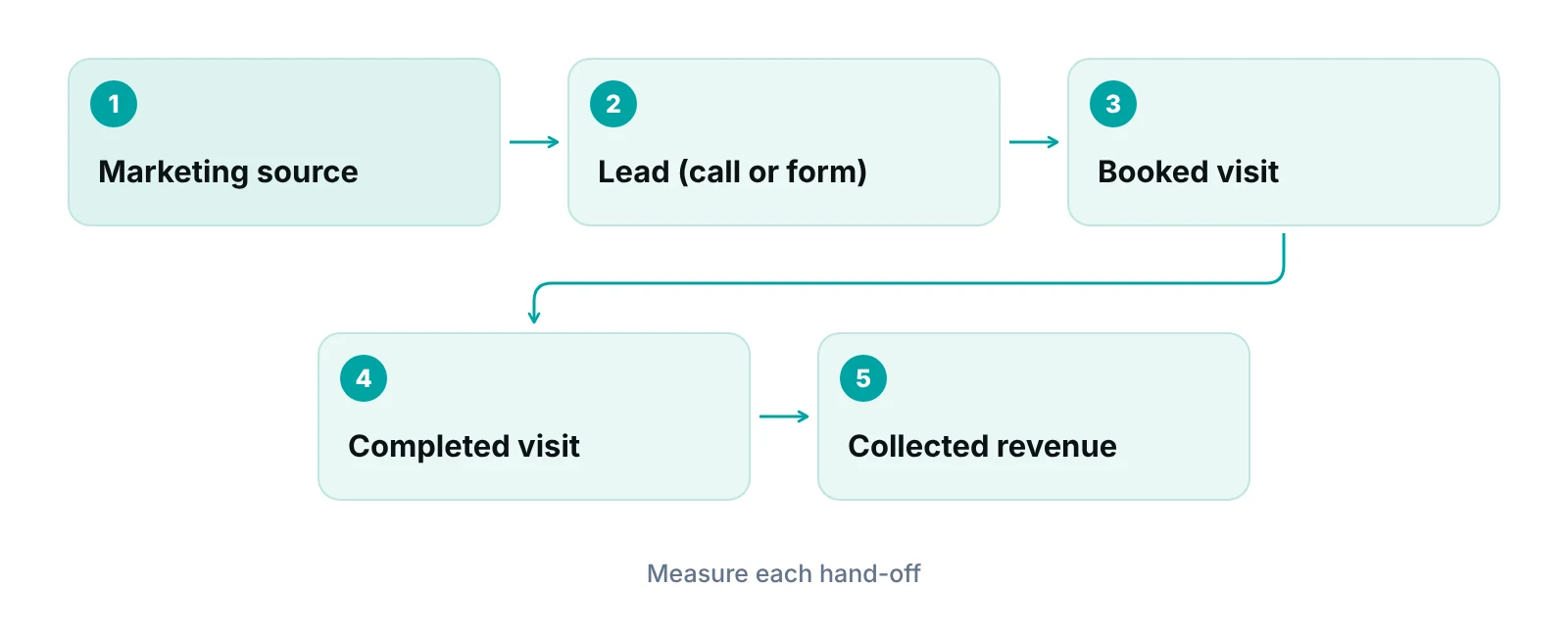
- Set a window. Pick a fixed period, such as one quarter of spend, and follow the patients it produced for at least 12 months.
- Count the full cost. Include ad spend, agency or freelancer fees, call-tracking and landing-page tools, and staff time you can put a number on.
- Count only traceable new patients. A patient counts if you can tie the first call, form or booking to the campaign. Existing patients who happened to click an ad do not.
- Use collected revenue. Payments received after contractual adjustments, denials and write-offs, not the amount you billed.
- Decide revenue ROI or contribution ROI. Revenue ROI ignores the cost of seeing the patient. Contribution ROI subtracts the direct costs of care first and is the one we trust for decisions.
What does a worked example of medical marketing ROI look like?
Here is one full calculation from first lead to ROI. Every number in this example is invented to show the method. None of them is a benchmark, an average or a target. Replace each one with your own data.
| Line | Illustrative value | How it is calculated |
|---|---|---|
| Marketing cost for the period | $3,000 | Ad spend $2,000 plus $1,000 for tracking tools, landing page and content |
| Leads (calls and web forms traced to the campaign) | 60 | Counted from call tracking and form source |
| Booked new-patient visits | 30 | 50% of leads. Cost per booked visit = $3,000 ÷ 30 = $100 |
| Completed first visits (new patients) | 24 | 80% of booked. Cost per new patient = $3,000 ÷ 24 = $125 |
| Average collected revenue per new patient, first 12 months | $600 | Assumed. Take it from your own payment posting data |
| Collected revenue from the campaign | $14,400 | 24 × $600 |
| Share of revenue left after direct cost of care | 60% | Assumed. $8,640 contribution = $14,400 × 60% |
| Revenue ROI | 380% | ($14,400 − $3,000) ÷ $3,000 = 3.8 |
| Contribution ROI | 188% | ($8,640 − $3,000) ÷ $3,000 = 1.88 |
Source: RCM Finder worked example with invented numbers for illustration. Not a benchmark; formulas are standard arithmetic.
The practice paid $50 per lead, $100 per booked visit and $125 per completed new-patient visit. Each new patient was worth $360 of contribution in year one under these assumptions ($600 × 60%). That $360 is also the break-even cost per new patient: the point where contribution ROI reaches zero. Here the practice pays $125, well under $360. At $400 per new patient it would lose money even though every patient showed up.
Revenue ROI (380%) flatters the campaign compared with contribution ROI (188%). Use contribution ROI when you decide whether to keep spending.
What happens when one step weakens?
Suppose the front desk books 40% of leads instead of 50%. Bookings fall from 30 to 24, and at the same 80% show rate that is about 19 completed visits (19.2, rounded down). Contribution becomes 19 × $600 × 60% = $6,840, and contribution ROI falls from 188% to 128%. The ads did not change. A slower callback did. See our piece on the front desk and revenue cycle belongs in any marketing review.
Should you use patient lifetime value in marketing ROI?
Yes, if you have your own retention data, because a 12-month view undercounts specialties and services where patients return. Patient lifetime value is the contribution a new patient generates over the whole time they stay with you, not just the first year.
Continue the illustration. Suppose the same 24 new patients, taken together, average $1,100 of collected revenue over 36 months (the $600 in year one plus $300 and $200 in the next two years, again invented numbers). Collected revenue becomes $26,400, contribution at 60% is $15,840, and 36-month contribution ROI is ($15,840 − $3,000) ÷ $3,000 = 4.28, or 428%.
Be careful with this. A lifetime figure is an estimate built on patients you have not yet seen return. Use real data from your own billing reports, and keep the 12-month ROI beside it so the long view never hides a weak first year.
How do you track which new patients came from which marketing?
Give every channel its own way in, and write down the source at the first contact. Without that, ROI is a guess, and the loudest channel gets the credit.
- Separate phone numbers per channel. One number for the Google Business Profile, another for paid ads and another for the website lets you count calls by source.
- A required source field at intake. The front desk asks “how did you hear about us?” and picks from a short list. Ten seconds, no free text.
- Landing pages with a form that does not collect health details. Name, phone and preferred time are enough. Symptoms belong in your secure intake.
- A monthly match to collected revenue. Link each new patient’s source to the payments posted for their visits. A visit that is denied or never paid is not a return.
That last step depends on knowing which claims were actually paid. A practice management system that tracks claims by stage, with an owner on each claim, makes it easier to see what was submitted, what is pending and what was paid. If you need background on those measures, our guide to revenue cycle KPIs explains how practices usually define them.
“Marketing reports count calls. The bank statement counts collected payments. I would rather a practice owner know the second number for every campaign than admire the first.”
— Awais Afzal, Healthcare Operations & Data Analyst
Where do your new-patient calls go?
Our free practice audit looks at how calls, forms and intake are handled today and where a new patient could be slipping away before you ever measure ROI.
Which marketing metrics answer which question?
ROI is the summary. These supporting metrics tell you where to look when the summary is disappointing, and each one is simple arithmetic you can run in a spreadsheet.
| Metric | Formula | What it tells you | Watch out for |
|---|---|---|---|
| Cost per lead | Marketing cost ÷ leads | How cheaply a channel produces calls and forms | A cheap lead that never books is not cheap |
| Booked and show rates | Booked ÷ leads; completed ÷ booked | Whether the front desk converts interest and patients arrive | Slow callbacks lower them before ads do |
| Cost per new patient | Marketing cost ÷ completed new-patient visits | The price of a real patient, the number to compare across channels | Count only traceable new patients |
| Revenue ROI / contribution ROI | (Revenue or contribution − cost) ÷ cost | Quick comparison / whether spend creates profit | Margin share must come from your own books |
| Patient lifetime value | Contribution per patient over their time with you | Whether a higher cost per patient is still worth it | An estimate; check it against real retention |
Source: standard marketing arithmetic; no external benchmark values are used. Define each term the same way every month.
Does specialty change the math?
Yes. Revenue per new patient, payer mix, referral dependence and how often patients return differ by specialty, so one practice’s cost per new patient says little about another’s. Start from your own collections, then look at the page for your specialty to see how billing patterns differ, since they shape what you actually collect.
How do you measure marketing ROI without breaking HIPAA or FTC rules?
Measure with the least patient information that works, keep tracking tools away from pages where patients share health details, and make only advertising claims you can support. The HIPAA and FTC primary sources below set the boundaries; your privacy officer or healthcare attorney decides how they apply to you.
HHS explains that, under the Privacy Rule, marketing is a communication about a product or service that encourages people to buy or use it, and that using or disclosing protected health information (PHI) for marketing generally needs the individual’s written authorization. HHS lists exceptions, including face-to-face communication and promotional gifts of nominal value, and says communications for a patient’s treatment are not marketing. It also says covered entities may not sell patient lists to third parties. See HHS OCR’s marketing guidance. Uploading a patient list to an ad platform, or sending patient details to an agency, is where practices can cross the line.
| What you want to measure | Rule that applies | Safer way to do it |
|---|---|---|
| Match patient names or lists to ad campaigns | HIPAA marketing rule: written authorization generally required; no sale of patient lists | Report by source and count, not by patient. Get privacy-officer approval before any list leaves the practice |
| Website analytics and ad tags | HHS online tracking guidance: tags can disclose PHI on authenticated pages and where a visitor schedules care; a tracking vendor handling PHI needs a BAA; a cookie banner is not an authorization | Keep tags off patient-portal, login and booking pages unless approved; review each tag with your privacy officer |
| Call tracking and recording | HHS business associate guidance: a vendor that creates, receives, maintains or transmits PHI for you is a business associate, decided by function, and needs a written BAA | Ask what the vendor stores, who can hear recordings and whether a BAA is needed before any patient calls are routed through it |
| Publishing results or patient stories in ads | FTC: ads must be truthful, with a reasonable basis before they run; “results may vary” is not enough on its own | Do not publish outcome or ROI-style claims without evidence; have counsel review testimonials |
Sources: HHS OCR marketing guidance; HHS OCR online tracking guidance (last reviewed June 26, 2024); HHS business associate guidance (last reviewed July 30, 2026); FTC Advertising FAQ’s: A Guide for Small Business.
One point on tracking tags deserves care. In June 2024 a federal court in American Hospital Association v. Becerra vacated the part of HHS’s guidance saying HIPAA is triggered when a tool links an IP address to a visit to a public webpage about health conditions or providers. HHS’s page said it was evaluating next steps. Because that can change, confirm the current position with counsel.
On advertising, the FTC says ads must be truthful and backed by objective evidence before they run; see the FTC advertising FAQs before you quote results, and our HIPAA compliance checklist for medical practices for wider safeguards.
How can a practice improve its marketing ROI?
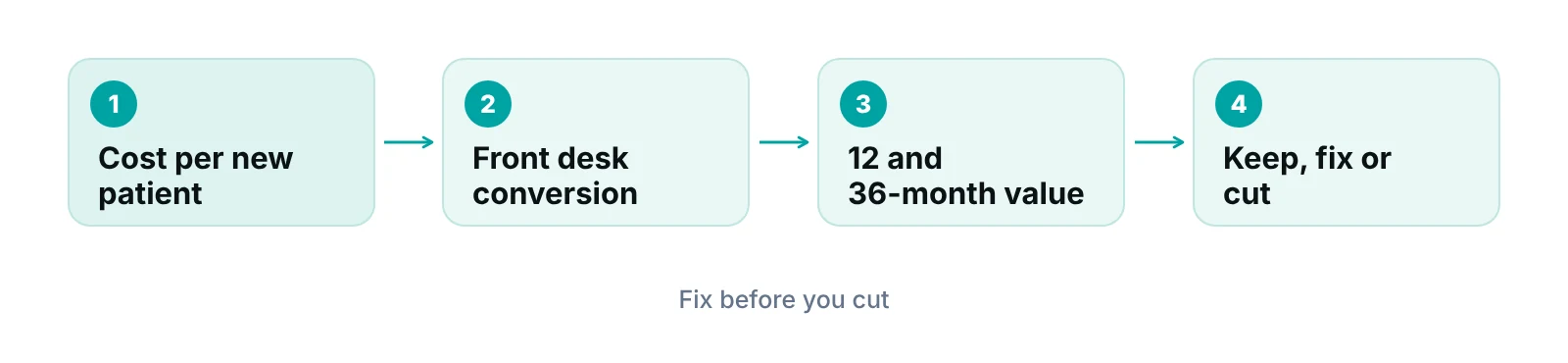
Fix the weakest measured step first, because improving it lifts every channel upstream.
- Answer every lead fast. A missed call or slow callback shrinks the booked rate before any ad can help.
- Fix the page that receives the click. Make the phone number, location and next step obvious on mobile. Our healthcare SEO guide covers the search side, and our review of medical website design covers page layout.
- Compare channels on cost per new patient and contribution ROI, not clicks.
- Protect your reputation signal. Honest reviews influence which practice a patient calls. See online reputation management for doctors for compliant ways to ask.
- Close the loop to collections. Re-run the numbers when payments post, so denied or unpaid visits stop counting as a return.
If you would rather hand the work to a team, our healthcare digital marketing services cover local search, paid search and reputation, with measurement set up around the steps in this article.
What is the next step after you understand the formula?
Put your own numbers into the same structure and see where the biggest gap sits.
Test your own numbers
Our revenue calculator helps you see how changes in collections and volume affect your practice, a useful companion to the ROI math above.
Our recommendations
- Start with one number you can trust. We would begin with cost per completed new-patient visit for one channel. It forces you to trace sources and count real patients before you build anything more complex.
- Write the source down at the first contact. We would make the source field mandatory at intake and keep the list short. Free text becomes unusable within a month.
- Report to your agency by source and count, not by patient. We would not send patient names or visit details to a marketing vendor to “prove” ROI. Aggregate counts do the job and keep PHI out of the report.
- Judge contribution ROI after a full cycle. We would wait for a booking, visit and payment cycle before cutting a channel, and we would compute contribution, not only revenue.
- Review tags and call tools with your privacy officer. We would list every tracking tag and call tool, ask who receives what, and get BAAs where a vendor handles PHI before any more spend goes through them.
- Keep your own benchmarks. We would build a four-quarter history of your own cost per new patient and collected revenue per patient. Your history beats any industry average.
Know which visits were actually paid.
Our portal tracks each claim by stage with an assigned owner, and reporting dashboards show where claims sit, which helps you tie new-patient visits to collected payments. It does not measure ad spend or lead sources.
See how the RCM Finder portal works · Create a portal account
Disclosure: RCM Finder builds and sells this portal. It is a practice management system, not an EHR.
Bottom line
Medical marketing ROI is net gain divided by cost, measured on traceable new patients and collected dollars, with contribution preferred to revenue and your own history preferred to any benchmark. Track each step from source to payment, keep patient information out of marketing reports, and fix the weakest step before spending more. If you want help running campaigns with measurement built in, see our healthcare digital marketing services, and if unpaid or denied visits are hiding your true return, our medical billing services address the collections side.
Frequently asked questions
How do I calculate medical marketing ROI?
Subtract the marketing cost from the return, divide by the marketing cost, and multiply by 100 for a percentage. Use collected revenue or contribution (revenue minus the direct cost of care) as the return, count only traceable new patients, and include all costs such as agency fees and tools. The worked example above shows each step.
What does an ROI of 4 actually mean?
An ROI of 4, or 400%, means $4 of net gain for every $1 spent, so $5 came back in total counting your original $1. Saying it “earned $4 back” understates the total return. Always say whether you are quoting net gain (ROI) or total return per dollar (often called ROAS).
Is revenue ROI or contribution ROI better?
Contribution ROI is better for decisions because it subtracts the direct cost of delivering care before comparing with marketing cost. Revenue ROI is fine for a quick channel comparison. In our illustrative example the two gave 380% and 188% for the same campaign, which shows how much the choice matters.
How long should I wait before judging a campaign?
Wait until patients from the campaign have booked, attended and been paid, which usually takes longer than the ad period itself. The exact time depends on your specialty and payers, so use your own booking and payment history rather than a generic number, and keep checking a 12-month view.
Can I give my marketing agency patient lists to measure ROI?
Be cautious. HHS says PHI generally cannot be used or disclosed for marketing without written authorization, and covered entities may not sell patient lists. Ask your agency to report by source and counts instead, and have your privacy officer or attorney review any arrangement that involves patient information.
Do website tracking tags create HIPAA risk?
They can. HHS guidance says tags on authenticated pages, and on pages where someone schedules care, can disclose PHI, and a vendor that handles PHI needs a business associate agreement. A court vacated one part of that guidance in June 2024, so confirm the current position with counsel before you add or keep tags.
Get your free practice audit
Tell us about your practice. We will contact you using the details you give.
- A review of your recent claims, denials and A/R aging
- Where your front desk and prior authorizations slow payment
- A prioritized fix list you keep, whether or not you hire us
Pricing is quoted after the audit, based on your volume and the services you choose. Prefer to talk? Call +1 (302) 556-2288.
Sources
- Marketing (HIPAA Privacy Rule guidance) — HHS Office for Civil Rights (n.d.)
- Guidance on HIPAA & Online Tracking Technologies — HHS Office for Civil Rights (2024 (last reviewed June 26, 2024))
- Business Associates — HHS Office for Civil Rights (2026 (last reviewed July 30, 2026))
- Advertising FAQs: A Guide for Small Business — Federal Trade Commission (n.d.)
Disclaimer: This article is general educational information about measuring practice marketing and is not legal, compliance, tax, accounting or financial advice. All dollar amounts and percentages in the worked examples are invented for illustration and are not benchmarks, averages or promises of results. HIPAA, FTC and state rules vary by situation and change over time. Have your privacy officer or a healthcare attorney review tracking tools, vendor arrangements, patient communications and advertising claims before you use them.
