
An explanation of benefits (EOB) is the statement a health plan sends a patient after it processes a claim. It shows the billed amount, the allowed amount, what the plan paid and what the patient may owe. It is not a bill. Practices post payments from the remittance advice instead.
This guide explains each line of an EOB, how it differs from the electronic remittance advice (ERA), and what billing staff should check before they send a patient a balance. It also covers the advance EOB created by the No Surprises Act and why you should confirm its status before relying on it.
Key takeaways
- An EOB is written for the patient; a remittance advice is written for the practice.
- Post payments from the remittance, and use the EOB to answer patient questions.
- Patient responsibility is what the patient owes, not what the patient is owed.
- Compare allowed amounts with your contract to find underpayments.
- The advance EOB had enforcement deferred as of the 2022 notice; confirm today’s status.
What an explanation of benefits is, and what it is not
An explanation of benefits is the statement a health plan sends to the member after it processes a claim. It shows what the provider billed, what the plan allowed, what the plan paid, and what the member may owe. It is usually marked as not a bill. The bill is the statement the practice sends.
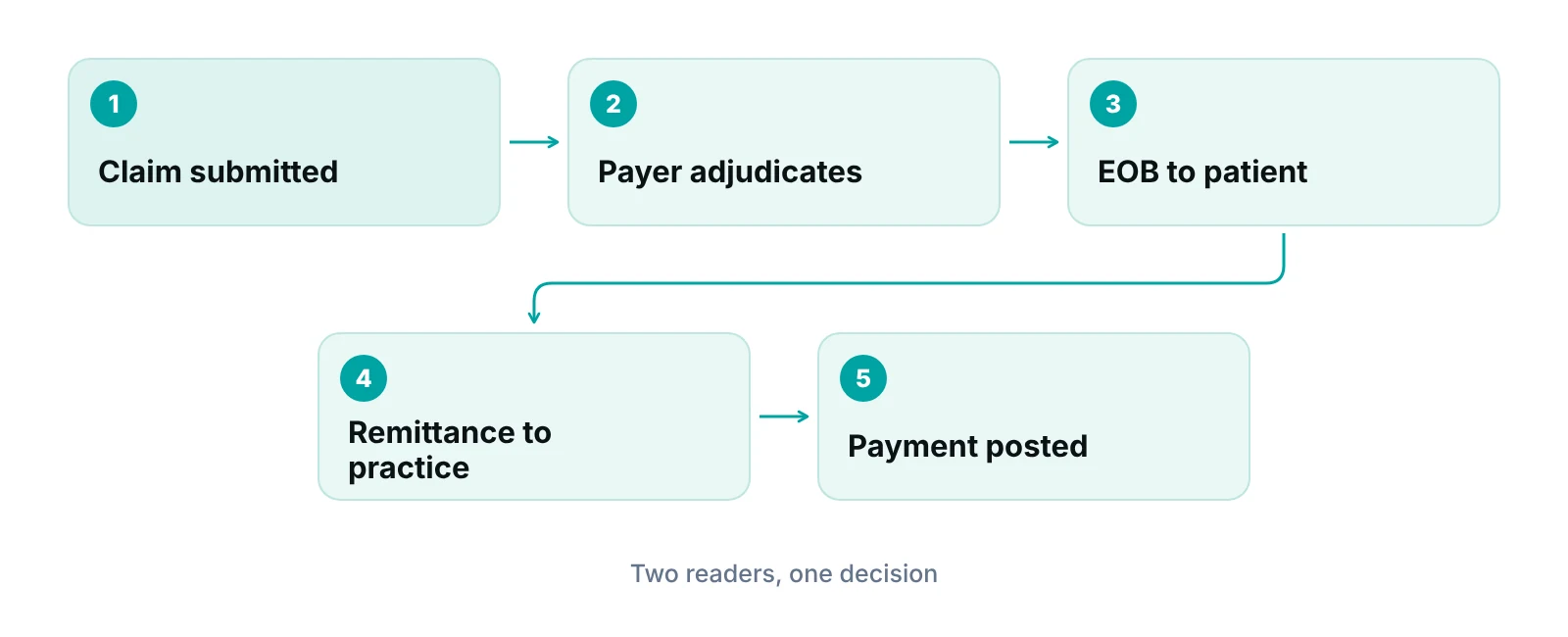
The EOB belongs to the patient and the plan. It is a summary written for a member, and it is usually one claim at a time. Your billing team works from a different document, the remittance advice, which comes from the payer to the practice and carries the detail needed to post payments and work denials. Many practices use the two terms as if they meant the same thing. They do not, and the difference shapes how a front desk answers a patient call.
The old version of this guide defined patient responsibility as the amount the patient is “owed” after insurance pays. That was wrong. Patient responsibility is the amount the patient owes, after the plan has applied the deductible, copay and coinsurance. We corrected it throughout this guide.
EOB or ERA: which one are you holding?
If it came to the patient from the health plan and explains one claim in plain language, it is an EOB. If it came to the practice, in an electronic file or on paper, and lists many claims with adjustment codes, it is a remittance advice. For the full comparison, see our guide to ERA vs EOB and electronic remittance advice.
How to read an EOB, line by line
Read an EOB from the top: who the patient is, which claim it covers, then the money from left to right, from billed to allowed to paid to owed. Layouts differ by plan, but most show the same building blocks under different labels.
| EOB field | What it usually means | What staff should check |
|---|---|---|
| Date of service and provider | The visit date and the billing provider on the claim | Matches your schedule and charge entry, including the rendering and billing provider |
| Procedure or service description | The service the plan processed, often shown with a code | Matches the codes you billed; flag any change made by the plan |
| Billed amount | The charge the practice submitted | Matches your charge master and the claim you sent |
| Allowed amount | The amount the plan treats as eligible for payment under its contract or rules | Matches your contracted rate for that plan; a gap is a possible underpayment |
| Plan paid | What the plan paid, or will pay, to the provider | Matches the payment or remittance you received |
| Patient responsibility | What the member owes, split into deductible, copay and coinsurance | Matches what you collected at the visit before you send a statement |
| Reason or remark notes | Plain-language or coded explanation of any denial or reduction | Decide whether to bill the patient, appeal, correct and resubmit, or write off |
General description of common EOB layouts. Field names and order vary by health plan.
Two terms trip up patients most. The allowed amount is not what you billed, and the gap between billed and allowed is usually not something the patient owes when the provider is in network. Patient responsibility is the only line that tells the patient what they may owe. Whether the practice can bill the difference between billed and allowed depends on the contract and on whether the provider is in network, so check the plan agreement before you send a balance. Our guide to in-network vs out-of-network billing covers that split.
If a patient has more than one plan, each plan sends its own EOB, and the order of payment matters. See how coordination of benefits works in medical billing before you bill the second plan or the patient.
EOB vs ERA: two documents for two readers
An EOB speaks to the patient. An ERA speaks to the billing system. For electronic payment and remittance advice, HIPAA names one standard: the ASC X12 835, Version 5010, identified as ASC X12N/005010X221, in the federal transaction rules (45 CFR 162.1602). Payers that send an 835 explain each adjustment with a claim adjustment reason code and, where needed, a remittance advice remark code. The CMS instructions to Medicare contractors require the same current codes on the 835 and on the paper remittance.
| Feature | EOB | ERA (835) or paper remittance |
|---|---|---|
| Written for | The patient or member | The provider’s billing and posting team |
| Sent by | The health plan | The payer, with or alongside the payment |
| Scope | Usually one claim, in plain language | Many claims in one payment, with line-level detail |
| Adjustment detail | Short notes on what the plan did | Standard claim adjustment reason codes and remark codes |
| Main use | Helps the patient check what they may owe | Posts payments, finds denials and underpayments |
| Format | Paper or portal | Electronic file under the HIPAA 835 standard, or a paper copy |
Source: eCFR, 45 CFR 162.1602 (current); CMS Change Request R1804CP (Medicare remittance advice). The Scope and Written-for rows are general descriptions, not regulatory text.
The practical rule: post from the remittance, not the EOB. Use the EOB when a patient calls, because it shows what the patient was told. Our explainer on what an ERA is and our payment posting steps show how the remittance feeds the ledger.
What your staff do with the EOB and the remittance
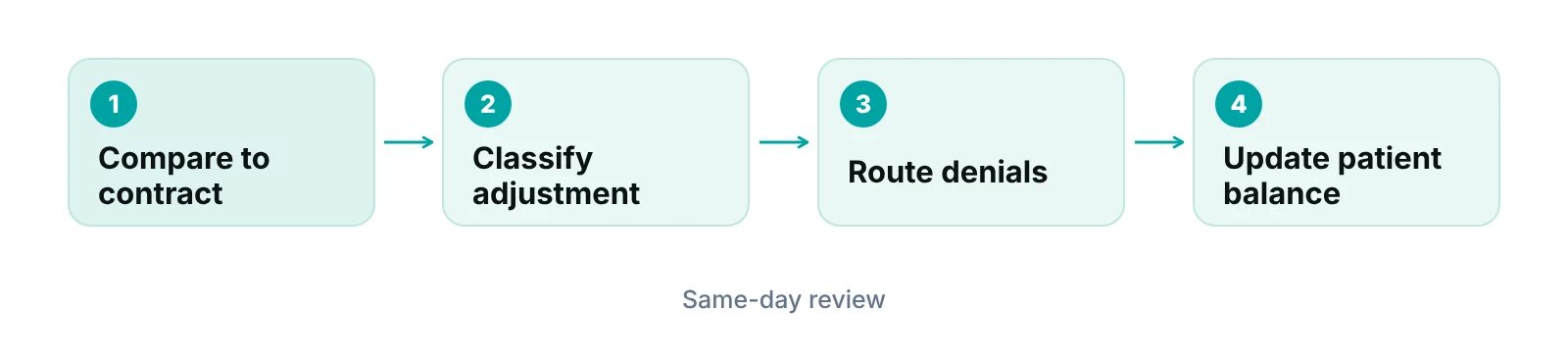
Staff use EOBs as a check on the account and as a script for patient calls. They use remittances to post and to find money left on the table. The two together answer one question: did the plan pay what the contract says, and does the patient owe what the plan says?
1. Match payment to expected amount
Compare the allowed and paid amounts with the contracted rate for that plan and that code. Differences go on a short list for follow-up. A practice that posts payments without comparing them to an expected amount will not see underpayments. A practice management system that tracks claims by stage and flags underpayments against expected amounts can do that comparison for you, but a spreadsheet and a fee schedule work for a small practice.
2. Sort every adjustment before billing the patient
Read the adjustment reason before moving any balance to the patient. Some adjustments are contractual and cannot be billed to the patient. Others are patient responsibility. Others are denials that need a correction or an appeal. Our guide to the CO-45 adjustment shows one common example of reading a contractual adjustment.
3. Route denials the same day
A denial that sits for weeks loses its appeal window. Route each denial to a named owner with a due date, and use your payer’s written rules to set the deadline. The workflow is covered in our medical billing denial management guide; practices that want it run for them can look at denial management services.
4. Answer patient calls from the EOB
Patients call when the EOB and the practice statement disagree. Ask the patient to read the claim number and the patient responsibility line, then compare it with your ledger. Our guide to patient responsibility in medical billing explains how the balance is built.
“A statement that disagrees with the EOB is a question, not a dispute. Check the claim number first, then the payer's remittance, then the balance.”
The advance EOB under the No Surprises Act
An advance explanation of benefits is a different document from the EOB you receive after a claim. It is a cost estimate a plan sends before care, and the law behind it is the No Surprises Act. Its enforcement has been on hold, so most practices will not see one yet. Check the current status before you build a workflow around it.
The law, added by section 111 of the Consolidated Appropriations Act, 2021, tells group health plans and insurers to send an advance EOB to the patient after they receive a good faith estimate from the provider. The Federal Register notice of September 16, 2022 lists what it must contain and states that the Departments deferred enforcement until rulemaking is complete.
| Required item | What it tells the patient |
|---|---|
| Network status | Whether the provider or facility is in network |
| Contracted rate | The rate for a participating provider, or how to find participating providers if the provider is out of network |
| Good faith estimate | The estimate the plan received from the provider |
| Plan payment estimate | The amount the plan expects to pay |
| Cost sharing | The amount the patient would owe |
| Accumulators | An estimate of what the patient has already paid toward deductible and out-of-pocket maximum |
| Care management notice | Whether prior authorization or step therapy may apply |
Source: Departments of Labor, Health and Human Services and the Treasury, Request for Information, Federal Register (September 16, 2022). The notice describes the statute; the document must also state it is an estimate that may change.
The notice sets timing at generally one business day after the plan receives the good faith estimate, and three business days when the service was scheduled at least ten business days ahead or the patient asked. As of that notice no rule had been proposed or finalized, and HFMA’s tracking of the No Surprises Act also reported enforcement as deferred. We did not find a later primary source in this review, so confirm today’s status with your compliance contact.
What practices can do now: keep good faith estimate data clean, because any future advance EOB will depend on it, and make sure scheduling captures the correct provider, facility and expected codes.
Not sure whether EOBs match your payments?
A free practice audit looks at how your remittances, patient balances and denials line up, and tells you where money is slipping.
Common EOB problems and how to prevent them
Most EOB problems start before the EOB exists, with eligibility, coding or registration errors. Fixing the claim data fixes the statement.
- Patient says they were told $0. Check the estimate you gave at scheduling and the plan’s benefit response on the date of service. Keep both in the account notes.
- Allowed amount is lower than the contract. Compare to the fee schedule, then raise it with the payer representative with the claim number and remittance in hand.
- Wrong patient responsibility. Look for a second plan, a deductible reset, or a claim sent to the wrong plan first.
- EOB arrives, remittance does not. Check enrollment for electronic remittance with the payer, and whether the payment went to a different address or account.
- Denial with a vague reason. Pull the reason and remark codes from the remittance, not the EOB, and decide: correct and resubmit, appeal, or bill the patient.
Many of these trace back to claim quality. Our guide to medical billing services describes how claims are built and checked before they leave the practice, and accounts receivable follow-up covers what happens when they do not pay.
Our recommendations
- Post from the remittance, review with the EOB. Make the remittance the posting source and keep the EOB for patient questions. Write that rule in your posting procedure.
- Set an expected amount for every plan and code. Without a contracted rate on file, nobody can say a payment is short. Load fee schedules for your top plans first.
- Classify every adjustment before you bill the patient. Use three buckets: contractual, patient responsibility, and needs action. Only the second bucket becomes a patient balance.
- Give each denial an owner and a date. Pull payer appeal deadlines from the written contract or provider manual and put the due date on the account.
- Teach the front desk to read the key lines. Claim number, allowed amount and patient responsibility answer most patient calls. A one-page cheat sheet beats a long training.
- Do not build around the advance EOB yet. Watch for a final rule, and keep your good faith estimate data tidy in the meantime.
Track every claim by stage with an owner, and flag payments that fall short of the expected amount.
RCM Finder's practice management system is claim-centred: it checks data completeness before submission, flags underpayments against expected amounts, and keeps an audit log by role.
See how the RCM Finder portal works · Create a portal account
Disclosure: RCM Finder builds and sells this portal. It is a practice management system, not an EHR.
Bottom line
An explanation of benefits tells the patient what happened to a claim. The remittance tells your team what to do about it. Practices that read both, and compare them with contracted rates, catch more short payments and field fewer patient calls. If you want help with the full cycle, see our revenue cycle management service or start with a free practice audit. You can also browse billing support by specialty or estimate your own numbers with the revenue calculator.
Frequently asked questions
What is an explanation of benefits (EOB)?
An explanation of benefits is the statement a health plan sends to a member after it processes a claim. It lists the billed amount, what the plan allowed and paid, and what the member may owe. It is usually marked as not a bill, and layouts differ by plan.
Is an EOB the same as a bill?
No. An EOB comes from the health plan and explains how a claim was processed. A bill or statement comes from the practice and asks for payment. If the two disagree, compare claim numbers first, then check the remittance for any adjustment that explains the gap.
What is the difference between an EOB and an ERA?
An EOB is written for the patient by the health plan. An ERA is an electronic remittance advice sent to the provider, normally in the HIPAA ASC X12 835 format, with adjustment codes for each claim. Practices post payments from the ERA and use the EOB for patient questions.
What does patient responsibility mean on an EOB?
Patient responsibility is the amount the member owes after the plan applies the deductible, copay and coinsurance. It is the amount owed by the patient, not to the patient. Practices should compare it with what was collected at the visit before sending a statement.
Why does the allowed amount differ from the billed amount?
The billed amount is what the practice charged. The allowed amount is what the plan treats as eligible for payment under its contract or rules. For in-network providers the difference is typically a contractual adjustment, but check your agreement before treating any difference as a patient balance.
What is an advance explanation of benefits?
An advance EOB is an estimate a plan must send after it receives a good faith estimate for scheduled care, under the No Surprises Act. Federal enforcement was deferred pending rulemaking as of the 2022 notice. Confirm the current status before changing your workflow.
Get your free practice audit
Tell us about your practice. We will contact you using the details you give.
- A review of your recent claims, denials and A/R aging
- Where your front desk and prior authorizations slow payment
- A prioritized fix list you keep, whether or not you hire us
Pricing is quoted after the audit, based on your volume and the services you choose. Prefer to talk? Call +1 (302) 556-2288.
Sources
- Request for Information; Advance Explanation of Benefits and Good Faith Estimate for Covered Individuals (CMS-9900-NC) — Federal Register (Departments of Labor, HHS, Treasury) (2022)
- 45 CFR 162.1602 Standards for health care payment and remittance advice transaction — eCFR (current)
- CMS Transmittal R1804CP (Claim Adjustment Reason Codes and Remittance Advice Remark Codes) — CMS
- No Surprises Act regulations remain a moving target — HFMA (2022)
Disclaimer: This guide is educational. It is not legal, coding or compliance advice. Payer rules, contract terms and EOB layouts vary, so check your payer agreements and current federal guidance before acting.
