
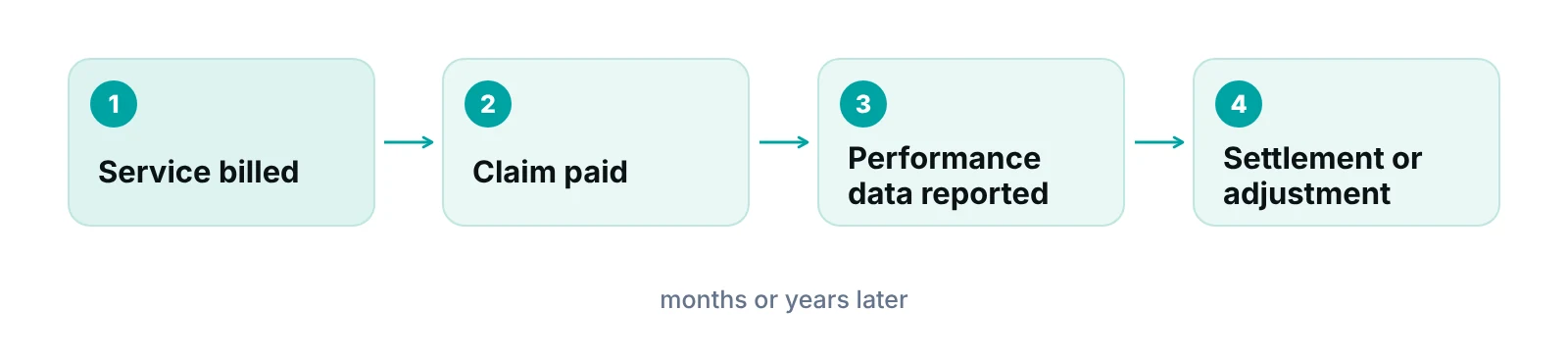
Fee-for-service vs value-based care comes down to what triggers payment. Fee-for-service pays for each billed service. Value-based care adds a payment tied to quality or cost, usually settled later. In 2026, MIPS adjusts Part B payments and TEAM hospitals keep billing fee-for-service, so clean claims still matter.
Most practices are not choosing between the two. They are paid both ways at once, and the value-based part arrives on a different schedule from the claim. This guide, current as of October 2026, explains the difference, names the Medicare programs that matter this year, and shows what changes in the billing office. For the wider list of payment models, including capitation, see our guide to types of reimbursement in healthcare.
We cite CMS pages and give the year of every figure. Program rules change, so check your own contracts and the CMS pages linked here before you act.
Key takeaways
- Fee-for-service pays when you bill a service; value-based care adds a payment tied to quality, cost or a benchmark.
- Most Medicare value-based programs still sit on top of claims, so clean billing comes first.
- In 2026 the programs to know are MIPS, the Shared Savings Program, ACO REACH moving to LEAD, and TEAM.
- Some value-based income lags: a 2026 MIPS result pays in 2028.
- Check your contracts and remittances to see which programs reach your practice.
What is the difference between fee-for-service and value-based care?
Fee-for-service pays a set amount for each service you bill, so revenue follows the number and type of services. Value-based care keeps a payment but ties part of it to quality, cost or a spending benchmark. The test is simple: ask what triggers the money. Under fee-for-service it is the claim. Under a value-based arrangement it is the claim plus a later comparison against a target.
Value-based care is a family of arrangements, not one model. Pay-for-performance, shared savings, bundled episodes and population-based payments all sit under the label. We compare them side by side in our guide to types of reimbursement in healthcare, so this post stays on the two ends of the range and on what the billing office has to do differently.
| What to compare | Fee-for-service | Value-based component |
|---|---|---|
| What triggers payment | A billed, covered service | Results against a quality, cost or spending benchmark, measured over a period |
| When the money arrives | After each claim is processed | Claim payments first, then an adjustment or settlement later |
| Where the financial risk sits | Mostly denials and bad debt | Also payment cuts, repayments or shared losses, depending on the program |
| Main billing task | Capture, code and submit every service | The same, plus accurate data behind program reports |
| What to watch | Denial rate, clean claim rate, days in A/R | Those, plus the program’s own feedback reports |
Source: RCM Finder summary of CMS program pages (TEAM, LEAD, MIPS), 2025 to 2026.
Value-based does not mean claim-free
In CMS’s Transforming Episode Accountability Model (TEAM), CMS states that participants keep billing Medicare fee-for-service as usual, and actual spending is compared with a target price afterwards. The claim is still the starting point.
Which Medicare value-based programs matter to practices in 2026?
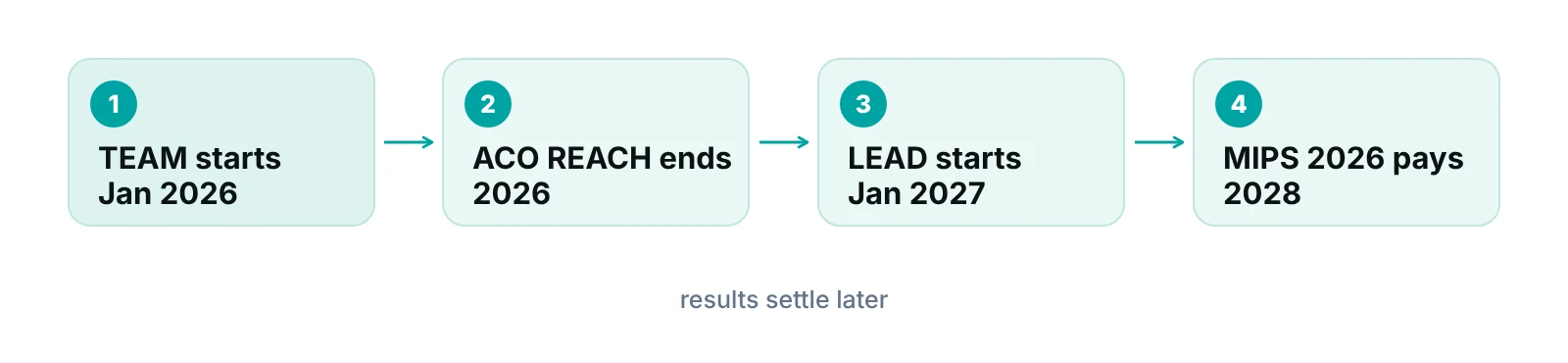
Four programs cover most of what a practice or its hospital partner will meet in Medicare in 2026: MIPS, the Medicare Shared Savings Program (MSSP), the ACO REACH Model that is ending and its successor LEAD, and the TEAM bundled-payment model. CMS’s Innovation Center strategy white paper sets a goal that all Medicare beneficiaries with Parts A and B are in a care relationship with accountability for quality and total cost of care by 2030. That page carries 2021 data, so treat the goal as direction, not a forecast for your payer mix.
MIPS: an adjustment to Part B payments
The Merit-based Incentive Payment System scores eligible clinicians in four categories: quality, cost, improvement activities and promoting interoperability (CMS Quality Payment Program). The score sets a positive, neutral or negative adjustment to Part B payments in a later year. For the 2026 performance year, CMS kept the performance threshold at 75 points and said it would hold it through the 2028 performance year (CMS, 2026 policy changes). The maximum negative adjustment for the 2028 payment year is 9%, and positive adjustments may be scaled for budget neutrality (CY 2026 QPP final rule fact sheet).
The timing matters for cash flow. The 2026 performance period maps to the 2028 payment year, so work done now shows up on remittances two years later. CMS also added six MIPS Value Pathways for 2026: diagnostic radiology, interventional radiology, neuropsychology, pathology, podiatry and vascular surgery. Our MIPS categories and scoring guide covers category scoring in more detail, written around the 2024 performance year.
ACOs: MSSP today, LEAD from 2027
An accountable care organization (ACO) is a group of clinicians and organizations that take shared responsibility for the cost and quality of care for an assigned group of patients. CMS reported 511 Shared Savings Program ACOs for 2026, serving 12.6 million people with Traditional Medicare. For performance year 2024, the CMS results fact sheet (updated September 29, 2025) covers 476 ACOs and 10.3 million assigned beneficiaries. It reports that Medicare saved $2.5 billion relative to benchmarks, ACOs earned $4.1 billion in performance payments, and 75% of ACOs earned shared savings. Sixteen ACOs owed shared losses totaling $20.0 million.
Read those figures as program totals. Savings are measured against benchmarks, and they say nothing about what a given practice would earn or owe. The same fact sheet shows both sides of the model: payments for ACOs that beat their benchmark and repayments for a few that did not.
ACO REACH ends in 2026, and CMS’s ACO REACH page names the Long-term Enhanced ACO Design (LEAD) Model as the successor, starting in January 2027. Per the LEAD model page, LEAD is a voluntary 10-year model running January 1, 2027, through December 31, 2036. It offers two risk options: global risk (up to 100% of savings and up to 100% of losses against the benchmark) and professional risk (up to 50% of each). It features flexible, capitated population-based payments, which is a bigger change to cash flow than a year-end adjustment.
Bundled payments: TEAM
TEAM began on January 1, 2026, and runs for five performance years, ending December 31, 2030. It is mandatory for acute care hospitals paid under the Inpatient Prospective Payment System in selected metropolitan areas. The five episode types are lower extremity joint replacement, surgical hip and femur fracture treatment, spinal fusion, coronary artery bypass graft and major bowel procedures. Each episode runs through 30 days after discharge. CMS sets a target price in advance, compares actual Medicare spending with it, and applies a quality adjustment (CMS TEAM page).
The hospital carries the financial risk, not the surgeon’s practice. Still, joint and spine episodes involve surgeons, so orthopedic practices should ask any TEAM hospital they work with whether it plans to change how it shares data, documentation requests or payments.
| Program | Who is in it | How payment changes | Key dates |
|---|---|---|---|
| MIPS | Eligible clinicians, individually or in groups | Positive, neutral or negative adjustment to Part B payments; maximum negative adjustment 9% for the 2028 payment year | 2026 performance year pays in 2028; threshold 75 points through the 2028 performance year |
| Shared Savings Program (MSSP) | 511 ACOs for 2026, serving 12.6 million people | Performance payments if spending beats a benchmark; some ACOs owe shared losses | PY2024 results published September 2025 |
| ACO REACH, then LEAD | ACO REACH ACOs and others; LEAD aims to add providers new to ACOs | LEAD: global risk (up to 100%) or professional risk (up to 50%), with capitated population-based payments | ACO REACH ends 2026; LEAD runs 2027 to 2036 |
| TEAM | Selected acute care hospitals (mandatory) | Hospitals bill fee-for-service; spending is compared with a target price, with a quality adjustment | January 1, 2026 to December 31, 2030 |
Source: CMS Quality Payment Program, Shared Savings Program, LEAD and TEAM pages (2025 to 2026).
What changes in billing and revenue cycle management?
Day-to-day claim work changes less than most people expect. What changes is the timing of some income, the reports you need to read and the contract terms you need to understand. A value-based adjustment sits on top of a stream of claims that still has to be coded, scrubbed and paid.
| Billing task | What stays the same | What changes with a value-based component |
|---|---|---|
| Charge capture and coding | Each service still needs an accurate code | The same codes and diagnoses can also feed program reports, so errors travel further |
| Claim submission | Scrubbing and payer edits work as before | Missing or wrong data can distort what a program sees, so completeness matters more |
| Remittance posting | Post each payment and adjustment by claim | A program adjustment or settlement can arrive separately; learn to recognize it |
| Cash forecasting | Days in A/R by payer | Some income lags: a 2026 MIPS result pays in 2028 |
| Reporting | Denials, A/R and collections | Add each program’s own feedback report and compare it with your remittances |
| Contract review | Fee schedules and timely filing | Benchmarks, patient attribution and risk terms |
Source: RCM Finder analysis; timing from CMS Quality Payment Program 2026 final rule fact sheet.
Start with the basics. Your clean claim rate and denial management routines decide how much of every payment reaches you, whatever model pays it. Then add the new reading skills. A program adjustment is easy to miss inside a remittance, and our guide to the electronic remittance advice (ERA) shows where payment-level adjustments appear. Track days in A/R by payer, and watch the revenue cycle KPIs that tell you whether a payer is paying on time.
Documentation matters in a different way. LEAD, for example, promises more accurate risk adjustment and benchmarking for high-needs patients (CMS LEAD page, 2026). Accurate benchmarks depend on records that describe each patient’s real conditions. Document what is clinically true and supported. Do not code to raise a score, because that creates compliance risk, not revenue.
How do you find out which of this applies to your practice?
Look at your payer contracts and your remittances before you look at the news. The programs above reach a practice in different ways, and the easy mistake is assuming one of them applies when it does not, or missing one that does.
- Check whether your clinicians are subject to MIPS and which reporting option they use. Confirm on the CMS Quality Payment Program site, because eligibility rules change each year.
- Ask whether your practice, or a group you contract with, participates in an ACO, and get the agreement that explains how savings and losses reach you.
- If your surgeons operate at an acute care hospital, ask whether it is a TEAM participant, and what it expects from you.
- List your top payers and note, next to each, whether the contract has any performance component.
- Reconcile what each payer paid with what your contract and the program report say it should have paid.
Step five is easier when every claim has a visible stage and an owner. We built a practice management system that tracks claims by stage for that reason: it shows where each claim sits and who is working it. It is not a quality-reporting tool and does not calculate MIPS or ACO results, so keep that work with your EHR vendor, registry or ACO.
Want to know which of your payers carry a performance component?
Our free practice audit reviews your top payers, shows where the claim, the contract and the payment do not line up, and flags what to ask next. Pricing, if you want help afterwards, is quoted after the audit.
Our recommendations
- Map every payer to its payment model. List your top payers and write next to each whether it pays per service, per episode, per patient or per result. Use the contract language, not the payer’s name, and mark any performance component.
- Fix claim quality before adding programs. A value-based adjustment cannot repair a weak claim process. We would get the clean claim rate and denial follow-up stable first, because every model starts there.
- Teach posters to spot program adjustments. Show your payment posters what a performance adjustment or settlement looks like on a remittance, and where it is posted. Reconcile it against the program’s own report.
- Forecast the lag. Build income timing into your cash plan. A 2026 MIPS result pays in 2028, and ACO settlements follow the performance year. Do not count that money as monthly revenue.
- Read the risk terms before you sign. Before joining an ACO or a LEAD arrangement, ask for the benchmark method, the attribution rules, the share of savings and losses you carry and the reporting you must supply. Ask a healthcare attorney or advisor to review the terms.
- Ask your hospital partners about TEAM. If your surgeons operate in a TEAM hospital, ask how it plans to handle documentation requests and data sharing, and who owns the questions your billing team will receive.
See where every claim sits while program results settle.
Our portal tracks each claim by stage with an owner, and reporting dashboards summarize claim activity. It does not report quality measures or calculate MIPS or ACO results; those stay with your EHR, registry or ACO.
See how the RCM Finder portal works · Create a portal account
Disclosure: RCM Finder builds and sells this portal. It is a practice management system, not an EHR.
Bottom line
Fee-for-service pays for the service and value-based care adds a payment tied to results, usually later. Most practices live with both, and both start from the claim. Map your payers to their models, keep the claim process clean and learn to read the adjustments. If you want a second pair of eyes on that, our end-to-end revenue cycle management team can review it with you, and a free practice audit is the first step.
Frequently asked questions
What is the main difference between fee-for-service and value-based care?
Fee-for-service pays for each service billed. Value-based care ties some or all of the payment to quality, cost or a spending benchmark. Most value-based programs in Medicare still start with claims. The difference is that a later comparison, such as a MIPS adjustment or a TEAM reconciliation, can raise or lower what you finally receive.
Is value-based care replacing fee-for-service in Medicare?
Not yet. CMS’s Innovation Center strategy sets a goal for all Medicare beneficiaries with Parts A and B to be in an accountable care relationship by 2030, but today’s programs, including MIPS and TEAM, still involve fee-for-service claims. Expect a mix for several years, and review your own payer contracts.
Do small practices have to take on downside risk?
Not by default. TEAM is mandatory only for selected hospitals, and LEAD is voluntary. MIPS can lower Part B payments, with a maximum negative adjustment of 9% for the 2028 payment year. Check the Quality Payment Program site for your eligibility and reporting options.
How does value-based care affect cash flow?
It adds income that arrives later. A 2026 MIPS performance period maps to the 2028 payment year, and CMS published its performance year 2024 Shared Savings Program results in September 2025. Plan for claim payments now and keep adjustments or settlements out of monthly revenue forecasts.
What is happening to ACO REACH?
ACO REACH ends in 2026. CMS has announced the LEAD Model as its successor, running 10 years from January 1, 2027. LEAD offers global risk and professional risk options, and CMS expects participants to include current ACO REACH ACOs and providers new to ACOs.
Does value-based care change medical coding?
The code sets stay the same. What changes is how much weight the data carries, because codes and diagnoses can feed program reports and risk adjustment. Code what is documented and clinically supported, and do not code to raise a score.
Get your free practice audit
Tell us about your practice. We will contact you using the details you give.
- A review of your recent claims, denials and A/R aging
- Where your front desk and prior authorizations slow payment
- A prioritized fix list you keep, whether or not you hire us
Pricing is quoted after the audit, based on your volume and the services you choose. Prefer to talk? Call +1 (302) 556-2288.
Sources
- Medicare Shared Savings Program: Updated Performance Year 2024 Financial and Quality Results — CMS (2025)
- 2026 Medicare Accountable Care Organization Initiatives Participation Highlights — CMS (2026)
- ACO REACH Improves Healthcare Quality — CMS Innovation Center (2026)
- LEAD (Long-term Enhanced ACO Design) Model — CMS Innovation Center (2026)
- TEAM (Transforming Episode Accountability Model) — CMS Innovation Center (2026)
- Innovation Center Strategy Refresh — CMS Innovation Center (2021)
- CMS Publishes 2026 Policy Changes for the Quality Payment Program — eCQI Resource Center (HHS/CMS) (2025)
- CY 2026 PFS Final Rule: QPP Fact Sheet and Policy Comparison Table — CMS (copy hosted by AAHD) (2025)
- Performance Categories — CMS Quality Payment Program (2026)
Disclaimer: This article is general education on fee-for-service and value-based payment. It is not billing, coding, legal or compliance advice. Medicare program rules, dates and figures change, and payer contracts vary. Verify current rules against the CMS pages linked here and your own agreements, and consult a qualified professional before making decisions for your practice.