
Behavioral health patient engagement, in operations terms, is the set of routines that keep a patient attending and informed between sessions: reminders, a written no-show policy, limited and consented messaging, outcome questionnaires, reactivation outreach and a clean discharge. Write each as a short policy with an owner, a channel and a record.
Most advice on this topic is written by texting vendors and promises engagement through software. This guide treats it as front-office operations: who sends what, on which channel, with whose consent, and what gets recorded. It covers administration only and gives no clinical advice. It sits inside the behavioral health practice management guide, and the clinical content of any message stays with your clinicians.
If you are still choosing tools, start with the behavioral health practice management software guide. If intake paperwork is the weak point, see the behavioral health registration and billing guide.
Key takeaways
- Write a one-page reminder and no-show policy, show it at intake and apply it the same way every time.
- Text reminders have specific conditions under federal rules: the patient’s own number, short, limited frequency, and a working STOP reply.
- Keep message content minimal: a name, a time and a callback number, with no diagnosis or clinical detail.
- Decide who sends outcome questionnaires, when, and who sees the score, before you send the first one.
- Plan reactivation and discharge as steps with owners, so no patient is left in an unclear status.
What does patient engagement mean for a behavioral health office?
For the office, engagement means the patient knows when the next visit is, can reach the practice for administrative needs, completes the paperwork and questionnaires the clinician asked for, and has a clear status if visits stop. Clinical engagement is the clinician’s work. The office builds the structure around it.
Behavioral health adds constraints: patients often ask for discreet contact, mental health records carry extra sensitivity, and a missed visit needs a person’s judgment, not only an automated message. HHS describes psychotherapy notes as notes kept separate from the rest of the record, and says patients generally have no right of access to them and that disclosure generally needs authorization (HHS, mental health information guidance).
A 2024 systematic review of open-access scheduling covered 16 studies from family medicine, pediatrics, geriatrics, ophthalmology, podiatry and rheumatology, and none reported behavioral health findings. It found 10 of 16 showed a significant drop in no-shows with open access and did not evaluate reminders on their own (Mazaheri Habibi et al., Health Sci Rep, 2024).
How should a practice set reminders and a no-show policy?
Set one written policy that covers reminders, the cancellation window, the fee (if any) and exceptions, then give it to every new patient at intake. Consistency matters more than strictness.
| Element | Decision to make | Practical note |
|---|---|---|
| Reminder timing | How many reminders, and how far ahead | Pick a schedule you can honor every time, such as one early notice and one close to the visit |
| Channel | Text, email, phone or portal, per patient | Record the patient’s preferred channel and number at intake, and who may be contacted |
| Cancellation window | How much notice counts as on-time | State it in hours and in plain words; match it to how quickly you can refill a slot |
| Late-cancel and no-show fee | Whether to charge, how much, and who may waive | Check payer contract terms and state rules first; many plans do not pay for missed visits |
| Exceptions | Illness, emergencies, weather | One person may waive; log each waiver |
| Repeat misses | What triggers outreach or a review | Define the trigger (for example a set number of consecutive misses) and who reviews it |
| Acknowledgment | How the patient agrees | Signature at intake, stored in the chart |
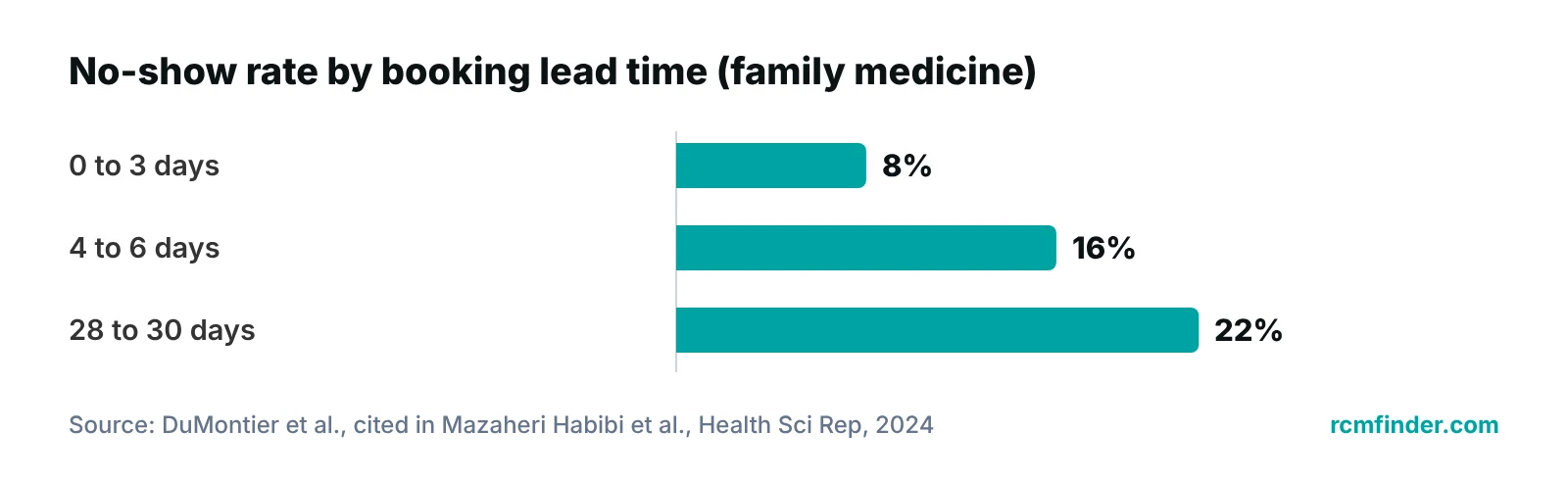
A short lead time helps in the one place the evidence speaks to it. In the review above, DuMontier and colleagues reported no-show rates of about 8% for visits booked 0 to 3 days out, 16% at 4 to 6 days and 22% at 28 to 30 days (family medicine, cited in the 2024 review). That is not behavioral health data, but it supports a plain rule: where clinicians allow, rebook the next visit before the patient leaves.
Billing a missed-visit fee is a revenue-cycle question as well as a policy one. The fee should be a separate patient charge with its own line, not folded into a claim; see the behavioral health revenue cycle management guide for how patient balances and claims fit together.
What privacy and consent rules apply to reminders and messages?
Three rule sets apply to office messages: HIPAA (what you may say), the federal TCPA (how you may text and call), and, for email, CAN-SPAM. Apply the minimum necessary content, get and record consent for the channel, and make opting out easy.
HIPAA: say less
HHS lets providers send appointment reminders to patients at home, including by answering machine, but says to limit the information, for example a name, a number and what is needed to confirm an appointment, or a request to call back (HHS FAQ). The minimum necessary standard asks covered entities to limit uses and requests of protected health information to the least needed and to define who in the practice needs which information (HHS). In practice: no diagnosis, clinician specialty or reason for visit in a reminder. See also our guide to voicemail in healthcare.
If a patient asks to be contacted a different way or at a different place, the same HHS FAQ says the provider must accommodate the request if reasonable, citing 45 CFR 164.522(b). Build a field for it in the chart. On email, HHS says the Privacy Rule does not prohibit unencrypted email for treatment-related contact but expects reasonable safeguards, and that a provider can warn the patient of the risks and let the patient decide (HHS FAQ 570, last reviewed 2013). Offer a secure channel and record the patient’s choice.
TCPA: the conditions for text reminders
Under 47 CFR 64.1200, autodialed or prerecorded calls and texts to a wireless number need the recipient’s prior express consent. The rule also has an exemption for certain health care messages, with conditions the practice should be able to show (47 CFR 64.1200, via Cornell LII). Whether your texting platform counts as an autodialer is a legal question to put to your counsel or vendor in writing.
| Message | Rule to check | Practical note |
|---|---|---|
| Appointment reminder text | Health care exemption conditions in 64.1200(a)(9)(iv): number the patient gave, practice name and contact info, no marketing or financial content, 160 characters or less, no more than 1 per day and 3 per week, STOP opt-out honored immediately | Keep it under 160 characters; log consent and number source |
| Late-cancel fee or balance notice | Financial content falls outside the exemption | Use another channel or documented consent; review with counsel |
| Questionnaire or form link | Not among the listed exempt purposes; rely on the patient’s consent for that purpose | Collect consent for forms and check-ins separately from reminders at intake |
| Reactivation or recall outreach | Advertising or telemarketing content needs prior express written consent under (a)(2), which carves out health care messages from covered entities | Have counsel classify the message before you send it |
| Marketing email | CAN-SPAM: truthful headers, ad disclosure, postal address, opt-out within 10 business days | Keep promotional mail separate from clinical mail |
| Any opt-out reply | Consent can be revoked by any reasonable method; STOP, quit, end, revoke, opt out, cancel and unsubscribe must be treated as revocation | Process within 10 business days at most; the exemption requires immediate handling of STOP |
Source: 47 CFR 64.1200 (Cornell LII); FTC CAN-SPAM compliance guide; Kutak Rock summary of the FCC 2015 order. Verify current text before relying on it.
Providing a phone number to a provider counts as consent only for limited, expected calls, according to a law-firm summary of the FCC’s 2015 order, and not where the patient has limited the use of the number or asked the provider to stop (Kutak Rock). Say at intake what you will send to that number. For email, the FTC lists eight requirements and a 10-business-day opt-out deadline (FTC CAN-SPAM guide).
Substance use records
If any part of your practice is a federally assisted substance use disorder program, 42 CFR Part 2 may add consent requirements. The final rule’s compliance date was February 16, 2026 (HHS fact sheet). Confirm your status before building a reminder or recall list from those patients.
What should be the limits on between-session communication?
Write a communication policy that says what the office channel is for, when staff reply and what it is not for. It sets expectations before a problem, not after.
- Purpose: scheduling, forms, billing questions and logistics. Clinical questions go to the clinician through the channel the clinician has approved.
- Response time: state business hours and a typical reply time, and do not imply round-the-clock monitoring.
- Urgent matters: include the crisis and emergency instructions your clinical lead has approved, in every portal welcome, auto-reply and voicemail greeting.
- Who may read messages: define roles. Front-desk staff see what they need for scheduling and billing; clinical content goes to licensed staff (the minimum necessary approach).
- Family and others: HHS says that with an adult patient who objects, the provider generally must respect that objection. Record who the patient allows you to talk to (HHS).
- Records of contact: decide which messages are filed to the chart and by whom; see the behavioral health EHR evaluation checklist.
Telehealth visits add their own consent and platform questions, covered in the behavioral health telehealth operations guide.
How do outcome measure check-ins fit into the workflow?
The clinician chooses the instrument and acts on the result. The office decides how the questionnaire is delivered, when, and where the score lands.
Two fetched sources show how structured the idea can be. A Massachusetts presentation describes a cycle of screening, measuring response, tracking outcomes and adjusting treatment, and says one-time screening and infrequent assessment are ineffective approaches (Mass.gov, screening and measurement-based care). A CMS measure-development page describes a draft process measure with baseline assessment, monitoring with validated tools at least once every quarter, and a documented decision on treatment adjustment. As of its September 2020 status the measure was still in development (CMS measure page). Use them as process models, not current reporting requirements.
- Ask the clinician which instrument and what interval, and put both in the chart as an order or template.
- Deliver the questionnaire before the visit by the channel the patient consented to, or in the waiting area on a tablet if they did not.
- Route the score to the clinician’s inbox, not to a general queue.
- Set a rule for missing responses: one reminder, then complete it at check-in.
- Store the scale used and the date in a consistent field.
If the questionnaire link goes by text, remember it is not on the list of exempt purposes above, so collect consent for it. If it goes through a web form, review tracking tools on those pages: HHS says tracking technologies on authenticated pages generally have access to PHI and that scheduling pages can also involve HIPAA (HHS tracking technologies guidance). A federal court vacated part of that HHS guidance in June 2024, so check its status.
How should a practice handle reactivation and discharge?
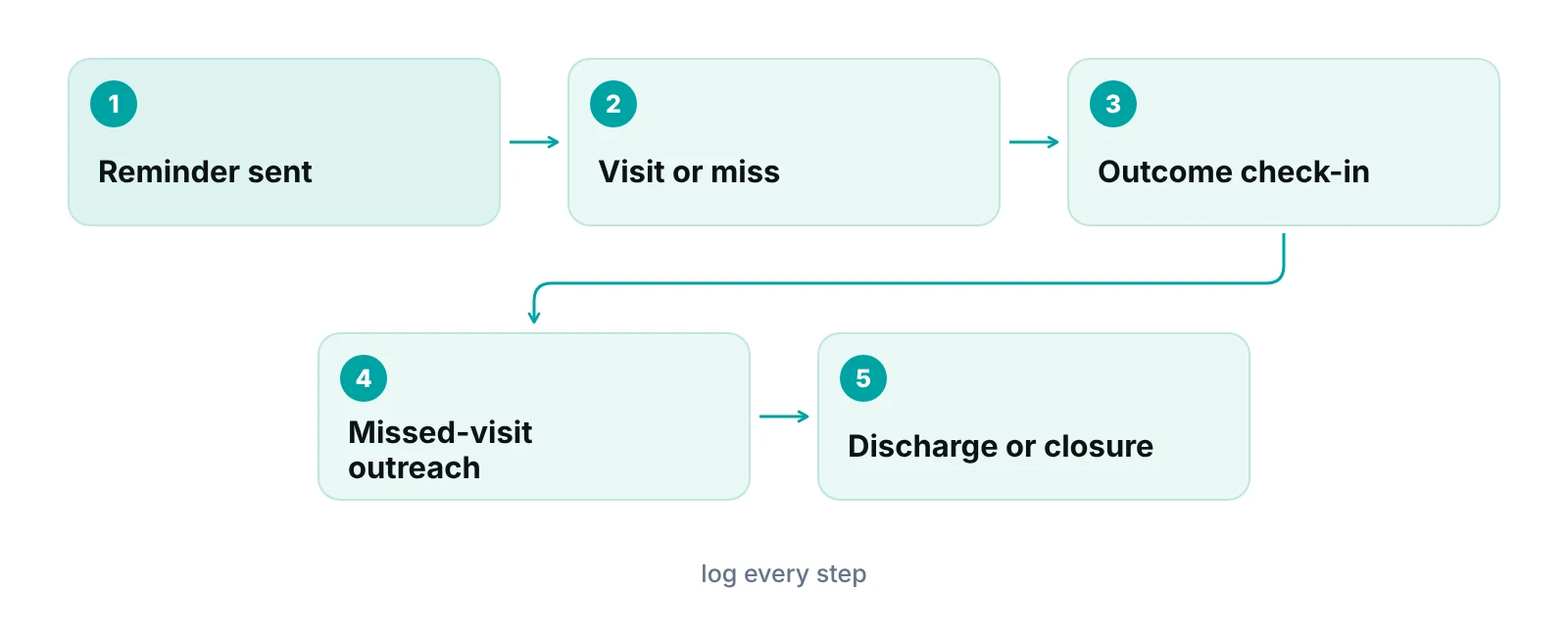
Treat a lapse as a process: a quiet check-in after missed visits, a defined point at which a patient becomes inactive, and a closure letter that makes the status clear. Every step has an owner and a record.
| Step | Trigger | Message content | Record |
|---|---|---|---|
| 1. Same-day outreach | No-show | Minimal text or call: we missed you, how to rebook, callback number | Date, channel, result |
| 2. Second contact | No rebooked visit after the first window you set | Short follow-up; offer to rebook; no clinical detail | Date, channel, staff initials |
| 3. Clinician flag | Repeat misses per your policy | Tell the clinician; the clinician decides any clinical follow-up | Flag and clinician response |
| 4. Inactive status | No contact after the steps you defined | Closure letter by the contact method the patient allowed | Letter copy, status change |
| 5. Records request | Patient asks for copies | Follow the access timeline; send in the format requested if readily producible | Request date, date sent |
Process design by RCM Finder; timelines under HIPAA right of access per 45 CFR 164.524 as summarized by UNC School of Government (2023).
Records requests have a federal clock. A covered entity must act within 30 calendar days of an access request and may take one 30-day extension with written notice, for a total no longer than 60 days (UNC School of Government summary of 45 CFR 164.524). The right of access does not extend to psychotherapy notes. State law may set shorter timelines or retention rules.
For reactivation, keep the message short and non-promotional, send it only to patients who agreed to be contacted, and do not mention the condition or treatment. Ask counsel how to classify the message under the TCPA before it goes out. Review requests and testimonials have their own limits in the behavioral health marketing guide.
Check how your follow-up fits your workflow
A free practice audit can review how scheduling, intake, messaging and billing connect in your office. Pricing is quoted after the audit.
Who runs this, and what should the tools do?
One named person should own the follow-up process, even in a small practice. Where front-desk hours are thin, remote staff can handle scheduling, eligibility checks and intake, as the virtual medical assistant service describes, while clinical judgment stays with licensed staff.
Whatever you use, ask: does it record consent by channel, send a short reminder with a working STOP reply, limit content by role, keep an audit trail, and will the vendor sign a Business Associate Agreement? The software guide covers how to compare tools.
Our recommendations
- Write the one-page policy first. Reminders, cancellation window, fee, exceptions and repeat misses, signed at intake.
- Record consent by channel. One field per channel (text, email, voicemail) with the date and number or address.
- Keep reminders to a name, a time and a callback number. No diagnosis, clinician type or reason for visit, and under 160 characters.
- Separate reminders from questionnaires and billing messages. Each has different consent and content rules.
- Give the clinician the score, not the queue. Route questionnaire results to the clinician.
- Define inactive status in writing. Set the number of contacts and days, and who sends the closure letter.
- Audit once a quarter. Sample reminders, opt-outs and closures against your own policy.
Bottom line
Engagement between sessions comes down to a few written routines: a reminder and no-show policy, limited messages with recorded consent, owned outcome check-ins, and clear reactivation and discharge steps. The overall picture sits in the behavioral health practice management guide. If you want the tools and staffing side reviewed, see our practice management system for medical practices page, where role-based permissions, audit logging and a client portal are described.
Frequently asked questions
Do I need consent to text appointment reminders?
Federal rules require prior express consent for autodialed or prerecorded texts to a wireless number, with an exemption for certain health care messages that has strict conditions (the patient’s own number, 160 characters or less, one per day and three per week, STOP honored). Record consent at intake and ask counsel about your platform.
Can I charge for late cancellations and no-shows?
Many practices do, but it depends on payer contracts, state rules and your licensing board’s expectations. Put the fee in a written policy that patients sign at intake, apply it consistently, and bill it as a patient charge, not on a claim. Have counsel review the policy first.
What may a reminder voicemail or text say?
As little as possible. HHS suggests limiting the information, for example to a name, a number and what is needed to confirm an appointment, or asking the patient to call back. Leave out diagnosis, clinician specialty and reason for the visit.
Can staff text patients between sessions about clinical issues?
That is a clinical-governance decision for the practice’s clinicians and counsel, not a front-desk one. Set a written policy on what the office channel is for, and route clinical questions to the clinician through the approved channel.
How do I handle a patient who stops coming?
Use a ladder: a short outreach after the missed visit, a second contact, a flag to the clinician after repeat misses, and a closure letter when your defined steps are complete. Log each step and send by the contact method the patient allowed.
How long do I have to send records after discharge?
Under HIPAA’s right of access, a covered entity must act within 30 calendar days of a request, with one 30-day extension if it gives written notice. State law can differ, and psychotherapy notes are excluded from the right of access. Confirm local rules.
Get your free practice audit
Tell us about your practice. We will contact you using the details you give.
- A review of your recent claims, denials and A/R aging
- Where your front desk and prior authorizations slow payment
- A prioritized fix list you keep, whether or not you hire us
Pricing is quoted after the audit, based on your volume and the services you choose. Prefer to talk? Call +1 (302) 556-2288.
Sources
- 47 CFR 64.1200 Delivery restrictions — Cornell Legal Information Institute (eCFR text) (2026)
- FCC clarifies TCPA robocall rules for health care — Kutak Rock LLP (2015)
- Minimum Necessary Requirement — HHS (2026)
- Does HIPAA permit health care providers to use email to discuss health issues with patients? (FAQ 570) — HHS (2013)
- Appointment reminders and confidential communications (FAQ 198) — HHS (2026)
- HIPAA Privacy Rule and Sharing Information Related to Mental Health — HHS (2026)
- CAN-SPAM Act: A Compliance Guide for Business — FTC (2026)
- Evaluation of no-show rate in outpatient clinics with open access scheduling: a systematic review — Health Science Reports (PubMed Central) (2024)
- Measurement-based Care Processes: Baseline Assessment, Monitoring and Treatment Adjustment — CMS (2020)
- Screening and Measurement-Based Care — Mass.gov (2026)
- Fact Sheet: 42 CFR Part 2 Final Rule — HHS (2026)
- HIPAA and the Right of Access: A Q&A for Covered Entities — UNC School of Government (2023)
- Use of Online Tracking Technologies by HIPAA Covered Entities and Business Associates — HHS (2024)
Disclaimer: This article is educational and is not legal, compliance, coding or clinical advice. HIPAA, the TCPA, state law, payer contracts and licensing board rules vary and change, so confirm current requirements with qualified counsel and your payers before you adopt a policy.
