
Behavioral health practice management is the set of routines that move a client from first call to final payment: intake, eligibility, payer enrollment, scheduling, documentation, billing, privacy and growth. Because visits repeat weekly, are billed by time and carry stricter privacy rules, each routine needs a named owner and a weekly check.
This guide is the map. Each section answers one operating question and points to a deeper post, so you can fix the weakest area first. It is about running the practice, not choosing software; for that, see the behavioral health practice management software guide. If you want the whole money path in one read, start with behavioral health revenue cycle management.
Key takeaways
- Eight areas make up the practice: intake, enrollment, scheduling, documentation, billing, privacy, systems and growth.
- The note is the billing document: Medicare contractors expect the session length in the record.
- Enrollment dates decide when a new clinician can bill, so track them like a project.
- Part 2 applies only to certain programs; confirm with counsel instead of assuming.
- Review a short list weekly and monthly, with one named owner per handoff.
What does behavioral health practice management cover?
It covers eight areas that every therapy, psychiatry and counseling practice runs, whether or not anyone has written them down. Behavioral practices differ from most clinics in three ways: clients return weekly or biweekly, sessions are billed by minutes, and the records are among the most sensitive in healthcare. Each of those changes where things go wrong.
The table shows the eight areas, the question each one answers and where to go deeper. Use it to pick the area that hurts most today.
| Area | The question it answers | Go deeper |
|---|---|---|
| 1. Intake and eligibility | Is this person covered, and what will they owe? | Eligibility verification post |
| 2. Credentialing and enrollment | Can we bill this payer for this clinician? | Group credentialing guide |
| 3. Scheduling and no-shows | Are chairs filled with kept appointments? | Patient engagement guide |
| 4. Documentation | Does the note prove what we bill? | Coding cheat sheet |
| 5. Billing, denials and A/R | Does every kept session turn into cash? | Revenue cycle guide; billing partner guide |
| 6. Privacy and records | Who may see what, and under which rule? | HIPAA checklist for practices |
| 7. Telehealth and systems | Can we deliver and record care remotely? | Telehealth guide; EHR guide |
| 8. Growth | Are the right new clients finding us? | Behavioral health marketing |
How should intake and eligibility run before the first session?
Intake should finish three things before the first visit: identify the client and subscriber correctly, confirm the plan covers the service, and tell the client what they will owe. Errors at this step are the cheapest to prevent and the most expensive to find after a denial.
Use one intake script, whoever answers the phone. Collect the insurance card, the subscriber’s details, consent forms and a preferred way to be contacted. Then check benefits for outpatient mental health specifically, including visit limits, copays, deductibles and any authorization rule, because therapy repeats. The step-by-step method is in the behavioral health eligibility verification post,.
Self-pay clients need their own step. A CMS document on the good faith estimate process says people who are uninsured, or who choose not to use insurance for a service, are generally treated as self-pay. The estimate is due within 1 business day if the visit is booked at least 3 business days ahead, and within 3 business days if it is booked at least 10 business days ahead or the client asks about cost. People in federal health care programs are not eligible (CMS). The document does not explain how this works for open-ended weekly therapy, so ask counsel how to document an estimate for a recurring course of care.
A scenario to test your intake
A new client calls Friday, books for Monday and gives the plan name but not the member ID. Who finishes the benefit check, by when, and what does the client hear about their cost? If the answer is “whoever has time”, that is the gap to close.
How do credentialing and payer enrollment affect growth?
A clinician cannot bill a payer until they are enrolled with it, so enrollment sets the date new revenue can start. Treat it as a tracked project with dates, not a one-time form.
Keep one record per clinician: license, liability insurance, NPI, each payer, application date, effective date and next renewal. CAQH describes its ProView service as a place where providers enter their information once and share it with authorized health plans (CAQH). Its provider guide says a provider must attest after changing profile information so authorized organizations can see the update, that unattested location changes are not sent to plans, and that a liability insurance document is rejected if the name, expiry date or policy number does not match the profile (CAQH provider guide). Payer timelines vary, so record dates rather than assuming a number. The insurance credentialing guide for group practices covers the process in detail.
Medicare adds one behavioral-specific item. Marriage and family therapists and mental health counselors became able to enroll in Medicare Part B on January 1, 2024, using Form CMS-855I, with a requirement of two years of supervised clinical experience, according to law firm Honigman. Check the current CMS enrollment pages before you hire or enroll one.
One rule for hiring: do not schedule a new clinician’s Medicare or commercial clients until the effective date is in hand, unless the payer’s policy allows otherwise in writing.
How should scheduling and no-shows be managed?
Schedule for kept sessions, not booked ones. A booked slot that goes empty is revenue you cannot recover, and in a weekly model one miss can break a client’s course of care.
The evidence is limited and mostly from other settings, so read it as a direction. A 2024 systematic review in Health Science Reports of 16 studies on open-access scheduling, mainly family medicine and pediatrics, reported that no-show rates ranged from 12% to 42% in some studies. One study in it found about 8%, 16% and 22% for lead times of 0 to 3, 4 to 6 and 28 to 30 days. The authors concluded that longer lead times go with more no-shows. Most of its studies did not measure reminders, though the authors say reminders reduce no-shows.
What that supports in a behavioral practice: keep the first appointment close to the intake call, book the next session before the client leaves, and send reminders by the channel the client chose. Ask about contact preference at intake. For email, an HHS FAQ says providers may email patients if they apply reasonable safeguards, such as confirming the address and limiting what the message contains; it was last reviewed in 2013, so confirm it is current (HHS).
- Write a no-show and late-cancel policy in plain words and have clients sign it at intake.
- Decide in advance who calls after a miss, and within what time.
- Keep a short waitlist so a cancelled slot can be refilled the same day.
- Review no-show reasons monthly: transport, cost, schedule or fit.
Between-session follow-up is its own topic. See the behavioral health patient engagement guide for how to keep clients attached to care without over-messaging them.
What should documentation and the billing handoff look like?
The note is the billing document. If the record does not show the minutes, the service and the signature, the claim is at risk no matter how clean the claim form looks.
A Medicare contractor, First Coast Service Options, lists 90832 at 16 to 37 minutes, 90834 at 38 to 52 minutes and 90837 at 53 minutes or longer, and says not to report psychotherapy for a session under 16 minutes. It also says the record must show the length of the encounter, and that claims with more than one unit of these codes are denied outside a partial hospitalization setting. Commercial payers set their own rules, so check each contract. Code-level help is in the behavioral health coding cheat sheet and the 90834 and 90837 psychotherapy billing guide.
The audit risk is real. The HHS Office of Inspector General reviewed Medicare psychotherapy payments from March 2020 to February 2021. Of 216 sampled enrollee days, 128 did not meet Medicare requirements, and OIG estimated about $580 million of roughly $1 billion in payments was improper, citing undocumented psychotherapy time and missing signatures (HHS OIG).
Build the handoff so nothing depends on memory. At the end of each day, every kept session should have a signed note with a start and stop time, a diagnosis, a service code and a charge. Anything missing goes on a list for the clinician the next morning, not the end of the month.
How should denials and accounts receivable be worked?
Work denials by cause, on a schedule, with a deadline for each payer. The money is rarely lost to one big error. It leaks through small items that nobody owns.
Two Medicare deadlines are fixed. CMS says a claim is untimely when received more than one calendar year after the service, and that an untimely-filing denial is not appealable, with only narrow exceptions (CMS). A redetermination, the first appeal level, must be requested within 120 days of receiving the remittance advice (CMS Medicare Learning Network). Commercial payers set shorter or longer windows, so put each payer’s limit in a tracker.
Group denials into a few causes: eligibility or coverage, authorization, coding or time, missing information and timely filing. Fix the cause at its source, not just the claim. The revenue cycle guide maps controls to each stage. If you outsource the follow-up, the behavioral health billing partner guide lists what to ask.
Patient balances need the same discipline. Send a statement soon after the claim pays, offer a payment option on file and agree on a plan before a balance ages.
Which privacy rules shape daily operations?
Three layers apply: HIPAA, stricter state law, and for some practices 42 CFR Part 2. Front-desk and billing staff need to know the differences because they handle these records every day.
HHS guidance says psychotherapy notes are notes a clinician keeps separate from the rest of the record, and that session times, medication details, diagnoses, treatment plans and progress are not psychotherapy notes. Authorization is generally needed to disclose them, and state law may be stricter (HHS Office for Civil Rights). The same guidance lets providers share relevant information with family or friends involved in care in set circumstances, such as when the client does not object, so train staff to ask the clinician first.
Part 2 protects records of substance use disorder treatment from federally assisted programs. HHS’s fact sheet says people subject to the final rule must comply by February 16, 2026. It allows one consent for future treatment, payment and operations uses, and creates a separate category for an SUD clinician’s counseling notes that need their own consent (HHS). HHS also says Part 2 breaches fall under the HIPAA breach notification rule (HHS Part 2 overview). Whether Part 2 applies to your practice depends on the facts, so confirm with counsel.
| Topic | What the source says | Source |
|---|---|---|
| Psychotherapy notes | Kept separate; session times and diagnoses are not part of them; authorization generally needed | HHS OCR |
| Family involvement | May share relevant information if the client does not object, or by professional judgment if the client cannot decide | HHS OCR |
| Part 2 consent | One consent can cover future treatment, payment and operations; counseling notes need separate consent | HHS (final rule) |
| Part 2 compliance date | February 16, 2026 | HHS |
| Email to clients | Allowed with reasonable safeguards; honor reasonable requests for other channels | HHS FAQ |
Source: HHS Office for Civil Rights mental health guidance; HHS 42 CFR Part 2 fact sheet; HHS HIPAA FAQ on email.
A short staff routine helps: verify identity before releasing anything, release the minimum needed, log each disclosure, and send unusual requests to the privacy lead. The HIPAA compliance checklist for medical practices gives a starting list.
Where do telehealth, the EHR and other systems fit?
Systems should carry your workflow, not define it. Write the workflow first, then check whether the tools support it. Telehealth and the clinical record are the two decisions that most often cause rework.
Medicare telehealth rules for behavioral health have moved repeatedly. A Penn State Office of Rural Health summary reports that the Consolidated Appropriations Act, 2026 extended the Medicare telehealth flexibilities through December 31, 2027, after a short lapse beginning January 30, 2026, and that the in-person requirement for mental health services is postponed (Penn State Office of Rural Health). These are extensions, not permanent policy. Confirm the current status on CMS pages before you set a telehealth schedule. Setup, billing and platform questions are in the behavioral health telehealth guide,.
For the record system, the questions are about notes, exports and billing handoff, not brand. The behavioral health EHR evaluation checklist lists them. For the scheduling, billing and reporting layer, use the practice management software guide.
How should a behavioral practice grow without overpromising?
Grow only as fast as intake, enrollment and the clinical schedule can absorb. More calls into a broken intake process just creates more missed first appointments.
Before adding marketing spend, check three numbers: how many inquiries become booked first visits, how many booked visits happen, and how many clinicians have open, billable slots with the payers those clients carry. Then choose channels. The behavioral health marketing guide covers claims, testimonials and advertising rules. Local search is in the behavioral health SEO guide, and paid, email and social channels are in the behavioral health digital marketing guide. Our healthcare digital marketing service shows how RCM Finder supports this work.
Find the weakest handoff
A free practice audit reviews how a client moves from first call to final payment and where a step has no owner. Pricing is quoted after the audit.
What should the owner review each week and month?
A short list on a fixed day beats a large dashboard nobody opens. Assign each check to a person, not a department.
| When | Check | Owner |
|---|---|---|
| Daily | Unsigned notes and sessions without a recorded time | Clinical lead |
| Daily | Tomorrow’s first visits with benefits not yet verified | Front desk |
| Weekly | Rejected and denied claims, grouped by cause | Billing lead |
| Weekly | No-shows, late cancels and open slots | Practice manager |
| Monthly | Claims open past 30, 60 and 90 days; oldest unworked item | Billing lead |
| Monthly | Enrollment dates, renewals and attestation due dates | Practice manager |
| Quarterly | Privacy refresher, access list review and policy updates | Privacy lead |
Benchmarks differ by payer mix, so compare the practice with its own earlier months first. If staff time is the constraint, RCM Finder’s Virtual Medical Assistant service provides remote front-desk staff for scheduling, eligibility checks, prior authorizations and intake, working in the practice’s time zone. Our team works inside your existing EHR (for example PrognoCIS, eClinicalWorks or athenahealth).
“Most practice problems are handoff problems. Name one owner for each handoff and review it on a fixed day.”
— Awais Afzal, Healthcare Operations & Data Analyst
Our recommendations
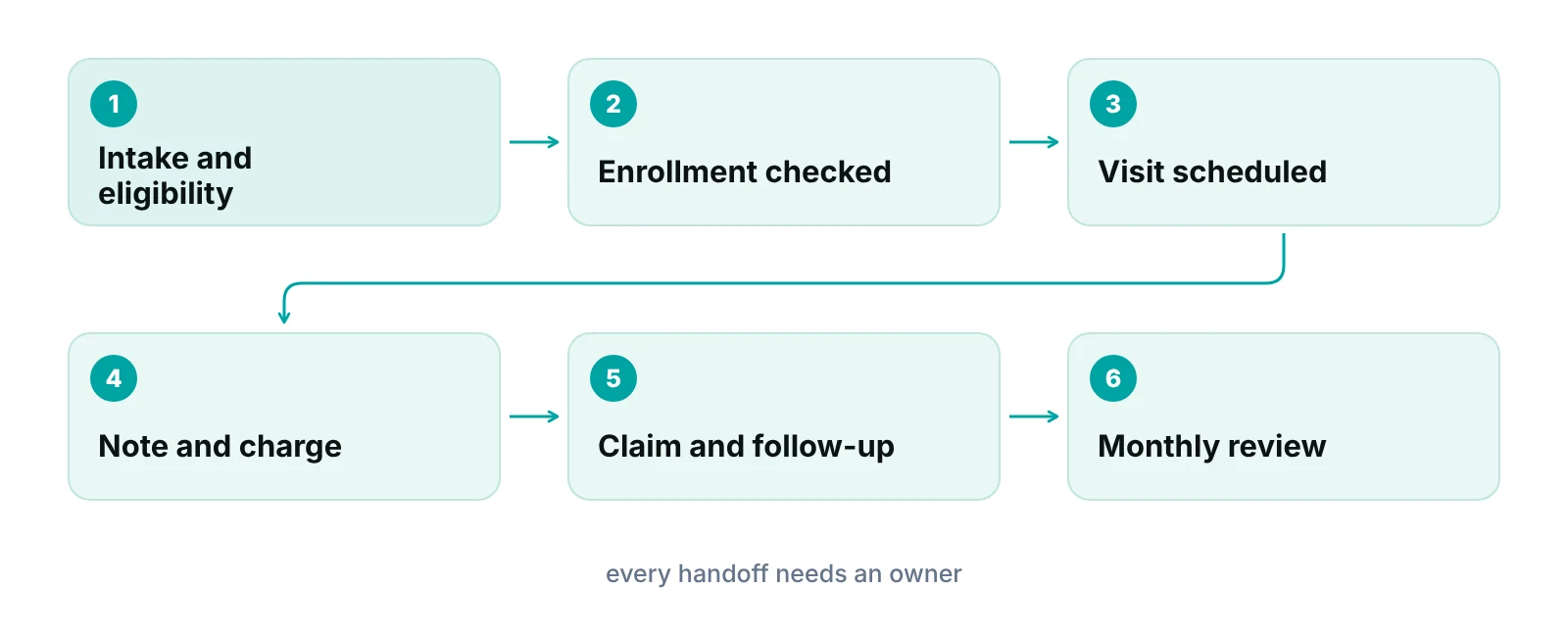
- Write the client path on one page. List every step from first call to final payment and put one name beside each. Gaps show up quickly.
- Verify benefits before the first visit, not after. Make it a rule that no new client is seen with an unverified plan unless the practice has chosen to take that risk.
- Track enrollment like a project. Keep dates for application, effective date, renewal and attestation for every clinician and payer.
- Make the note the billing source. Require start and stop times and a signature on every session, and review gaps daily.
- Set payer deadlines in a tracker. Put timely filing and appeal windows for each payer where billing staff see them.
- Train staff on the three privacy layers. Cover HIPAA, state law and Part 2 where it applies, and send unusual requests to one privacy lead.
- Grow only into capacity. Check open billable slots and enrolled payers before you spend on marketing.
Bottom line
Behavioral health practice management comes down to owners, dates and records: a named person for each handoff, tracked enrollment and filing deadlines, and notes that prove the minutes billed. Start with the weakest area in the table, then use the linked guides. If you want help with the revenue side, see the behavioral and mental health RCM operations page, or the practice management system page for what our portal offers today.
Frequently asked questions
What is behavioral health practice management?
It is the day-to-day running of a therapy, psychiatry or counseling practice: intake, eligibility, payer enrollment, scheduling, documentation, billing, privacy and growth. The behavioral difference is recurring visits, time-based codes and stricter privacy rules for psychotherapy notes and substance use records.
What is the first thing a new therapy practice should set up?
Start with payer enrollment and an intake script, because they decide when you can bill and whether the first visit is covered. Then add a note template that captures session time, a no-show policy and a privacy routine. Software choices come after the workflow is written down.
Does 42 CFR Part 2 apply to every behavioral health practice?
No. HHS describes Part 2 as applying to federally assisted programs that provide substance use disorder diagnosis, treatment or referral. Many therapy practices are covered by HIPAA only. Whether Part 2 applies depends on your services and funding, so ask counsel before you decide.
How do I reduce no-shows in a therapy practice?
Book the first visit soon after the intake call, rebook before the client leaves, send reminders by the channel the client chose, and keep a waitlist. A 2024 review of open-access scheduling found longer lead times went with more no-shows, though it covered mostly primary care.
Why do psychotherapy claims get denied?
Common causes are coverage or authorization gaps, missing or unsupported session time, wrong code for the minutes, missing information and late filing. Medicare contractors say the record must show the length of the session. Group denials by cause each week and fix the source.
Should a behavioral health practice outsource billing?
It depends on volume, staff and how well the current process runs. Many practices keep clinical work and intake in-house and hand claim follow-up to a partner. Whatever you choose, keep ownership of payer deadlines and ask for a Business Associate Agreement before sharing data.
Get your free practice audit
Tell us about your practice. We will contact you using the details you give.
- A review of your recent claims, denials and A/R aging
- Where your front desk and prior authorizations slow payment
- A prioritized fix list you keep, whether or not you hire us
Pricing is quoted after the audit, based on your volume and the services you choose. Prefer to talk? Call +1 (302) 556-2288.
Sources
- Fact Sheet: 42 CFR Part 2 Final Rule — HHS (n.d.)
- Understanding Confidentiality of Substance Use Disorder Patient Records (Part 2) — HHS (n.d.)
- Mental health and HIPAA guidance — HHS Office for Civil Rights (n.d.)
- Psychotherapy services — First Coast Service Options (Medicare) (n.d.)
- Medicare improperly paid providers for some psychotherapy services — HHS Office of Inspector General (n.d.)
- Timely filing of Medicare claims (Transmittal R12909CP) — CMS (2024)
- Medicare Parts A and B appeals process (MLN006562) — CMS Medicare Learning Network (n.d.)
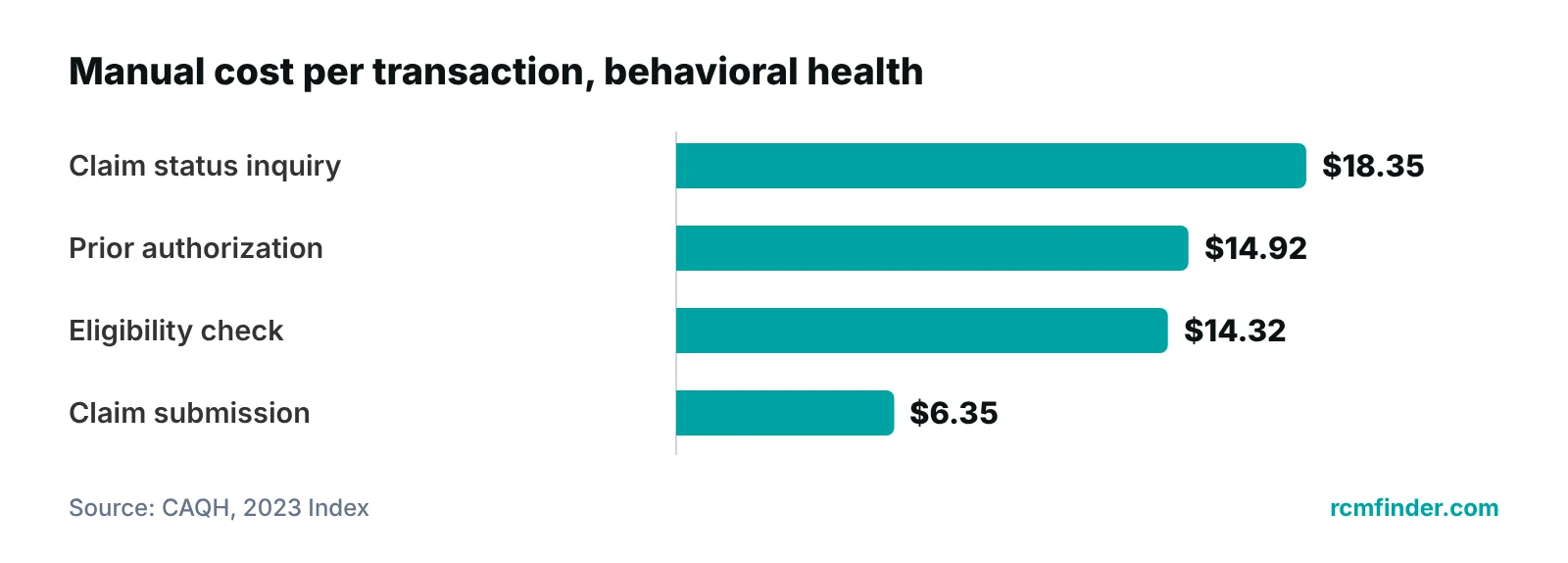
- 2023 CAQH Index, provider specialty issue brief — CAQH (2023)
- CAQH ProView overview — CAQH (2015)
- CAQH Provider Data Portal provider user guide — CAQH (n.d.)
- Good faith estimate and patient-provider dispute resolution — CMS (CCIIO) (n.d.)
- Open access scheduling and no-show rates: systematic review — Health Science Reports (PubMed Central) (2024)
- Medicare Part B enrollment for MFTs and mental health counselors — Honigman LLP (n.d.)
- Medicare telehealth waivers extended through 2027 — Penn State Office of Rural Health (2026)
- Does HIPAA permit providers to use email with patients? — HHS (2013 (page reviewed))
Disclaimer: This article is educational and is not legal, compliance, coding or financial advice. CPT is a registered trademark of the American Medical Association. Payer rules vary, and privacy, Part 2 and Medicare telehealth rules change, so confirm current requirements with counsel and your payers before you act. No products are recommended.
