
Choose virtual medical assistant services by testing them on six things: a written task scope, a signed Business Associate Agreement, a named supervisor, a training and onboarding plan, contract exit terms, and KPIs you can check. Reject any vendor that will not put these in writing before accessing patient data.
Many pages that rank for this topic list named companies and call one the winner. This guide does something different. It gives you a way to evaluate any provider, whether a managed agency, a marketplace freelancer or an in-house remote hire, so that you can decide on evidence rather than a ranking.
Key takeaways
- Write your own task list first; a vendor can only be judged against a scope.
- A signed Business Associate Agreement must exist before any access to patient information.
- Ask who supervises the work, who covers absences and how quality is sampled.
- Agree KPI definitions and a baseline before the first shift, and pilot on a narrow scope.
- Treat badges, rankings and unlimited-work offers as claims to verify, not answers.
Decide the scope before you talk to any vendor
Start with a written list of tasks, because a vendor can only be judged against a scope. A virtual medical assistant is remote staff who take on front-desk and administrative work for a practice. The exact mix differs from one practice to the next, and that mix drives every later decision on this page.
Write the list from your own week, not from a vendor brochure. Have the front desk log what they do for five working days, then sort tasks into three groups: a remote person can own it, a remote person can prepare it, or it must stay in the building. Checking a patient in at the counter stays. Phone work and scheduling often do not. Specialty matters here: front-desk workflows differ across the specialties we support, and a vendor should show it understands yours.
| Task area | Define before you buy | Ask the vendor |
|---|---|---|
| Scheduling and phones | Hours covered, call types, booking rules, who handles cancellations | Which scheduling and phone systems do you work in, and who owns a missed call? |
| Insurance and benefits checks | Which payers, what fields get recorded, where the result is saved | What does a completed check look like, and how are failures flagged? |
| Prior authorization support | Which services, who submits, who follows up, who owns denials | How do you track each request until a decision? |
| Billing hand-off | What the assistant gathers before a claim, and who takes over | How is incomplete registration data caught before submission? |
Front-desk accuracy flows into payment, as shown in our guide to how front-desk staff affect the revenue cycle.
Agency, marketplace or in-house hire
Pick the model before the vendor, because the model decides who carries the management and compliance work.
- Managed service. The provider recruits, trains, supervises and replaces staff. You pay for that overhead and you gain a party who is accountable under a contract.
- Freelance marketplace. Fewer fees, but you become the employer of record for the work: you vet, train, supervise and handle access. Check how the platform terms treat patient data before you consider it at all.
- In-house remote hire. The most control, and the most management time. It makes sense when the volume is steady and you already have a manager who can supervise.
Some practices run a hybrid, with an outside team on phones and verification. Our overview of virtual medical assistant services for medical practices explains how this split typically works, and the medical appointment scheduling services page covers scheduling as a standalone scope.
HIPAA and data handling: what any vendor must put in writing
If a vendor will see patient information, HIPAA treats it as a business associate, and a written agreement must be in place first. HHS describes a business associate as an entity that performs functions or activities involving protected health information on behalf of a covered entity, and says the covered entity may disclose that information only after getting satisfactory assurances, in writing, that it will be protected (HHS, Business Associates).
Under that guidance, the contract has to describe the business associate’s permitted and required uses of the information, bar any other use or disclosure, and require appropriate safeguards. HHS also says that if a covered entity knows of a material breach by the business associate, it must take reasonable steps to cure it or end the violation, and terminate the contract if that fails. The agreement sets conditions you may later need to enforce.
The Security Rule applies to business associates directly as well as to covered entities. It requires a security awareness and training program for all members of the workforce, including management, as the HHS Office for Civil Rights noted in its July 2017 cybersecurity newsletter. That gives you a fair question for any vendor: what training do your staff complete, how often, and how do you document it?
Questions to put in writing
- Will you sign our Business Associate Agreement, or your own template for our review? Do not allow any access to patient data before it is signed.
- Which subcontractors, call platforms or software tools will touch our patient data, and are they bound by the same terms?
- Where do your staff work from, and where is patient information stored or accessed? Whatever the answer, it should appear in the contract, not only in a sales call.
- How is access granted, limited to the minimum needed, logged and removed on the day someone leaves the account?
- What happens if there is a suspected breach? Who tells us, how fast, and what will you hand over so we can meet our own duties?
- What happens to our data and credentials when the contract ends?
A badge is not a safeguard
Marketing pages often say a company is “HIPAA certified” or “HIPAA compliant.” Treat that as a prompt to ask for the signed agreement, the written policies and the training records, not as an answer. Your own HIPAA obligations stay with you; a vendor cannot take them over by describing itself.
For the internal side of the same question, see our HIPAA compliance checklist for medical practices and the guide to HIPAA compliance at the healthcare front desk. Both cover your own staff’s duties.
Check who you are actually hiring
Ask how the vendor screens its people, and screen the vendor too. HHS’s Office of Inspector General can exclude individuals and entities from Federal health care programs such as Medicare and Medicaid. Its guidance says no Federal health care program payment may be made for items or services furnished by an excluded person, and that a provider that arranges or contracts with someone it knows or should know is excluded may face civil monetary penalties (OIG, Exclusion and Screening for Exclusions).
OIG’s guidance advises screening employees and contractors against its public List of Excluded Individuals and Entities at the time of hire and routinely afterward. When a vendor supplies the people, the sensible approach is to ask whether the vendor screens its staff against that list, how often, and whether it will share the results on request. Put the answer in the contract.
Also ask about the people, not only the company:
- Will the same named assistants work on your account, or is the team rotated?
- What background checks does the vendor run, and what does it do when one fails?
- What medical-office experience do the assistants have in your specialty?
- Can you speak to the people who would answer your phones before you sign?
Do not accept claims about licenses or experience from a website alone. Ask for them in writing, and check any license with the state board.
Supervision and training: who watches the work
Find out who reviews the assistant’s work, how often, and what happens when an error reaches a patient. A remote assistant without a named supervisor is a single point of failure. Look for a point of contact, a second person who knows your account, and a written escalation process.
- Who is the named supervisor, and how many accounts does that person manage?
- How is quality sampled, for example calls listened to or records re-checked, and will you see the results?
- What is the escalation path for a clinical question, an angry caller or a possible emergency? The assistant should route these to your clinicians by a written rule, not by judgment.
- Who is the backup if the assigned assistant is absent or leaves?
Clinical judgment is not an administrative task. If a vendor’s sales material describes assistants giving clinical advice, interpreting results or deciding triage, ask which licensed person in your practice has authority over that, and how the vendor’s scope fits state scope-of-practice rules. Our guide to virtual nursing assistants covers the difference between administrative and clinical support.
A practical onboarding plan
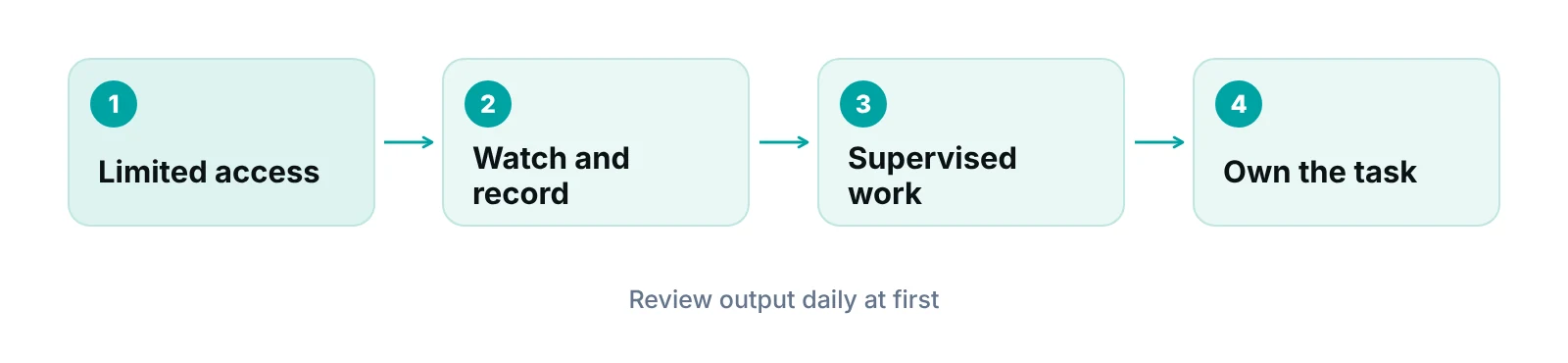
A vendor can teach general office skills, but only you can teach your schedule templates, payer quirks and provider preferences. A staged plan keeps risk low:
- Access. Set up a named login for each assistant with the minimum permissions needed. Use a password manager or the system’s own sharing features, never email or chat, and never share one login between people.
- Show. Record a screen walkthrough of each task as you do it, saying why you take each step and what you do when something is unusual.
- Observe. Have the assistant do the task while you watch, and correct early.
- Review. Check the output at the end of each day at first, then each week. Manage the result, not every click.
- Write it down. Turn what you learned into a short procedure for each task, so a replacement assistant can follow it.
“The tasks that stay in a vendor's hands longest are the ones that were written down clearly on day one.”
Contract terms that protect a practice
Read the service agreement and the Business Associate Agreement together, because a gap between them is where disputes start.
| Term | What to look for | Why it matters |
|---|---|---|
| Scope and exclusions | Task list by role, hours covered, what is not included | Prevents arguments over what was promised |
| Business Associate Agreement | Signed before access; covers subcontractors; breach notice steps; return or destruction of data at the end | Required before the vendor sees patient information, and sets your enforcement rights |
| Term and exit | Length, notice period, early-exit rights, handover help | Lets you leave without losing your procedures or data |
| Staffing | Named or dedicated staff, replacement time, backup coverage | Avoids coverage gaps and constant retraining |
| Service levels | Response times, coverage hours, reporting schedule | Gives you something concrete to measure |
| Pricing structure | Hourly, monthly, per-task or per-seat; what overage, rollover and onboarding cost | Hidden fees often sit in minimums and unused hours |
| Liability and insurance | Who bears loss from a breach or error; what coverage the vendor holds | Shows how the vendor shares the risk |
| Ownership | Who owns scripts, recordings and call notes | Keeps your procedures with your practice |
A word on prices: this guide does not quote any, because rates change often and vary by country, scope and contract. Ask every vendor for a written quote on the same scope and compare what is in each, including minimum hours, unused hours, setup charges and notice periods.
Avoid long auto-renewals without a clear way out, and have your attorney review the final documents. Questions about our own service go through our contact page.
KPIs: how you will know it is working
Agree on the measures and their definitions before the first shift, so the vendor reports numbers you can check. Set a baseline from your current staff for each measure, then compare. This guide gives no target values, because acceptable levels depend on your specialty, volume and starting point.
| Measure | How to define it | What to watch for |
|---|---|---|
| Call answer and abandonment | Calls answered, and calls dropped before an answer, during agreed hours | Missed calls at the busiest times of day |
| Scheduling accuracy | Appointments booked correctly for provider, type and length, checked by sampling | Wrong visit types that cause rework or denials |
| No-show and cancellation handling | Share of open slots refilled and reminders sent on time | Slots lost without a recall attempt |
| Verification completeness | Share of checks with all required fields recorded before the visit | Gaps that surface later as denials |
| Prior authorization turnaround | Time from request to submission, and from submission to a recorded decision | Requests with no clear owner |
| Rework rate | Share of tasks your own staff had to redo | A rising rate after the first month |
Several of these feed claims, so tie them to financial measures. Our guide to revenue cycle KPIs shows how to define denial and A/R measures, and the revenue calculator can estimate what a recurring front-desk error is worth at your volume.
Red flags when you evaluate a service
Several warning signs show up before you sign anything. None proves a vendor is poor, but each should be explained to your satisfaction in writing.
- No Business Associate Agreement, or reluctance to sign one before access to patient information.
- Vague answers about where staff work, which systems they use, or which subcontractors are involved.
- “Unlimited” work for a flat fee with no scope, service levels or fair-use terms.
- No named supervisor and no process for escalation or backup.
- Guaranteed results of any kind. Outcomes depend on your workflows as well as theirs, so a promise of a specific revenue figure or denial rate is a warning.
- Sales claims you cannot verify, such as acceptance rates, staff credentials or client lists you are asked to take on faith.
- Ranked review pages that do not disclose how vendors were chosen or whether they are paid. A better test is to run the same short pilot with your top choices.
Run a short pilot, then decide
A paid pilot of 30 to 60 days on a narrow scope tells you more than any demo. Choose one or two tasks, such as inbound calls for one location or pre-visit verification for one provider. Set the KPIs from the table above, agree who reviews results, and say in advance what a pass looks like.
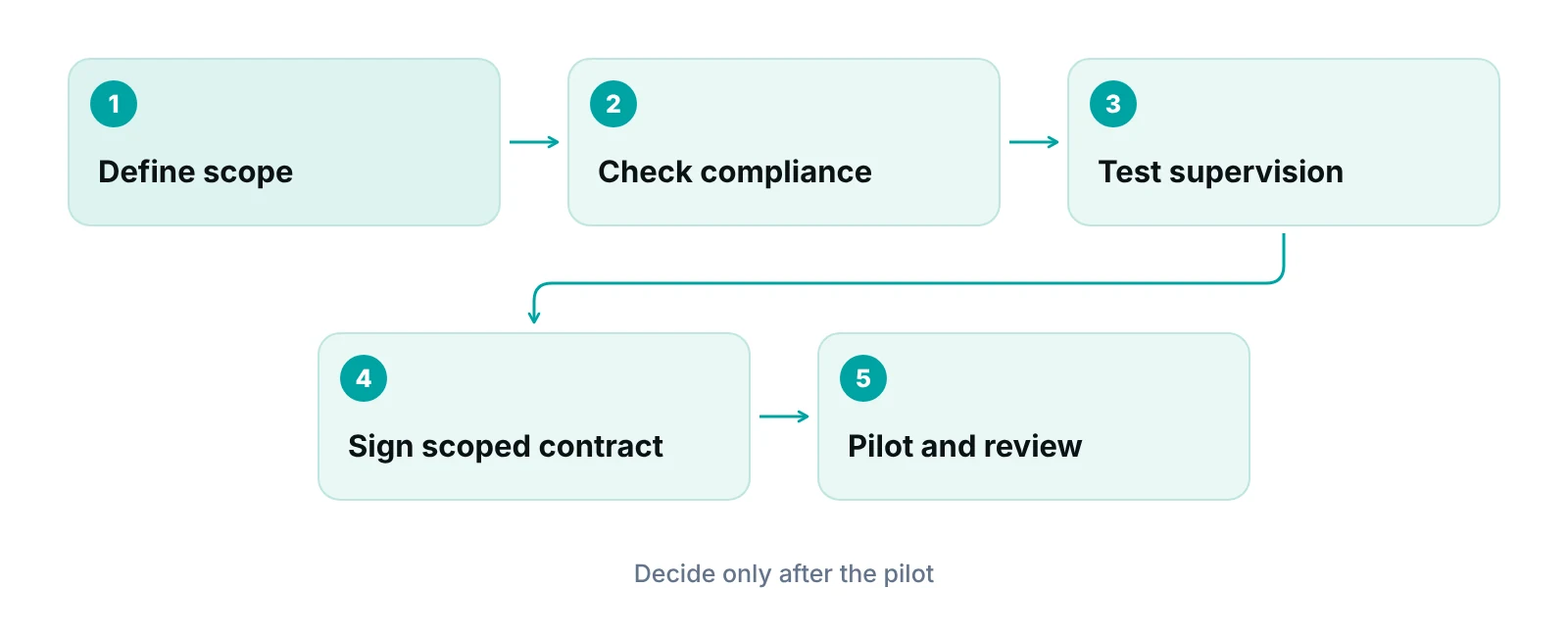
Use the same scope with each shortlisted vendor. At the end, compare the KPI results, the supervision and how each vendor handled the problems that came up, because every pilot has some.
Want a second opinion on your front-desk workflow?
Before you pick a vendor, find out where calls, verification and authorizations are slipping. Our free practice audit looks at your current workflow and shows where outside help would fit, if at all.
Our recommendations
- List your tasks before you contact any vendor. Log a week of front-desk work and sort tasks into own, prepare or keep in-house. Quotes cannot be compared without a common scope.
- Require a signed Business Associate Agreement before any access. No test logins, sample records or shared screens until it is signed.
- Get the people and the places in writing. Ask where staff work, which subcontractors and tools touch patient data, and how staff are screened. Put each answer in the contract.
- Name the supervisor and the backup. The contract should name who reviews the work, how quality is sampled and who covers an absence.
- Define each KPI before the first shift. Write the formula, the data source and the reporting date for every measure. Set a baseline from your own staff first.
- Pilot on a narrow scope with every shortlisted vendor. Use the same tasks and the same measures for each. Decide on pilot results, not on presentations.
- Have counsel review the final contract. A healthcare attorney should read the service agreement and the Business Associate Agreement before you sign.
Bottom line
The best provider for your practice is the one that can show its scope, safeguards, supervision and numbers in writing, and that still looks good after a short pilot. Use the questions above with every vendor on your shortlist, and see how our virtual medical assistant service works if you want to include us in that comparison, or ask for a free practice audit first.
Frequently asked questions
How do I know if a virtual medical assistant service is legitimate?
Ask for a signed Business Associate Agreement, the names of your assistants and supervisor, a written scope and references you can call. A legitimate service answers each of these in writing. Be cautious if you are told it is “HIPAA certified” in place of a signed agreement, or if claims cannot be checked.
Does a virtual medical assistant need a Business Associate Agreement?
If the assistant will see or handle patient information on your behalf, yes. HHS says a covered entity may disclose protected health information to a business associate only after getting satisfactory written assurances. Have the agreement signed before any access, and ask counsel to review it.
What should a virtual medical assistant do, and what should it not do?
Typical scopes include scheduling, phones, benefit checks, referral tracking and reminders. Clinical judgment, triage and diagnosis should stay with your licensed clinicians. Write the boundary into the contract, with a clear route for escalating anything clinical.
Is it better to hire through an agency, a marketplace or directly?
It depends on how much management and compliance work you want to carry. A managed service handles recruiting, training and replacement. A marketplace or direct hire leaves those to you. Whichever you choose, the data-protection terms and supervision need to be in writing.
What KPIs should I track for a virtual medical assistant?
Start with call answer and abandonment, scheduling accuracy, verification completeness, prior authorization turnaround, complaints and rework. Set a baseline from your current staff and agree on the definitions with the vendor. Review them monthly and adjust.
How long should a trial last before I commit?
A pilot of 30 to 60 days on a narrow scope is a practical range, though it is a rule of thumb rather than a standard. It needs to be long enough to include a busy period and a few problems, so you can see how the vendor handles them.
Get your free practice audit
Tell us about your practice. We will contact you using the details you give.
- A review of your recent claims, denials and A/R aging
- Where your front desk and prior authorizations slow payment
- A prioritized fix list you keep, whether or not you hire us
Pricing is quoted after the audit, based on your volume and the services you choose. Prefer to talk? Call +1 (302) 556-2288.
Sources
- Business Associates (HIPAA Privacy Rule guidance) — HHS Office for Civil Rights (accessed 2026-10-14)
- OIG Exclusion and Screening for Exclusions — HHS Office of Inspector General (accessed 2026-10-14)
- OCR Cybersecurity Newsletter, July 2017 — HHS Office for Civil Rights (2017 (accessed 2026-10-14))
Disclaimer: This article is educational and is not legal, compliance or employment advice. HIPAA obligations depend on your facts, and contracts and state rules vary. Have a qualified healthcare attorney review any vendor agreement before you sign.
