
Cardiology billing services should do more than submit claims. A good partner knows how echo, stress, Holter, nuclear and device checks split into global, professional and technical parts, tracks prior authorization for imaging, signs a Business Associate Agreement, and reports denials by test and payer. Ask how it works before you sign.
A cardiology claim is rarely one line. One visit can include a consult, an echo your staff performed, a Holter hookup and a device check, and each has its own rule for who bills which part. Add hospital reads and imaging that needs approval before the patient arrives, and a general billing service can miss revenue without anyone noticing.
This guide is a buyer’s checklist. It covers what a partner must handle, the rules behind the global, professional and technical split, device checks, imaging documentation and authorization, the questions to ask, and what to expect in reports. For the revenue cycle itself, see our post on cardiology revenue cycle management.
Key takeaways
- Cardiology billing has four streams: visits, in-office tests, device checks and hospital reads. A partner must handle all four.
- CMS marks every code with a PC/TC indicator. The indicator, not habit, decides whether a code is billed global or split.
- Device checks are billed by device and period, with frequency limits that a claim must respect.
- Imaging claims need an order, a documented reason and a signed report in the chart before they go out.
- Ask for a Business Associate Agreement, a named modifier reviewer and written report definitions before you sign.
What should cardiology billing services cover?
They should cover every way a cardiology practice earns revenue, not only office visits. Most groups bill four kinds of work: visits, in-office diagnostic tests, device checks, and reads or procedures done at a hospital. Each needs different data on the claim. Table 1 shows the four and what a partner needs from you.
| Stream | The billing question | What the partner needs from you |
|---|---|---|
| Office visits and consults | Visit level, and a diagnosis that supports the test | Visit notes; an order and reason for each test |
| In-office tests (echo, stress, Holter, nuclear) | Global claim, or a professional and technical split | Equipment owner, reader, supervisor and signed report |
| Device checks, in person and remote | Programming or interrogation code, and how often it may be billed | Device type, check date, signed report, any outside monitor |
| Hospital reads and procedures | Professional claim only; the hospital bills its own part | Site of service for every study and a hospital read log |
A partner used to office visits tends to miss the second and third rows. For imaging, procedures and denials at claim level, read cardiology revenue cycle management.
How do global, professional and technical billing work for in-office tests?
A global claim bills both parts of a diagnostic test on one line. A split bills the professional component (the physician’s read and report) and the technical component (equipment, staff and supplies) separately. CMS marks each code in the fee schedule so a coder knows which is allowed.
In CMS’s fee schedule indicator list (last modified July 14, 2026), indicator 1 codes generally have both a professional and a technical component. Indicator 2 codes are professional only, indicator 3 codes are technical only, and indicator 4 codes are global only, with matching professional and technical codes. A coder cannot apply modifier 26 or TC by habit. The code decides.
| Test family | Global | Professional only | Technical only |
|---|---|---|---|
| Holter, up to 48 hours | 93224 | 93227 (review and interpretation) | 93225 (recording) and 93226 (scan analysis with report) |
| Holter, more than 7 and up to 15 days | 93245 | 93248 | 93246 and 93247 |
| Cardiac event monitor, 24-hour attended | 93268 | 93272 | 93270 (recording) and 93271 (transmission and analysis) |
| Mobile cardiac telemetry | No global code | 93228 | 93229 |
| Remote pacemaker or ICD check, up to 90 days | No global code | 93294 (pacemaker) or 93295 (ICD) | 93296 |
| SPECT myocardial perfusion imaging | 78451 (single study) or 78452 (multiple studies) | Same code with 26 | Same code with TC |
Source: Boston Scientific external monitoring guide (2026); Abbott device monitoring guide (2026); GE HealthCare reimbursement guide (2023); CMS indicator list (2026). Manufacturer guides are secondary sources; confirm in the CMS fee schedule.
Echo and stress testing need the same indicator check, so confirm each code in the fee schedule before it goes into charge setup. Note that remote device checks use separate codes for each part, while SPECT uses one code with a modifier. A general biller can easily get this wrong.
Supervision is a payment condition
Under 42 CFR 410.32(b) (eCFR current as of October 19, 2026), most diagnostic tests need general, direct or personal supervision. Direct supervision means the physician is in the office suite and immediately available. The rule lets real-time audio and video count as presence for services without a 010 or 090 global surgery indicator, but audio-only does not count. The CMS indicator list gives the level for each code (01 general, 02 direct, 03 personal).
A billing partner cannot see who supervised a test, so your staff must record it.
Why does the place of service change who bills which part?
Because the hospital, not your practice, bills the technical side for its own patients. In the Medicare Claims Processing Manual, chapter 13, Medicare Part B contractors may not pay the technical component of radiology services for hospital inpatients, and hospital outpatient radiology is paid to the hospital under the outpatient payment system (section 20.2.1). The same chapter says an interpretation includes a written report (section 20.1).
So a cardiologist reading a hospital study sends a professional claim only, and a partner must know the site of every study. See our guide to hospital versus professional billing for how the two claim types differ.
Ask about leased equipment and staff
The same chapter (section 20.3.2) calls arrangements where a physician leases equipment and staff to meet the supervision rule suspect. If you use one, have counsel review it.
What should a billing partner know about cardiac device checks?
Device checks are billed by device type, kind of check and period covered. In-person work uses programming evaluation and interrogation codes (93279 to 93291 in Abbott’s 2026 guide). Remote work uses codes that cover a 30-day or 90-day period (93293 to 93298), and the professional and technical parts are separate codes. Remote checks also raise telehealth questions, covered in our cardiology telehealth post.
- Know the pairs. In the guide, 93294 (pacemaker) and 93295 (ICD) are the physician analysis codes, and 93296 is the technical code that goes with either when one practice does both parts.
- Count the days. The guide says 93294 to 93296 are reported no more than once every 90 days and not if monitoring ran under 30 days. For 93297 and 93298 the limits are once every 30 days and not under 10 days. A partner must hold a claim until the period is complete.
- Know the Medicare frequency rules. Novitas LCD L34833 allows routine electronic analysis of a pacing cardioverter-defibrillator within one month after implant and every three months after that. It sends pacemaker frequency to NCD 20.8.1.1 and counts clinic and remote visits together. It applies to Novitas jurisdictions J-H and J-L; other Medicare contractors may differ.
- Get the outside report. When a monitoring service performs the check, the LCD says results go to the attending physician and are documented in the record. Agree in writing who bills the technical part.
- Split hospital checks. The guide says the physician bills the professional part on a CMS-1500, and the hospital bills its part on a UB-04.
How should imaging be documented before the claim goes out?
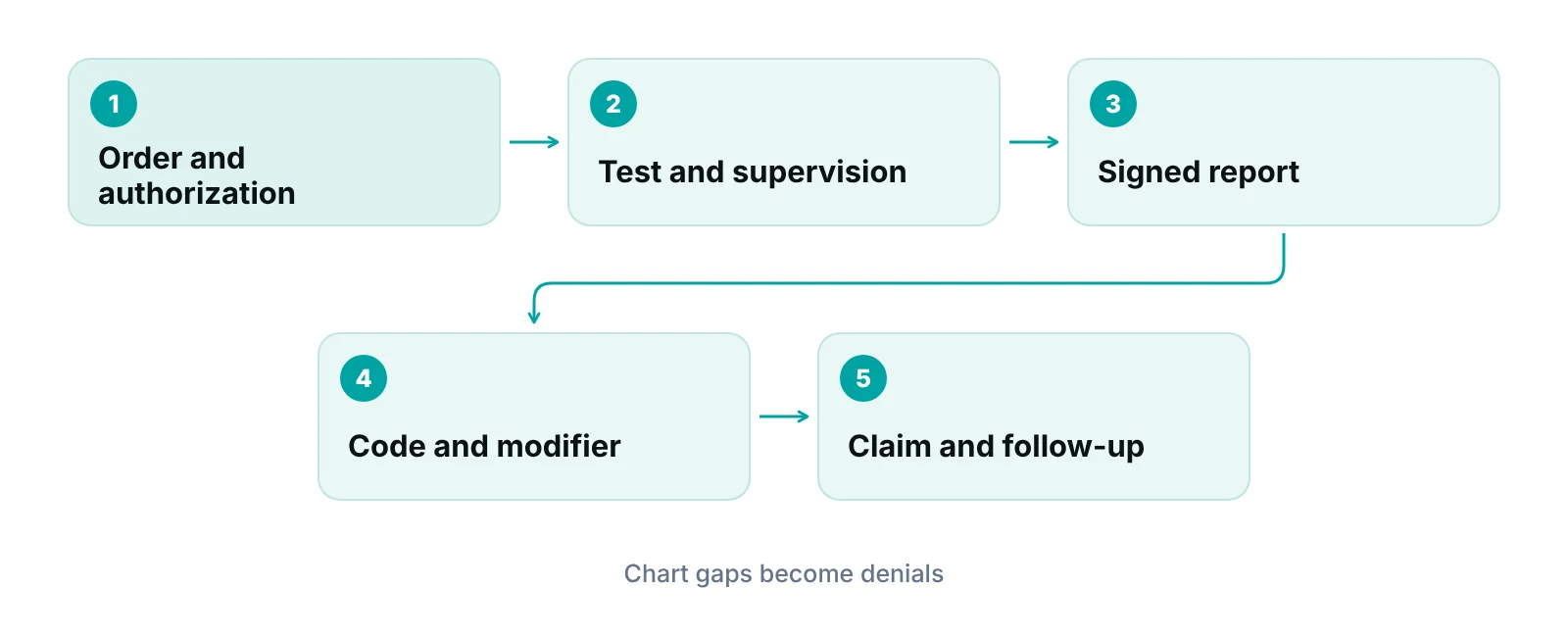
Every imaging claim needs three things in the chart: an order from the treating physician, a documented reason, and a signed report. A billing partner can chase these items. It cannot create them.
- Order. Under 42 CFR 410.32(a), Medicare tests must be ordered by the treating physician, meaning the physician who treats the patient for a specific problem and uses the result to manage it.
- Echo. CMS approved Recovery Audit topic 0111 (dated September 4, 2018) on the medical necessity and documentation of transthoracic echocardiography, covering codes 93303, 93306 and 93307. Expect requests for the order, the reason and the report.
- Nuclear and PET. Under NCD 220.6.1, Medicare covers PET heart perfusion imaging with rubidium-82 or ammonia N-13 when it replaces a SPECT study or follows an inconclusive one, and the inconclusive result must be documented. CMS notes a newer version of the NCD exists, so check the current text. A partner should flag any PET claim that follows SPECT without that note.
- Drug line. A 2023 manufacturer guide says that in physician offices Medicare pays the radiopharmaceutical on AWP, ASP or invoice, while hospital outpatient departments receive it packaged. Charge capture needs a drug line for each study, with units that match what was given.
- Diagnosis. The symptom or condition on the order must support the test. Our chest pain ICD-10 guide shows how that diagnosis is chosen.
What does prior authorization for cardiac imaging involve?
Whether a plan requires approval for a given echo, stress or nuclear study is that plan’s decision, so a partner needs a plan-by-plan list that is checked when the study is scheduled.
What has changed is the timetable. The CMS interoperability and prior authorization final rule (CMS-0057-F) applies to Medicare Advantage organizations, state Medicaid and CHIP fee-for-service programs, Medicaid and CHIP managed care, and qualified health plan issuers on the federal exchanges. Drugs are excluded. From January 1, 2026, covered payers must decide expedited requests within 72 hours and standard requests within seven calendar days (the timeframes do not apply to the exchange issuers), and must give a specific reason for a denial. The Prior Authorization API is due January 1, 2027.
Your partner should track each approval as data, not as a note. Ask whether it records:
- The authorization number, approved code and units.
- The approved date range and the rendering site.
- A link between the approval and the scheduled study.
- A re-check when the order changes, for example from a resting echo to a stress study.
- The denial reason and appeal deadline when a request is refused.
Authorization requests are front-desk work. Some practices give it to a partner, and others use remote staff such as our virtual medical assistants. Agree who owns it. Our prior authorization guide covers the process in general.
What should the partner handle, and what stays with your practice?
The partner should own everything from charge entry to payment follow-up. Your practice owns the clinical record and the facts only your staff can supply. Put the split in writing so a denied claim does not start an argument.
- Partner: charge entry from the schedule and device-check logs; coding review with modifier and component checks; claim scrubbing and submission; payment posting and underpayment checks; denial, appeal and A/R follow-up; scheduled reports.
- Your practice: orders, medical necessity and signed reports; the supervision record for each test; equipment and read arrangements; authorization at scheduling, unless the contract moves it to the partner.
What should you ask before you sign?
Ask to see each answer done on your own claims. Table 3 lists the questions that separate a cardiology-ready partner from a general biller.
| Question | Why it matters | A good answer includes |
|---|---|---|
| Show a Holter, an echo and a remote device check built from our schedule. | Each splits differently. | The code’s PC/TC indicator checked first, not one rule for all. |
| Who reviews modifier 26 and TC before submission? | Wrong-component claims are denied or recovered later. | A named reviewer and a check of code against site of service. |
| How do you track imaging authorizations? | A missing approval means a denied study. | Number, units, dates and site stored per study, checked at scheduling. |
| How do you handle 30-day and 90-day device periods? | Early billing breaks frequency limits. | Claims held until the period closes; payer limits on a rule sheet. |
| Will you sign a Business Associate Agreement before seeing patient data? | HIPAA requires one for billing vendors. | A written agreement, a list of subcontractors and breach reporting. |
| What reports do we get, and how are they defined? | Metrics differ between vendors. | Definitions in writing, with denials by test, payer and reason. |
Source: HHS business associate guidance (2026) for the Business Associate Agreement row; the other rows are our checklist based on the CMS rules cited above.
For a general vendor checklist, see our post on questions to ask when choosing a medical billing company.
What does HIPAA require of a billing partner?
HIPAA requires a written agreement before a billing vendor sees patient data. HHS guidance (content last reviewed July 30, 2026) lists billing and claims processing as business associate activities. A covered entity may share protected health information with a business associate only after satisfactory written assurances, usually a Business Associate Agreement (BAA).
The agreement must describe permitted uses, bar other uses, and require the partner and its subcontractors to follow the Security Rule and report security incidents, including breaches of unsecured information. Subcontractors that handle the data are business associates too.
At RCM Finder, we use role-based access, audit logging and encrypted (HTTPS) connections, and we put a Business Associate Agreement in place before we access patient data. Our HIPAA Security Rule post covers what the rule expects of vendors.
What reporting should a cardiology billing partner give you?
Reports should show where money is stuck and why, split by test type, payer and site. A single collections total hides the problem. Ask for these at minimum:
- Denials by reason, test type and payer.
- Charge lag: days from service to claim.
- Days in A/R and claim aging by payer.
- Underpayments against the expected amount.
- Authorization status for scheduled studies.
- Device-check periods that are due or open.
Aging matters because of the filing limit. Under 42 CFR 424.44 (eCFR current as of October 16, 2026), a Medicare claim generally must be filed within one calendar year after the date of service, with exceptions for agency error and retroactive entitlement. Ask for the definition of every metric in writing, since vendors can calculate days in A/R differently. Our revenue cycle KPI guide defines the standard measures, and reporting can come from your software too (see cardiology practice management software).
See what your denied claims have in common
Use the revenue calculator to estimate what denied and delayed claims cost, then bring the numbers to a free audit.
How does RCM Finder approach cardiology billing?
We start with an audit of your claims. Our revenue cycle team covers billing, coding support, claim scrubbing, denial management and A/R follow-up, and works inside your existing EHR.
Our portal tracks claims by stage, applies specialty-aware billing logic per claim, checks data completeness before submission, flags underpayments against expected amounts, and keeps role-based permissions and an audit log. We built and tested the billing pipeline on real claim data from an affiliated multi-provider pain management and neurology practice in Indiana. Cardiology has its own test and device rules, so we begin with a sample of your claims. Pricing is quoted after the free audit.
Want a second look at your cardiology claims?
Send a sample of denied or short-paid claims with their notes. A free practice audit shows whether the cause is the code, the component split, the authorization or the chart.
Our recommendations
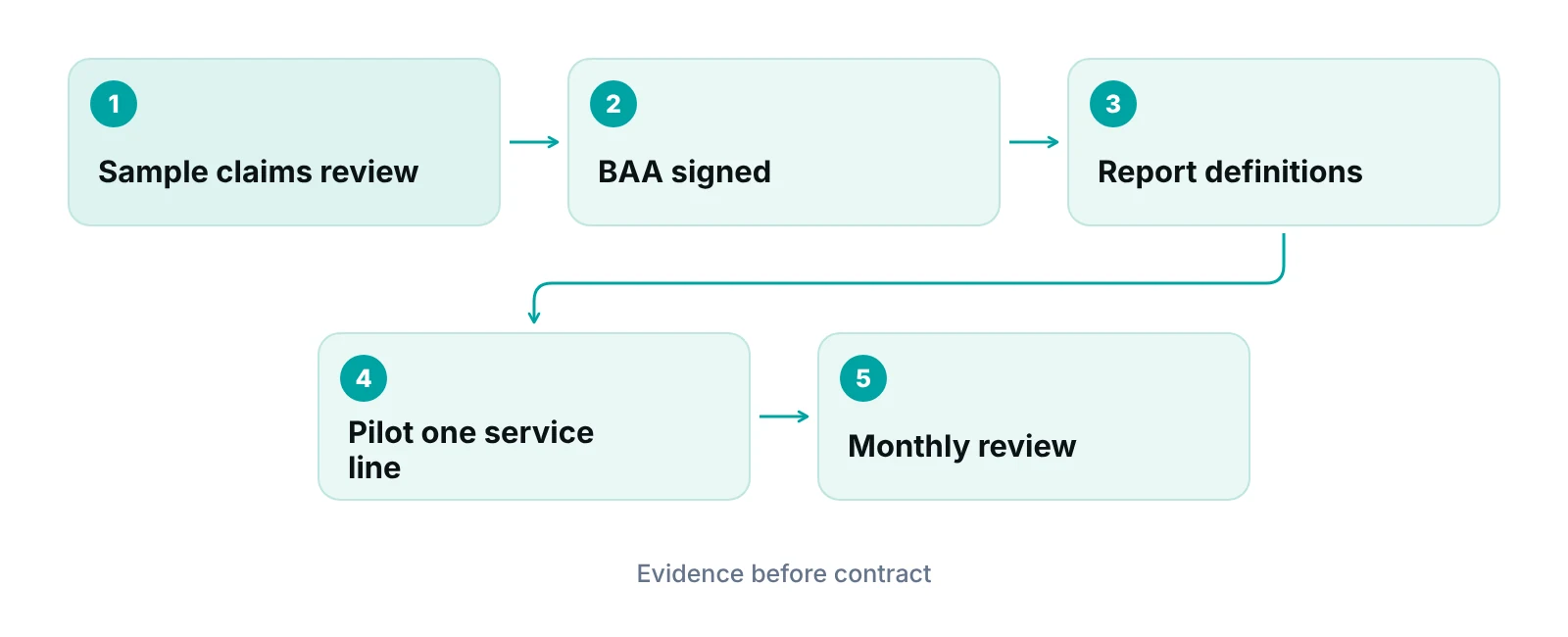
- Test with 30 days of your own claims. Give a candidate partner one month of claims across all four streams. Ask it to show what it would have changed and why.
- Keep a written supervision and read log. Record who supervised and who read each test. A billing partner cannot recover that fact later.
- Load PC/TC indicators into charge setup. Set each code up as global, split or separate-code from the fee schedule, so the modifier is a rule and not a guess.
- Hold device-check claims to the period. Build a due-date list for 30-day and 90-day periods and release the claim only when the period has closed.
- Make authorization part of scheduling. No imaging study is booked until the approval number, units and dates are in the record.
- Sign the BAA before any data moves. Get the agreement and the subcontractor list in hand before the partner touches a patient record.
Bottom line
A cardiology billing partner earns its place in the details: the Holter split correctly, the device check billed after its period, the imaging study with its approval on file, and a report that shows why claims return. If your claims are coming back for these reasons, our revenue cycle management team can review a sample. The companion post on cardiology revenue cycle management goes deeper on imaging, procedures and denials.
Frequently asked questions
What do cardiology billing services include?
They include charge entry, coding review, claim submission, payment posting, denial follow-up and A/R work. For cardiology they should also include component splits for in-office tests, device-check frequency rules, imaging authorization tracking and reporting by test type and payer.
Should we bill echo and stress tests globally or split them?
It depends on who performs and reads the test and where it happens. If your practice owns the equipment and your physician reads it, you generally bill both parts. At a hospital, the hospital bills the technical part and you bill the professional part. Check each code’s PC/TC indicator.
How often can a remote pacemaker check be billed?
A 2026 manufacturer guide says remote pacemaker and ICD monitoring codes 93294 to 93296 are reported no more than once every 90 days and not for periods under 30 days. Medicare contractors and commercial plans set their own limits, so confirm with each payer.
Do we need a Business Associate Agreement with a billing company?
Yes. HHS lists billing and claims processing as business associate activities, and a covered entity may share patient data with a business associate only after satisfactory written assurances, usually a Business Associate Agreement. Ask for it, and for the subcontractor list, before data moves.
Does cardiac imaging need prior authorization?
It depends on the plan. Each payer decides which echo, stress or nuclear studies need approval, so a partner needs a plan-by-plan list. Under CMS-0057-F, Medicare Advantage and Medicaid payers must decide standard requests within seven calendar days from January 1, 2026.
How long do we have to file a Medicare cardiology claim?
Generally one calendar year after the date of service, with limited exceptions such as agency error and retroactive entitlement, under 42 CFR 424.44. Commercial plans set their own deadlines, often shorter, so put each payer’s limit on your rule sheet.
Get your free practice audit
Tell us about your practice. We will contact you using the details you give.
- A review of your recent claims, denials and A/R aging
- Where your front desk and prior authorizations slow payment
- A prioritized fix list you keep, whether or not you hire us
Pricing is quoted after the audit, based on your volume and the services you choose. Prefer to talk? Call +1 (302) 556-2288.
Sources
- Status Indicators (PC/TC and physician supervision indicator definitions) — CMS (2026)
- 42 CFR 410.32: Diagnostic tests, conditions — eCFR (CMS) (2026)
- Medicare Claims Processing Manual, Chapter 13: Radiology Services and Other Diagnostic Procedures — CMS (2026)
- 0111-Transthoracic Echocardiography: Medical Necessity and Documentation Requirements — CMS Recovery Audit Program (2018)
- Cardiac Rhythm Device Evaluation (L34833) — Novitas Solutions via CMS Medicare Coverage Database (2020)
- NCD 220.6.1: PET for Perfusion of the Heart — CMS Medicare Coverage Database (2009)
- CMS Interoperability and Prior Authorization final rule (CMS-0057-F) fact sheet — CMS (2026)
- Business Associates guidance — HHS Office for Civil Rights (2026)
- 42 CFR 424.44: Time limits for filing claims — eCFR (CMS) (2026)
- CRM Cardiac Device Monitoring Quick Reference Guide — Abbott (2026)
- External Cardiac Monitoring Coding and Payment Quick Reference — Boston Scientific (2026)
- Myoview Reimbursement Guide — GE HealthCare (2023)
Disclaimer: This article is educational and is not legal, coding, tax or compliance advice. CPT is a registered trademark of the American Medical Association, and its official descriptors are not reproduced here. Medicare contractors and commercial payers set their own policies, and rules change, so confirm current requirements with your payers, Medicare contractor, attorney and compliance officer before acting.