
Cardiology revenue cycle management is the chain of steps from scheduling a test to collecting the last patient balance. In cardiology it is shaped by in-office imaging and procedures: authorization before the test, complete documentation and charge capture during it, and denial and A/R follow-up after. Gaps in the first two stages cause most late-stage problems.
A patient has a stress echo with contrast. Three weeks later the claim is denied because the order never stated a reason, and the contrast line was never charged. Neither problem started in billing. Both started on the day of the test. This guide follows cardiology revenue cycle management stage by stage to show where imaging and procedure revenue leaks and who should catch it.
It is a process view. To choose a partner, see cardiology billing services: what to look for. For where the data should live, see the cardiology practice management software checklist.
Key takeaways
- Most cardiology denials are decided before the test: authorization, a specific order and a documented reason.
- CMS paused the appropriate use criteria program effective January 1, 2024, so Medicare claims carry no AUC data.
- Charge capture means three records agree: the order, the signed report and the supply log.
- In a 2024 Noridian review of stress echo claims, the top denial reasons were missing records, medical necessity and incomplete documentation.
- Sort denials by cause, not by payer, so each fix lands upstream.
What does cardiology revenue cycle management cover?
It covers six stages: authorize the test, perform and document it, capture every charge, submit a clean claim, work denials and A/R, and collect the patient balance. One cardiology visit can produce an E/M service, an ECG and an echo or stress test, each with its own order, report, supervision rule and payer edit. A claim can only be as complete as the record behind it, so the early stages set the ceiling for the later ones.
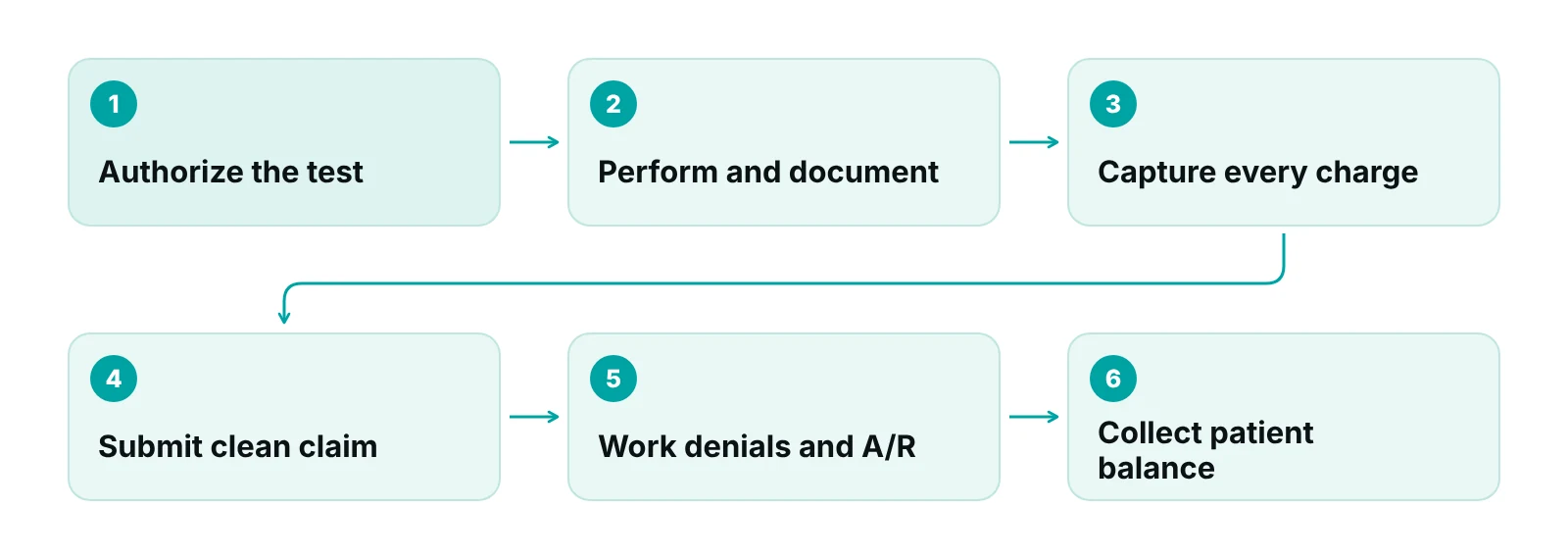
| Stage | Where money leaks | What to check |
|---|---|---|
| 1. Authorize | Test done without an approval, or outside its scope | Plan rule, site, approval dates and units |
| 2. Perform and document | No order, thin reason, unsigned or missing report | Order, reason and report agree |
| 3. Capture charges | Contrast, stress agents and add-ons never reach the claim | Order, report and supply log reconciled |
| 4. Submit | Wrong component, duplicate or bundled lines | Code edits and ordering physician on claim |
| 5. Denials and A/R | Appeals late or without records | Denial cause logged, deadline tracked |
| 6. Patient balance | No estimate, unclear statement | Estimate before the test |
Source: RCM Finder process map. The rules behind each row are cited below.
Stage 1: What should happen before an imaging test or procedure?
Confirm whether the patient’s plan requires authorization for the specific test and site, and attach the order and clinical reason before the appointment. Those two items are what every later review looks for.
Medicare’s rule starts there. Under 42 CFR 410.32, diagnostic tests generally must be ordered by the treating physician who uses the results; tests ordered by others are not reasonable and necessary, with listed exceptions.
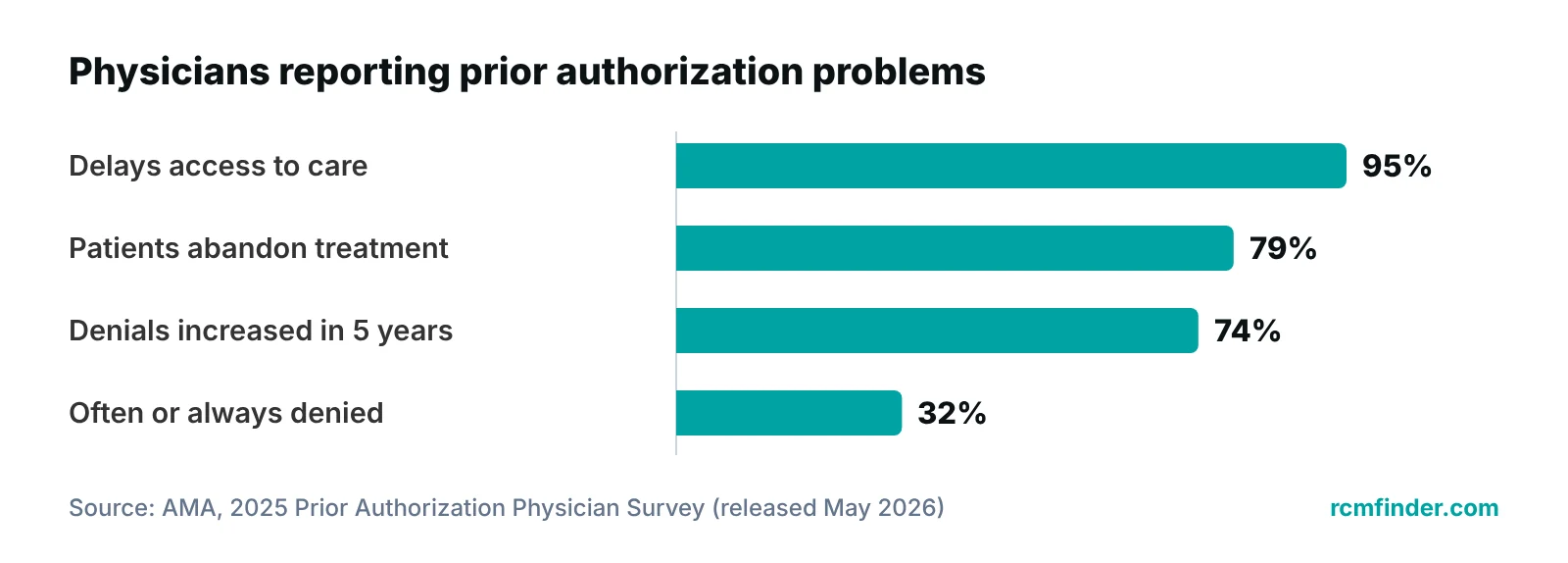
The workload is large. In the AMA 2025 prior authorization survey of 1,000 physicians across all specialties (released May 2026), physicians averaged 40 authorizations and 13 hours of staff time a week, and 40% employed staff who work only on authorizations. The survey is not cardiology-specific.
Timelines have changed for some payers. CMS-0057-F requires impacted payers to decide expedited requests within 72 hours and standard requests within 7 calendar days, and to give a specific denial reason, from January 1, 2026. Impacted payers include Medicare Advantage organizations, Medicaid and CHIP programs and plans, and exchange issuers, though exchange issuers are excluded from the timeframes. Drugs are excluded, and the electronic authorization interfaces are generally due January 1, 2027. Employer-sponsored commercial plans are not on the list, so confirm their timelines with each payer.
- Payer, plan and whether this test needs an approval for this patient on this date.
- Exact codes planned, including add-ons such as contrast, and the site of service.
- A signed order from the treating physician with the reason in plain words.
- Approval number, dates and units saved where the scheduler and biller can both see them.
- A hold on the schedule slot until the approval is recorded.
Ask what the approval covers
If a plan approves a stress echo, ask whether it also covers the contrast add-on. Approvals can be written for specific codes.
For the general process, see our prior authorization guide; for a missed approval, the retro-authorization guide. Remote staff can run this step, as shown on our virtual medical assistant page.
Do appropriate use criteria still apply to cardiology imaging?
Not on Medicare claims today. The CMS Appropriate Use Criteria program page says the CY 2024 Physician Fee Schedule final rule paused the program and removed its regulations at 42 CFR 414.94, effective January 1, 2024. CMS tells providers to stop including AUC consultation information on fee-for-service claims, and it has not specified a timeframe to resume.
Indications still matter. In Noridian’s Jurisdiction E Part B review of stress echo claims for October through December 2024, a top denial reason was documentation that did not support medical necessity under the NCD or LCD (Noridian). Another MAC may publish different policies, so check the one that pays you.
Older policies also tie volume to the patient’s condition. A university compliance checklist of one echo local coverage determination (2019) notes that studies more often than annually in stable disease need contemporaneous documentation of necessity (checklist). Confirm the current policy for your contractor.
In practice, write the reason into the order in clinical terms: the symptom, the change since the last study, or the decision the result will inform. Diagnosis codes should match it; see our chest pain ICD-10 guide. The AUC pause has no restart date, so re-check the CMS page each quarter.
Stages 2 and 3: How do you capture every charge for in-office imaging and procedures?
Build each charge from three records that must agree: the order, the signed report and the supply log. A missing record is either a leak, because the charge never goes out, or a denial, because the payer cannot see support.
Start with the professional and technical split. CMS’s PC/TC indicator definitions say indicator 1 codes can carry modifier 26 or TC; indicator 2 codes are professional only (93010 is the example); indicator 3 codes are technical only (93005); indicator 4 codes are global tests with separate component codes; and indicator 0 services cannot be split. Check the indicator before adding a modifier.
| What to capture | Rule or example to check | Source |
|---|---|---|
| Stress echo base code | 93350 covers rest and stress imaging; 93351 applies when the same physician provides monitoring, supervision, interpretation and report | Noridian JE; WPS (2010) |
| Contrast with a stress echo | Add-on 93352, no more than once per stress echo; record why conventional images were inconclusive | Noridian JE; WPS |
| Contrast and stress drugs | Billed separately from the test; narrative with agent, route and dose in older WPS guidance | Noridian JE; WPS |
| Resting echo, same day | 93306, 93307 and 93308 are included in 93350, so not billed with it | WPS (2010) |
| Nuclear study and stress test | One commercial payer pays 93015 and 93018 in addition to the nuclear study; if SPECT (78451, 78452) and planar (78453, 78454) are both reported for the same patient and time, only SPECT is payable | BCBS Minnesota (2023) |
| Imaging and stress agents | Same payer pays the imaging agent and pharmacologic stress agent when given outside a hospital or skilled facility | BCBS Minnesota (2023) |
Sources: Noridian JE Part B (2025), WPS echo guidance (2010), Blue Cross Blue Shield of Minnesota General Coding 018 (effective 12/01/2023). Other MACs and payers may differ.
The WPS guidance is dated 2010, so use it as a prompt to find your own contractor’s current article. The Minnesota policy is one commercial payer’s edit. The record matters as much as the code: a university checklist of an echo policy lists a formal written report with interpretation kept with the images, and an ordering physician on every echo (checklist).
Missed lines cost more now. Medicare’s 2026 conversion factors are $33.40 for non-qualifying APM participants and $33.57 for qualifying participants, with a 2.5% efficiency adjustment to non-time-based work values (CMS CY 2026 final rule fact sheet). CMS proposed 2027 factors of $32.84 and $33.17 on July 14, 2026, because the one-year 2.50% increase expires (CMS CY 2027 proposed rule fact sheet). The proposal is not final.
Stage 4: What should a cardiology claim carry before it goes out?
It should carry the approval number, the ordering physician, the correct component and modifier, and a diagnosis that supports the stated reason. Check before submission, not after the denial.
- Authorization number and dates match the date of service and the codes billed.
- Ordering physician is identified on the claim, and the order is on file.
- Professional and technical lines match who did the work and where.
- Add-on codes link to the base test and appear once.
- Combinations the payer bundles, such as resting echo with stress echo, are removed.
Medicare filing time is a hard limit: under 42 CFR 424.44, Part B claims must be filed within one calendar year after the date of service, with narrow extensions. Commercial contracts set their own limits. RCM Finder’s portal tracks claims by stage and runs data-completeness checks before submission, and our team works inside your existing EHR (for example PrognoCIS, eClinicalWorks or athenahealth).
Why do cardiology claims get denied, and how do you sort them by cause?
Sort denials by cause, not by payer, because each cause has a different fix and a different owner. Sorted by payer, a pile of denials says who to call; sorted by cause, it says which stage to repair.
| Cause | What triggers it | Fix upstream |
|---|---|---|
| No or wrong authorization | Test done without an approval, or outside its dates, units or codes | Hold the slot until the approval is recorded; check add-ons |
| Medical necessity | Reason missing or not matching the payer policy | Put the clinical reason in the order |
| Missing or incomplete records | Records request unanswered; support missing for the code billed | Keep order, report and images together; track request dates |
| Coding and edit conflicts | Wrong component, duplicate stress study, SPECT with planar | Check PC/TC indicators and payer bundling |
| Ordering and supervision | No treating-physician order, or supervision level not met | Confirm both before the test |
| Late filing | Claim outside the payer’s window | Track limits by payer; work unbilled lists weekly |
Sources: Noridian (2025), CMS (2026), eCFR (2026), BCBS Minnesota (2023), WPS (2010). Other MACs and payers may differ.
Noridian’s review of stress echo (CPT 93351) for October through December 2024 lists the top denial reasons as requested records not received, documentation not supporting medical necessity, and incomplete or insufficient documentation. Records are due within 45 calendar days with no extensions, and claims are denied if they arrive on day 46 (Noridian). Those are record-keeping failures, not coding errors.
CMS also approved a recovery audit topic on echo medical necessity and documentation (topic 0111); the provider types it lists are hospitals and skilled nursing facilities, so check which reviews apply to your practice. For the full workflow, see our denial management guide and the CO-197 denial guide for missing approvals.
Stage 5: How should cardiology A/R be worked?
Work A/R by age and by cause: new denials first while the record is fresh, then high-value imaging claims, then older balances. Log one cause per denial so the same fix is not rediscovered ten times.
- Review new denials and records requests within days, and attach the order, report and images before the deadline on the letter.
- Appeal with the documentation up front. One commercial policy states that documentation must be submitted with any appeal.
- Compare paid amounts with the contract rate on imaging lines, since underpayments hide inside paid claims. Our portal flags payments below expected amounts.
- Track claims with no response by payer, and call before the filing limit.
- Report denials by cause monthly and send the top cause to the stage owner.
Appeal deadlines are on each denial notice; we found no single cardiology-wide deadline. The accounts receivable guide covers aging routines.
Stage 6: How do you handle patient balances after in-office imaging?
Estimate the patient’s share before the test, say it in plain words, collect what the plan assigns to the patient, and send a clear statement for the rest. Imaging can fall under a deductible or coinsurance depending on the plan, so check the plan, not the test.
Do the estimate when you check the authorization, since the same plan details are open. Use the allowed amount for each line, not the charge; our patient responsibility guide explains the arithmetic. After the plan pays, the statement should name the test and date, show what the plan paid and say what is owed. Keep denial work and patient billing apart: a claim denied for no authorization should not become a patient bill until the appeal is decided and your contract and state rules are checked.
Find where cardiology claims leak
A free practice audit reviews recent imaging and procedure claims, denials and records, then shows which stage is costing the practice revenue.
Our recommendations
- Gate every non-emergency test on an approval check. Keep a one-page list per payer of which tests need approval and who confirms it.
- Put the clinical reason in the order. Train ordering staff to write the symptom, change or decision in plain words. It answers most medical necessity questions.
- Reconcile order, report and supply log weekly. Pull tests with a report but no charge, and charges with no report. Both lists show leaks.
- Add component and bundling checks to claim review. Check the PC/TC indicator, duplicate stress studies and same-day echo conflicts before submission.
- Tag every denial with one cause. Use the six causes here, review monthly and send each to its stage owner.
- Re-run your test economics after the 2027 final rule. Compare your payer mix against the final conversion factors before changing test volume or staffing.
Bottom line
Cardiology revenue cycle management works when the early stages are treated as billing work: an approval before the test, a specific order, a signed report and a charge for everything used. Tag each denial with one cause for a month, then fix the stage that produces the most. RCM Finder’s end-to-end revenue cycle management service is available to practices that want help running the back end.
Frequently asked questions
What is cardiology revenue cycle management?
It is the process that turns a cardiology visit, test or procedure into collected payment: authorization, documentation, charge capture, claim submission, denial and A/R work, and patient billing. In cardiology it centers on in-office imaging and procedures, each with its own order, report and payer rules.
Do Medicare claims still need appropriate use criteria information?
No. CMS paused the AUC program and removed its regulations at 42 CFR 414.94 effective January 1, 2024, and told providers to stop including AUC consultation information on fee-for-service claims. CMS has not set a restart date, so re-check its program page.
Why are stress echo claims denied?
In Noridian’s Jurisdiction E Part B review of CPT 93351 for October through December 2024, the top reasons were records not received, documentation not supporting medical necessity, and incomplete documentation. Records are due within 45 days of the request, and late records are denied. Other MACs and payers may differ, so read your own contractor’s articles.
How fast must payers answer a prior authorization request?
Under CMS-0057-F, impacted payers must decide expedited requests within 72 hours and standard requests within 7 calendar days from January 1, 2026, and give a specific denial reason. Exchange issuers are excluded from the timeframes, and employer-sponsored commercial plans are not on the list.
How long do we have to file a Medicare Part B claim?
Generally one calendar year after the date of service under 42 CFR 424.44, with limited extensions for agency error and retroactive entitlement. Commercial payers set their own windows in the contract, so track each one and put the limit where the billing team can see it.
Which stage should we fix first?
Start with the stage that produces the most denials by cause. For many practices that is authorization and documentation, because both sit upstream of coding, claims and A/R, and a gap there shows up later as a denial. Tag every denial with one cause for a month before choosing.
Get your free practice audit
Tell us about your practice. We will contact you using the details you give.
- A review of your recent claims, denials and A/R aging
- Where your front desk and prior authorizations slow payment
- A prioritized fix list you keep, whether or not you hire us
Pricing is quoted after the audit, based on your volume and the services you choose. Prefer to talk? Call +1 (302) 556-2288.
Sources
- Appropriate Use Criteria Program — CMS (2026)
- CMS Interoperability and Prior Authorization Final Rule (CMS-0057-F) fact sheet — CMS (2026)
- AMA survey: prior authorization reform pledge falls short for physicians (2025 survey) — American Medical Association (2026)
- Medical Record Review Results: CPT 93351 (JE Part B TPE, Oct-Dec 2024) — Noridian Healthcare Solutions (2025)
- Medical Record Review Results (JE Part B) — Noridian Healthcare Solutions (2026)
- Approved RAC Topic 0111: Transthoracic Echocardiography — CMS (2018)
- Status Indicators (PFS PC/TC indicator help) — CMS (2026)
- 42 CFR 410.32: Diagnostic tests, conditions — eCFR (National Archives) (2026)
- 42 CFR 424.44: Time limits for filing claims — eCFR (National Archives) (2026)
- Calendar Year (CY) 2026 Medicare Physician Fee Schedule Final Rule (CMS-1832-F) fact sheet — CMS (2025)
- Calendar Year (CY) 2027 Medicare Physician Fee Schedule Proposed Rule fact sheet — CMS (2026)
- General Coding 018: Myocardial Perfusion (Cardiovascular Stress Test) — Blue Cross Blue Shield of Minnesota (2023)
- Coding guidance for echocardiography and stress echo (CV-026, LCD L28565) — WPS (via CMS Medicare Coverage Database attachment) (2010)
- Transthoracic Echocardiography LCD L33768 Checklist — University of Florida Jacksonville compliance office (2019)
- Mastering Revenue Cycle Management at a Cardiology Clinic — Rivet Health (2026)
- Advanced RCM strategies help streamline operations, improve profits — Diagnostic and Interventional Cardiology (2025)
Disclaimer: This article is educational and is not legal, coding, tax or compliance advice. Medicare contractors and commercial payers differ and change their policies, so confirm current requirements with your Medicare Administrative Contractor and each payer before acting. CPT is a registered trademark of the American Medical Association; official code descriptors are not reproduced here.