
CO-226 is claim adjustment reason code 226: information requested from the billing or rendering provider was not provided, was not provided on time, or was insufficient or incomplete. At least one remark code must accompany it, and that remark code tells you what the payer needs.
CO-226 looks vague because it is. The code only says the payer asked for something and did not receive a usable answer. The detail sits in the remark code that comes with it, which is why a team that reads only the reason code tends to guess.
This guide shows how to read the remittance, what to do first, and how to stop these denials from returning. Codes and rules change, so confirm against the current X12 code lists and your payer’s manual.
Key takeaways
- CARC 226 pairs with at least one remark code, which names the missing information.
- CO is a contractual obligation group code: the provider is generally responsible, so the patient is not billed for the denied amount.
- Most cases are late or missing responses to a payer request, so a tracked deadline is the best prevention.
- CARC 227 is the equivalent for information requested from the patient or insured, so do not mix them up.
What does CO-226 mean?
The X12 code list defines CARC 226 as information requested from the billing or rendering provider that was not provided, not provided on time, or was insufficient or incomplete. The code has been active since 2008 and was modified in 2013. The list also says at least one remark code must be sent with it, either an NCPDP reject reason code or a non-alert remittance advice remark code.
In plain terms: the payer asked, the answer did not arrive or did not satisfy them, and they closed the claim. The reason code does not say what was missing. For how remittances are structured, see what an ERA is and electronic remittance advice.
What does the CO group code tell you?
Group codes show who bears the adjustment. CO means contractual obligation, so the provider is generally responsible and cannot bill the patient for that amount unless the contract or rules allow. Our guide to explanations of benefits shows how patient responsibility is shown separately.
| Code | Meaning | Difference from 226 |
|---|---|---|
| CO-226 | Information requested from the billing or rendering provider not provided, late or incomplete | Provider side |
| CO-227 | Information requested from the patient or insured not provided, late or incomplete | Patient or insured side |
| CO-16 | Claim lacks information or has billing errors | Usually no prior request; claim data problem |
| CO-252 | An attachment or other documentation is required | Specific request for documents |
Descriptions paraphrased from the X12 claim adjustment reason code list.
See our CO-16 guide for claims that lack information at submission.
How do you read the remark code?
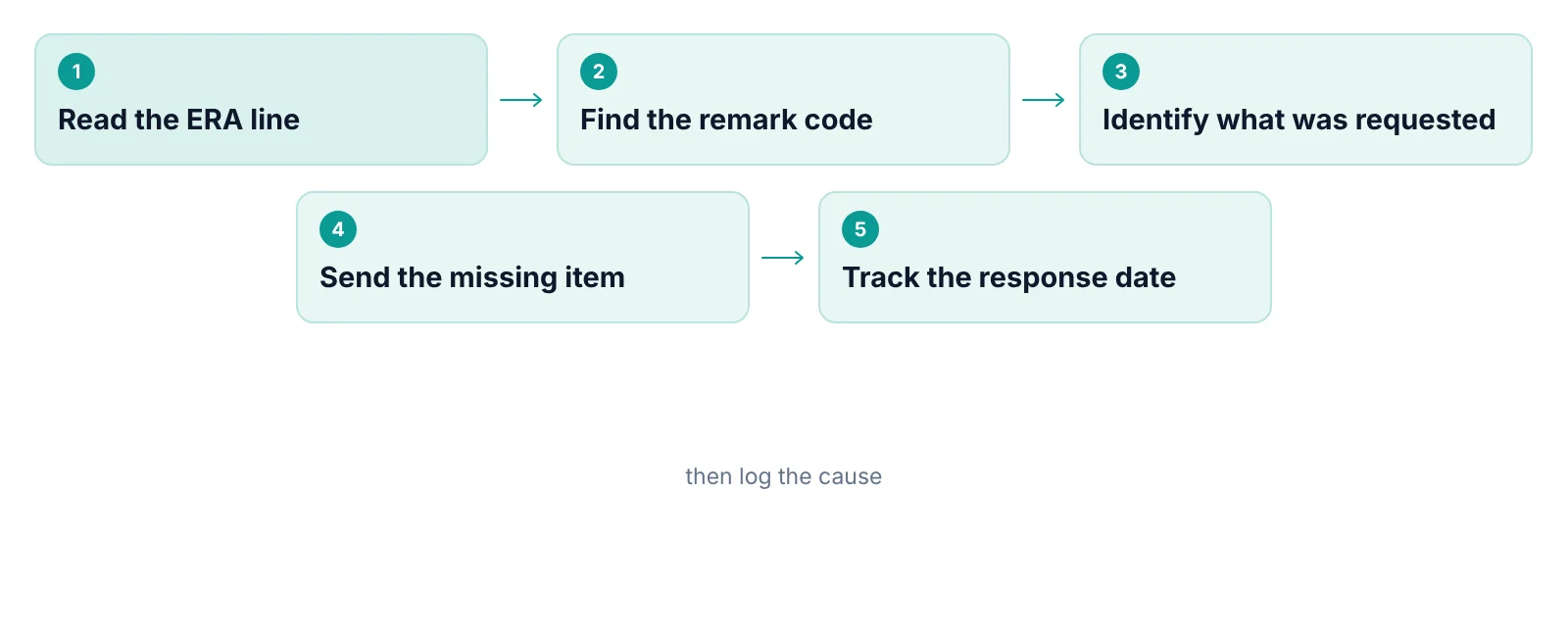
Look on the ERA line for the remark code (RARC) next to 226. The remark code names the missing item, such as medical records, documentation of a service or other data. Look up the exact text in the X12 remark code list and in the payer’s own explanation.
- Match the remark code to the payer letter or portal message that made the request.
- If there was no letter, call the payer and ask for the request date, the item needed and the response address.
- Write the findings in the account notes so the next person does not repeat the research.
| Type of request | Example item | Where it usually comes from |
|---|---|---|
| Clinical records | Visit note, operative report or test result | Clinical staff or the EHR |
| Billing detail | Itemized charges or corrected claim data | Billing system |
| Authorization proof | Prior authorization number or referral | Authorization log |
| Other coverage | Primary payer remittance | Posting records |
These are examples only. The remark code and the payer request define the actual item.
If you are not sure whether the rejection came from the clearinghouse or the payer, see clearinghouse rejection codes.
How do you fix a CO-226 denial?
| Step | Action | Owner |
|---|---|---|
| 1 | Pull the ERA and note the remark code and date | Denials specialist |
| 2 | Find the original request in the portal, mail or fax log | Denials specialist |
| 3 | Gather the item: records, forms, corrected data | Clinical or billing staff |
| 4 | Send it by the method and address the payer specifies, and keep proof | Denials specialist |
| 5 | Request reconsideration or file an appeal if the deadline allows | Billing lead |
Check appeal and reconsideration deadlines in the payer contract.
Want a second pair of eyes on your claims?
Send us your recent denials and we will show where the same issue repeats. The audit is free and the fix list is yours to keep.
If the payer will not reopen the claim, the appeal process is next. See our denial management guide and tips for insurance denials.
How do you prevent CO-226?
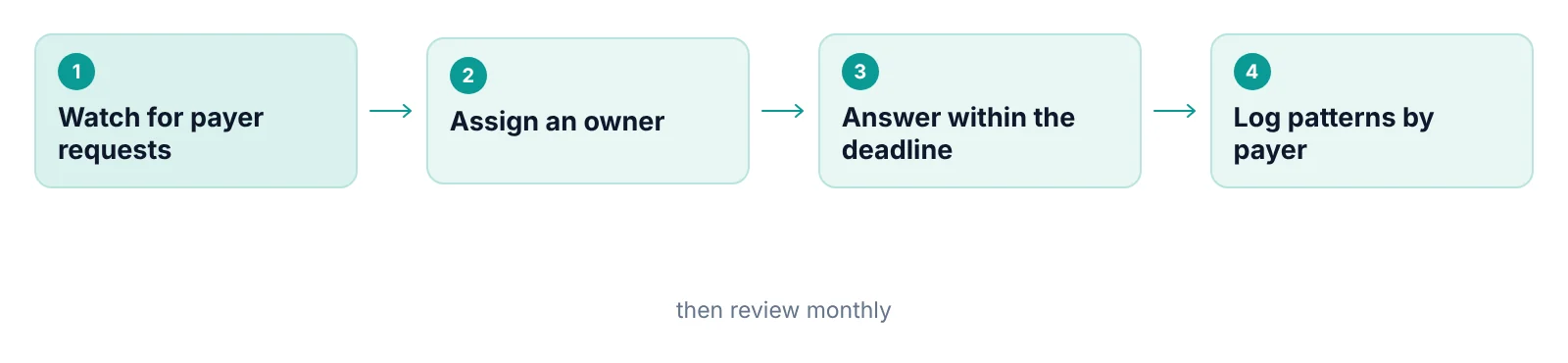
Prevention is about catching requests early and answering them on time.
- Check payer portals and mailboxes for records requests on a fixed schedule.
- Assign one owner for each request and set a due date inside the payer deadline.
- Keep a log of requests, due dates, responses and proofs of delivery.
- Review CO-226 by payer and by cause each month using root cause analysis.
Teams that use a dedicated denial management service often start with this log because it shows where requests are being missed.
Where CO-226 sits among related denials
CO-226 belongs to the family of information denials. See CO-22 for coordination of benefits, CO-197 for authorization, and accounts receivable management for follow-up work.
Our recommendations
- Read the remark code every time. It names the missing information.
- Log every payer request. A date and an owner prevent misses.
- Respond through the payer’s required channel. Wrong channels count as no response.
- Keep proof of delivery. It is your evidence in an appeal.
- Track CO-226 by payer. A payer that sends many requests may need a standing process.
- Escalate when deadlines are tight. Do not wait for the next A/R review.
Bottom line
CO-226 means the payer is waiting on information it asked for. Read the remark code, find the request, send the item the way the payer requires, and keep proof. Then log the cause so the same request does not slip through again.
Frequently asked questions
What does CO-226 mean?
CO-226 means the payer asked the billing or rendering provider for information and did not receive it, did not receive it on time, or received an insufficient or incomplete response. The code needs at least one remark code that names the missing information, so read the remark code before acting.
Can I bill the patient for a CO-226 denial?
Generally no. CO is the contractual obligation group code, which means the provider is responsible for the denied amount under the contract. Billing the patient for a CO adjustment can breach the payer agreement. Check your contract and state rules, and correct the claim or appeal instead.
What is the difference between CO-226 and CO-227?
CO-226 refers to information requested from the billing or rendering provider. CO-227 refers to information requested from the patient or insured. The team that should respond is different, so check which code you have before starting work on the account.
How is CO-226 different from CO-16?
CO-16 says the claim lacks information or has billing errors, usually found when the claim is first processed. CO-226 follows a payer request for more information that was not answered or was not enough. Both need the remark code to identify what is missing.
How long do I have to respond?
The deadline comes from the payer’s request letter, portal message or contract. Medicare contractors and commercial payers use different time limits. Always read the request for its date and method, and note the appeal deadline for the denial as well, which runs on its own clock.
Should I appeal a CO-226 denial?
First try to send the missing information and request reconsideration if the payer allows it. If the payer rejects that, an appeal is the next step, with the proof of what you sent. Check the contract for deadlines, because they often start from the remittance date.
Get your free practice audit
Tell us about your practice. We will contact you using the details you give.
- A review of your recent claims, denials and A/R aging
- Where your front desk and prior authorizations slow payment
- A prioritized fix list you keep, whether or not you hire us
Pricing is quoted after the audit, based on your volume and the services you choose. Prefer to talk? Call +1 (302) 556-2288.
Sources
- Claim Adjustment Reason Codes — X12 (2026)
- Remittance Advice Remark Codes — X12 (2026)
- Claim Adjustment Reason Code and Remittance Advice Remark Code lists — Centers for Medicare & Medicaid Services (2026)
- Medicare Claims Processing Manual, Chapter 22 (Remittance Advice) — Centers for Medicare & Medicaid Services (2026)
- Original Medicare appeals — Centers for Medicare & Medicaid Services (2026)
- Administrative simplification and HIPAA transactions — Centers for Medicare & Medicaid Services (2026)
Disclaimer: This article is educational and is not legal, coding, billing, medical or compliance advice. CPT codes and modifier descriptions are owned by the AMA, and code meanings, Medicare contractor policies and payer rules change and vary by payer, contractor and state. Verify current requirements with the official CPT manual, your payers and your counsel before you act.
